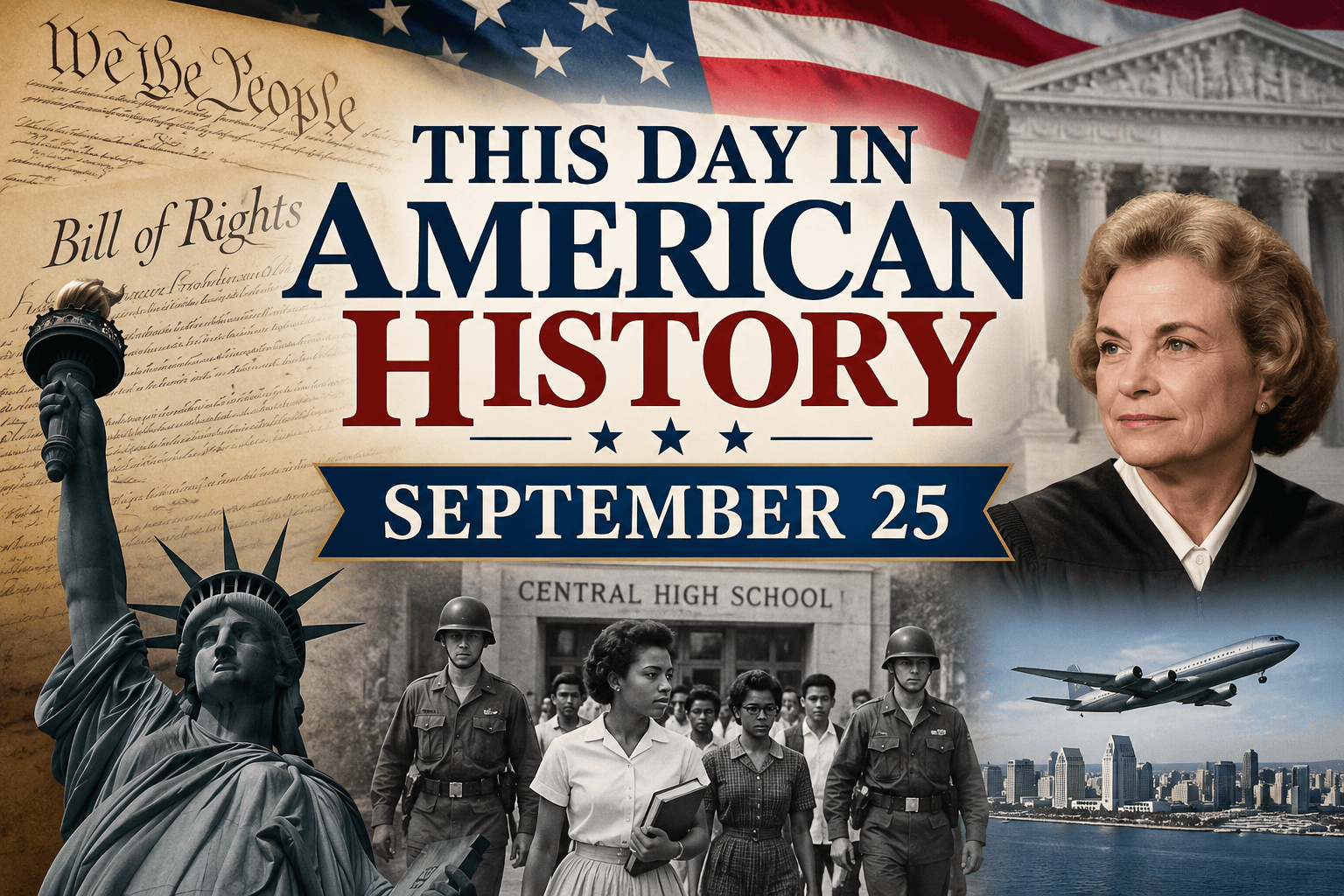
September 25 is a date connected to some of the most important themes in American history: individual liberty, constitutional government, civil rights, equality, tragedy, technological progress, and breaking barriers.
Perhaps no event associated with September 25 is more foundational than the action taken by the First Congress in 1789. On this date, Congress approved 12 proposed amendments to the newly created United States Constitution and sent them to the states for ratification. Ten eventually became what Americans know today as the Bill of Rights.
Nearly 170 years later, September 25 became another defining date in the continuing struggle to make the nation’s promises of equality a reality. On September 25, 1957, the Little Rock Nine entered Central High School in Little Rock, Arkansas, under the protection of federal troops.
Then, in 1981, another barrier fell when Sandra Day O’Connor was sworn in as the first woman to serve on the United States Supreme Court.
Together, these moments make September 25 a remarkable day for looking at how American ideals have developed—and how generations of Americans have struggled to make those ideals apply more fully.
1789 – Congress Proposes the Bill of Rights
One of the most consequential events in American constitutional history occurred on September 25, 1789.
The Constitution had gone into effect earlier that year, establishing the framework for the new federal government. But the Constitution remained controversial.
Many Americans feared that the federal government might eventually become too powerful. Memories of British rule and abuses of governmental authority before the American Revolution were still fresh. Critics of the Constitution wanted explicit protections for individual liberties.
Several states had called for amendments protecting those rights during the Constitution’s ratification process.
James Madison became one of the leading figures in turning those demands into constitutional amendments. He introduced proposed amendments in the House of Representatives on June 8, 1789. After months of debate and revisions between the House and Senate, Congress agreed on a package of 12 amendments on September 25.
Those amendments were then submitted to the states.
Only ten of the original twelve received the necessary approval at the time. They were ratified on December 15, 1791, becoming the first ten amendments to the Constitution—the Bill of Rights.
The Rights That Became Part of American Life
The Bill of Rights established protections that remain central to American constitutional law and political debate.
Among them are protections involving freedom of religion, speech, press, assembly and petition; the right to keep and bear arms; protections against unreasonable searches and seizures; protections for people accused of crimes; the right to a speedy and public trial; and protections against excessive bail and cruel and unusual punishment.
The Ninth Amendment recognizes that listing certain rights in the Constitution should not be interpreted as denying other rights retained by the people.
The Tenth Amendment addresses the division of governmental authority by reserving powers not delegated to the federal government, or prohibited to the states, to the states or the people.
These amendments did much more than complete a political compromise from the founding era. They became an enduring part of the country’s understanding of liberty.
Americans continue to debate exactly how individual constitutional rights should be interpreted and applied, but those debates themselves demonstrate the lasting importance of what Congress did on September 25, 1789.
An Interesting Story About the Original 12 Amendments
An often-overlooked fact about the Bill of Rights is that Congress originally proposed 12 amendments, not ten.
The first proposed amendment concerned representation in the House of Representatives and was never ratified.
The second dealt with changes in congressional compensation. It remained unratified for more than two centuries before finally receiving the required approval in 1992.
It became the 27th Amendment to the Constitution—203 years after Congress originally proposed it.
That extraordinary journey demonstrates how American constitutional history sometimes develops across generations rather than years.
1957 – The Little Rock Nine Enter Central High School
September 25 would become significant again in 1957, this time during one of the defining confrontations of the American Civil Rights Movement.
Three years earlier, the Supreme Court’s decision in Brown v. Board of Education had declared racial segregation in public schools unconstitutional.
But a Supreme Court ruling did not immediately eliminate segregation.
Resistance remained fierce in many communities.
One of the most dramatic confrontations occurred at Central High School in Little Rock, Arkansas.
Nine African American students had been selected to integrate the previously all-white school. They became known as the Little Rock Nine.
Their names were:
Ernest Green, Elizabeth Eckford, Jefferson Thomas, Terrence Roberts, Carlotta Walls LaNier, Minnijean Brown, Gloria Ray Karlmark, Thelma Mothershed and Melba Pattillo Beals.
The students faced enormous hostility.
Arkansas Governor Orval Faubus initially used the Arkansas National Guard to prevent them from entering the school.
The conflict quickly became a national constitutional crisis.
Could a state resist federal court orders?
And would the federal government enforce the constitutional rights of Black students?
President Eisenhower Takes Action
The crisis intensified during September 1957.
On September 23, the students entered Central High, but a violent crowd gathered outside. Police eventually removed the students because officials feared for their safety.
President Dwight D. Eisenhower then intervened.
On September 24, Eisenhower federalized the Arkansas National Guard and ordered soldiers from the U.S. Army’s 101st Airborne Division into Little Rock.
The following morning, September 25, the Little Rock Nine returned.
This time, federal troops protected them.
At approximately 9:22 a.m., the nine students were escorted through the front doors of Central High School by members of the 101st Airborne. Hundreds of paratroopers were positioned around the school as federal authorities worked to maintain order.
The students completed their first full day of classes at Central High.
It was an extraordinary scene.
American soldiers were protecting American children so that they could exercise a constitutional right to attend school.
The Courage of the Little Rock Nine
Federal troops could escort the students through the doors, but they could not eliminate racism inside the school.
The Little Rock Nine endured harassment, threats and abuse throughout the school year.
Yet they continued.
Their courage transformed them into enduring figures in American civil rights history.
Their experience also demonstrated an important reality about constitutional rights: a right written in law means little if institutions are unwilling to enforce it.
That makes the connection between September 25, 1789, and September 25, 1957 especially powerful.
In 1789, Americans were defining constitutional liberties.
In 1957, the country was confronting the difficult question of whether constitutional guarantees would actually be enforced when people resisted them.
The two events occurred 168 years apart, yet they belong to the same larger American story.
1956 – A New Era of Transatlantic Communication
September 25 also represents technological progress.
In 1956, the first transatlantic telephone cable entered service, dramatically improving telephone communications between North America and Europe.
Before reliable undersea telephone cables, transatlantic communication had been far more limited.
The new system helped make direct voice communication across the Atlantic more practical and dependable.
From today’s perspective—when people can instantly video-call someone thousands of miles away—the accomplishment can seem modest.
At the time, however, it represented another major step toward the interconnected world we now take for granted.
Technology has repeatedly changed the way Americans conduct business, maintain relationships, share information and interact with the rest of the world.
The communications revolution of the twentieth century did not happen all at once. It developed through innovations like radio, telephone networks, undersea cables, communications satellites, computers, fiber optics and eventually the internet.
September 25, 1956, represents one important chapter in that transformation.
1978 – The Pacific Southwest Airlines Flight 182 Disaster
Not every important event remembered on September 25 is a story of progress.
On September 25, 1978, tragedy struck the skies above San Diego, California.
Pacific Southwest Airlines Flight 182 collided in midair with a small Cessna aircraft while approaching San Diego.
Both aircraft crashed.
The disaster killed 144 people, including people on the ground, making it one of the deadliest aviation disasters in United States history at the time.
The tragedy became part of the broader history of American aviation safety.
Major transportation disasters often lead investigators, regulators and the aviation industry to examine procedures and technologies designed to prevent similar accidents.
The story of American aviation is therefore not simply one of aircraft becoming faster and more advanced. It is also a story of lessons learned—often painfully—from accidents and failures.
September 25, 1978, remains a solemn date in San Diego history and in the history of American commercial aviation.
1981 – Sandra Day O’Connor Breaks a 191-Year Barrier
Another historic American milestone occurred on September 25, 1981.
Sandra Day O’Connor was sworn in as the first woman to serve as a justice of the United States Supreme Court.
President Ronald Reagan had nominated O’Connor earlier that year.
Her appointment broke a barrier that had existed since the Supreme Court was established.
For approximately 191 years, every Supreme Court justice had been a man.
That changed when O’Connor raised her hand and took the oath of office.
Chief Justice Warren Burger administered the oath before hundreds of guests, with President Reagan among those attending the ceremony.
O’Connor’s appointment carried significance far beyond one person receiving a prestigious government position.
Generations of American women had been largely excluded from positions of political, legal and institutional authority.
By 1981, that landscape had changed considerably, although substantial barriers remained.
Seeing a woman seated on the nation’s highest court represented another visible change in American public life.
O’Connor would go on to serve on the Supreme Court for more than two decades.
September 25 and America’s Continuing Story
Looking across the history associated with September 25 reveals something interesting.
Several of the day’s most important events involve the meaning of rights, opportunity and equality.
On September 25, 1789, Congress proposed amendments intended to protect individual liberty from governmental abuse.
On September 25, 1957, nine Black students entered a previously segregated public school under federal protection.
On September 25, 1981, Sandra Day O’Connor took her place on a Supreme Court bench that had never before included a woman.
These events are separated by generations, yet each raises a similar question:
Who gets to participate fully in the American promise?
The answer has changed throughout American history.
The ideals written into America’s founding documents were powerful, but the country’s history repeatedly demonstrates that putting those ideals into practice has required debate, court decisions, legislation, political leadership and personal courage.
The Little Rock Nine did not simply read about constitutional equality.
They walked through a hostile crowd to claim it.
Sandra Day O’Connor did not merely live in a country that spoke about equal opportunity.
Her appointment demonstrated that another institution once closed to women could change.
And the Bill of Rights did not end arguments over individual freedom.
It created a constitutional framework within which many of those arguments continue.
Why September 25 Matters
History becomes more meaningful when we stop viewing it as a collection of unrelated dates.
September 25 shows how different generations can become connected through the same fundamental ideas.
The lawmakers of 1789 could not have imagined soldiers from the 101st Airborne escorting Black teenagers into an Arkansas high school in 1957.
The Little Rock Nine could not have known every way their courage would inspire future generations.
And when the Supreme Court began operating in 1790, few could have imagined that nearly two centuries would pass before a woman finally joined the Court.
Yet all of these events became chapters in the same national story.
American history has always contained a tension between ideals and reality.
The country has declared powerful principles about liberty and equality while repeatedly struggling over who receives those protections.
Progress has rarely happened automatically.
It has happened because people challenged existing systems, demanded that laws be enforced, changed institutions and sometimes displayed remarkable courage simply by walking through a door others believed should remain closed to them.
Remembering September 25
September 25 deserves recognition as an especially meaningful date in American history.
It gave the country the proposed amendments that eventually became the Bill of Rights.
It witnessed federal troops escort the Little Rock Nine into Central High School as the United States confronted segregation and resistance to constitutional authority.
It brought technological progress through improved transatlantic telephone communication.
It carries the memory of 144 lives lost in the 1978 San Diego aviation disaster.
And it marked the moment Sandra Day O’Connor became the first woman to sit on the United States Supreme Court.
Some September 25 stories are inspiring.
Others are painful.
Together, they remind us that American history is not simply the story of presidents, wars and elections. It is also the story of rights being written, challenged and defended; barriers being confronted; technologies changing everyday life; tragedies reshaping safety; and ordinary people finding themselves at the center of extraordinary moments.
More than two centuries after Congress approved the proposed Bill of Rights, Americans are still debating many of the same fundamental questions about liberty, equality, government power and individual rights.
That may be one of the greatest lessons September 25 offers us.
History does not stay in the past.
The decisions made by one generation become the freedoms, responsibilities, debates and challenges inherited by the next.
When future generations look back at our time, what will they say we did to protect freedom, expand opportunity and move America closer to the ideals it has promised for generations?
Leave a Reply