Halloween is a holiday filled with mystery, strange traditions, and superstitions that have fascinated people for centuries. From black cats crossing your path to the belief that spirits wander among the living, Halloween has long been associated with supernatural forces, good and bad luck, and the unknown.
Many of the Halloween superstitions we recognize today have roots in ancient Celtic traditions, European folklore, medieval religious beliefs, and customs brought to America by immigrants. Some began as attempts to explain frightening events, while others were meant to protect people from evil spirits or predict what the future might hold.
Although most people today consider these beliefs harmless fun, they offer a fascinating glimpse into how earlier generations understood the world around them.
Here are 15 Halloween superstitions and the stories behind their origins.
1. Black Cats Bring Bad Luck
One of the most recognizable Halloween superstitions is the belief that a black cat crossing your path brings bad luck.
During parts of medieval and early modern European history, cats became associated with witchcraft and supernatural activity. Some people believed witches could transform themselves into cats, while others thought black cats served as witches’ magical companions, known as familiars.
Because black cats were difficult to see at night, their mysterious appearance also contributed to their frightening reputation.
However, not every culture considered black cats unlucky. In parts of Britain and elsewhere, black cats have been regarded as symbols of good fortune.
The connection between black cats, witches, and Halloween became especially popular through folklore, literature, and later Halloween decorations.
Today, black cats remain among Halloween’s most famous symbols, even though their supposed supernatural powers are nothing more than superstition.
2. Seeing a Spider on Halloween Means a Loved One Is Watching Over You
Spiders are common Halloween decorations, but one modern superstition gives them a surprisingly comforting meaning.
According to a popular belief, seeing a spider on Halloween means the spirit of a deceased loved one is nearby, watching over you.
Spiders have appeared in folklore around the world as symbols of patience, creativity, fate, and the connections between life and death.
Their ability to weave intricate webs has sometimes inspired comparisons with the weaving of destiny.
However, the specific belief that a Halloween spider represents a deceased loved one does not have a clearly documented ancient origin. It appears more often in modern collections of Halloween folklore.
For those who find comfort in the idea, the spider becomes something more meaningful than a frightening creature.
Instead of representing fear, it symbolizes remembrance and the possibility that love continues beyond death.
3. Spirits Return to Earth on Halloween Night
Perhaps the most important superstition associated with Halloween is the belief that spirits can return to the world of the living.
This tradition is often connected to Samhain, an ancient Gaelic seasonal festival marking the transition from harvest time into winter.
Samhain was associated with the beginning of the darker half of the year, a period when the boundary between the ordinary world and the supernatural realm was believed to become especially significant.
Stories described encounters with spirits, fairies, and other supernatural beings.
As Christianity spread through Europe, the observances of All Saints’ Day and All Souls’ Day added further associations with death, remembrance, and the departed.
Over time, these traditions contributed to Halloween’s reputation as a night when the supernatural world feels unusually close.
Although there is no evidence that spirits actually return on Halloween, the belief remains central to the holiday’s mysterious atmosphere.
4. Walking Under a Ladder Brings Bad Luck
Walking under a ladder is considered unlucky throughout much of Western folklore, and the superstition often appears in Halloween-themed collections of frightening beliefs.
One explanation connects the superstition to Christian symbolism.
A ladder leaning against a wall forms a triangular shape, which some later interpretations associated with the Holy Trinity. Walking through that triangle was therefore imagined as disturbing something sacred.
Other explanations are more practical.
Walking beneath a ladder can be dangerous because tools, paint, or other objects might fall from above.
Historical interpretations also connect ladders with executions and other disturbing imagery, although the precise origin of the superstition is uncertain.
While the belief is not specifically a Halloween tradition, it fits naturally into a holiday associated with avoiding misfortune.
5. Breaking a Mirror Causes Seven Years of Bad Luck
The belief that breaking a mirror brings seven years of bad luck is another superstition frequently associated with Halloween.
Mirrors have fascinated people for thousands of years because they produce reflections that can seem almost magical.
In some ancient traditions, reflections were associated with the soul or a person’s spiritual identity.
The superstition is commonly linked to Roman beliefs about the body and periods of renewal. According to a widely repeated explanation, the Romans believed that life renewed itself in seven-year cycles, making a damaged reflection a source of prolonged misfortune.
However, the exact historical development of the seven-year punishment is difficult to establish.
Mirrors also became important objects in Halloween fortune-telling traditions.
Young people sometimes used mirrors in darkened rooms while attempting to glimpse the face of a future spouse.
These mysterious associations helped make mirrors a lasting symbol of supernatural possibility.
6. Bats Flying Around Your House Mean Something Bad Is Coming
Bats are closely associated with Halloween, haunted houses, and vampire stories.
One old superstition suggests that a bat flying around a home is a warning of death, misfortune, or supernatural activity.
Because bats emerge at dusk and move through darkness, people once regarded them as mysterious creatures connected to the night.
In European folklore, bats eventually became associated with witches, demons, and frightening supernatural beings.
The connection grew stronger with the popularity of vampire literature, especially Bram Stoker’s Dracula, published in 1897.
Some folklore also claimed that a bat entering a house could signal an approaching death.
In reality, bats are ordinary mammals that play valuable roles in ecosystems by eating insects, pollinating plants, and dispersing seeds.
Their Halloween reputation comes from centuries of storytelling rather than any ability to predict misfortune.
7. Wearing Costumes Protects You From Evil Spirits
Dressing in costumes is one of Halloween’s most beloved traditions, but costumes once carried meanings beyond entertainment.
A common explanation connects Halloween disguises to older customs of masking and guising.
In parts of Europe, people dressed in unusual clothing, wore masks, or disguised themselves during seasonal celebrations.
Some traditional explanations suggest that disguises helped people avoid recognition by wandering spirits or supernatural beings.
Others connect costumes with mumming, folk performances, and visiting households in exchange for food or gifts.
The history of Halloween costumes developed through several traditions rather than one single ancient practice.
By the nineteenth and twentieth centuries, Halloween costumes became increasingly popular in North America.
What may once have carried protective, ceremonial, or communal meanings eventually evolved into the creative costumes people wear today.
8. Knocking on Wood Keeps Bad Luck Away
Many people knock on wood after mentioning something fortunate, hoping to prevent bad luck from following.
The practice is sometimes included among Halloween superstitions because it reflects the same desire to protect oneself from unseen forces.
One popular theory suggests that ancient people believed spirits lived inside trees and that touching or knocking on wood could attract their protection.
Another explanation connects the custom to Christian symbolism involving the wood of the cross.
However, historians have not established a single definitive origin for the modern expression.
Some researchers have suggested connections with nineteenth-century children’s games involving touching wood for safety.
Regardless of its beginnings, knocking on wood became a familiar way of attempting to prevent misfortune.
It demonstrates how deeply beliefs about luck and supernatural protection have influenced everyday behavior.
9. Hearing Footsteps Behind You on Halloween Means a Spirit Is Following
One eerie Halloween superstition warns against turning around if you hear unexplained footsteps behind you.
According to versions of this folk belief, the footsteps might belong to a ghost or another supernatural presence.
Some tellings suggest that looking backward could invite misfortune or bring someone face-to-face with something frightening.
The belief reflects a broader tradition of ghost stories in which nighttime sounds are interpreted as signs of invisible visitors.
Before modern lighting, unfamiliar noises in dark streets, forests, and isolated countryside could be especially unsettling.
Halloween’s association with wandering spirits made such stories even more frightening.
Although the precise origin of this particular warning is uncertain, it belongs to the larger family of European ghostly encounter traditions.
Today, the idea remains a popular ingredient in Halloween storytelling.
10. Bobbing for Apples Can Predict Who You Will Marry
Bobbing for apples might seem like a simple Halloween party game, but it once carried romantic significance.
In older British and Irish Halloween customs, apples were frequently used in fortune-telling games.
One superstition claimed that the first unmarried participant to successfully catch an apple with their teeth would be the next to marry.
In another version, apples were marked with names, and the apple someone caught supposedly revealed the identity of their future romantic partner.
Apples were natural choices for autumn celebrations because they were plentiful during harvest season.
The games eventually traveled to North America, where they became popular at Halloween parties.
By the nineteenth and early twentieth centuries, apple-bobbing and similar fortune-telling activities were familiar features of Halloween gatherings.
Although the marriage predictions have largely disappeared, bobbing for apples remains a recognizable Halloween tradition.
11. Looking Into a Mirror at Midnight Reveals Your Future Spouse
One of the strangest historical Halloween superstitions involved standing in front of a mirror at midnight.
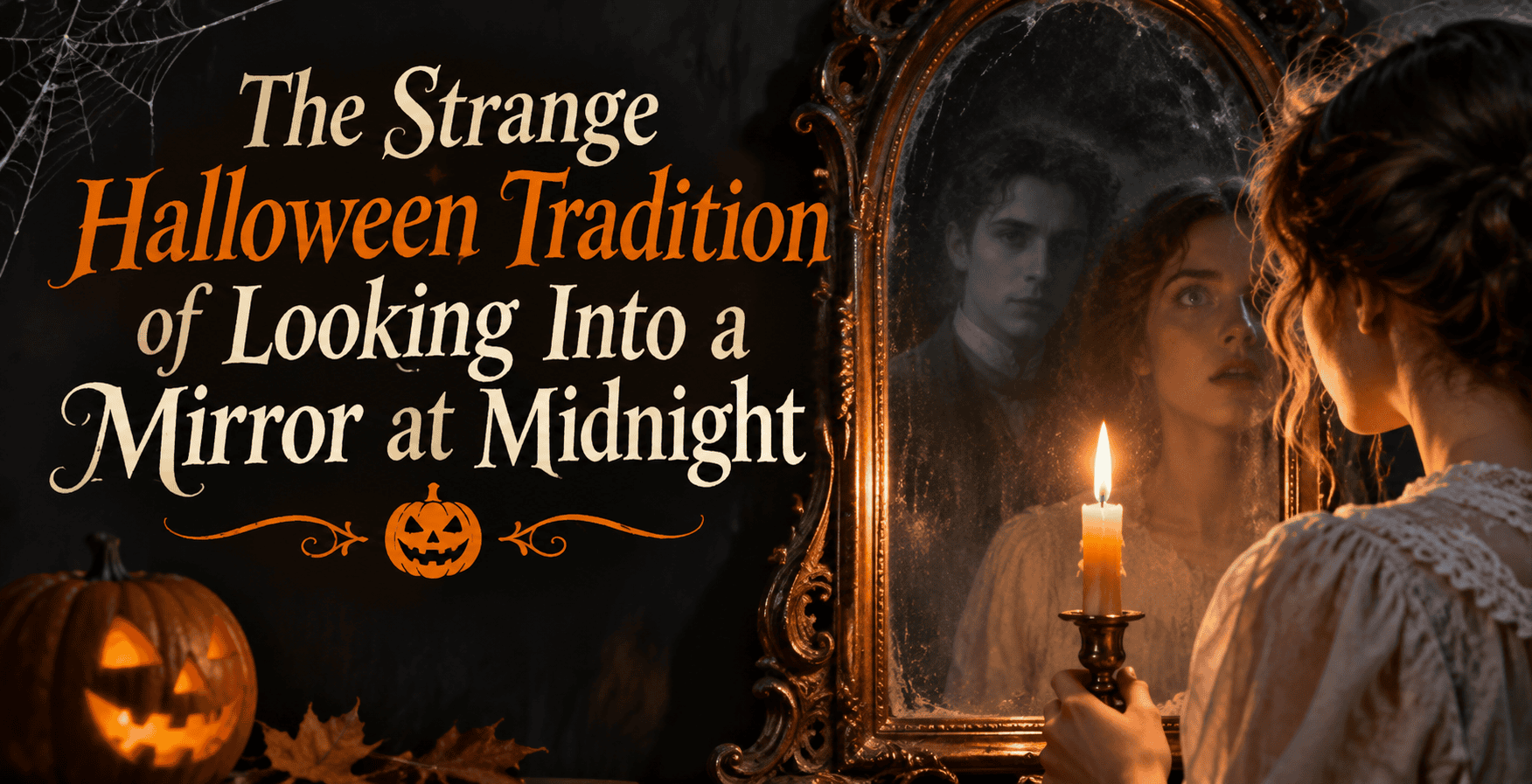
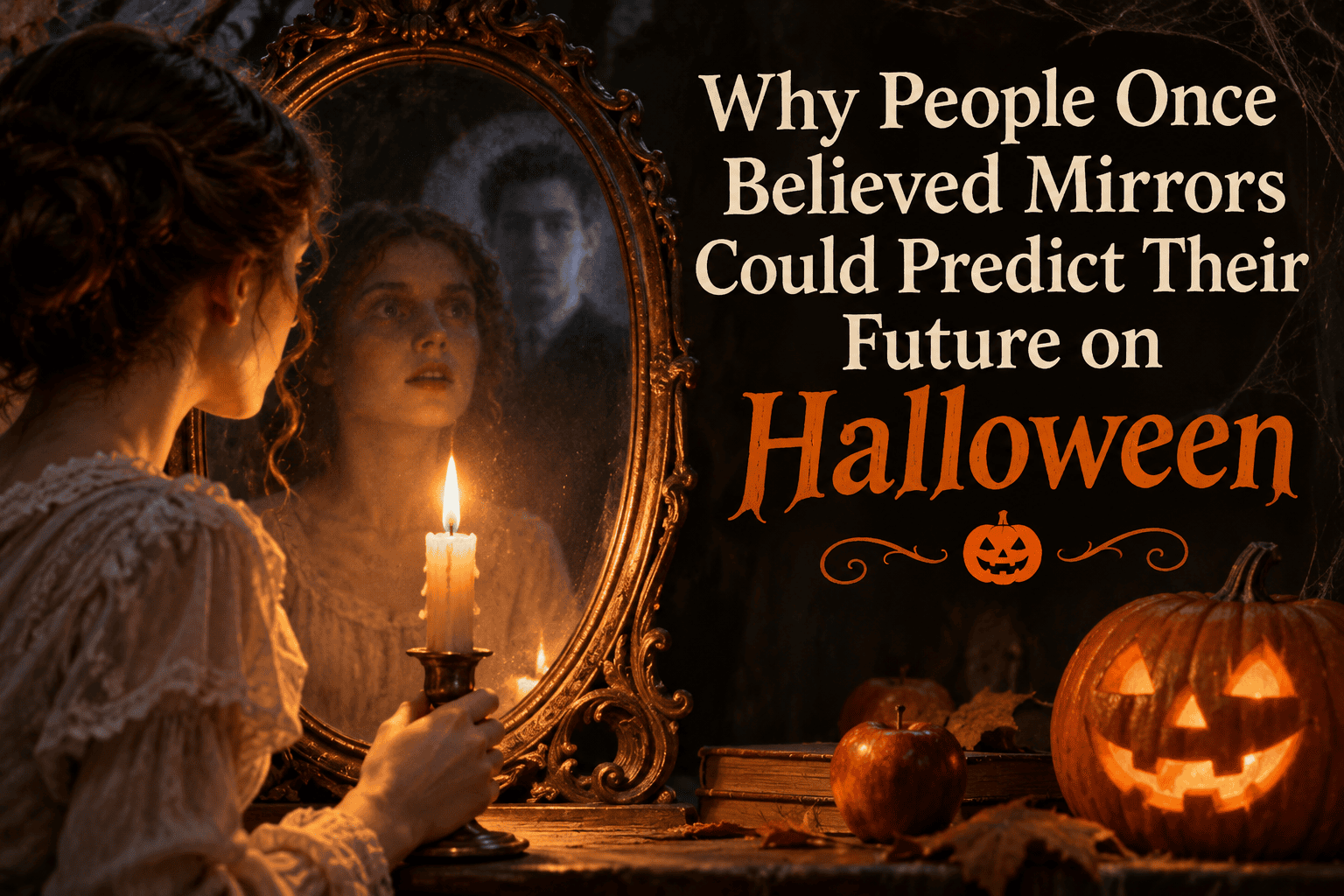
According to the tradition, an unmarried person could enter a dark room, hold a candle, and look into a mirror to see the face of a future husband or wife.
Some versions required eating an apple while gazing into the reflection.
Others warned that a frightening image might appear instead.
This practice belonged to a wider tradition of Halloween divination, particularly popular in Ireland, Britain, and nineteenth- and early twentieth-century America.
At the time, Halloween celebrations frequently included games intended to predict marriage, romance, and future happiness.
Mirrors were considered especially mysterious because they appeared to reveal another world behind their reflective surfaces.
The tradition eventually faded as Halloween became more focused on costumes, candy, and entertainment.
Nevertheless, the image of someone staring into a candlelit mirror remains one of Halloween folklore’s most haunting scenes.
12. Throwing an Apple Peel Over Your Shoulder Reveals Your True Love
Another old Halloween superstition claimed that an apple peel could reveal the initials of a future romantic partner.
The ritual was simple.
A person would peel an apple in one long, continuous strip, then throw the peel over their shoulder.
Whatever letter the peel appeared to form when it landed was believed to be the first initial of their future spouse.
This tradition became particularly popular in British and Irish Halloween celebrations and later appeared in American Halloween parties.
Like many Halloween fortune-telling games, it reflected the importance placed on courtship and marriage in earlier generations.
Apples were also closely connected with autumn harvest celebrations, making them convenient objects for seasonal games.
The superstition was more playful than frightening, showing that Halloween was not always focused on ghosts and monsters.
For many young people, it was once considered an exciting opportunity to imagine their romantic futures.
13. Finding a Ring in Halloween Food Means Marriage Is Coming
In Ireland, Halloween food was sometimes used to predict the future.
One traditional dish associated with the holiday is barmbrack, a fruit bread that may contain symbolic objects.
Finding a ring in a slice was believed to predict marriage.
Other objects could represent different possibilities, such as wealth, hardship, or remaining unmarried.
Similar fortune-telling customs involved hiding objects in dishes such as colcannon, a traditional Irish mixture of potatoes and cabbage or kale.
These practices developed within Irish Halloween traditions, where seasonal gatherings often included games about marriage and the coming year.
The idea was that a person’s randomly selected portion could reveal something about their destiny.
Although most people today do not believe that food can predict the future, symbolic objects remain part of some traditional Halloween celebrations.
Modern versions should use food-safe methods and avoid concealed choking hazards.
14. Lighting Bonfires Keeps Evil Spirits Away
Fire has played an important role in autumn festivals for centuries.
During Samhain and later Halloween celebrations, bonfires were associated with the changing seasons, community gatherings, and supernatural protection.
In some traditions, fire was believed to help ward off harmful spirits or other dangerous influences.
The flames also represented warmth and security as communities prepared for the colder, darker months ahead.
Large seasonal fires became important gathering places where people celebrated, told stories, and participated in communal activities.
The connection between Halloween and fire continued through later European customs.
As Halloween traditions evolved, large outdoor bonfires became less central to celebrations in many communities.
However, their symbolic role survived through candles, lanterns, and illuminated Halloween decorations.
Today, glowing jack-o’-lanterns and flickering candles continue to contribute to the holiday’s mysterious atmosphere.
15. Carved Jack-o’-Lanterns Keep Evil Spirits Away
One of Halloween’s most famous traditions involves carving frightening faces into pumpkins and placing lights inside them.
However, the custom originally involved vegetables such as turnips rather than pumpkins.
In Ireland and parts of Britain, people carved faces into root vegetables to create lanterns.
These lanterns became associated with supernatural stories, including the Irish legend of Stingy Jack.
According to versions of the tale, Jack tricked the Devil and was eventually condemned to wander the darkness with only a glowing ember to light his way.
The story helped explain the mysterious wandering lights sometimes called jack-o’-lanterns.
Carved lanterns were also associated with frightening away unwanted supernatural visitors.
When Irish immigrants brought their traditions to North America, pumpkins became a popular alternative because they were larger and easier to carve.
Over time, the pumpkin jack-o’-lantern became one of the most recognizable symbols of Halloween.
Although most people now carve pumpkins for decoration, the tradition preserves elements of older beliefs about spirits, darkness, and protection.
Why Were Halloween Superstitions So Popular?
Halloween superstitions developed during periods when people had fewer scientific explanations for the world around them.
Unusual sounds, unexpected illnesses, mysterious lights, and frightening encounters could easily inspire supernatural interpretations.
The changing seasons also played an important role.
As autumn gave way to winter, shorter days and colder temperatures reminded communities of uncertainty, hardship, and mortality.
Halloween traditions offered ways to confront those fears.
Some superstitions promised protection from danger. Others attempted to predict marriage, prosperity, or misfortune.
Many provided entertainment during gatherings with family, friends, and neighbors.
The popularity of fortune-telling games also reveals that Halloween was once associated with hope and curiosity about the future, not simply fear of the dead.
People wanted to know whom they would marry, whether they would experience good fortune, and what the coming year might bring.
Halloween became a time when those questions could be explored through games, rituals, and storytelling.
How Halloween Superstitions Changed in America
As immigrants from Ireland, Scotland, England, and other European countries settled in America, they brought seasonal traditions and folk beliefs with them.
During the nineteenth century, Halloween celebrations increasingly included parties, games, storytelling, and community gatherings.
Many of the activities focused on romance and fortune-telling.
Young people played games involving apples, nuts, candles, and mirrors.
By the early twentieth century, Halloween parties had become popular social events.
Newspapers and magazines published suggestions for decorations, games, and seasonal entertainment.
As Halloween became more commercialized, supernatural superstitions were increasingly transformed into decorations, costumes, and playful traditions.
Black cats became decorative symbols. Witches appeared on greeting cards. Ghost stories became entertainment, and jack-o’-lanterns became familiar household decorations.
By the middle of the twentieth century, trick-or-treating and children’s costumes had become defining features of American Halloween celebrations.
Many older fortune-telling rituals gradually disappeared from mainstream celebrations, although their stories survived.
Are Halloween Superstitions Still Believed Today?
Some people continue to take certain superstitions seriously, while others view them as entertaining pieces of folklore.
Beliefs about black cats, broken mirrors, and unlucky encounters remain recognizable even among people who do not consider themselves superstitious.
Halloween movies, television programs, books, and social media have also helped preserve and reinvent supernatural traditions.
Modern Halloween celebrations frequently combine historical customs with newly invented stories.
That distinction is important because not every superstition described as ancient actually has a documented ancient origin.
Some beliefs can be traced through historical accounts, while others are modern interpretations of much older themes.
What they share is a fascination with mystery, uncertainty, and the possibility that the world contains more than we can explain.
The Lasting Mystery Behind Halloween Traditions
Halloween superstitions reveal much more than old-fashioned fears.
They show how people throughout history attempted to understand death, protect their families, predict their futures, and find meaning in the unknown.
Some traditions were frightening, while others were surprisingly hopeful.
A black cat could represent bad luck in one culture and good fortune in another. A mirror could reveal a terrifying spirit or the face of a future spouse. An apple could become a playful symbol of love, while a glowing lantern could represent protection against darkness.
These differences demonstrate how folklore changes across generations and communities.
Although Halloween has become a celebration filled with costumes, candy, parties, and decorations, its older superstitions continue to influence how we experience the holiday.
Every carved pumpkin, mysterious black cat, and ghost story carries an echo of the past.
Perhaps that is what makes Halloween so fascinating. It allows us to enjoy a little mystery while remembering the stories that earlier generations passed down.
And even if we no longer believe that a broken mirror brings seven years of bad luck or that a midnight reflection can reveal our future, those stories remain part of Halloween’s enduring charm.
Which Halloween superstition have you heard the most, and is there one you still believe might be true?
Leave a Reply