Halloween has always been a night filled with mystery, superstition, and the belief that the ordinary rules of the world might not apply. Long before Halloween became associated with costumes, candy, haunted houses, and trick-or-treating, people practiced unusual traditions in hopes of discovering what the future held.
One of the most fascinating of these forgotten Halloween customs involved something found in nearly every home: a mirror.
For generations, people believed that looking into a mirror on Halloween night could reveal secrets about their future. Some hoped to see the face of the person they would marry. Others feared that the reflection might reveal something far more frightening, including signs of death or misfortune.
These beliefs were especially popular among young women who wanted to learn whether they would find love and marriage.
But why were mirrors considered powerful enough to reveal the future? And how did these mysterious Halloween traditions become part of American folklore?
The answers can be found in centuries of European superstition, ancient divination practices, and the belief that Halloween was a night when the boundary between the living and supernatural worlds became unusually thin.
The Ancient Belief That Halloween Was a Night of Supernatural Power
To understand why mirrors became associated with Halloween fortune-telling, it helps to understand how people once viewed the holiday itself.
Halloween developed from a combination of traditions, including the ancient Gaelic festival of Samhain and later Christian observances surrounding All Saints’ Day and All Souls’ Day.
Samhain marked the transition from the harvest season into winter. In Gaelic tradition, this seasonal turning point was associated with supernatural activity and encounters with beings from the Otherworld.
Over time, Halloween became surrounded by beliefs about spirits, omens, and the possibility of receiving messages about the future.
People practiced various forms of divination, attempting to predict events involving marriage, prosperity, health, and death.
Some traditions involved apples, nuts, candles, or household objects. Others required participants to perform rituals at midnight or in complete silence.
Mirrors became especially intriguing because they already carried a reputation for mystery.
A mirror could show a person an image of themselves, but that image appeared to exist in another space beyond the glass.
For people who believed in supernatural forces, that strange reflection could seem like a doorway into something unknown.
Why Mirrors Were Once Considered Magical Objects
Today, mirrors are ordinary household items used for grooming, decoration, and checking our appearance.
However, throughout history, reflective surfaces have been associated with magic, spiritual communication, and fortune-telling.
Before modern glass mirrors became widely available, people used polished metal, dark stones, and still water to see reflections.
Some cultures developed practices involving gazing into reflective surfaces to seek visions or hidden knowledge.
This practice is often called scrying.
Scrying involves looking into a reflective or otherwise visually absorbing surface while attempting to perceive symbolic images or messages.
People have used water, polished stones, crystals, and mirrors for this purpose.
In European folklore, mirrors also became associated with the soul, personal identity, and supernatural danger.
This helps explain why so many mirror-related superstitions developed.
Breaking a mirror was believed to bring bad luck. Covering mirrors after a death became a mourning custom in some communities. Certain stories warned that mirrors might attract spirits or reveal things that ordinary eyes could not see.
These beliefs were not universal, and their meanings varied across cultures and historical periods.
Nevertheless, the mirror’s mysterious reputation made it a natural object for Halloween fortune-telling.
The Halloween Mirror Ritual That Supposedly Revealed Your Future Husband
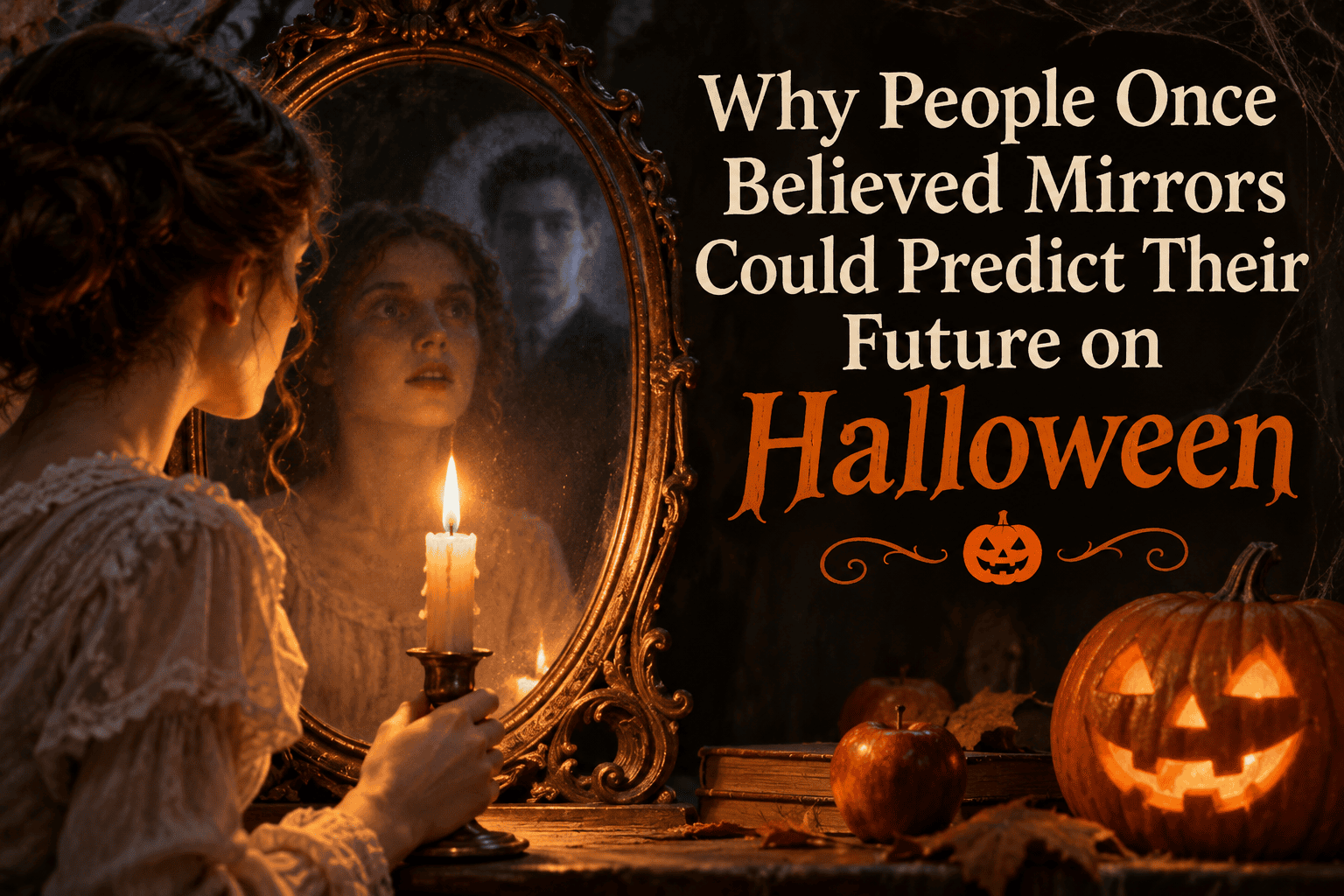
One of the best-known Halloween mirror superstitions involved young women hoping to see the face of their future husbands.
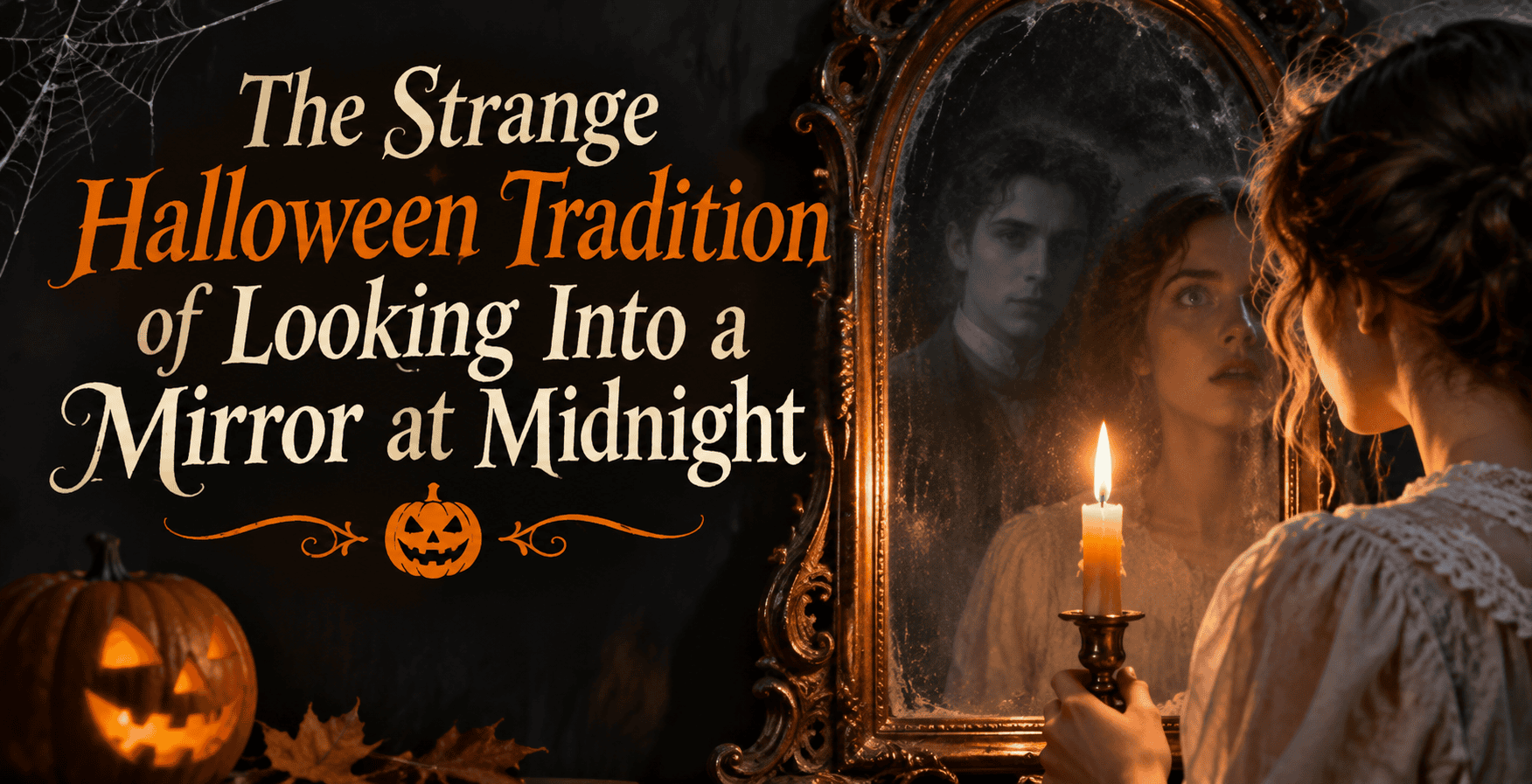
In versions of the tradition recorded in British and American folklore, a young woman would enter a dark room on Halloween night and look into a mirror.
Depending on the version, she might carry a candle, eat an apple, comb her hair, or stand before the glass at midnight.
The ritual was supposed to produce an extraordinary result.
Instead of seeing only her own reflection, she might glimpse the face or figure of the man she would eventually marry.
Some accounts suggested that the future husband would appear behind her shoulder.
Other versions described his image gradually becoming visible within the mirror.
The experience was considered both exciting and frightening.
For young women living in societies where marriage strongly influenced their future security and social position, discovering the identity of a future husband could hold enormous emotional importance.
The mirror ritual offered a playful, mysterious way to explore that uncertainty.
Of course, there is no scientific evidence that mirrors can reveal future spouses.
However, the tradition remained popular because it combined romance, suspense, and supernatural possibility.
Why Candles Were Used During Halloween Mirror Fortune-Telling
Candles played an important role in many traditional Halloween mirror rituals.
Participants were sometimes instructed to enter a darkened room with only a single candle for illumination.
The candlelight created flickering reflections, moving shadows, and unusual visual effects.
These conditions could make an ordinary reflection appear mysterious or unfamiliar.
In a dimly lit room, the human brain can struggle to interpret facial details accurately.
Staring at a reflection for an extended period may also produce perceptual distortions, particularly when lighting is poor.
Modern psychological research has documented strange-face illusions that can occur when people gaze at faces or reflections under certain conditions.
These effects offer one possible explanation for why someone might believe they had seen another face in a mirror.
However, they do not establish exactly what participants in historical Halloween rituals experienced.
For people already expecting a supernatural vision, the combination of candlelight, anticipation, and fear could make the ritual especially convincing.
The Apple and Mirror Halloween Tradition
Another fascinating version of Halloween mirror divination involved eating an apple.
According to some traditional accounts, a young woman would sit or stand before a mirror while eating an apple, sometimes at midnight.
She might be instructed to remain silent throughout the ritual.
The belief was that the image of her future husband would appear in the mirror, sometimes as though he were standing behind her.
In certain versions, the ritual involved brushing or combing the hair instead of eating an apple.
These customs reflected a larger connection between apples, romance, and Halloween fortune-telling.
Apples were important in autumn harvest celebrations and became associated with various traditional games intended to predict romantic futures.
Apple-peel divination, for example, involved throwing a long strip of apple peel over the shoulder and interpreting the shape it formed as the initial of a future spouse.
The apple-and-mirror ritual brought together two objects already associated with mystery and prediction.
Although these traditions were generally practiced as folklore or entertainment, participants sometimes approached them with genuine belief.
What Did It Mean If You Saw a Skeleton in the Mirror?
Not every Halloween mirror prediction promised romance.
Some versions of the tradition included a much darker warning.
According to certain accounts, a person who looked into a mirror while attempting to see a future spouse might instead see a skull, skeleton, or other frightening figure.
Such an appearance was interpreted in the folklore as an omen that the person would die before marrying.
This belief made the ritual particularly unsettling.
Participants were not simply hoping to discover a future romantic partner. They were also confronting the possibility of receiving an unwelcome prediction.
Stories of terrifying mirror visions helped reinforce Halloween’s reputation as a night when curiosity could lead to frightening discoveries.
These warnings should be understood as elements of superstition and storytelling, not genuine predictions of death.
Nevertheless, the possibility of seeing something terrifying added suspense to Halloween gatherings.
How Halloween Mirror Fortune-Telling Became Popular in America
Many Halloween fortune-telling customs practiced in the United States developed from traditions brought by European immigrants, particularly those with Irish and Scottish backgrounds.
During the nineteenth century, Halloween celebrations in America gradually incorporated games, storytelling, seasonal gatherings, and romantic divination.
By the late nineteenth and early twentieth centuries, Halloween parties frequently included activities intended to predict future marriages.
Mirrors were among the objects used in these games.
Participants might enter dark rooms, perform traditional rituals, or follow elaborate instructions designed to produce mysterious results.
Halloween postcards and illustrations from the early twentieth century also depicted mirror fortune-telling.
These images often showed young women looking into mirrors and seeing the faces of prospective husbands.
The popularity of such imagery demonstrates how closely Halloween was once associated with romance and marriage predictions.
Today, Halloween is primarily marketed around frightening decorations, costumes, and candy.
A century ago, however, romantic fortune-telling was a recognizable part of the holiday’s popular culture.
Why Halloween Was Once More About Romance Than Horror
Modern Halloween celebrations often emphasize ghosts, monsters, witches, and frightening entertainment.
Yet many historical Halloween party games focused on finding love.
This may seem surprising, but marriage was a major concern in the lives of many young adults.
In earlier societies, marriage could determine a person’s financial stability, household responsibilities, and social opportunities.
Young people were naturally curious about whom they might marry and when that marriage might occur.
Halloween fortune-telling provided an opportunity to explore those questions through games and superstition.
Mirror rituals were only one example.
Other traditions involved floating walnut shells with candles, interpreting the behavior of nuts roasting near a fire, or using apples to predict romantic outcomes.
These activities turned uncertainty about the future into social entertainment.
They also created opportunities for laughter, excitement, and nervous anticipation.
Although some participants believed in the predictions, others likely treated the rituals as seasonal amusements.
The Connection Between Mirrors, Spirits, and the Otherworld
Mirrors have long inspired stories about worlds beyond ordinary human perception.
A reflection appears to reproduce reality, but it also reverses certain aspects of how we see ourselves.
This unusual quality contributed to the mirror’s symbolic importance in folklore.
In some supernatural traditions, mirrors were believed to reveal hidden truths or provide glimpses into spiritual realms.
Other beliefs warned against looking into mirrors at night or using them during periods associated with supernatural activity.
Halloween’s reputation as a time of heightened supernatural possibility made mirrors especially suitable for mysterious rituals.
The idea that a reflection could reveal a future spouse fit naturally into a broader collection of beliefs about omens, spirits, and unseen forces.
However, not every mirror superstition originated with Halloween.
Many existed independently and were later incorporated into seasonal celebrations.
The history of Halloween mirror divination is therefore best understood as a mixture of older fortune-telling customs, regional folklore, and evolving holiday entertainment.
The Legend of Bloody Mary and Its Connection to Mirror Superstitions
One of the most recognizable modern mirror legends involves Bloody Mary.
According to versions of this supernatural game, participants stand before a mirror, often in a dark bathroom, and repeat a particular name.
The legend claims that a ghostly figure may appear in the reflection.
Different versions describe different consequences, ranging from a frightening appearance to supernatural harm.
Although Bloody Mary shares several features with older Halloween mirror rituals, the traditions should not be treated as identical.
Both involve mirrors, darkness, anticipation, and the possibility of seeing an unexpected figure.
However, the modern Bloody Mary legend is primarily associated with frightening supernatural encounters rather than predicting marriage.
Its precise origins remain debated, and there is no established historical line proving that it developed directly from Halloween marriage divination.
Still, the similarities show how mirrors have continued to serve as powerful objects in supernatural storytelling.
Why People Sometimes See Strange Faces in Mirrors
There is a psychological explanation for some of the unusual experiences associated with mirror-gazing.
When a person stares at their reflection under dim lighting, their visual perception can change.
Facial features may seem distorted, unfamiliar, or temporarily altered.
Researchers have studied unusual perceptual experiences during prolonged mirror-gazing, including reports of unfamiliar faces and changes in perceived facial identity.
Several factors may contribute to these effects, including visual adaptation, lighting conditions, and the way the brain processes facial information.
Expectation also matters.
Someone who enters a dark room believing a ghost or future spouse might appear is already prepared to interpret ambiguous visual information in a particular way.
Fear and excitement may further influence that interpretation.
This does not mean every historical report can be explained with certainty.
It does mean that unusual mirror experiences can occur without requiring supernatural forces.
The human visual system is complex, and our perceptions are not always as reliable as they seem.
Why Halloween Mirror Traditions Eventually Faded
Halloween mirror fortune-telling gradually became less prominent as American Halloween celebrations changed.
During the twentieth century, the holiday increasingly emphasized costumes, neighborhood activities, trick-or-treating, decorations, and commercial entertainment.
Marriage divination remained part of some parties and folklore collections, but it was no longer a defining feature of the holiday.
Changing social expectations surrounding marriage also reduced the cultural importance of predicting a future spouse.
As educational opportunities, careers, and personal independence expanded, marriage became less central to the imagined futures of many young people.
Meanwhile, horror films and popular entertainment helped strengthen Halloween’s association with frightening supernatural themes.
Mirror-related legends did not disappear completely.
Instead, they survived in ghost stories, childhood dares, horror movies, and modern paranormal folklore.
The idea of looking into a mirror and seeing something unexpected remains unsettling even today.
Do People Still Practice Halloween Mirror Divination?
Traditional Halloween mirror fortune-telling is far less common today than it was during the height of romantic Halloween party customs.
However, interest in historical Halloween traditions continues.
People sometimes recreate old-fashioned Halloween games at themed gatherings or explore them through folklore research.
Others encounter mirror divination through stories, historical illustrations, and discussions of forgotten seasonal customs.
Modern interest is generally driven by curiosity, entertainment, or appreciation for cultural history rather than confidence that mirrors can predict future events.
Anyone exploring the history of these rituals should remember that they were based on superstition, not demonstrated supernatural abilities.
Mirrors cannot reliably reveal future spouses, predict death, or show events that have not happened.
Their historical importance lies in what these traditions tell us about human hopes, fears, and imagination.
What Halloween Mirror Superstitions Reveal About the Past
The history of Halloween mirror fortune-telling reveals something deeper than an unusual holiday game.
It shows how people have always wanted answers about an uncertain future.
Love, marriage, death, and personal destiny are subjects that have inspired curiosity for centuries.
When people lacked reliable ways to predict what might happen, they sometimes turned to rituals and symbolic objects.
Mirrors were particularly compelling because they allowed people to confront their own reflections while imagining another reality beyond the glass.
Halloween added a special atmosphere to these experiences.
The darkness of autumn evenings, the excitement of seasonal gatherings, and the influence of supernatural folklore made the rituals memorable.
For some, mirror divination was a serious attempt to discover hidden knowledge.
For others, it was an entertaining game filled with suspense.
Either way, the tradition became part of Halloween’s cultural history.
Frequently Asked Questions About Halloween Mirror Superstitions
Why did people look into mirrors on Halloween?
Some people believed that looking into a mirror on Halloween night could reveal their future, particularly the identity of someone they would eventually marry. The practice was part of traditional fortune-telling customs.
What was the Halloween mirror ritual for finding a husband?
Different versions instructed a young woman to look into a mirror in a dark room, sometimes while holding a candle, eating an apple, or combing her hair. According to the superstition, her future husband’s image might appear.
What did seeing a skeleton in a Halloween mirror mean?
In some versions of the folklore, seeing a skull or skeleton instead of a future spouse was considered an omen of death before marriage. This was a superstition, not a reliable prediction.
Were Halloween mirror traditions popular in Victorian times?
Mirror fortune-telling was known during the nineteenth century, and related romantic divination games remained popular in Halloween celebrations around the turn of the twentieth century.
Can mirrors actually predict the future?
No. There is no credible scientific evidence that mirrors can predict future events or reveal the identity of a future spouse. Unusual visual experiences during mirror-gazing can have psychological and perceptual explanations.
Is Bloody Mary based on old Halloween mirror rituals?
Bloody Mary shares similarities with older mirror superstitions, but a direct historical connection has not been firmly established. The modern legend is primarily associated with frightening supernatural encounters.
Final Thoughts: The Forgotten Mystery of Halloween Mirrors
Long before Halloween became a celebration of costumes, candy, and haunted attractions, people gathered around candles and mirrors hoping to discover secrets about their futures.
For some, the reflection promised the possibility of love. For others, it carried the frightening suggestion of death or misfortune.
These rituals reflected a world in which superstition, folklore, and uncertainty played important roles in everyday life.
Today, we understand that mirrors reflect light rather than reveal destiny. Yet the stories surrounding them remain fascinating.
They remind us that Halloween has not always been about frightening ourselves for entertainment. It was also a time when people explored their hopes, questioned the unknown, and imagined what tomorrow might bring.
Perhaps that is why these old mirror superstitions continue to capture our imagination.
Even when we know there is nothing supernatural waiting in the glass, the idea of seeing something unexpected in our own reflection can still send a chill down our spine.
Would you have dared to look into a mirror on Halloween night if you believed it might reveal the person you would marry—or something much more frightening?
Leave a Reply