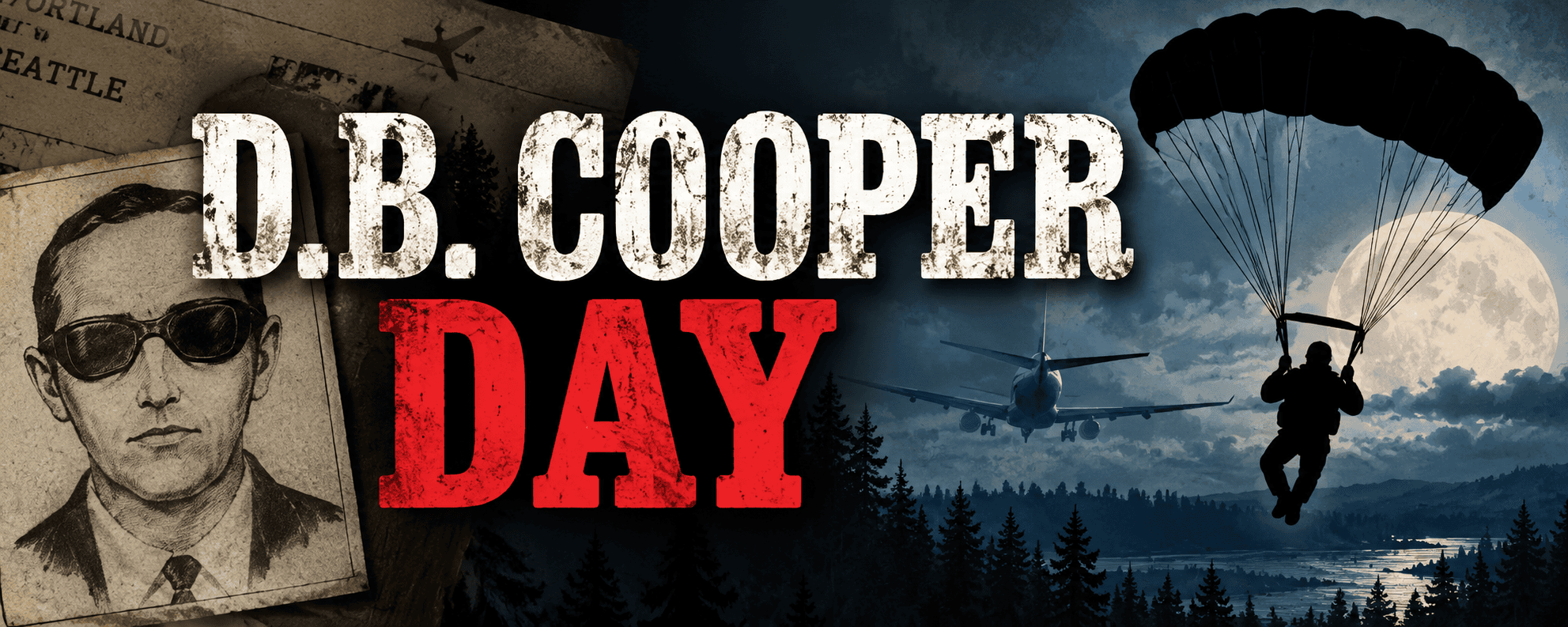
Every year on November 24, D.B. Cooper Day recognizes one of the most fascinating unsolved mysteries in American history. It commemorates the mysterious man who hijacked a commercial airplane in 1971, demanded $200,000 in ransom, and parachuted into the darkness over the Pacific Northwest, never to be conclusively identified or found.
More than five decades later, the disappearance of D.B. Cooper remains one of America’s most famous aviation mysteries. His daring escape, mysterious identity, and the unanswered questions surrounding his fate have inspired books, documentaries, television programs, and countless theories.
D.B. Cooper Day is an informal observance rather than an official federal holiday. It provides an opportunity to revisit the remarkable events of November 24, 1971, examine the evidence, and explore why this mystery continues to capture the American imagination.
What Is D.B. Cooper Day?
D.B. Cooper Day is observed annually on November 24, the anniversary of the infamous 1971 hijacking of Northwest Orient Airlines Flight 305.
On that day, a man identifying himself as Dan Cooper boarded a flight from Portland, Oregon, to Seattle, Washington. What appeared to be an ordinary airline journey quickly became one of the most extraordinary criminal investigations in American history.
The hijacker demanded money and parachutes before releasing the passengers and ordering the aircraft back into the air. During the second flight, he jumped from the airplane with the ransom money and disappeared.
Despite an extensive FBI investigation, numerous suspects, and decades of public speculation, his identity and ultimate fate remain unknown.
Today, the story is remembered not only for the mystery but also for its place in aviation history and its influence on airline security.
The History of D.B. Cooper
November 24, 1971: The Hijacking Begins
On the afternoon before Thanksgiving in 1971, a neatly dressed man purchased a one-way airline ticket at Portland International Airport.
He identified himself as Dan Cooper.
Witnesses described him as a middle-aged man wearing a dark business suit, white shirt, black tie, and sunglasses. He appeared calm, polite, and unremarkable.
Cooper boarded Northwest Orient Airlines Flight 305, a Boeing 727 traveling from Portland to Seattle.
Shortly after takeoff, he handed a note to flight attendant Florence Schaffner. At first, she reportedly assumed it was an ordinary personal note.
Cooper then made it clear that he was carrying a bomb.
He opened a briefcase containing objects that appeared to be explosive devices and communicated his demands.
He wanted $200,000 in cash, four parachutes, and a fuel truck waiting in Seattle.
The flight crew informed authorities, and arrangements were made to meet his demands.
The Ransom Exchange in Seattle
When Flight 305 landed at Seattle-Tacoma International Airport, authorities provided the ransom money and parachutes.
The $200,000 ransom was supplied in $20 bills, with serial numbers recorded to help investigators identify the money later.
Cooper released the passengers after receiving the ransom and parachutes.
However, he kept several crew members aboard and ordered the aircraft to take off again.
His requested destination was Mexico City, although the plane would need to stop for fuel along the way.
Cooper also specified unusual flight conditions, including a low altitude and reduced airspeed.
These instructions would become crucial to understanding his disappearance.
The Mysterious Parachute Jump
After departing Seattle, Cooper prepared to leave the aircraft.
The Boeing 727 featured a rear stairway that could be lowered during flight, providing an unusual escape route.
Cooper instructed the remaining crew members to stay in the cockpit.
Sometime around 8:13 p.m., while the airplane was flying over southwestern Washington, Cooper apparently jumped into the dark, rainy night.
He carried the ransom money and wore a parachute.
The weather was poor, visibility was limited, and the terrain below included forests, rivers, and rugged wilderness.
No confirmed witness saw him land.
When the aircraft eventually landed in Reno, Nevada, Cooper was gone.
The hijacker had disappeared without leaving behind a confirmed trail.
His escape would become one of the most famous mysteries in FBI history.
Why Was He Called D.B. Cooper?
One of the most interesting details about this case is that the hijacker never actually identified himself as D.B. Cooper.
He purchased his airline ticket using the name Dan Cooper.
The name D.B. Cooper emerged because of an early media reporting error that became widely repeated.
Over time, the mistaken name became permanently associated with the mystery.
Even today, the public overwhelmingly remembers him as D.B. Cooper rather than Dan Cooper.
This small mistake demonstrates how quickly a news story can develop a lasting identity of its own.
The FBI Investigation
Following Cooper’s disappearance, the FBI launched an enormous investigation known as NORJAK, short for Northwest Hijacking.
Investigators interviewed witnesses, examined physical evidence, searched wilderness areas, and investigated thousands of possible leads.
The investigation became one of the longest-running and most widely recognized cases in FBI history.
Authorities attempted to determine several important facts: who Cooper really was, whether he survived the jump, where he landed, and what happened to the ransom money.
The FBI examined numerous possible suspects over the decades, but none was conclusively identified as the hijacker.
In 2016, the FBI announced that it was redirecting resources away from actively investigating the case, although it would still consider significant new physical evidence.
The decision did not solve the mystery.
Instead, it left one of America’s most intriguing criminal cases officially unresolved.
The Discovery of the Ransom Money
One of the most significant developments occurred in February 1980.
An eight-year-old boy named Brian Ingram discovered deteriorating bundles of $20 bills while vacationing with his family along the Columbia River near Vancouver, Washington.
The money was partially buried in the sand at a location known as Tena Bar.
Investigators confirmed that the serial numbers matched the ransom money given to Cooper.
The discovery totaled approximately $5,800.
This was the only confirmed portion of the ransom recovered.
The location of the money raised additional questions.
Had Cooper landed nearby? Had the money been carried downstream? Did the discovery suggest that he had died during the jump?
Investigators considered multiple explanations, but the evidence did not conclusively establish what happened.
The remaining ransom money has never been definitively recovered.
Did D.B. Cooper Survive?
Whether Cooper survived his parachute jump remains one of the biggest unanswered questions.
There are arguments supporting both possibilities.
The Theory That He Survived
Some believe Cooper carefully planned his escape and possessed enough knowledge of aircraft and parachuting to survive.
Supporters of this theory point to his apparent familiarity with the Boeing 727 and its rear stairway.
His calm behavior during the hijacking also suggests that he may have prepared extensively.
According to this theory, Cooper landed successfully, escaped the search area, and lived under another identity.
However, there is no verified evidence establishing that he survived.
The Theory That He Died
Others believe the conditions surrounding the jump made survival unlikely.
Cooper jumped at night in poor weather while wearing ordinary business clothing.
The terrain was difficult, and investigators could not establish that he had suitable survival equipment.
The discovery of part of the ransom money near the Columbia River has also contributed to speculation that he may not have survived.
Nevertheless, no confirmed remains have been recovered, and investigators have never established his death.
The question remains unanswered.
Who Was D.B. Cooper?
Over the years, numerous individuals have been suggested as possible suspects.
Some theories focus on military veterans or experienced parachutists. Others suggest aviation workers, criminals, or people familiar with the Boeing 727.
Investigators examined suspects based on physical descriptions, personal histories, aviation knowledge, and possible connections to the Pacific Northwest.
Despite decades of investigation, no suspect has been conclusively connected to the hijacking.
Some individuals have been promoted as Cooper by independent researchers, family members, or documentary filmmakers, but these claims remain unproven.
The uncertainty surrounding his identity is one reason the story continues to attract attention.
How the Hijacking Changed Aviation Security
Although Cooper’s disappearance is often presented as an adventurous mystery, the event was a serious criminal act that endangered passengers and crew members.
It also exposed significant weaknesses in airline security during the early 1970s.
At that time, commercial aviation security procedures were considerably less restrictive than those used today.
The hijacking contributed to growing pressure for stronger security measures.
Airlines eventually adopted additional passenger screening procedures, and Boeing 727 aircraft were equipped with a device designed to prevent the rear stairway from being lowered during flight.
That device became commonly known as the Cooper vane.
The case remains an important example of how aviation incidents can lead to changes in security practices.
How Is D.B. Cooper Day Celebrated?
Because D.B. Cooper Day is an informal observance, there are no nationwide official ceremonies or required traditions.
However, history enthusiasts, aviation researchers, and mystery fans recognize the anniversary in several ways.
-
Learning about the hijacking: Reading historical accounts and examining the timeline of Flight 305.
-
Watching documentaries: Exploring investigations and theories about Cooper’s disappearance.
-
Discussing the mystery: Comparing evidence and considering whether Cooper survived.
-
Exploring aviation history: Understanding how commercial airline security evolved after the incident.
-
Visiting Pacific Northwest communities: Discovering the regional history associated with the hijacking.
The observance provides an opportunity to appreciate historical research while recognizing the seriousness of the crime.
Interesting Facts About D.B. Cooper
The case contains numerous unusual details that distinguish it from other aviation mysteries.
1. His real name remains unknown. The hijacker used the name Dan Cooper, but investigators never established his true identity.
2. The ransom was worth $200,000 in 1971. Adjusted for inflation, that would represent well over $1 million in today’s purchasing power.
3. He requested four parachutes. Investigators have speculated that requesting multiple parachutes may have been intended to create uncertainty about whether he planned to take a hostage.
4. He escaped from a Boeing 727. The aircraft’s distinctive rear stairway made his midair departure possible.
5. Part of the ransom was found in 1980. Approximately $5,800 was recovered along the Columbia River.
6. The FBI investigated the case for decades. The investigation remained active until resources were redirected in 2016.
7. The case inspired aviation safety changes. The Cooper vane was developed to prevent similar escapes from Boeing 727 aircraft.
8. No definitive solution has emerged. Despite numerous suspects and theories, Cooper’s identity and fate remain unconfirmed.
Why Does the D.B. Cooper Mystery Still Fascinate America?
Part of the fascination surrounding D.B. Cooper comes from the extraordinary circumstances of his disappearance.
The story contains nearly every element of a classic mystery: an unidentified stranger, a carefully executed crime, a dramatic escape, missing money, and a trail that suddenly ends.
Unlike many historical mysteries, the Cooper case also includes physical evidence, eyewitness descriptions, and official investigative records.
These details allow researchers to develop theories while leaving enough uncertainty for continued debate.
The case has become deeply embedded in American popular culture.
It has inspired fictional characters, television episodes, documentaries, books, and discussions about whether a person could successfully disappear without being identified.
However, the story also raises serious questions about how mysteries become romanticized.
Cooper committed a federal crime, threatened an aircraft and its occupants, and placed innocent people in danger.
Remembering the event as history does not require celebrating the crime itself.
Instead, D.B. Cooper Day can encourage thoughtful examination of the facts, the investigation, and the cultural fascination with unsolved mysteries.
The Lasting Legacy of D.B. Cooper
More than half a century after the hijacking, D.B. Cooper remains one of the most recognizable unidentified figures in American criminal history.
His disappearance influenced aviation security, generated decades of investigative work, and became part of the historical identity of the Pacific Northwest.
The case also demonstrates the limitations investigators faced before modern surveillance, digital records, and advanced forensic technology became widespread.
Today, new theories occasionally emerge, but a compelling story is not the same as verified evidence.
Until reliable proof establishes his identity and fate, the mystery remains open to speculation.
Final Thoughts: Remembering D.B. Cooper Day on November 24
D.B. Cooper Day reminds us that some historical events continue to raise questions long after the people involved have disappeared from public view.
On November 24, 1971, an unidentified man boarded an ordinary commercial flight and set in motion one of the most extraordinary investigations in American aviation history.
He demanded a ransom, released the passengers, and disappeared into the night.
More than fifty years later, the central questions remain unanswered.
Who was D.B. Cooper? Did he survive the jump? What happened to the rest of the money?
Perhaps someday new evidence will finally reveal the truth.
Until then, November 24 remains an opportunity to revisit the facts, reflect on the event’s impact on aviation history, and explore one of America’s most enduring unsolved mysteries.
Do you believe D.B. Cooper survived his famous parachute jump, or do you think the mystery ended in the wilderness that November night?

Leave a Reply