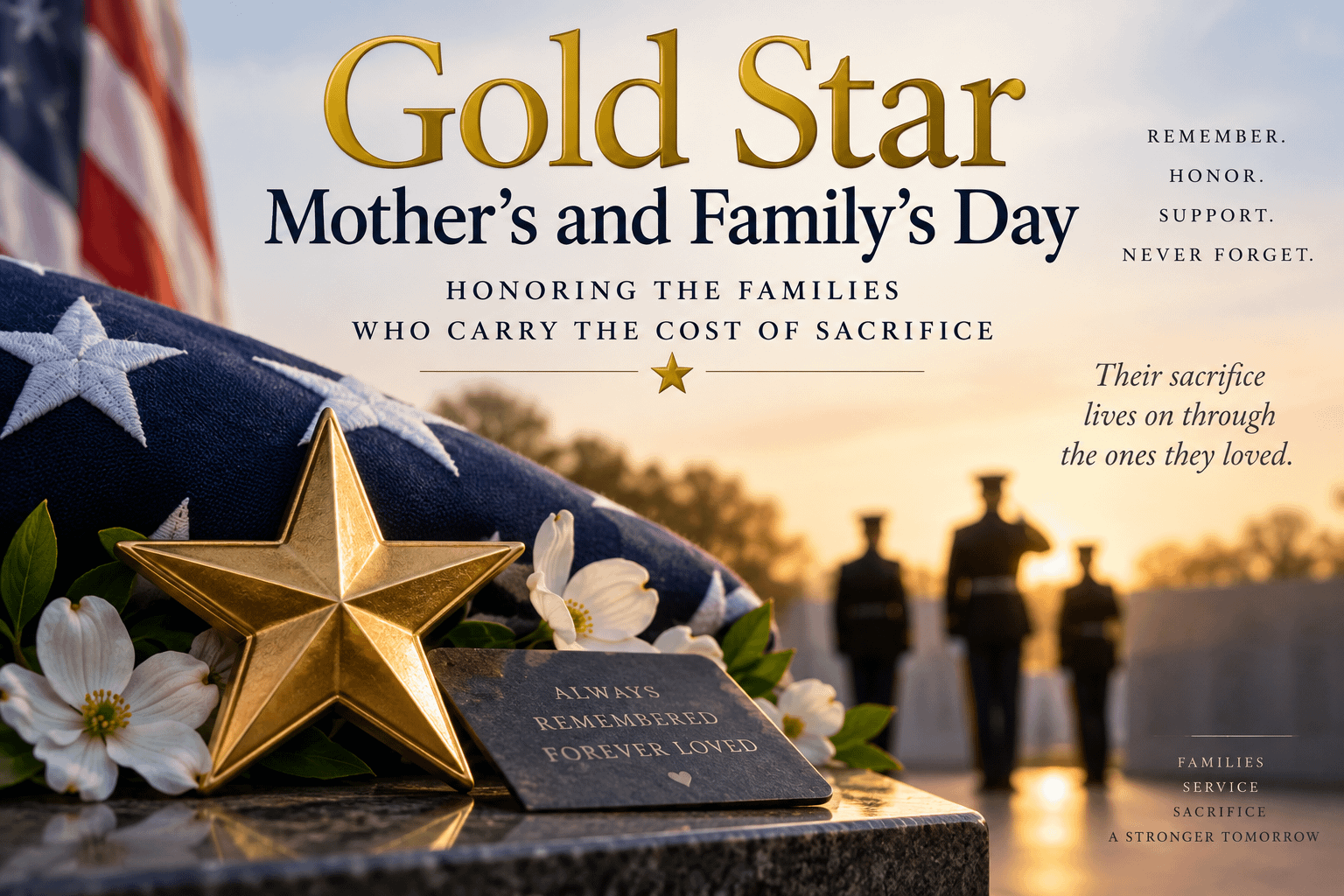
Every year on the last Sunday in September, Americans have an opportunity to recognize families who understand sacrifice in a way most of us never will.
Gold Star Mother’s and Family’s Day honors the mothers, fathers, spouses, children, siblings, and other loved ones of United States service members who died in service to our country.
It is a day of remembrance.
It is a day of gratitude.
But perhaps most importantly, it is a day to remember that behind every fallen service member is a family whose life was forever changed.
For those families, sacrifice isn’t simply something discussed during a ceremony or remembered on a national holiday. Their loved one’s absence becomes part of birthdays, holidays, family gatherings, quiet evenings, anniversaries, and countless ordinary moments.
Their grief continues long after the ceremonies have ended.
Gold Star Mother’s and Family’s Day asks the nation to remember not only those who served and died, but also the families who continue carrying their memory.
What Is Gold Star Mother’s and Family’s Day?
Federal law designates the last Sunday in September as Gold Star Mother’s Day. The law also calls for the American flag to be displayed and for appropriate gatherings to be held as a public expression of love, sorrow, and reverence for Gold Star Mothers. The observance traces its statutory roots to legislation enacted on June 23, 1936.
In modern presidential proclamations, the observance has also recognized the broader community of Gold Star Families, reflecting the reality that the death of a service member affects an entire family. For example, the 2025 presidential proclamation designated September 28, 2025, as “Gold Star Mother’s and Family’s Day.”
In 2026, the last Sunday of September falls on September 27.
This is not intended to be a celebration in the traditional sense.
It is an observance rooted in remembrance, respect, gratitude, and recognition.
What Does “Gold Star” Mean?
The Gold Star has become one of America’s most solemn symbols of military loss.
It represents something no military family ever hopes to experience: the death of someone they love while serving the country.
Behind that symbol is a person.
Someone’s son.
Someone’s daughter.
Someone’s husband or wife.
Someone’s mother or father.
Someone’s brother or sister.
Someone who had dreams, friendships, traditions, inside jokes, favorite meals, plans for the future, and people waiting for them at home.
When we talk about Gold Star Families, it is important that we never allow the terminology to overshadow the humanity behind it.
These families aren’t defined solely by a symbol.
They are families remembering someone they deeply loved.
The History Behind the Observance
The national recognition of Gold Star Mothers dates back generations.
On June 23, 1936, legislation established the last Sunday in September as Gold Star Mother’s Day and called for Americans to publicly express their love, sorrow, and reverence for Gold Star Mothers. That designation remains part of federal law today under 36 U.S.C. §111.
The language is significant.
The observance isn’t merely about acknowledging military service.
It recognizes sorrow.
That matters because national sacrifice is often discussed through words such as bravery, courage, patriotism, honor, and heroism.
Those words have an important place.
But sacrifice also has another side.
There is an empty chair at the dinner table.
There is a bedroom that suddenly feels different.
There are photographs that become priceless.
There are birthdays without the person who should have been there.
There are holidays when someone’s absence seems impossible to ignore.
There are parents who expected to watch their children grow older.
There are spouses who expected decades together.
There are children who grow up hearing stories about a parent they desperately wish were still beside them.
Those realities are also part of the cost of military sacrifice.
Remembering the Mothers
There is something especially heartbreaking about a parent burying a child.
Parents spend years protecting their children.
From the moment they enter the world, parents imagine their futures.
First steps.
First days of school.
Graduations.
Careers.
Marriage.
Grandchildren.
Growing older together.
When a son or daughter dies, those imagined years disappear with them.
A Gold Star Mother carries both tremendous pride and tremendous grief.
She may be proud of the person her child became.
She may treasure stories from fellow service members.
She may proudly display photographs, medals, uniforms, flags, or other reminders of her son or daughter’s service.
But pride does not erase grief.
And honor does not eliminate heartbreak.
Years can pass, yet a mother can still remember her child’s voice.
She may remember the way they laughed.
The foods they loved.
The way they walked through the door.
The conversations they shared.
The last hug.
The last phone call.
The last time she said goodbye without realizing how important that goodbye would eventually become.
Gold Star Mother’s and Family’s Day gives the country an opportunity to say something simple but powerful:
We remember your child.
Remembering Gold Star Fathers
Fathers deserve recognition on this day as well.
A grieving father may feel pressure to remain strong for everyone around him.
He may believe he needs to support his spouse, children, relatives, or others while privately carrying tremendous pain himself.
Some fathers speak openly about their grief.
Others carry much of it quietly.
Neither experience makes the loss smaller.
A father may remember teaching his child to ride a bicycle, throwing a baseball together, going fishing, fixing a car, attending school events, having long conversations, or simply sitting together doing nothing particularly important.
Those ordinary memories often become extraordinary after someone dies.
A father may also carry questions that never receive answers.
What would my child be doing today?
Would they have gotten married?
Would I have grandchildren?
Where would they be living?
What would they think about the person I’ve become?
Grief doesn’t only mourn what happened.
It also mourns everything that will never get the opportunity to happen.
Gold Star fathers carry that reality too.
Remembering Spouses
When a service member dies, a husband or wife may suddenly lose the person with whom they expected to build the rest of their life.
Plans can disappear overnight.
Vacations that were going to happen.
A house they hoped to buy.
Children they planned to raise.
Retirement dreams.
Anniversaries that should have been celebrated together.
The surviving spouse must somehow continue living while carrying the love they still have for someone who can no longer physically walk beside them.
Moving forward does not mean leaving that person behind.
A Gold Star spouse can build a new life while continuing to honor the person who died.
Love and grief can exist alongside hope.
Remembering the Children
Some of the most heartbreaking members of Gold Star Families are children who grow up without a parent.
Some remember their mother or father clearly.
Others were very young when their parent died.
Some may know their parent largely through photographs, videos, letters, stories, military records, and memories shared by relatives and fellow service members.
As those children grow, their grief may change.
A five-year-old understands loss differently than a teenager.
A teenager understands it differently than an adult getting married.
New milestones can create new forms of grief.
Graduation.
Marriage.
The birth of a child.
Buying a first home.
Beginning a career.
At each milestone, there may be the thought:
I wish Mom or Dad were here to see this.
Gold Star children deserve to know that their parent’s life and service have not been forgotten.
Grief Doesn’t Follow a Calendar
National observances are important because they encourage collective remembrance.
But grief doesn’t wait for designated days.
A Gold Star Family may experience grief on an ordinary Tuesday morning.
A song might bring back a memory.
Someone may discover an old photograph.
A familiar smell might remind them of home.
A television show may bring back an inside joke.
A stranger might unknowingly say something that triggers a memory.
Grief can appear unexpectedly because love is woven into everyday life.
That is why supporting Gold Star Families cannot be limited to one Sunday in September.
Remember them throughout the year.
Say Their Names
One of the greatest fears many grieving families experience is that their loved one will eventually be forgotten.
Years pass.
People move.
Communities change.
News stories disappear.
New generations arrive.
But families continue remembering.
One meaningful thing we can do is simply allow families to talk about the person they lost.
Ask about them.
Listen to their stories.
Look at their photographs.
Remember their birthdays.
Remember important anniversaries.
And when appropriate, say their names.
You aren’t reminding a grieving parent, spouse, sibling, or child that their loved one died.
They already know.
You may instead be reminding them that someone else remembers that their loved one lived.
Ways to Observe Gold Star Mother’s and Family’s Day
There are many respectful ways to recognize the day. You can display the American flag, attend a remembrance ceremony, learn about a fallen service member from your community, support organizations serving military survivors, visit a memorial, reach out to a Gold Star Family you personally know, or simply take time to reflect on the human cost of military service.
Federal law specifically encourages displaying the American flag and holding appropriate gatherings at homes, churches, or other suitable places as expressions of remembrance and reverence.
Whatever you choose, sincerity matters more than making a grand gesture.
Sometimes the most meaningful words are simply:
“I’m thinking about your family today, and I remember your loved one.”
More Than One Day of Remembrance
Gold Star Mother’s and Family’s Day lasts one day on the calendar.
Their loss does not.
When Monday arrives, families will still wake up without someone they love.
When Thanksgiving comes, someone may be missing from the table.
When Christmas arrives, there may be one less gift beneath the tree.
When birthdays arrive, families may wonder what that person would look like today.
When anniversaries come around, memories may feel incredibly close again.
That is why remembrance shouldn’t end when the official observance ends.
We can continue honoring these families by remembering their loved ones and acknowledging that military sacrifice reaches far beyond the battlefield.
A Nation Remembers
There are debts that cannot truly be repaid.
No ceremony can return someone’s child.
No medal can replace a spouse.
No monument can give a child another afternoon with a parent.
No words can completely remove the pain carried by a family after losing someone they love.
But remembrance still matters.
Gratitude matters.
Names matter.
Stories matter.
And making sure families know their loved ones haven’t been forgotten matters.
On Gold Star Mother’s and Family’s Day, we honor those who died while serving our nation, and we stand in remembrance with the families who continue carrying their love, their stories, and their legacy.
To every Gold Star mother, father, spouse, child, sibling, and family member:
May your loved one’s name continue to be spoken.
May their story continue to be told.
May their service continue to be remembered.
And may you always know that the life behind the Gold Star mattered.
Today, we remember the fallen—and we remember the families who carry their absence every day.
Who will you take a moment to remember and honor this Gold Star Mother’s and Family’s Day?
Leave a Reply