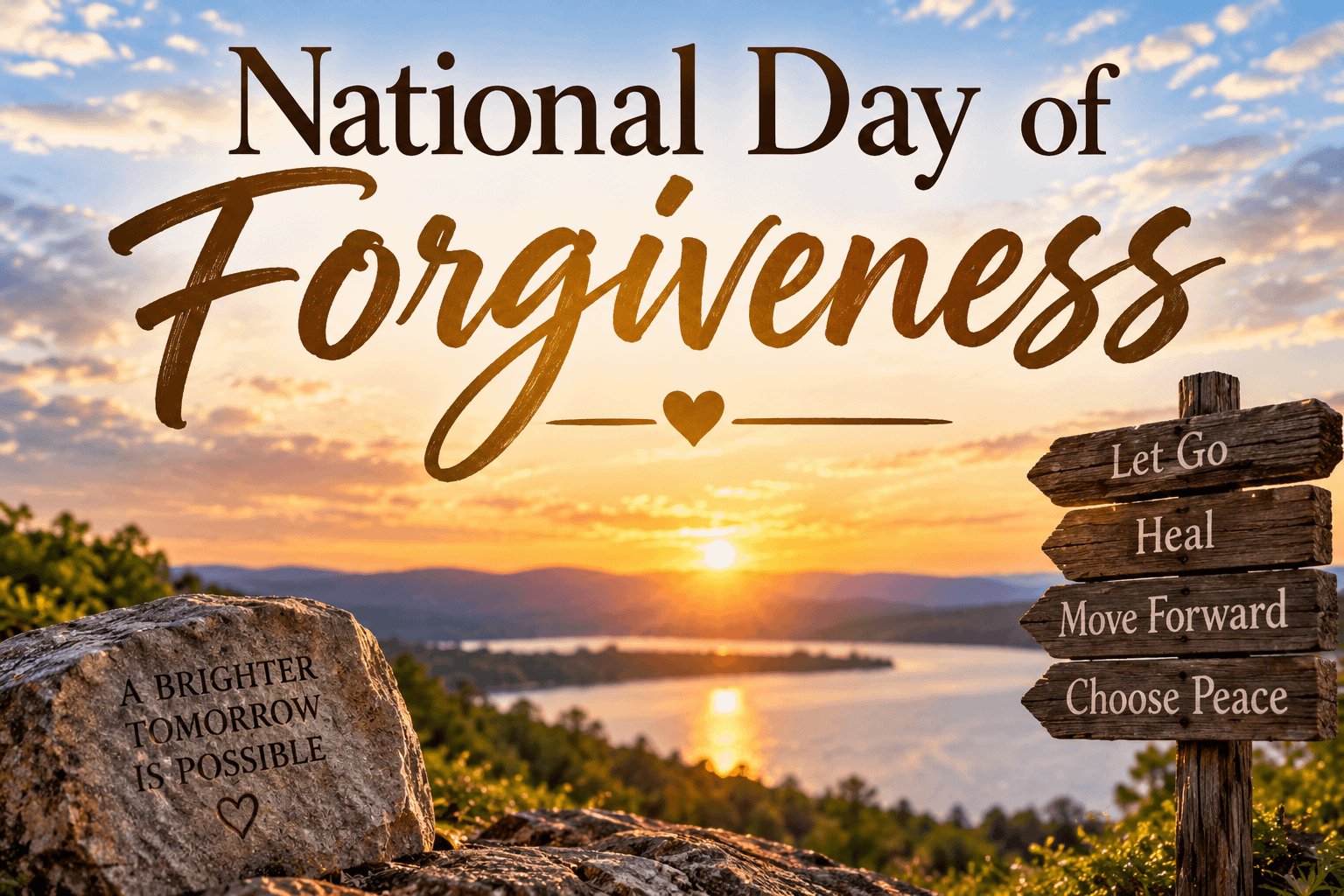
Forgiveness can be one of the hardest things we ever choose to do.
It sounds simple when people say, “You need to forgive.” But forgiveness becomes much more complicated when someone has betrayed you, abandoned you, lied to you, disappointed you, or caused pain that changed your life.
Some wounds disappear with time. Others leave scars.
The National Day of Forgiveness is an opportunity to think about those wounds—not because we should pretend they never happened, but because carrying anger, resentment, bitterness, and regret can become an exhausting burden.
Forgiveness doesn’t necessarily mean reconciliation.
It doesn’t mean forgetting.
It doesn’t mean approving of what happened.
And it certainly doesn’t mean giving someone permission to hurt you again.
Sometimes forgiveness simply means deciding that what happened yesterday will no longer control tomorrow.
What Forgiveness Really Means
One of the biggest misunderstandings about forgiveness is the idea that forgiving someone somehow excuses their behavior.
It doesn’t.
You can forgive someone and still believe what they did was wrong.
You can forgive someone and maintain boundaries.
You can forgive someone and decide they should no longer have a place in your life.
Forgiveness is often less about changing the person who hurt you and more about changing the relationship you have with the pain they caused.
You may never receive the apology you deserve.
You may never hear someone admit what they did.
They may never understand how deeply their actions affected you.
Waiting for someone else to make things right can leave your peace dependent on a person who may never give you what you need.
Forgiveness allows you to begin reclaiming that peace for yourself.
Forgiveness Doesn’t Erase the Past
There are things in life we simply cannot forget.
Certain experiences become part of our story.
A betrayal may change how easily we trust.
A painful relationship may teach us the importance of boundaries.
A difficult experience may change the way we see people or even ourselves.
Forgiveness doesn’t require deleting those memories.
Instead, it means learning how to remember without allowing the memory to dictate every part of your future.
The goal isn’t always to forget what happened.
Sometimes the goal is simply reaching the point where remembering it doesn’t have the same power over you.
Forgiveness Can Take Time
There is no deadline for forgiveness.
Some hurts are relatively small, and we can move past them quickly. Other wounds may take months or years to process.
You might even believe you have forgiven someone only to experience anger again when something reminds you of what happened.
That doesn’t necessarily mean you failed.
Healing isn’t always a straight line.
There may be days when you feel peaceful about the past and other days when the emotions return unexpectedly.
Forgiveness can be a decision we make repeatedly.
Today, you may choose not to replay the argument.
Tomorrow, you may choose not to imagine what you wish you had said.
Another day, you may choose not to check what the person who hurt you is doing.
Eventually, those small decisions can create distance between you and the pain.
Forgiving Someone Doesn’t Mean Letting Them Back Into Your Life
This distinction is incredibly important.
Forgiveness and reconciliation are not the same thing.
Reconciliation requires trust, accountability, changed behavior, communication, and usually participation from both people.
Forgiveness can happen with only one person.
You.
There may be situations where rebuilding a relationship is healthy and possible. There may also be situations where maintaining distance is the healthiest choice.
You can say:
“I forgive you, but I cannot trust you the way I once did.”
You can forgive someone while maintaining boundaries.
You can wish someone well without inviting them back into your life.
You can release your anger without rebuilding the relationship.
Forgiveness doesn’t require surrendering your wisdom.
Sometimes the Person You Need to Forgive Is Yourself
We often talk about forgiving other people, but self-forgiveness can be even more difficult.
Most of us carry moments we wish we could change.
Maybe you stayed somewhere too long.
Maybe you trusted someone you shouldn’t have.
Maybe you said something you regret.
Maybe you made a decision that changed your life.
Maybe you ignored warning signs.
Maybe you hurt someone.
Maybe you simply weren’t the person then that you wish you had been.
It can be incredibly easy to look backward with the knowledge you have today and criticize the person you were years ago.
But that person didn’t know everything you know now.
Growth means learning.
And learning often means realizing that some of our past choices were wrong.
You can take responsibility without sentencing yourself to a lifetime of shame.
Ask yourself:
Have I learned from what happened?
If the answer is yes, then continuing to punish yourself doesn’t change the past.
It only steals from your future.
Forgiveness and Grief
Forgiveness can also become complicated when grief enters our lives.
After losing someone we love, we may discover anger we weren’t expecting.
We might be angry at doctors.
Angry at circumstances.
Angry at another person.
Angry at ourselves.
Sometimes we may even feel angry at the person who died.
Then guilt appears because we believe we’re not supposed to feel that way.
But grief contains many emotions.
Love, sadness, anger, confusion, regret, loneliness, gratitude, guilt, and longing can exist together.
There may also be things we wish we had said.
More calls we wish we had made.
More time we wish we had spent together.
More photographs we wish we had taken.
More times we wish we had said, “I love you.”
Self-forgiveness can become an important part of learning to carry grief.
We cannot rewrite yesterday.
We can only decide how we will live today.
Sometimes honoring someone we love means allowing their memory to inspire us to live with greater love, kindness, compassion, and purpose.
Forgiveness Is Not Weakness
Holding onto anger can sometimes feel like strength.
We may think:
“If I forgive them, they win.”
But forgiveness isn’t about declaring a winner.
It is about deciding how much space the experience deserves in your life.
Imagine carrying a heavy backpack everywhere you go.
Inside are resentment, anger, disappointment, betrayal, regret, and unanswered questions.
You carry it into new friendships.
You carry it into relationships.
You carry it to work.
You carry it home.
You even carry it into moments that should be happy.
Eventually, you may realize the person who hurt you isn’t carrying that backpack.
You are.
Forgiveness is gradually removing some of that weight.
Not because what happened was acceptable.
Because you deserve the freedom to keep moving.
You Don’t Need an Apology to Begin Healing
An apology can be powerful.
Hearing someone say, “I was wrong. I hurt you. I’m sorry,” can bring validation and closure.
Unfortunately, apologies don’t always come.
Some people refuse to take responsibility.
Some minimize what happened.
Some rewrite the story.
Some disappear.
Others may genuinely believe they did nothing wrong.
If your healing requires their apology, you may remain emotionally connected to them indefinitely.
You can acknowledge what happened without their agreement.
You know what you experienced.
You know how it affected you.
You can choose to begin healing even when the person responsible never takes accountability.
What Forgiveness Might Look Like
Forgiveness doesn’t always arrive as a dramatic moment.
Sometimes it happens quietly.
You stop checking their social media.
You stop replaying old conversations.
You stop imagining arguments that will never happen.
You stop hoping they finally realize what they lost.
You stop trying to prove that you were right.
You stop allowing their actions to determine your mood.
Then one day, you realize something.
You haven’t thought about it for a while.
That doesn’t mean the memory disappeared.
It means your life became bigger than the wound.
That is progress.
Forgiveness Through Faith
For people of faith, forgiveness can carry an even deeper meaning.
Christian teaching places forgiveness at the center of how we are called to treat one another. Colossians 3:13 teaches believers to forgive as the Lord forgave them.
That can be challenging when the wound is deep.
Sometimes the most sincere prayer isn’t:
“God, I forgive them completely.”
Sometimes it begins with:
“God, help me become willing to forgive.”
There is a difference.
Forgiveness can be a process.
You may need strength beyond your own.
You may need to surrender the anger repeatedly.
You may need to ask God to heal parts of your heart that still hurt.
Faith doesn’t require pretending pain doesn’t exist.
It can provide a place to bring that pain while asking for the strength to move forward.
Use the National Day of Forgiveness as a New Beginning
You don’t have to resolve every painful experience today.
Instead, use the National Day of Forgiveness as an opportunity to ask yourself a few important questions.
Who am I still angry with?
What memory do I keep replaying?
Is there someone whose actions still control my emotions?
Am I waiting for an apology that may never come?
Is there something I need to forgive myself for?
You don’t need perfect answers.
Awareness itself can be the beginning of change.
Maybe today you write a letter you never send.
Maybe you pray about someone who hurt you.
Maybe you finally stop checking their social media.
Maybe you talk with someone you trust.
Maybe you apologize to someone you’ve hurt.
Or perhaps you simply whisper to yourself:
“I don’t want to carry this anymore.”
That can be enough for today.
Forgive, but Remember What You Learned
Forgiveness should not erase wisdom.
If someone showed you repeatedly that they couldn’t be trusted, remember the lesson.
If someone constantly crossed your boundaries, strengthen them.
If a relationship taught you what you never want to experience again, carry that knowledge forward.
Forgiveness isn’t returning to the person you were before you were hurt.
Sometimes you can’t.
Instead, it can mean becoming someone wiser without becoming someone consumed by bitterness.
Keep the lesson.
Release as much of the anger as you can.
Give Yourself Permission to Move Forward
There comes a point when healing requires looking ahead.
Your past may always be part of your story, but it doesn’t have to become the entire story.
There are still people you haven’t met.
Places you haven’t visited.
Memories you haven’t created.
Conversations you haven’t had.
Dreams you haven’t pursued.
And moments of happiness you haven’t experienced yet.
Don’t allow someone who hurt you years ago to occupy space that belongs to your future.
Forgiveness doesn’t change yesterday.
It changes what you carry into tomorrow.
Final Thoughts
The National Day of Forgiveness reminds us that forgiveness is not about pretending everything is okay.
Sometimes everything wasn’t okay.
Someone hurt you.
Someone betrayed you.
Someone disappointed you.
Or perhaps you are carrying regret over something you did yourself.
You are allowed to acknowledge that truth.
But you are also allowed to heal.
Forgive when you’re ready.
Set boundaries where they’re necessary.
Learn from what happened.
Give yourself grace for the mistakes you’ve made.
And remember that forgiveness doesn’t mean the pain never mattered.
It means you are deciding that the pain doesn’t get to control the rest of your life.
You may never forget what happened.
You may always carry the lesson.
But you don’t have to carry the same weight forever.
What would change in your life if you finally began letting go of something you’ve been carrying for far too long?
Leave a Reply