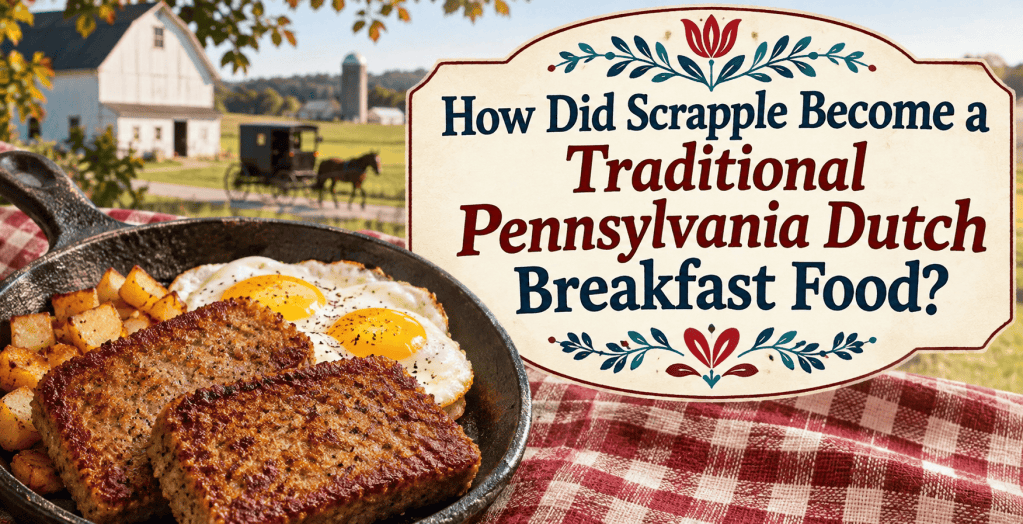
Scrapple is one of Pennsylvania’s most distinctive traditional breakfast foods, with roots stretching back to the earliest German-speaking settlers in colonial America. Made from pork, cornmeal, flour, and seasonings, this hearty dish represents generations of resourcefulness, family traditions, and practical farmhouse cooking.
Although scrapple may seem unusual to people unfamiliar with Pennsylvania Dutch cuisine, it has remained a beloved breakfast staple for centuries. Its crispy exterior, tender interior, and savory pork flavor have earned it a special place on breakfast tables throughout Pennsylvania and the Mid-Atlantic region.
But how did scrapple become such an important part of Pennsylvania Dutch food culture? The answer begins with European immigration, traditional butchering practices, and a philosophy that valued using every part of an animal.
What Is Scrapple?
Scrapple is a traditional American pork dish made by combining cooked pork with broth, cornmeal, wheat flour, and seasonings. The mixture is simmered until thick, poured into loaf pans, and refrigerated until firm.
Once chilled, the loaf is sliced and typically pan-fried until the outside becomes golden brown and crispy.
Unlike traditional breakfast sausage, scrapple has a distinctive texture created by the combination of meat and grain. Its exterior develops a satisfying crust during cooking, while the inside remains soft and flavorful.
Common scrapple ingredients include:
-
Cooked pork and pork trimmings
-
Pork broth or stock
-
Cornmeal
-
Wheat flour or buckwheat flour
-
Salt and black pepper
-
Sage
-
Thyme and other traditional seasonings
Recipes vary considerably between families, communities, and commercial producers.
Some versions use finely chopped pork shoulder, while others incorporate pork organs or meat recovered during traditional butchering.
The result is a filling breakfast food that reflects the practical cooking traditions of Pennsylvania’s early farming communities.
Where Did Scrapple Originally Come From?
Scrapple developed from European pork preparations brought to colonial Pennsylvania by German-speaking immigrants during the 17th and 18th centuries.
Many of these settlers came from regions of Germany where traditional butchering practices emphasized making use of nearly every edible part of a slaughtered pig.
One important predecessor was panhas, a German dish made from pork broth, meat remnants, and grain or flour.
Panhas belonged to a broader European tradition of preparing hearty dishes from ingredients remaining after butchering.
Rather than allowing valuable meat, broth, or fat to go to waste, families combined these ingredients into economical meals that could feed large households.
When German-speaking settlers established farms in Pennsylvania, they adapted their familiar recipes to the ingredients available in North America.
Cornmeal, which became widely used in colonial American cooking, was particularly important.
By combining European pork-processing traditions with locally available cornmeal, settlers helped develop the dish Americans now recognize as scrapple.
The exact date and location of scrapple’s invention are not documented, but its origins are strongly associated with Pennsylvania’s German-speaking agricultural communities.
Why Is Scrapple Associated With the Pennsylvania Dutch?
The Pennsylvania Dutch were primarily descendants of German-speaking immigrants who settled in southeastern Pennsylvania.
Despite the name, Pennsylvania Dutch does not generally refer to immigrants from the Netherlands.
The term is historically associated with the German word Deutsch, meaning German.
These communities established farms, villages, churches, and markets throughout Pennsylvania, particularly in areas that would become Lancaster, Berks, Lebanon, and surrounding counties.
Food played an important role in preserving their cultural identity.
Pennsylvania Dutch cooking emphasized hearty ingredients, seasonal produce, home preservation, and economical meals.
Scrapple fit naturally into these traditions.
It allowed families to transform inexpensive pork ingredients into a substantial food that could be prepared in advance and served over several days.
As generations continued preparing scrapple, it became more than a practical recipe.
It became a recognizable symbol of Pennsylvania Dutch heritage.
How Did Early Pennsylvania Farmers Make Scrapple?
Traditional scrapple preparation was closely connected to hog butchering, an important seasonal activity on Pennsylvania farms.
Before modern refrigeration, many farming families butchered hogs during colder months when low temperatures helped preserve meat during processing.
Butchering was often a major household event that required considerable labor and careful planning.
Families prepared fresh cuts of pork while also preserving meat through salting, smoking, and other methods.
After the most desirable cuts had been removed, smaller pieces of meat and bones could be simmered to extract additional nourishment.
The resulting broth and meat provided the foundation for scrapple.
The Traditional Scrapple-Making Process
1. Cooking the pork
Pork bones, trimmings, and other usable portions were simmered in water until the meat became tender and a flavorful broth developed.
2. Separating and chopping the meat
Cooked meat was removed from the bones and chopped or ground into small pieces.
3. Preparing the grain mixture
Cornmeal and sometimes wheat or buckwheat flour were gradually stirred into the hot broth.
4. Adding seasonings
Salt, pepper, sage, and other spices were added according to family preferences.
5. Cooking until thick
The mixture was stirred and simmered until it developed a thick consistency.
6. Forming the loaves
The finished mixture was poured into pans or molds and allowed to cool until firm.
7. Slicing and frying
Once the scrapple had set, slices could be cut from the loaf and fried for breakfast.
This process transformed ingredients that might otherwise have been discarded into a flavorful and satisfying food.
Why Was Scrapple So Important to Early Pennsylvania Dutch Families?
Scrapple became popular because it addressed several practical challenges faced by early farming households.
1. It Reduced Food Waste
One of the most important principles of traditional Pennsylvania Dutch cooking was making efficient use of available resources.
Raising livestock required significant time, labor, and expense.
Consequently, wasting edible portions of an animal was economically undesirable.
Scrapple allowed families to use small pieces of pork, broth, and other ingredients that remained after butchering.
This reflected a broader agricultural philosophy of thrift and self-sufficiency.
2. It Helped Feed Large Families
Many early Pennsylvania farming households needed substantial meals to support physically demanding work.
Scrapple combined protein-rich pork with inexpensive grains, producing a filling food from relatively modest quantities of meat.
Serving scrapple alongside eggs, potatoes, or bread created a hearty breakfast.
3. It Could Be Prepared Ahead of Time
Traditional scrapple was cooked in batches and formed into loaves.
Once cooled, it could be sliced and prepared as needed.
Before modern refrigeration, storage still depended on cold temperatures and careful handling, so scrapple was not an indefinitely shelf-stable food.
Nevertheless, making several loaves at once reduced daily preparation work.
4. It Used Familiar Ingredients
Pork, grain, salt, and herbs were common ingredients in Pennsylvania Dutch households.
Scrapple required no elaborate equipment or expensive imported ingredients.
Its simplicity made it especially practical for rural families.
How Did Cornmeal Change Traditional German Pork Recipes?
Cornmeal was one of the ingredients that helped distinguish American scrapple from its European predecessors.
German-speaking immigrants were already familiar with grain-thickened pork dishes.
However, corn became an important agricultural crop in colonial Pennsylvania, where Indigenous peoples had cultivated maize long before European settlement.
As settlers incorporated corn into their diets, cornmeal became a useful and economical cooking ingredient.
It could be used to prepare breads, porridges, mush, and other substantial dishes.
Adding cornmeal to pork broth produced a thick mixture that could be cooled, sliced, and fried.
Cornmeal also helped give scrapple its characteristic texture.
The grain absorbed liquid during cooking, allowing the finished mixture to become firm enough to form a loaf.
This adaptation illustrates how immigrant food traditions evolved through contact with the ingredients and agricultural practices of North America.
Scrapple was not simply a European dish transplanted unchanged to Pennsylvania.
It developed into a regional American food shaped by both inherited traditions and local resources.
When Did Scrapple Become a Popular Pennsylvania Breakfast Food?
Scrapple was established in Pennsylvania Dutch communities by the 19th century, although its roots reach back into the colonial period.
As farms, towns, and regional markets expanded, traditional homemade foods increasingly reached customers beyond the households that originally prepared them.
Local butchers and meat processors began producing scrapple for sale.
This helped transform scrapple from a primarily farmhouse preparation into a commercially available regional specialty.
By the late 19th and early 20th centuries, scrapple was becoming a familiar offering in butcher shops, markets, and breakfast kitchens across parts of Pennsylvania.
Its popularity also spread into neighboring Mid-Atlantic states.
Delaware, Maryland, and New Jersey developed their own scrapple traditions, although Pennsylvania remained especially closely associated with the dish.
The growth of commercial production helped preserve scrapple’s popularity as fewer families butchered their own livestock.
Why Is Scrapple Traditionally Eaten for Breakfast?
Scrapple became associated with breakfast partly because it was convenient to prepare from an already cooked loaf.
A few slices could be placed in a hot skillet and fried until crisp.
This required much less preparation than cooking a fresh pork dish from scratch.
Scrapple also paired naturally with other traditional breakfast foods.
Common accompaniments included eggs, fried potatoes, toast, and pancakes.
Its rich, savory flavor provided a contrast to milder foods such as bread and potatoes.
For farming families, a substantial breakfast was especially valuable before beginning physically demanding chores.
Over time, the combination of scrapple, eggs, and potatoes became a recognizable regional breakfast tradition.
Today, many diners throughout Pennsylvania and neighboring states continue serving scrapple as a classic breakfast meat.
What Does Traditional Pennsylvania Dutch Scrapple Taste Like?
Scrapple has a savory pork flavor with earthy grain notes and seasonings that may include sage, pepper, and thyme.
Its taste depends heavily on the ingredients and preparation method.
Traditional recipes made with pork broth and finely chopped meat often have a deeper flavor than versions prepared primarily with lean pork.
The texture is equally important.
Properly fried scrapple develops a crisp, browned exterior while retaining a soft interior.
The contrast between these textures is one of the qualities that makes scrapple distinctive.
People trying scrapple for the first time sometimes compare it to breakfast sausage, pork pâté, or fried cornmeal mush.
However, none of these comparisons completely captures its flavor and consistency.
Scrapple has its own character, shaped by both its ingredients and cooking method.
How Is Scrapple Different From Sausage?
Although scrapple and breakfast sausage both commonly contain pork, they are prepared differently.
Traditional breakfast sausage is generally made from ground meat, fat, and seasonings.
It may be formed into links or patties and cooked directly.
Scrapple, by contrast, combines cooked pork with broth and grain.
The mixture is cooked, formed into a loaf, cooled, and then sliced for frying.
This produces a different texture.
Sausage generally retains a meatier consistency, while scrapple has a softer, grain-thickened interior.
Scrapple also reflects a particular historical purpose: making use of broth and smaller meat portions remaining from traditional pork processing.
Both foods are associated with hearty breakfasts, but their preparation methods and culinary histories are distinct.
How Do You Cook Scrapple the Traditional Way?
Pan-frying is one of the most common and traditional methods for preparing scrapple.
The goal is to create a crisp exterior without breaking apart the slices.
Ingredients
-
1 pound prepared scrapple
-
1–2 tablespoons butter or cooking oil, as needed
-
Optional flour for lightly coating the slices
Instructions
-
Remove the chilled scrapple from its packaging.
-
Cut it into slices approximately 1/4 to 1/2 inch thick.
-
Heat a heavy skillet over medium heat.
-
Add a small amount of butter or oil.
-
Place the scrapple slices in the skillet without overcrowding.
-
Cook for approximately 4–6 minutes on the first side, depending on thickness and heat.
-
Carefully flip each slice once a firm crust has developed.
-
Cook the opposite side until golden brown and heated through.
-
Remove from the skillet and serve immediately.
For the best texture, avoid moving the slices too frequently.
Allowing the scrapple to develop a firm crust helps prevent it from falling apart.
Some cooks prefer a light coating of flour to encourage browning.
Others fry scrapple without any additional coating.
Both approaches can produce excellent results.
Commercial scrapple is generally precooked, but always follow the package’s storage and heating instructions.
What Do Pennsylvania Dutch Families Traditionally Serve With Scrapple?
Scrapple is versatile and can be served with both savory and sweet accompaniments.
Popular traditional pairings include:
-
Fried or scrambled eggs
-
Home fries
-
Hash browns
-
Buttered toast
-
Pancakes
-
Apple butter
-
Applesauce
-
Maple syrup
-
Molasses
The use of sweet toppings sometimes surprises people unfamiliar with scrapple.
However, the combination of sweet and savory flavors has a long history in Pennsylvania Dutch cooking.
Apple butter and syrup provide a pleasant contrast to scrapple’s rich pork flavor.
Some families prefer scrapple with ketchup or mustard, while others consider those additions unnecessary.
Preferences often reflect family traditions passed down through generations.
Is Scrapple the Same as Livermush?
Scrapple and livermush are related regional American pork dishes, but they are not identical.
Livermush is particularly associated with North Carolina and parts of the American South.
Like scrapple, it is commonly prepared as a loaf containing pork and cornmeal.
However, livermush characteristically contains pork liver, which contributes to its distinctive flavor.
Scrapple may contain organ meats depending on the recipe, but liver is not a required ingredient in every version.
The seasoning blends can also differ.
Both dishes developed from traditions of economical pork preparation and reflect the regional food cultures in which they became popular.
Their similarities demonstrate how different American communities developed comparable methods of making use of available meat and grain.
How Did Scrapple Spread Beyond Pennsylvania?
Scrapple’s popularity gradually extended beyond Pennsylvania through migration, regional trade, and commercial food production.
As Pennsylvania Dutch communities interacted with neighboring populations, their culinary traditions became more widely known.
Butchers and markets helped introduce scrapple to customers who had not grown up preparing it at home.
The dish became particularly familiar in Delaware, Maryland, and parts of New Jersey.
Regional manufacturers also helped maintain demand by producing ready-to-slice scrapple loaves.
Today, scrapple remains most strongly associated with the Mid-Atlantic region.
Although it can sometimes be found elsewhere in the United States, it is not as universally available as bacon or breakfast sausage.
Its regional identity is part of its appeal.
For many people, eating scrapple represents a connection to Pennsylvania family history and local food traditions.
Is Scrapple Still Popular in Pennsylvania Today?
Yes. Scrapple remains an important part of Pennsylvania’s regional food culture.
It continues to appear in grocery stores, butcher shops, farmers markets, and diners, especially in southeastern Pennsylvania.
Lancaster County and surrounding Pennsylvania Dutch communities are particularly associated with traditional scrapple.
Some families continue making homemade versions using recipes passed down through generations.
Others purchase commercially prepared loaves and fry them at home.
Scrapple also attracts interest from visitors exploring Pennsylvania Dutch cuisine.
Its unusual name and traditional ingredients often make it a conversation starter.
For longtime residents, however, scrapple may simply be a familiar breakfast food associated with childhood, family gatherings, and weekend mornings.
The dish’s continued popularity demonstrates how traditional regional foods can survive major changes in agriculture, food production, and everyday cooking habits.
Why Is Scrapple an Important Part of Pennsylvania Dutch Heritage?
Scrapple represents more than a particular combination of pork and cornmeal.
It reflects the historical experiences and values of the communities that developed it.
Its origins are connected to immigration, agriculture, food preservation, and the practical demands of early American farm life.
The dish also illustrates how cultural traditions evolve.
German-speaking settlers brought familiar pork-processing methods to Pennsylvania but adapted those practices to the grains and resources available in their new environment.
The resulting food became distinctly associated with Pennsylvania Dutch culture.
Over generations, scrapple recipes became part of family identity.
The choice of seasonings, the preferred thickness of slices, and the decision to serve scrapple with syrup or eggs could all reflect household traditions.
Even as modern food production changed the way scrapple was manufactured, its connection to Pennsylvania’s history remained.
For many families, preparing scrapple is a way of maintaining a connection with earlier generations.
Frequently Asked Questions About Pennsylvania Dutch Scrapple
Who invented scrapple?
No single inventor is known. Scrapple developed through the cooking traditions of German-speaking settlers in Pennsylvania, drawing on older European pork-and-grain dishes.
Is scrapple German or American?
Scrapple is considered a traditional American regional food with German culinary roots. Its development in Pennsylvania combined European butchering traditions with ingredients commonly available in colonial America.
Why is it called scrapple?
The name is commonly associated with the use of pork scraps and trimmings. Its precise linguistic history is less certain than the general connection to traditional pork processing.
Does all scrapple contain organ meat?
No. Ingredients vary by recipe and manufacturer. Some traditional versions contain organ meats, while others use pork trimmings, shoulder, or other cuts.
Is scrapple made from leftovers?
Historically, scrapple was often made using usable meat and broth remaining after hog butchering. Modern commercial versions are produced according to standardized recipes rather than necessarily using household leftovers.
What part of Pennsylvania is most famous for scrapple?
Southeastern Pennsylvania, particularly Lancaster County and surrounding Pennsylvania Dutch communities, is strongly associated with scrapple.
Can scrapple be eaten without frying?
Commercial scrapple is usually precooked, but frying is the customary way to serve it. Follow the manufacturer’s directions for safe handling and preparation.
Why do some people eat scrapple with syrup?
The sweet flavor of maple syrup contrasts with scrapple’s savory pork seasoning. Sweet-and-savory combinations are also familiar in Pennsylvania Dutch food traditions.
Is scrapple a traditional Amish food?
Scrapple is found in Amish and other Pennsylvania Dutch food traditions. However, Pennsylvania Dutch culture includes multiple religious and cultural communities, so scrapple should not be considered exclusively Amish.
Final Thoughts: How Scrapple Became a Pennsylvania Breakfast Tradition
Scrapple became a traditional Pennsylvania Dutch breakfast food through a combination of European culinary heritage, American agricultural ingredients, and practical farmhouse cooking.
German-speaking settlers brought pork-processing traditions to Pennsylvania and adapted them to their new surroundings. By combining cooked pork, broth, cornmeal, and seasonings, they developed an economical food that could nourish families while making efficient use of available ingredients.
Over time, scrapple moved from farmhouse kitchens into butcher shops, markets, and diners, becoming one of Pennsylvania’s most recognizable regional specialties.
Its lasting appeal comes from more than its crispy texture and savory flavor. Scrapple represents the resourcefulness, family traditions, and cultural history of the Pennsylvania Dutch.
Centuries after its origins, scrapple continues to connect modern breakfast tables with the farming communities that helped shape Pennsylvania’s food heritage.
For those who grew up eating it, scrapple is often more than breakfast. It is a familiar taste of home, family, and tradition.


Leave a Reply