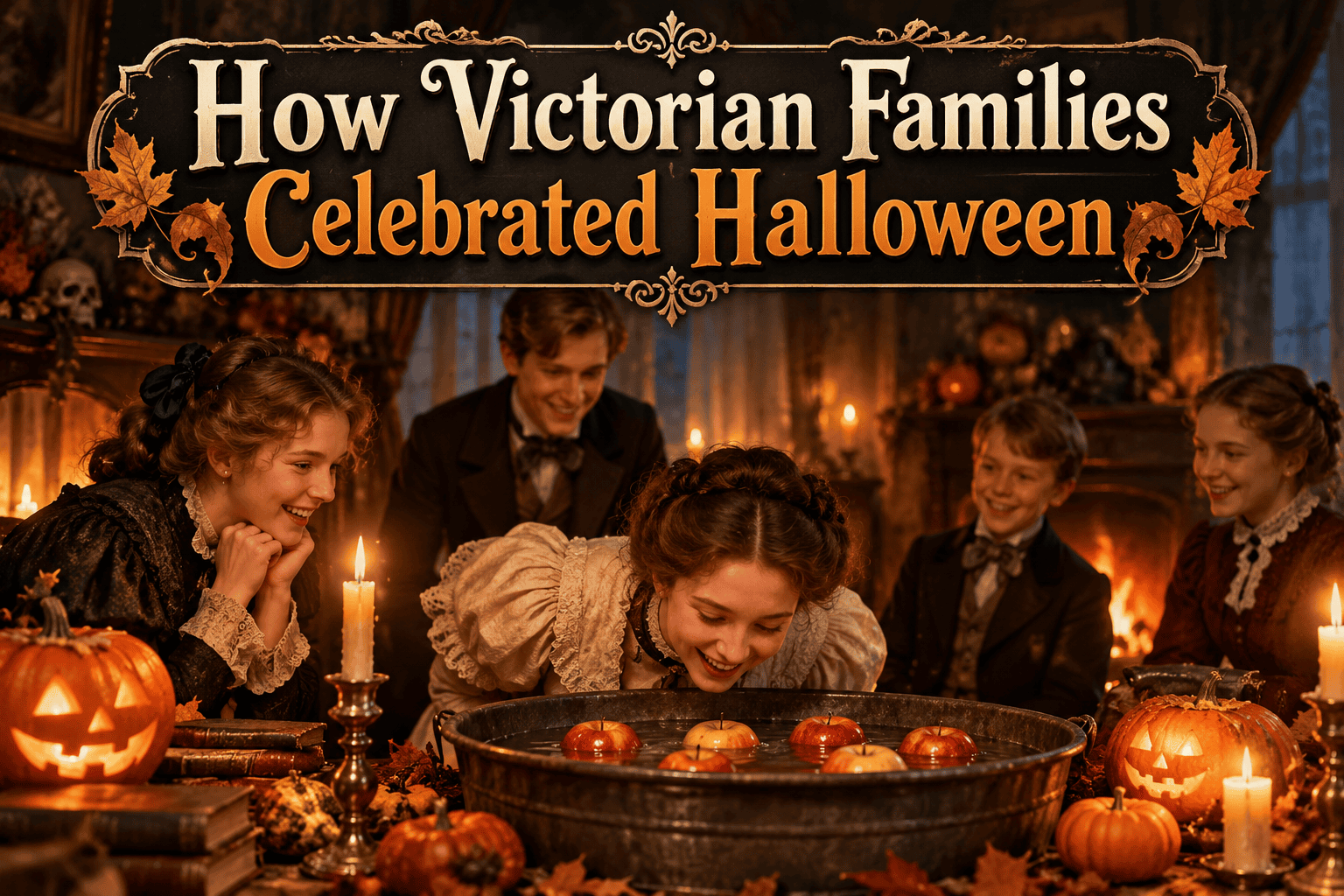
Halloween in the Victorian era was a celebration filled with mystery, superstition, romance, and family entertainment. Long before neighborhoods were filled with trick-or-treaters, inflatable decorations, and elaborate costumes, Victorian families celebrated October 31 with candlelit gatherings, fortune-telling games, seasonal foods, and traditions passed down through generations.
During the 19th century, Halloween looked very different from the holiday Americans recognize today. Rather than focusing primarily on candy and frightening costumes, many celebrations centered around social gatherings, courtship rituals, storytelling, and playful attempts to predict the future.
For Victorian families, Halloween was an evening when ordinary household activities could take on mysterious meanings. Apples, nuts, mirrors, candles, and even vegetable peels became tools for entertainment and superstition.
Many of these customs originated centuries earlier in Scotland, Ireland, and other parts of the British Isles. As immigrants brought their traditions to America, Halloween gradually developed into a holiday that combined European folklore with new American celebrations.
Understanding how Victorian families celebrated Halloween reveals a fascinating chapter in the history of one of America’s most popular holidays.
What Was Halloween Like During the Victorian Era?
The Victorian era lasted from 1837 to 1901, during the reign of Queen Victoria of the United Kingdom.
Throughout this period, Halloween celebrations varied considerably depending on geography, religion, social class, and family traditions.
In Scotland and Ireland, Halloween customs were deeply rooted in folklore and seasonal celebrations. In England, observance was less widespread and differed by region. In the United States, Halloween became increasingly familiar during the second half of the 19th century, particularly in communities influenced by Irish and Scottish immigration.
Unlike modern Halloween, Victorian celebrations were not necessarily centered around children.
Teenagers and young adults frequently participated in games designed to reveal their romantic futures. Families gathered around fireplaces to tell ghost stories, while friends attended seasonal parties decorated with autumn produce.
Halloween was often viewed as a night when the boundary between the ordinary world and the supernatural seemed especially mysterious.
This atmosphere made the holiday ideal for games, legends, and imaginative entertainment.
1. Victorian Families Gathered for Halloween Parties
One of the most recognizable Victorian Halloween traditions was the evening gathering.
Families and friends sometimes hosted parties featuring seasonal refreshments, parlor games, storytelling, and fortune-telling activities.
In homes with the means to entertain, guests might gather in a decorated sitting room illuminated by lamps and candles. Apples, nuts, pumpkins, and autumn greenery could contribute to the seasonal atmosphere.
These gatherings were generally more intimate than today’s large Halloween celebrations.
Entertainment often involved activities that required little equipment and encouraged everyone to participate.
Guests might compete in apple games, test traditional superstitions, or listen to stories about ghosts and mysterious happenings.
For young adults, Halloween gatherings also provided opportunities to socialize and participate in romantic fortune-telling customs.
The evening offered a combination of excitement, laughter, and suspense.
2. Apple Bobbing Was a Popular Halloween Game
Apple bobbing, sometimes called ducking for apples, was among the best-known traditional Halloween activities.
Participants attempted to retrieve apples floating in a tub of water without using their hands.
The game required determination, coordination, and a willingness to get wet.
Although it became popular as a party amusement, apples also carried symbolic associations with love, marriage, and fortune-telling.
Some versions of apple games involved identifying particular apples with potential romantic partners.
Other variations focused simply on the challenge of catching an apple.
The popularity of apple games reflected the importance of seasonal harvest foods in traditional Halloween celebrations.
Apples were readily available in autumn and could be used for entertainment without expensive decorations or equipment.
Today, apple bobbing remains one of the most recognizable connections between Victorian-era Halloween festivities and modern celebrations.
3. Young Women Used Apple Peels to Predict Marriage
One of the most curious Victorian Halloween traditions involved peeling an apple.
According to a popular superstition, a young woman could discover the initial of her future husband’s name by carefully removing an apple’s peel in one continuous strip.
After peeling the apple, she would toss the long strip over her shoulder.
The shape it formed when it landed was supposedly the first letter of her future husband’s name.
For example, a peel resembling the letter J might suggest that her future husband would have a name beginning with that letter.
Of course, this was a playful superstition rather than a reliable prediction.
Nevertheless, games involving marriage and romantic destiny were common in Halloween folklore.
They provided entertainment while reflecting the social importance placed on courtship and marriage during the 19th century.
4. Roasting Nuts Could Reveal Romantic Futures
Another unusual Halloween custom involved placing nuts near or on the heat of a fireplace.
In some traditions, participants named two nuts after themselves and someone they admired.
The behavior of the nuts as they heated was interpreted as a prediction about the relationship.
If the nuts burned quietly together, some believed it suggested harmony and lasting affection.
If one jumped away or cracked dramatically, it could be interpreted as a sign of disagreement or separation.
Different communities had different interpretations of these results.
The practice was particularly associated with older British and Irish Halloween customs and remained part of the folklore known to Victorian families.
For participants, the suspense of watching the nuts roast added excitement to the evening.
The tradition also demonstrates how ordinary household objects became part of Halloween entertainment.
5. Looking Into Mirrors Was a Halloween Fortune-Telling Ritual
Mirrors played an important role in some Victorian Halloween superstitions.
According to certain traditions, an unmarried person could perform a ritual involving a mirror in hopes of seeing the face or image of a future spouse.
One version involved entering a darkened room with a candle and looking into a mirror.
Other versions included eating an apple or following particular instructions while standing before the glass.
The belief was that a mysterious image might appear, revealing the person’s romantic future.
These rituals could be frightening, especially when performed alone in dim lighting.
Some versions of the folklore warned that seeing a skull or other ominous figure could predict misfortune.
Such stories were part of the supernatural atmosphere associated with Halloween.
They also reveal how the holiday combined romantic curiosity with a fascination for ghosts, spirits, and unexplained events.
6. Ghost Stories Were Shared Around the Fireplace
Victorian society had a strong fascination with ghost stories and supernatural literature.
Throughout the 19th century, tales of haunted houses, mysterious apparitions, and unexplained encounters became popular forms of entertainment.
Ghost stories were enjoyed at different times of year, especially during winter and Christmas gatherings in Britain, but they also suited the mysterious atmosphere of Halloween.
Families and friends could gather around a fireplace while someone told a frightening story.
Without television, movies, or electronic entertainment, storytelling provided an accessible way to create suspense.
A skilled storyteller could transform an ordinary room into a setting filled with imaginary footsteps, strange noises, and ghostly visitors.
These stories often drew inspiration from local legends, family traditions, or popular literature.
The practice helped establish the connection between Halloween and frightening entertainment that continues today.
7. Turnip Lanterns Came Before Modern Jack-o’-Lanterns
One of the most important differences between Victorian Halloween and modern Halloween was the type of vegetable used to make lanterns.
Before pumpkins became strongly associated with American Halloween celebrations, people in parts of Ireland and Scotland carved lanterns from turnips and other root vegetables.
These lanterns were sometimes made with frightening faces and illuminated from within.
Their appearance could be particularly eerie because turnips were smaller, harder, and more irregularly shaped than pumpkins.
The custom was connected with folklore about wandering spirits and the legendary figure commonly known as Stingy Jack.
As Irish immigrants settled in America, pumpkins became a practical alternative.
Pumpkins were generally larger and easier to carve than turnips, making them well suited for decorative lanterns.
Over time, the pumpkin jack-o’-lantern became one of the defining symbols of American Halloween.
However, the older tradition of carving root vegetables reminds us that Halloween’s familiar decorations developed gradually.
8. Halloween Was a Night for Predicting the Future
Fortune-telling was a central feature of many traditional Halloween gatherings.
Victorian participants used everyday objects to play games that supposedly revealed future events.
Common themes included marriage, relationships, prosperity, and personal destiny.
Some traditions involved drawing objects from bowls or dishes, with each object representing a different future.
Others used food, candles, or household items to create symbolic predictions.
One particularly well-known Scottish tradition involved pulling stalks of kale or cabbage from the ground.
The appearance of the stalk or the amount of soil attached to its roots could supposedly reveal characteristics of a future spouse or indicate future prosperity.
Although these activities might seem strange today, they were rooted in older folk beliefs and agricultural traditions.
For many participants, the real appeal was the excitement of uncertainty and the opportunity to laugh with friends.
9. Victorian Halloween Celebrations Featured Seasonal Foods
Food played an important role in Halloween gatherings.
Because Halloween occurred during the autumn harvest season, celebrations frequently included ingredients that were readily available at that time of year.
Apples, nuts, potatoes, and other seasonal foods appeared in traditional games and meals.
In Ireland, Halloween was associated with dishes such as colcannon, a mixture commonly made with mashed potatoes and cabbage or kale.
Some households included small objects in festive foods as part of fortune-telling customs.
Depending on the tradition, finding a ring might suggest an upcoming marriage, while other objects could represent different fortunes.
These practices were not universal across Victorian households, but they were important elements of regional Halloween folklore.
Food helped connect the holiday with the harvest, family gatherings, and the anticipation of winter.
10. Halloween Costumes Were Different From Today’s Costumes
Victorian Halloween clothing traditions were not identical to modern costume celebrations.
In parts of Scotland and Ireland, disguising oneself was associated with guising, a custom in which people wore costumes or concealed their identities while visiting homes or participating in seasonal activities.
Disguises could include masks, old clothing, or unusual garments.
However, elaborate Halloween costume parties were not a universal Victorian tradition.
In America, the widespread popularity of commercially manufactured Halloween costumes developed largely after the Victorian period.
During the late 19th century, Halloween parties and masquerade-style celebrations helped establish a foundation for later costume traditions.
The modern practice of children dressing as superheroes, movie characters, and fictional creatures emerged through subsequent changes in popular culture.
Victorian disguises were more closely connected to regional folklore, masquerading, and the playful disruption of ordinary social expectations.
11. Halloween Could Include Mischief and Practical Jokes
Halloween was not always a quiet evening of family entertainment.
In some communities, especially in parts of North America, the holiday became associated with practical jokes and mischievous behavior.
Young people might engage in pranks involving gates, household objects, or other property.
These activities varied widely between communities.
Some were treated as harmless entertainment, while others caused frustration or damage.
During the late 19th and early 20th centuries, concerns about Halloween mischief contributed to efforts to organize more supervised celebrations.
Community parties, school events, and structured activities eventually became ways to encourage safer holiday entertainment.
This development helped shape Halloween’s transition toward the family-centered celebrations familiar today.
12. Halloween Decorations Were Simple and Seasonal
Victorian families did not have access to the mass-produced Halloween decorations commonly found in modern stores.
Instead, household decorations could be made from available seasonal materials.
Pumpkins, apples, nuts, leaves, and other harvest items provided natural decorations.
Candles and lanterns created atmospheric lighting, while ordinary household objects could become props for games.
Some late Victorian and early 20th-century Halloween entertaining traditions also featured handmade paper decorations and themed invitations.
However, many of the familiar black-and-orange paper decorations associated with vintage Halloween became especially widespread after 1900.
Victorian decorations were generally less standardized than today’s commercial Halloween displays.
Their charm came from creativity, seasonal symbolism, and the mysterious atmosphere created by low lighting.
How Victorian Halloween Traditions Reached America
Halloween’s transformation into an American holiday was influenced heavily by immigration and cultural exchange.
During the 19th century, large numbers of Irish immigrants arrived in the United States, particularly following the Great Famine of the 1840s.
Irish and Scottish immigrants brought seasonal customs, folklore, and traditions associated with October 31.
These practices interacted with existing American harvest celebrations and community activities.
By the late Victorian period, Halloween parties, games, and social gatherings were becoming more visible in American culture.
Newspapers, magazines, and books helped circulate descriptions of traditional Halloween customs.
Some activities that had once been closely associated with specific regions became familiar to a wider audience.
The holiday gradually shifted from a collection of regional traditions into a more recognizable American celebration.
However, the fully developed modern Halloween—with widespread door-to-door trick-or-treating, commercial costumes, and large-scale candy distribution—would emerge later.
Victorian Halloween vs. Modern Halloween
Although Victorian and modern Halloween celebrations share certain traditions, their emphasis can be quite different.
| Victorian-era Halloween | Modern Halloween |
|---|---|
| Fortune-telling and marriage games | Trick-or-treating and costume parties |
| Apples, nuts, and seasonal foods | Candy and themed treats |
| Turnip lanterns in some regions | Pumpkin jack-o’-lanterns |
| Parlor games and storytelling | Haunted attractions and movies |
| Regional disguising customs | Commercial costumes |
| Family and social gatherings | Neighborhood and community events |
| Handmade seasonal decorations | Mass-produced Halloween decorations |
These differences show how Halloween has evolved while retaining elements of its older traditions.
Apple games, jack-o’-lanterns, ghost stories, and costumes all have connections to customs that existed during or before the Victorian era.
Why Were Victorians So Fascinated With Halloween Superstitions?
The Victorian period was marked by major changes in science, industry, transportation, and communication.
At the same time, many people remained interested in folklore, spiritualism, supernatural experiences, and unexplained phenomena.
Spiritualism became a prominent cultural movement during the 19th century, particularly in Britain and America.
However, spiritualism and traditional Halloween fortune-telling were not the same practice.
Halloween superstitions generally developed from older regional folk customs, while organized spiritualism involved claims about communication with the dead.
Both reflected broader Victorian interests in mystery and the possibility of realities beyond ordinary experience.
For some families, Halloween games were simply entertaining traditions.
For others, they preserved beliefs inherited from earlier generations.
The mixture of skepticism, curiosity, and imagination helped make supernatural themes appealing.
Which Victorian Halloween Traditions Still Exist Today?
Several customs familiar to Victorian celebrants remain recognizable in modern Halloween festivities.
Apple bobbing continues to appear at traditional autumn parties.
Jack-o’-lanterns remain among the most popular Halloween decorations, although pumpkins have largely replaced turnips in the United States.
Ghost stories have evolved into horror movies, haunted houses, and frightening seasonal entertainment.
Costume traditions have expanded into an enormous part of Halloween culture.
Halloween parties continue to bring families and friends together, just as social gatherings did during the 19th century.
Even fortune-telling games occasionally appear at historical reenactments or vintage-themed Halloween celebrations.
Although the meanings and popularity of these customs have changed, they preserve connections to earlier generations.
How to Host a Victorian-Inspired Halloween Party Today
Anyone interested in experiencing a little Victorian Halloween atmosphere can organize a celebration inspired by historical customs.
Start with a room decorated using pumpkins, autumn leaves, apples, and lanterns.
Use battery-operated candles to recreate the appearance of old-fashioned lighting without the risks associated with open flames.
Offer seasonal foods such as baked apples, roasted nuts, and traditional potato dishes.
Include games inspired by historical Halloween entertainment, such as apple-peel fortune-telling or a supervised apple-bobbing alternative.
Guests can also participate in storytelling by sharing traditional ghost tales or creating their own mysterious stories.
For additional historical atmosphere, encourage guests to wear Victorian-inspired clothing or simple masquerade costumes.
The goal is not to reproduce every historical practice exactly, but to capture the spirit of an evening built around imagination, folklore, and shared entertainment.
The Lasting Legacy of Victorian Halloween Celebrations
Victorian Halloween was a fascinating combination of old-world folklore and changing social traditions.
For some families, it was a time to gather around the fireplace and share stories. For young adults, it offered playful opportunities to imagine their romantic futures. For children and other participants, seasonal games and disguises could provide excitement and entertainment.
The customs were not identical everywhere, and many had existed long before Queen Victoria came to the throne.
Nevertheless, the 19th century was an important period in Halloween’s development, particularly as European traditions became more familiar in the United States.
Many activities that seem distinctly modern have roots in practices enjoyed by earlier generations.
From apple bobbing and lantern carving to ghost stories and costume gatherings, Victorian-era customs helped connect Halloween’s folklore with the celebrations that followed.
Final Thoughts
Halloween has changed dramatically since the Victorian era, but the holiday’s fascination with mystery, imagination, and tradition remains.
Victorian families did not need elaborate decorations, expensive costumes, or mountains of candy to create a memorable Halloween evening.
Simple games, seasonal foods, storytelling, and old-fashioned superstitions could transform an ordinary autumn night into a celebration filled with laughter and suspense.
Perhaps the most interesting aspect of Victorian Halloween is how many of its traditions remain familiar more than a century later.
The next time you carve a pumpkin, enjoy an apple game, or listen to a ghost story on October 31, you are participating in customs connected to generations of Halloween celebrations.
Which Victorian Halloween tradition would you most like to bring back today: apple-peel fortune-telling, old-fashioned ghost stories, or a candlelit Halloween party?
Leave a Reply