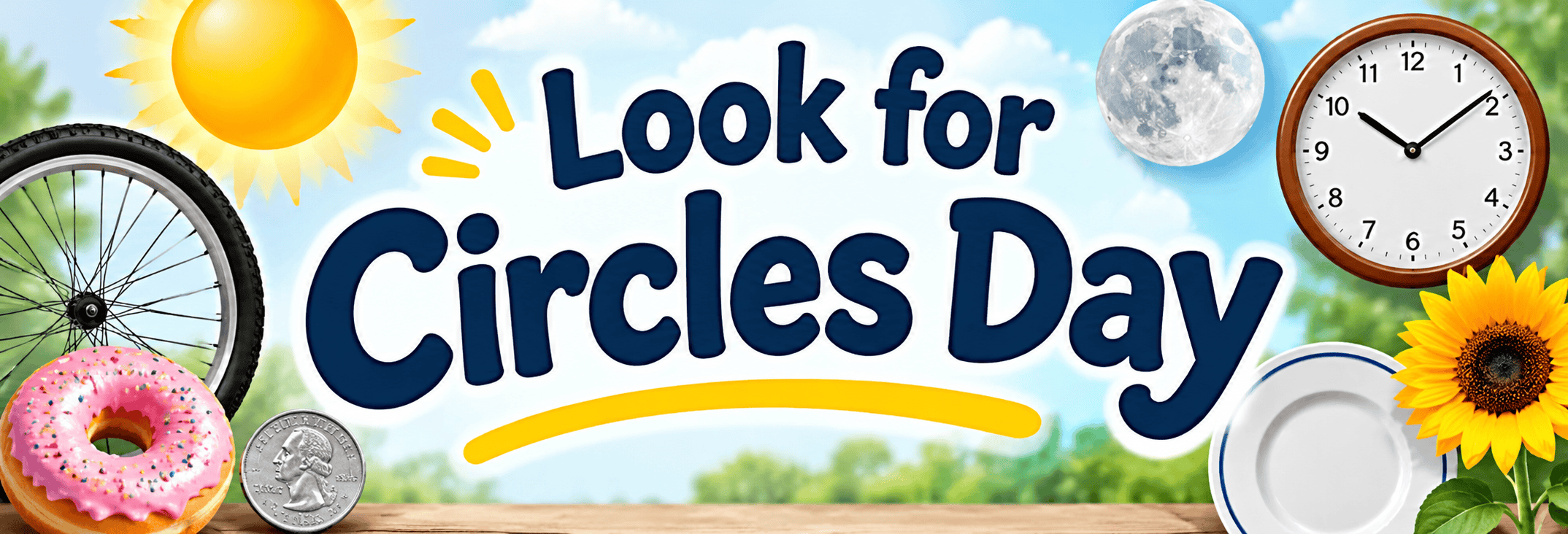
Every year on November 2, people are encouraged to take a closer look at the world around them in celebration of Look for Circles Day. This unusual and lighthearted observance reminds us that something as simple as a circle can be found almost everywhere, from the sun shining overhead to the wheels on our cars and the plates on our dinner tables.
At first glance, looking for circles might seem like a silly activity. However, this special day offers an opportunity to appreciate everyday objects, explore geometry, encourage creativity, and discover the beauty hidden in ordinary surroundings.
Whether you are a parent looking for a fun activity with your children, a teacher searching for an educational classroom exercise, or simply someone who enjoys discovering unusual national days, Look for Circles Day provides a reason to slow down and observe the world differently.
When Is Look for Circles Day?
Look for Circles Day is observed annually on November 2.
This unofficial holiday encourages people of all ages to identify circular shapes in their surroundings. Unlike major national holidays, it does not involve formal ceremonies, traditional meals, or established celebrations.
Instead, the purpose is simple: spend some time noticing circles wherever you go.
You might discover circles in places you have walked past hundreds of times without paying attention.
The observance is especially popular as an idea for educational activities, family games, and creative projects because it combines entertainment with basic learning.
What Is Look for Circles Day?
Look for Circles Day is a fun observance dedicated to recognizing circular shapes in everyday life.
A circle is one of the most familiar geometric shapes. In mathematics, a circle consists of all points in a plane that are the same distance from a central point.
In everyday conversation, people also use the word circle to describe round objects, even when those objects are technically three-dimensional.
From coins and clocks to basketball hoops and bicycle wheels, circular designs appear throughout our homes, communities, and natural environments.
Look for Circles Day challenges us to notice these familiar shapes and consider why they are so common.
The celebration can also encourage mindfulness. By deliberately looking for something specific, we become more aware of details that might otherwise go unnoticed.
The History of Look for Circles Day
The exact origins of Look for Circles Day remain unclear.
Although the observance appears on various calendars of unusual holidays, there is no widely documented founder or established historical event explaining why November 2 was selected.
Unlike holidays connected to government proclamations or historical anniversaries, Look for Circles Day appears to have developed as an informal celebration of shapes, observation, and creativity.
Even without a documented origin, the concept has educational value.
For generations, teachers have used shape-recognition activities to introduce children to geometry. Asking students to find circles in classrooms, playgrounds, and neighborhoods helps connect mathematical ideas with real-world experiences.
Look for Circles Day builds on that familiar learning activity and makes it accessible to everyone.
Why Are Circles Everywhere?
Circles are among the most recognizable shapes in the world.
Their appearance in nature, engineering, architecture, and everyday products is not accidental.
Circular forms offer several practical advantages.
For example, wheels rotate smoothly around an axle, making transportation easier. Circular gears can transfer rotational motion between mechanical components, while round pipes provide an efficient shape for carrying liquids.
In nature, circular patterns can develop through physical forces, growth processes, and movement.
Water droplets tend toward spherical shapes because surface tension minimizes their surface area. Ripples often spread outward in circular patterns when a disturbance occurs on a calm water surface.
The sun and moon also appear approximately circular when viewed from Earth.
These examples demonstrate how mathematics and natural processes help explain the world around us.
25 Everyday Places to Look for Circles
One of the easiest ways to celebrate Look for Circles Day is to organize a circle scavenger hunt.
Here are 25 places where you might discover circles.
-
Wall clocks hanging in your home
-
Dinner plates on the kitchen table
-
Coins inside your wallet or pocket
-
Bicycle wheels
-
Car tires
-
Round mirrors
-
Buttons on clothing
-
Pizza crusts
-
Drinking glass rims
-
Jar lids
-
Doughnuts
-
Basketball hoops
-
Round doorknobs
-
Ceiling lights
-
Compact discs
-
Rings and bracelets
-
Round flowerpots
-
Steering wheels
-
Round cookies
-
Bottle caps
-
Clock faces on watches
-
Circular traffic signs
-
Round coasters
-
Garden stepping stones
-
The full moon
Once you begin looking, you may be surprised by how many circles appear in a single room.
For an added challenge, try finding 50 different circular objects throughout the day.
Fun Ways to Celebrate Look for Circles Day
Look for Circles Day does not require expensive supplies, elaborate planning, or special equipment.
A little curiosity is enough to turn this unusual observance into an entertaining experience.
1. Organize a Circle Scavenger Hunt
Challenge family members or friends to locate as many circles as possible.
Create a checklist of circular objects and see who can find the most examples.
You can make the activity more interesting by assigning points for unusual discoveries.
For younger children, focus on familiar objects such as clocks, plates, and wheels.
Older participants can search for circles in architecture, machinery, and natural environments.
2. Take a Neighborhood Circle Walk
Go for a walk around your neighborhood and pay attention to circular shapes.
Look at street signs, vehicle wheels, decorative windows, playground equipment, and landscaping features.
You might notice details that have always been present but rarely attracted your attention.
This activity combines light physical movement with observation and can be enjoyed alone or with others.
3. Create Circle-Inspired Artwork
Use circles as the foundation for an art project.
Draw overlapping circles, create colorful patterns, or arrange circular cutouts into interesting designs.
Children can turn circles into animals, flowers, balloons, faces, or imaginary creatures.
Adults may enjoy experimenting with abstract designs, mandalas, or geometric compositions.
The possibilities are nearly endless.
4. Make Circular Foods
Food offers plenty of opportunities to celebrate circles.
Prepare pancakes, homemade pizzas, cookies, or sandwiches cut into round shapes.
You could also arrange sliced cucumbers, tomatoes, oranges, and other round foods on a platter.
For families with young children, preparing circular snacks can become an entertaining lesson about shapes.
5. Photograph Circles
Grab your phone or camera and spend the day photographing circular objects.
Try capturing circles in unusual locations or from interesting angles.
You might photograph reflections in water, architectural details, flowers, or household objects.
At the end of the day, create a collection of your favorite pictures.
This activity encourages creativity while helping you notice details in your surroundings.
6. Learn About Geometry
Use Look for Circles Day as an opportunity to explore basic mathematical concepts.
Learn the difference between a circle, sphere, oval, and ellipse.
Practice identifying the radius, diameter, and circumference of circular objects.
You can even measure a round household item and calculate its circumference.
For children, these hands-on activities can make mathematics more approachable.
7. Create a Circle-Themed Family Game
Turn circle hunting into a friendly competition.
Give each participant five minutes to find as many circular objects as possible.
Award one point for each unique object and bonus points for particularly creative discoveries.
The person with the most points wins.
This simple game works well at home, in classrooms, or during family gatherings.
Interesting Facts About Circles
Circles have fascinated mathematicians, scientists, artists, and philosophers for thousands of years.
Here are several interesting facts worth exploring on Look for Circles Day.
1. A circle has no corners.
Unlike triangles, squares, and rectangles, circles have no vertices or straight sides.
2. Every point on a circle is equally distant from its center.
This property defines a mathematical circle.
3. Pi is connected to every circle.
The mathematical constant pi, approximately 3.14159, represents the ratio of a circle’s circumference to its diameter.
4. Circles have 360 degrees.
A complete turn around a circle measures 360 degrees, a convention rooted in ancient mathematical and astronomical traditions.
5. Circles are important in transportation.
Wheels and many rotating mechanical components rely on circular geometry to function effectively.
6. Tree trunks contain growth rings.
Many trees develop approximately circular growth rings that can provide information about their age and environmental conditions.
7. Circular patterns appear in water.
When a small object falls into still water, ripples often spread outward in expanding circles.
8. Circles have symbolic meaning.
Across different cultures and traditions, circles have represented unity, wholeness, continuity, and eternity.
9. The sun and moon appear round.
Both appear approximately circular in the sky because we see the outlines of nearly spherical celestial bodies.
10. Circular designs are common in architecture.
Domes, arches, windows, fountains, and decorative patterns frequently incorporate circles or portions of circles.
The Symbolism of Circles
Beyond mathematics and everyday objects, circles have carried symbolic meaning throughout human history.
Because a circle has no obvious beginning or ending, it is frequently associated with eternity and continuity.
Circular designs also appear in wedding rings, religious artwork, cultural traditions, and decorative symbols.
For many people, circles represent unity and connection.
A group of people standing in a circle can symbolize equality and togetherness because everyone occupies a position along the same continuous shape.
Circles can also suggest the repeating patterns of life.
The changing seasons, the movement of the planets, and recurring celebrations are often described as cycles.
Although these examples are not always literal circles, the shape provides a familiar way to represent repetition and renewal.
Look for Circles Day offers an opportunity to appreciate both the practical and symbolic importance of this simple geometric form.
Look for Circles Day Activities for Kids
Children often enjoy discovering shapes in their surroundings.
Look for Circles Day can turn that natural curiosity into a fun educational experience.
Circle Sorting Activity
Gather safe household objects in different shapes.
Ask children to separate the circular items from squares, rectangles, and triangles.
Discuss what makes each shape different.
Circle Drawing Challenge
Give children paper, crayons, and markers.
Ask them to draw as many pictures as possible using circles.
They might create suns, flowers, balloons, animals, or smiling faces.
Circle Counting Game
Choose a room and ask children to count every circular object they can find.
Compare their results and discuss any objects they missed.
Circle Stamping Art
Use washable paint and round household items, such as cardboard tubes or bottle caps, to create stamped circle patterns.
Make sure the materials are clean, safe, and appropriate for the children’s ages.
Circle Storytelling
Ask children to invent a story featuring a circle.
Perhaps a little circle travels around the world discovering different shapes.
This activity combines imagination, storytelling, and shape recognition.
How Teachers Can Celebrate Look for Circles Day
Look for Circles Day provides teachers with an opportunity to make geometry more engaging.
Preschool and elementary school students can participate in simple shape hunts, drawing exercises, and sorting games.
Older students can explore mathematical formulas and practical applications.
For example, students can measure the diameter of a circular object and calculate its circumference using the formula:
Here, \(C\) represents circumference and \(d\) represents diameter.
Teachers can also introduce the formula for the area of a circle:
In this formula, \(A\) represents area and \(r\) represents radius.
Students can compare their calculations with measurements taken from actual objects.
Another interesting classroom project involves researching circular designs in architecture, transportation, sports, and nature.
These activities demonstrate that geometry is not limited to textbooks.
It is part of everyday life.
Look for Circles Day and Mindfulness
One of the less obvious benefits of Look for Circles Day is the opportunity to practice mindful observation.
Many people move through their daily routines without paying much attention to their surroundings.
They drive familiar roads, walk through the same rooms, and encounter the same objects without noticing small details.
A simple activity such as searching for circles encourages intentional attention.
Instead of rushing through an ordinary moment, you focus on what is directly in front of you.
You might notice the pattern of a flower, the shape of a window, or the reflection of a light.
Although searching for circles is not a substitute for established mindfulness practices or mental health treatment, it can be an enjoyable exercise in awareness.
Sometimes, noticing something small can help make an ordinary day feel a little more interesting.
Why Unusual Holidays Like Look for Circles Day Matter
Not every holiday needs a major historical event or an elaborate tradition.
Some observances exist simply to encourage curiosity, creativity, and enjoyment.
Look for Circles Day is a good example.
It gives families an inexpensive activity, provides teachers with an educational theme, and offers individuals a reason to explore familiar surroundings.
Unusual holidays can also create opportunities for connection.
A parent and child might spend an afternoon searching for shapes. Friends might challenge each other to find the most unusual circle. A classroom might work together to create a large piece of circular artwork.
These activities may seem small, but they encourage learning and shared experiences.
The value of the celebration comes from participation rather than expense or ceremony.
Frequently Asked Questions About Look for Circles Day
When is Look for Circles Day celebrated?
Look for Circles Day is observed every year on November 2.
Is Look for Circles Day an official national holiday?
No. Look for Circles Day is an unofficial observance rather than a federally recognized holiday in the United States.
Who created Look for Circles Day?
The original creator is not reliably documented, and the exact history of the observance remains uncertain.
What is the purpose of Look for Circles Day?
The purpose is to encourage people to notice circular shapes in everyday life while promoting curiosity, creativity, and an appreciation of geometry.
How can children celebrate Look for Circles Day?
Children can participate in circle scavenger hunts, shape-sorting games, drawing activities, crafts, and simple geometry lessons.
What are examples of circles in nature?
Examples include the apparent outlines of the sun and full moon, some flower centers, tree growth rings, and ripples spreading across still water.
Can adults participate in Look for Circles Day?
Absolutely. Adults can enjoy photography challenges, nature walks, artwork, geometry activities, or simply observing circular shapes throughout the day.
Final Thoughts: Discovering Beauty in Everyday Circles
Look for Circles Day, celebrated annually on November 2, reminds us that even the simplest things can become interesting when we take the time to notice them.
Circles surround us in our homes, neighborhoods, natural environments, and everyday activities. They appear in the foods we eat, the vehicles we drive, the buildings we enter, and the objects we use.
While searching for circles may sound like a small activity, it can encourage creativity, learning, observation, and meaningful time with family and friends.
You do not need special equipment or elaborate plans to participate. All you need is curiosity and a willingness to look at familiar surroundings from a different perspective.
The next time you see a clock, a wheel, a flower, or the moon shining in the night sky, take a moment to appreciate the simple geometry that makes circles such a familiar part of our world.
This November 2, celebrate Look for Circles Day by discovering just how many circles are hiding in plain sight.
And here is a fun challenge: How many circles can you find around you right now?



Leave a Reply