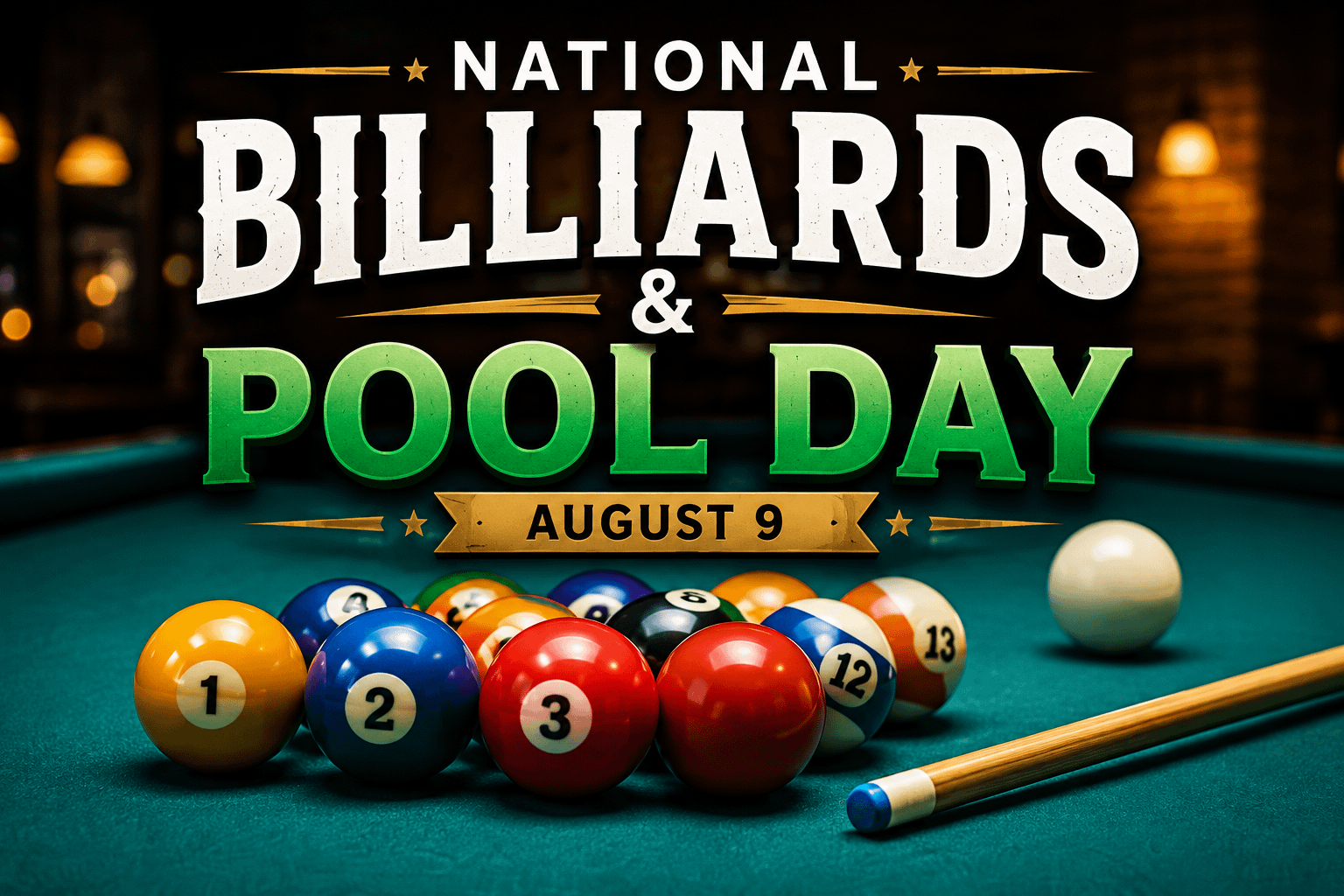
Every year on August 9, cue-sport enthusiasts have another reason to head to the table for National Billiards & Pool Day. It is a celebration of billiards, pool, the people who play these games, and the generations of competition and friendship that have developed around the pool table.
Few games combine concentration, geometry, strategy, coordination, patience, and social interaction quite like pool.
At first, the objective appears incredibly simple: use a cue stick to strike the cue ball and pocket the other balls.
Then you start playing.
Suddenly, you discover that making the ball is only part of the challenge.
Where will the cue ball stop?
What shot will you have next?
Should you play aggressively or defensively?
Can you break apart a cluster without scratching?
Should you attempt the difficult bank shot or leave your opponent with nothing?
That combination of simplicity and complexity is one reason cue sports have remained popular for generations.
Whether you play regularly in a league, occasionally visit a pool hall, have a table at home, or haven’t picked up a cue in years, National Billiards & Pool Day on August 9 is a perfect opportunity to rediscover this timeless game.
What Is National Billiards & Pool Day?
National Billiards & Pool Day is observed annually on August 9 as a celebration of billiards, pool, and cue-sport culture.
It is a day for everyone from beginners to experienced competitors.
You don’t have to know complicated techniques or understand every rule to participate. Simply getting together with friends or family for a game can be enough.
For experienced players, the day might mean practicing difficult shots, competing in a tournament, watching professional matches, or spending a few hours at a favorite pool hall.
For beginners, it can be an opportunity to learn how to hold a cue, develop a stance, aim properly, and understand the rules of popular games such as 8-ball.
At its heart, the celebration recognizes something that billiards has been doing for centuries:
bringing people together around a table.
A Brief History of Billiards
The history of billiards stretches back centuries and includes numerous changes in equipment, rules, terminology, and playing styles.
Early forms of billiards are generally associated with European lawn games that eventually moved indoors.
Instead of playing outside, people began recreating elements of these games on tables.
Early billiard tables looked considerably different from the modern pool tables we recognize today. Equipment and rules continued evolving as the activity became increasingly popular.
Billiards eventually became associated with royalty, aristocracy, clubs, social gatherings, and later the broader public.
As the centuries passed, different versions of cue sports developed in different regions.
Some emphasized pocketing balls.
Others emphasized striking balls together in particular combinations.
Eventually, games including pool, carom billiards, and snooker became established forms of cue sports with their own traditions and competitive communities.
Today, billiards continues to be enjoyed around the world.
From Outdoor Game to Indoor Table
One of the most fascinating parts of billiards history is its connection to outdoor games.
Early versions were reportedly influenced by lawn-style activities.
Moving the game indoors allowed people to continue playing regardless of weather conditions.
The table became the playing field.
The cloth represented the grassy surface.
Cushions created boundaries.
And over time, specialized equipment transformed the activity into something entirely different.
Eventually, the modern billiard table became an instantly recognizable symbol of recreation and competition.
Why Is Billiard Cloth Traditionally Green?
Walk into a traditional billiard room and there is a good chance you will see a table covered in green cloth.
That familiar green surface is often associated with billiards’ historical connection to outdoor lawn games.
Green helped recreate the appearance of grass when the activity moved indoors.
Today, pool tables can feature cloth in numerous colors, but traditional green remains closely associated with the sport.
The Evolution of the Pool Cue
The pool cue is such a fundamental part of the modern game that it can be difficult to imagine billiards without it.
But early players did not always use cues exactly as we do today.
Equipment gradually evolved as players searched for more accurate and practical ways to strike the ball.
Modern cues are designed to give players tremendous control.
A skilled player can use the cue not only to send the cue ball toward an object ball but also to control spin, speed, direction, and positioning.
For advanced players, the cue becomes an extension of the arm.
Billiards, Pool, and Snooker: What’s the Difference?
These terms are sometimes used interchangeably, but they can refer to different cue sports.
Billiards
“Billiards” can serve as a broad term for cue sports.
More specifically, carom billiards refers to games traditionally played on tables without pockets.
Players score by using the cue ball to contact other balls according to the rules of the particular game.
Pool
Pool is generally played on a table containing six pockets.
Several games fall under the pool category, including:
- 8-ball
- 9-ball
- 10-ball
- Straight pool
- One-pocket
- Bank pool
Each game has different rules and strategies.
Snooker
Snooker is another cue sport with its own rules, equipment, scoring system, and table dimensions.
Players use a cue ball along with red and colored balls, accumulating points according to the game’s rules.
Although these games share similarities, becoming highly skilled in one does not automatically make someone an expert in another.
The Popularity of 8-Ball
Of all the different forms of pool, 8-ball is one of the most recognizable.
The game generally uses 15 numbered object balls and a cue ball.
After the appropriate determination during play, competitors attempt to clear their designated group before legally pocketing the 8-ball.
The concept is simple enough for new players to understand relatively quickly.
But the strategy can become extremely complicated.
Strong 8-ball players don’t simply pocket whatever ball looks easiest.
They evaluate the entire table.
They look for problem balls.
They identify clusters.
They consider which pockets are available.
They determine whether the 8-ball is accessible.
They think about cue-ball positioning several shots ahead.
A casual player may see one shot.
An experienced player may see an entire sequence.
What Is 9-Ball?
Another popular pool game is 9-ball.
It is played with balls numbered 1 through 9 plus the cue ball.
The lowest-numbered ball on the table must generally be contacted first, although combinations can create opportunities to pocket other balls.
Because fewer balls are involved and combinations are possible, 9-ball can produce fast-paced and exciting matches.
Positioning remains incredibly important.
One poor cue-ball position can turn control of the table over to an opponent.
The Importance of the Break
Every game has to start somewhere.
In pool, that means the break.
A good break isn’t necessarily about hitting the balls as hard as possible.
Control matters.
Players attempt to transfer energy efficiently into the rack while maintaining control of the cue ball.
Depending on the game and rules being used, players may also be attempting to pocket a particular ball, create a favorable spread, or avoid scratching.
The break can influence the entire game.
Why Pool Is a Game of Geometry
Pool provides a practical lesson in geometry every time someone approaches the table.
Players constantly deal with:
Angles
Where should the object ball be contacted?
Reflection
How will a ball rebound from the cushion?
Speed
How hard should the cue ball be struck?
Spin
How will rotation affect the cue ball’s movement?
Collision
What happens after two balls make contact?
You don’t need to solve equations before taking every shot.
Experienced players develop an intuitive understanding through practice.
Eventually, they begin seeing angles almost automatically.
Cue-Ball Control Changes Everything
Beginners often focus almost entirely on pocketing the object ball.
That makes sense.
But as players improve, they discover that controlling the cue ball can be even more important.
Imagine pocketing your intended ball perfectly but leaving the cue ball against a cushion with no reasonable next shot.
You succeeded technically—but created a difficult situation.
Better players consider two goals:
Make the current shot.
And:
Create the next shot.
This is called position play.
Learning position play transforms pool from a series of individual shots into a strategic sequence.
Follow, Draw, and English
Advanced cue-ball control involves striking different areas of the cue ball.
Follow
Striking above center can create topspin, encouraging the cue ball to continue moving forward after contact.
Draw
Striking below center can create backspin that may cause the cue ball to travel backward after contacting an object ball.
Watching a well-executed draw shot is one of the most satisfying sights in pool.
English
Side spin is commonly referred to as English.
It can influence how the cue ball reacts after contacting cushions or other balls.
These techniques take practice.
Trying extreme spin without understanding the fundamentals can make shots considerably more difficult.
Defense Is Part of the Game
Not every great pool shot ends with a ball falling into a pocket.
Sometimes the smartest shot is a safety.
A safety is a defensive play designed to leave the opponent with a difficult situation.
Instead of attempting a low-percentage shot, an experienced player may position the balls so their opponent has no easy opportunity.
This introduces another layer of strategy.
You aren’t simply playing the balls.
You’re playing the opponent.
The Mental Side of Pool
Pool requires physical technique, but the mental side can be equally important.
A player needs:
- Patience
- Concentration
- Confidence
- Discipline
- Strategic thinking
- Emotional control
- Decision-making
- Consistency
One missed shot can be frustrating.
But becoming angry about that miss can lead to another mistake.
Strong players learn to leave the previous shot behind and concentrate on what is happening now.
In that sense, pool offers a useful life lesson:
You can’t replay the shot you missed. You can only prepare for the shot in front of you.
Pool Teaches Patience
Beginners often want immediate improvement.
They see experienced players controlling the table and wonder why their own shots don’t behave the same way.
The answer is usually practice.
Pool requires repetition.
Your stance becomes more natural.
Your stroke becomes smoother.
Your aim improves.
Your understanding of speed develops.
Your ability to predict cue-ball movement increases.
Progress can sometimes feel slow, but every practice session builds experience.
The Social Side of Pool
Not everyone plays pool because they want to become a champion.
Many people play because it is fun.
Pool tables have traditionally been gathering places.
Friends can play while talking.
Families can compete against one another.
Coworkers can relax after work.
Experienced players can teach newcomers.
A pool table creates an activity without preventing conversation.
There are pauses between shots, opportunities for laughter, and plenty of chances for friendly competition.
Sometimes nobody remembers who won.
They remember the ridiculous bank shot that somehow went in.
Pool Halls and American Culture
Pool halls have played an interesting role in American entertainment and recreation.
They became gathering places where players could meet, practice, compete, and socialize.
Some players became local legends.
Regulars knew who had the best break, who could make impossible bank shots, and who nobody wanted to challenge when money or pride was involved.
Pool also found its way into movies, television, music, recreation centers, bars, clubs, and private homes.
The image of someone leaning over a green table while carefully lining up a shot became part of popular culture.
Famous Pool Terminology
Learning pool also means learning its vocabulary.
Break
The opening shot that separates the racked balls.
Scratch
Generally refers to the cue ball being pocketed or otherwise committing certain cue-ball fouls, depending on the rules.
Rack
The arrangement of balls before the opening break.
Bank Shot
A shot in which the object ball rebounds from a cushion before reaching the intended pocket.
Combination
A shot involving one object ball striking another object ball.
Safety
A defensive shot designed to leave the opponent with a difficult position.
Run
A sequence in which a player successfully pockets multiple balls without surrendering the table.
Cue Ball
The white ball struck by the player’s cue.
Object Ball
A ball the cue ball is used to strike.
One of the six openings on a standard pool table.
Why Pool Is Easy to Learn but Hard to Master
Almost anyone can pick up a cue and start playing.
That accessibility is one of pool’s greatest strengths.
Within a short time, a beginner can understand the general concept.
But mastery is another story.
Players eventually learn that there are levels to the game.
First, you try to hit the correct ball.
Then you learn to pocket it.
Then you learn to pocket it consistently.
Then you learn cue-ball position.
Then patterns.
Then defense.
Then advanced spin.
Then strategic table management.
Every improvement reveals another skill to develop.
That means pool can remain challenging even after decades of play.
Pool Can Connect Generations
A pool table can become a place where generations connect.
A parent can teach a child how to hold a cue.
A grandparent can share techniques learned decades earlier.
Friends can create rivalries that continue for years.
Experienced players can introduce beginners to the etiquette and traditions of the game.
The rules may vary depending on where and how people play, but the basic experience remains familiar:
Chalk the cue.
Study the table.
Choose the shot.
Line it up.
Take the stroke.
Watch the ball.
And hope you hear that satisfying sound as it drops into the pocket.
Pool Table Etiquette
National Billiards & Pool Day is also a good opportunity to remember basic table etiquette.
Respect the equipment.
Don’t sit on the table unless the venue specifically allows it.
Avoid distracting someone while they are shooting.
Keep food and drinks away from the playing surface.
Know which rules are being used before the game begins.
Don’t move balls unless the rules allow it.
Be respectful whether you win or lose.
And perhaps most importantly:
Don’t blame the table for every missed shot.
Sometimes you just missed.
Tips for Beginners
If you’re playing pool for the first time this National Billiards & Pool Day, don’t worry about complicated spin or trick shots.
Start with fundamentals.
Develop a Stable Stance
You want to feel comfortable and balanced.
Create a Bridge
Your bridge hand helps support and guide the cue.
Keep Your Stroke Smooth
Avoid stabbing at the cue ball.
Try to develop a controlled back-and-forward motion.
Aim Carefully
Take your time identifying where the cue ball needs to contact the object ball.
Don’t Hit Every Shot Hard
Power doesn’t automatically improve accuracy.
Often, a softer controlled shot is more effective.
Watch Better Players
Pay attention to where experienced players leave the cue ball.
You may learn more from their positioning than from their most impressive shots.
How to Celebrate National Billiards & Pool Day
There are plenty of ways to celebrate on August 9.
Play Pool With Friends
Call a few friends and organize a casual night of 8-ball or 9-ball.
Visit a Local Pool Hall
Support a local billiards establishment and spend some time practicing.
Join a Pool League
If you enjoy playing regularly, look into local leagues.
League play can provide structured competition while introducing you to other players.
Organize a Tournament
Create a friendly bracket at home, at work, or with friends.
You can even create a small trophy for the winner.
Teach Someone the Game
Introduce someone new to billiards.
Teaching another person can also improve your own understanding of the fundamentals.
Practice for an Hour
Choose one skill and focus on it.
Practice:
- Straight shots
- Bank shots
- Cue-ball control
- Draw shots
- Follow shots
- Breaks
- Position play
Watch Professional Players
Study how elite players approach the table.
Pay particular attention to where they leave the cue ball after each shot.
Learn a New Game
Normally play 8-ball?
Try 9-ball.
Already play 9-ball?
Explore straight pool, one-pocket, bank pool, snooker, or carom billiards.
Create a National Billiards & Pool Day Challenge
Turn August 9 into a friendly competition.
Create challenges such as:
Longest winning streak
Who can win the most consecutive games?
Best bank shot
Each player gets several attempts.
Break challenge
Who produces the best legal break?
Around-the-table challenge
Set up specific shots and see who can complete them.
Beginner vs. experienced player
Give the beginner an appropriate handicap and make the competition interesting.
The goal doesn’t have to be determining the greatest pool player in town.
The goal is enjoying the game.
Fun Facts About Billiards and Pool
Billiards and cue sports have existed in different forms for hundreds of years.
The traditional green billiard cloth is associated with the game’s historical connection to outdoor lawn games.
Pool tables generally have six pockets.
The cue ball is the only ball intentionally struck directly with the cue during normal play.
Players use chalk on cue tips to improve friction between the tip and cue ball.
Cue-ball positioning becomes increasingly important as players advance.
A soft, controlled shot can sometimes require more skill than a powerful shot.
Pool involves practical applications of geometry and physics.
Defensive play can be just as important as pocketing balls.
Different pool halls, leagues, and organizations may use different rule sets, making it important to agree on the rules before beginning.
Why National Billiards & Pool Day Matters
National Billiards & Pool Day may sound like a simple recreational celebration, but it recognizes something bigger.
Games matter because shared activities matter.
They give people opportunities to interact.
They create memories.
They encourage friendly competition.
They challenge us to improve.
They teach us how to win gracefully and lose without giving up.
Pool does all of those things.
Two people who have little else in common can stand around the same table and understand the same challenge:
Make the shot.
That simplicity has helped cue sports cross cultures, generations, and social boundaries.
Life Lessons From the Pool Table
Perhaps billiards has remained popular because some of its lessons extend beyond the game.
Think Ahead
The easiest shot right now isn’t always the smartest shot.
Position Matters
Where you end up can determine what opportunities are available next.
Control Beats Power
Hitting harder isn’t always better.
Patience Pays Off
Sometimes you need to wait for the right opportunity.
Mistakes Happen
Even great players miss.
Learn From Every Shot
Success and failure both provide information.
Stay Focused
Thinking about the last mistake makes the next one more likely.
Practice Creates Confidence
Skill develops through repetition.
Those lessons can apply far beyond a pool table.
National Billiards & Pool Day FAQ
When Is National Billiards & Pool Day?
National Billiards & Pool Day is observed annually on August 9.
What Does National Billiards & Pool Day Celebrate?
It celebrates billiards, pool, cue sports, players, pool halls, and the social and competitive traditions surrounding these games.
Is Pool Considered Billiards?
Pool belongs to the broader family of cue sports commonly associated with billiards, although specific forms of billiards and pool have different tables, rules, equipment, and objectives.
What’s the Difference Between Pool and Snooker?
Pool and snooker use different tables, balls, rules, and scoring systems. Pool commonly includes games such as 8-ball and 9-ball, while snooker follows its own distinct format.
What Is the Most Common Pool Game?
8-ball is one of the most recognizable and widely played forms of pool, especially in the United States.
What Is a Scratch in Pool?
A scratch commonly occurs when the cue ball is pocketed, although specific foul rules depend on the game and rule set being used.
Why Do Players Put Chalk on Their Cues?
Cue chalk increases friction between the cue tip and cue ball, helping reduce unwanted slipping during contact and allowing players to apply controlled spin.
What Is a Bank Shot?
A bank shot occurs when an object ball rebounds from one or more cushions before entering the intended pocket.
What Is a Safety?
A safety is a defensive shot designed to leave an opponent with a difficult or limited shot.
Can Beginners Celebrate National Billiards & Pool Day?
Absolutely.
In fact, August 9 is a perfect excuse to learn.
Find someone who knows the game, grab a cue, and start with basic shots.
Nobody begins as an expert.
Celebrate National Billiards & Pool Day on August 9
National Billiards & Pool Day on August 9 celebrates far more than colorful balls rolling across a felt-covered table.
It celebrates competition.
It celebrates strategy.
It celebrates concentration.
It celebrates practice.
And perhaps most importantly, it celebrates connection.
For generations, people have gathered around billiard tables to compete, laugh, talk, teach, learn, and spend time together.
Some players will spend National Billiards & Pool Day competing seriously.
Others will play one casual game with friends.
Some will practice for hours trying to perfect their cue-ball control.
And someone, somewhere, will probably attempt an outrageous bank shot, completely miss what they intended, accidentally pocket another ball, and pretend the entire thing was planned.
That’s part of the fun.
So on August 9, grab a cue, chalk the tip, rack the balls, invite someone to play, and celebrate National Billiards & Pool Day.
Take your time.
Study the table.
Think about your next move.
And remember:
Pool isn’t only about making the shot in front of you. It’s about setting yourself up for whatever comes next.
Read More Holidays & National Days
Leave a Reply