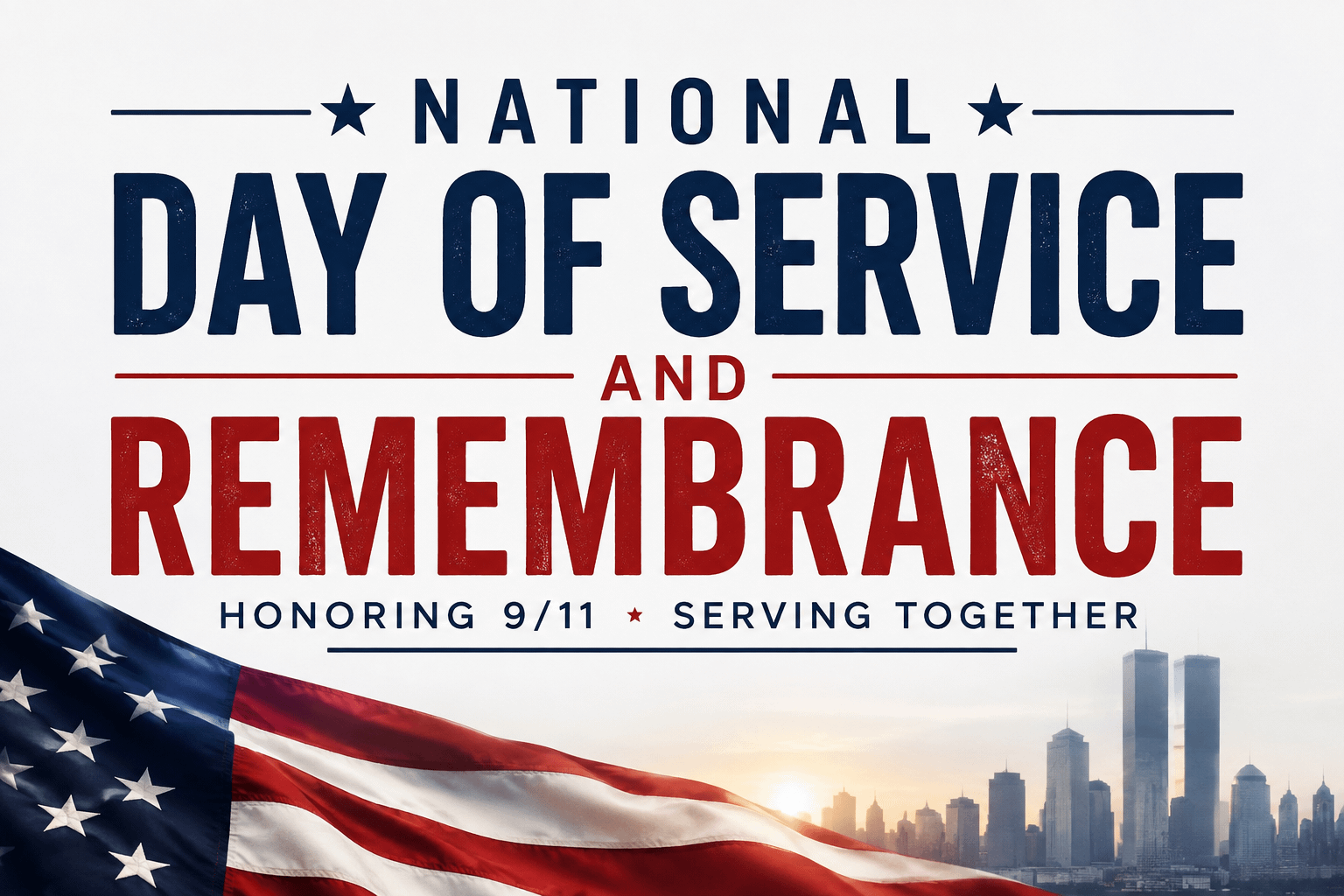
Every September 11, Americans pause to remember one of the most painful days in the nation’s history. We remember the lives that were lost, the families whose lives were forever changed, the first responders who rushed toward danger, and the countless people who stepped forward to help strangers during an unimaginable tragedy.
But September 11 has also become a day dedicated to something powerful: service.
The September 11 National Day of Service and Remembrance, often called the 9/11 Day of Service, encourages Americans to honor those affected by the terrorist attacks of September 11, 2001, by helping others and strengthening their communities.
In 2026, the observance carries particular significance. September 11, 2026, marks the 25th anniversary of the September 11 attacks.
Rather than allowing the anniversary to be defined only by tragedy, Americans are encouraged to transform remembrance into meaningful action.
Whether that means volunteering at a food bank, donating blood, helping a veteran, cleaning a neighborhood park, supporting first responders, checking on an elderly neighbor, or simply performing an unexpected act of kindness, National Day of Service and Remembrance reminds us that everyone has something they can give.
When Is the National Day of Service and Remembrance?
The September 11 National Day of Service and Remembrance is observed annually on September 11.
In 2026, it falls on:
Friday, September 11, 2026
According to AmeriCorps, Americans of all ages and backgrounds are encouraged to participate in community service projects on September 11 and during the surrounding days.
The goal is simple but meaningful: remember those who were lost by helping those who are living.
Why September 11 Became a Day of Service
The terrorist attacks of September 11, 2001, changed the United States forever.
Nearly 3,000 people were killed when terrorists hijacked four commercial airplanes. Two planes struck the World Trade Center towers in New York City, another struck the Pentagon in Virginia, and a fourth, United Airlines Flight 93, crashed in Pennsylvania after passengers and crew members fought back against the hijackers.
The images of destruction became permanently connected with September 11.
Yet another part of the story emerged almost immediately.
People helped each other.
Firefighters, police officers, paramedics, military personnel, medical workers, volunteers, construction workers, clergy members, neighbors, and ordinary citizens responded.
Some ran toward danger.
Others donated blood.
People distributed food and water.
Volunteers searched for survivors and later assisted with recovery efforts.
Communities organized donations.
People opened their homes.
Strangers comforted strangers.
Across the country, Americans asked one simple question:
How can I help?
That spirit of service became an important part of how September 11 would eventually be remembered.
How the 9/11 Day of Service Began
The movement to transform September 11 into a day dedicated to service began shortly after the attacks.
According to AmeriCorps, families who had lost loved ones began leading efforts in 2002 to create a meaningful and forward-looking tribute.
Instead of remembering September 11 exclusively through ceremonies and memorials, they wanted Americans to honor those who died by doing something positive for someone else.
Those efforts eventually helped establish the September 11 National Day of Service and Remembrance in 2009, with AmeriCorps given responsibility for supporting the effort nationwide.
Today, AmeriCorps works with 9/11 Day and organizations across the country to encourage volunteerism and community service.
The idea behind the observance remains powerful:
Turn remembrance into service.
The Meaning Behind National Day of Service and Remembrance
September 11 will always be a solemn anniversary.
There is no service project that can erase what happened.
There is no volunteer event that can replace the people who were lost.
But service gives people a constructive way to remember.
Instead of focusing only on what America lost that day, the National Day of Service also remembers something that emerged afterward—the willingness of people to help one another.
It reminds us that compassion can exist during tragedy.
Courage can appear during fear.
Generosity can emerge during uncertainty.
And communities can become stronger when people decide to care for one another.
That is one reason service is such a meaningful tribute.
2026 Marks 25 Years Since September 11
The 2026 National Day of Service and Remembrance carries extraordinary historical significance because it marks 25 years since September 11, 2001.
A quarter-century has passed.
For millions of Americans, September 11 remains a vivid personal memory.
They remember where they were when they heard the news.
They remember watching television as events unfolded.
They remember calling family members.
They remember the uncertainty and fear.
But an entire generation has now grown up without personal memories of that day.
Someone born in 2001 is now an adult.
Today’s schoolchildren know September 11 primarily through history lessons, documentaries, memorials, photographs, and stories told by parents and grandparents.
That makes remembrance increasingly important.
The 25th anniversary provides an opportunity not only to remember what happened but also to teach younger generations about the courage, sacrifice, compassion, and unity demonstrated by countless people afterward.
Service can become part of that education.
Ways to Participate in the National Day of Service
You don’t need to organize a massive volunteer project to participate.
A meaningful act of service can involve hundreds of people—or just one person helping another.
Here are several ways to honor September 11 through service.
Volunteer at a Food Bank
Food insecurity continues to affect families throughout the United States.
Volunteer opportunities may include sorting donated food, preparing boxes, organizing shelves, distributing groceries, or helping with community food drives.
You can also organize your own food collection.
Before collecting donations, contact a local food bank or pantry and ask which items are most urgently needed.
That simple step can make your donation drive much more useful.
Serve Meals to People in Need
Homeless shelters, community kitchens, churches, and nonprofit organizations frequently need volunteers to prepare and distribute meals.
A warm meal can provide more than nutrition.
It can provide dignity, kindness, and human connection.
September 11 can be an opportunity to spend a few hours serving people who might otherwise feel forgotten.
Donate Blood
Blood donation is another meaningful form of service.
Blood supplies are constantly needed for surgeries, emergencies, cancer treatments, trauma patients, and many other medical situations.
For eligible donors, giving blood can be a powerful way to honor the first responders, medical professionals, volunteers, and ordinary Americans who stepped forward after September 11.
Help a Veteran
The effects of September 11 extended far beyond that single day.
Thousands of American military personnel served in the years following the attacks.
Consider supporting veterans in your community.
You might volunteer with a veterans organization, donate needed supplies, visit residents at a veterans facility, assist a veteran with household tasks, or simply spend time listening to someone’s story.
Sometimes service begins with being present.
Thank First Responders
Firefighters, police officers, paramedics, emergency dispatchers, nurses, doctors, and other emergency personnel serve communities every day.
September 11 provides an appropriate opportunity to recognize their service.
Consider delivering thank-you cards to a local fire station, organizing a meal for first responders, or encouraging children to write messages of appreciation.
A simple thank-you can mean more than we realize.
Help an Elderly Neighbor
Service doesn’t always require joining an organization.
Look around your neighborhood.
Someone may need groceries picked up.
Someone may need help moving something heavy.
A yard may need attention.
Someone living alone may simply appreciate conversation.
Helping one neighbor may seem small compared with a national volunteer campaign, but service is measured by the difference it makes—not by the number of people watching.
Clean Up Your Community
Organize a neighborhood cleanup.
Pick up litter at a park.
Clean a beach.
Remove trash from walking trails.
Plant flowers.
Help restore a community garden.
Beautifying shared spaces is a simple way to create an immediate and visible improvement in your community.
AmeriCorps specifically encourages community beautification projects as one way people can participate in the 9/11 Day of Service.
Collect School Supplies
Teachers and families frequently spend their own money purchasing classroom supplies.
Consider collecting notebooks, pencils, backpacks, art supplies, tissues, or other materials for a nearby school.
Contact the school first and ask what teachers and students currently need.
Your service project can then address an actual need instead of guessing.
Become a Mentor
One day of service can become something much bigger.
Consider mentoring or tutoring a young person.
Helping a student improve reading skills, complete homework, prepare for college, learn job skills, or simply develop confidence can have an impact lasting far beyond September 11.
The National Day of Service can become the beginning of a longer commitment.
Small Acts of Kindness Count Too
Not everyone can spend several hours volunteering.
You might have work.
You might be caring for children or another family member.
You might have health or mobility limitations.
That doesn’t mean you cannot participate.
Service can happen anywhere.
Pay for someone’s coffee.
Leave a generous tip.
Call someone who lives alone.
Bring dinner to a struggling family.
Write a thank-you note.
Donate clothing.
Give someone encouragement.
Help a neighbor carry groceries.
Let someone go ahead of you in line.
Tell someone that you appreciate them.
None of these actions will make national headlines.
They don’t need to.
The purpose isn’t recognition.
The purpose is kindness.
Teach Children About Service
National Day of Service and Remembrance also offers parents and teachers an opportunity to introduce younger generations to September 11 in an age-appropriate way.
Children can participate in service projects themselves.
They might collect canned food, create thank-you cards for firefighters, donate toys, help clean a park, collect pet supplies for an animal shelter, or help an elderly neighbor.
The lesson becomes larger than history.
Children learn that remembering difficult events can inspire positive actions.
They learn that citizenship involves responsibility toward others.
Most importantly, they learn that kindness is something they can actively practice.
Remember the First Responders
One of the most enduring images from September 11 is that of first responders running toward danger while thousands of others were desperately trying to escape.
Their courage remains an important part of the day’s legacy.
Firefighters climbed stairwells.
Police officers helped evacuate buildings.
Emergency medical personnel treated the injured.
Dispatchers coordinated emergency responses.
Medical professionals prepared hospitals for casualties.
Many responders made the ultimate sacrifice.
Others later experienced serious health problems associated with their work at the disaster sites.
Remembering September 11 means remembering their courage and sacrifice.
Remember the Families
Behind every name engraved on a September 11 memorial is a family.
Parents lost children.
Children lost parents.
People lost husbands, wives, brothers, sisters, friends, coworkers, and neighbors.
Twenty-five years does not erase that loss.
Anniversaries can bring memories back with tremendous intensity.
While much of the country observes September 11 as a historical anniversary, thousands of families experience it as something deeply personal.
It is the anniversary of someone they loved dying.
That should never be forgotten.
The National Day of Service offers a way to honor those families by demonstrating that their loved ones continue to be remembered.
Service Doesn’t Have to End on September 11
Perhaps the greatest lesson of National Day of Service and Remembrance is that service shouldn’t be limited to one day.
September 11 can be the beginning.
Someone who volunteers at a food bank may decide to return every month.
Someone who participates in a neighborhood cleanup might organize another one.
Someone who begins tutoring a student could continue throughout the school year.
Someone who visits a lonely neighbor may develop a friendship.
One day of service can become a lifetime habit.
That may be one of the most meaningful ways to honor September 11.
From “Never Forget” to “Never Stop Caring”
For decades, two words have been associated with September 11:
Never Forget.
We should never forget.
We should remember those who went to work that morning and never returned home.
We should remember the passengers and crews aboard the airplanes.
We should remember the first responders.
We should remember the survivors.
We should remember the military members who served afterward.
We should remember the families who continue carrying their loss.
But remembrance can also inspire another commitment:
Never stop caring.
Care about your neighbors.
Care about your community.
Care about people who are struggling.
Care about the lonely.
Care about veterans.
Care about first responders.
Care about children who need mentors.
Care about families who need food.
Care enough to do something.
A Day That Shows What Service Can Mean
The September 11 National Day of Service and Remembrance demonstrates that even one of America’s darkest days can inspire acts of compassion.
We cannot change what happened on September 11, 2001.
We can decide what we do with its memory.
We can remember.
We can honor.
We can teach.
And we can serve.
On Friday, September 11, 2026, as America marks 25 years since the attacks, consider finding one way—large or small—to help another person.
Volunteer.
Donate.
Encourage.
Clean.
Feed.
Teach.
Support.
Listen.
Help.
Because one of the strongest ways to honor those who were lost is to continue the spirit of people who stepped forward when others needed them most.
This September 11, what act of service or kindness will you do to honor those we lost and make your community a little stronger?
Leave a Reply