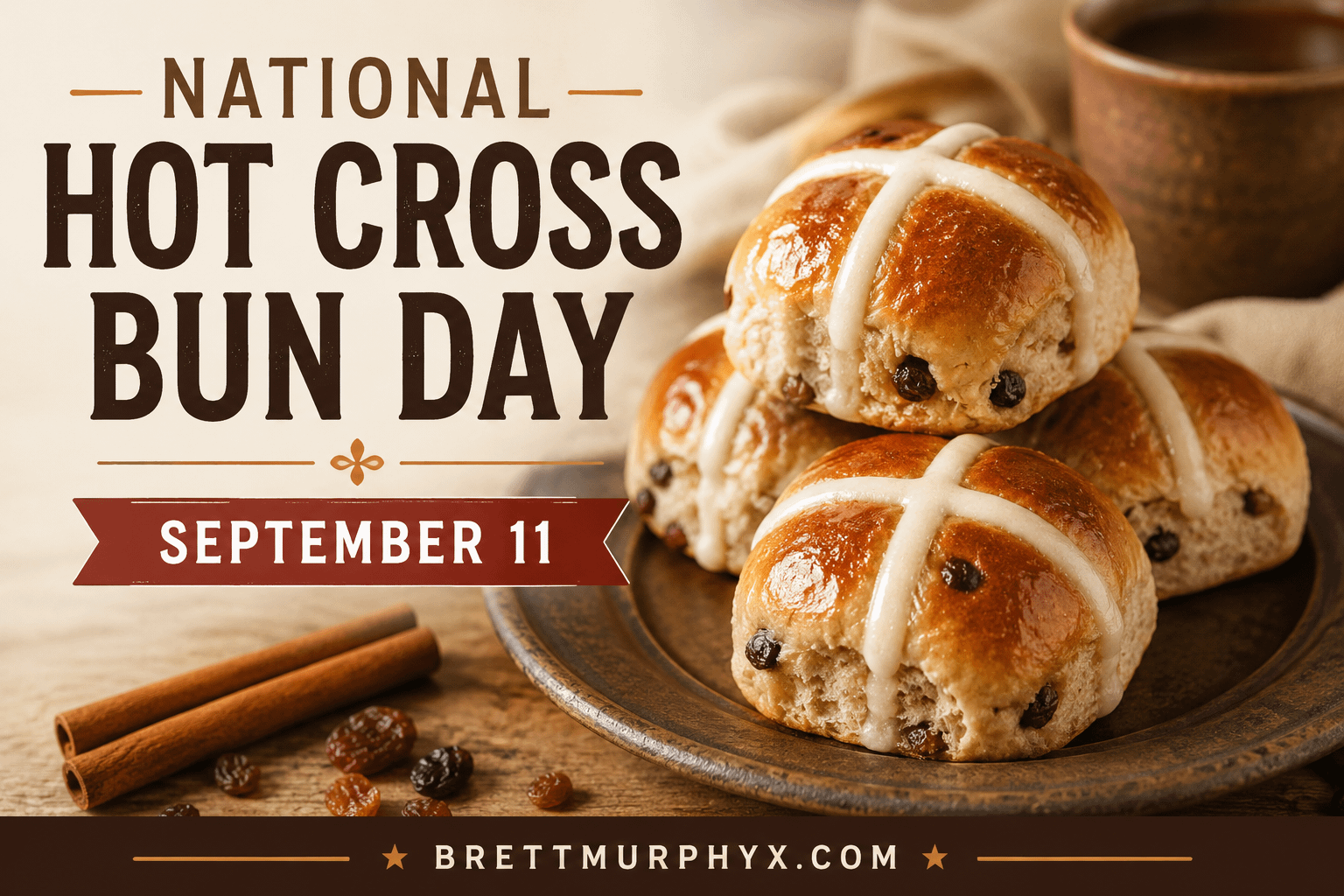
Every year on September 11, National Hot Cross Bun Day gives us an opportunity to enjoy one of the most recognizable baked treats in the world: the hot cross bun.
Soft, lightly sweet, warmly spiced, and traditionally filled with dried fruit, hot cross buns are instantly recognizable by the cross decorating the top. While these buns are most famously connected with Easter and Good Friday, National Hot Cross Bun Day gives them a celebration of their own.
Whether you pick up a batch from a local bakery, make them from scratch at home, or simply want to learn more about this centuries-old baked treat, National Hot Cross Bun Day is a delicious reason to appreciate a recipe that has survived generations.
What Is National Hot Cross Bun Day?
National Hot Cross Bun Day is observed annually on September 11 and celebrates the traditional spiced sweet bun known as the hot cross bun.
A classic hot cross bun is made from a lightly sweetened yeast dough flavored with spices such as cinnamon, nutmeg, or allspice. Raisins, currants, or other dried fruits are usually mixed throughout the dough.
The signature feature, of course, is the cross on top.
Traditionally, the cross is formed with a simple flour-and-water paste before baking, although some modern versions use icing or another sweet topping.
After baking, the buns may also be brushed with a glaze to give them a beautiful shine and a little additional sweetness.
The result is somewhere between a dinner roll and a sweet breakfast pastry: soft enough to pull apart, flavorful enough to eat on its own, and especially delicious when served warm with butter.
The History of Hot Cross Buns
Hot cross buns have a long and fascinating history.
Their exact origin is difficult to establish because spiced breads and ceremonial baked goods existed in different cultures long before the modern hot cross bun appeared.
However, the buns eventually became strongly associated with Christianity, particularly Good Friday.
The cross on top came to symbolize the crucifixion of Jesus Christ, while the spices used in the buns have traditionally been associated with the spices used in preparing Christ’s body for burial.
Over the centuries, hot cross buns became deeply connected with Easter traditions, particularly in Britain.
One frequently repeated story credits a monk at St. Albans in England with creating an early version of the bun during the 14th century. Whether that account represents the precise beginning of the modern hot cross bun or simply one stage in its development, the bread’s history stretches back hundreds of years.
By the 18th and 19th centuries, hot cross buns had become widely recognized as a Good Friday tradition.
Eventually, their popularity spread far beyond Britain.
Today, hot cross buns can be found in bakeries, grocery stores, homes, and cafés throughout many parts of the world.
Why Is There a Cross on a Hot Cross Bun?
The cross is the feature that immediately distinguishes a hot cross bun from an ordinary sweet roll.
For Christians, the cross traditionally represents the crucifixion of Jesus.
Because hot cross buns became associated with Good Friday—the Friday before Easter Sunday—the symbolism made the bread particularly meaningful during the Easter season.
There are several ways bakers create the cross.
Traditional versions commonly use a flour-and-water paste that is piped across the dough before the buns go into the oven.
Some modern recipes instead add icing after baking. This creates a sweeter, more dessert-like bun.
Either way, without that recognizable cross, it wouldn’t quite feel like a traditional hot cross bun.
What Do Hot Cross Buns Taste Like?
If you’ve never tried one, imagine a soft and fluffy yeast roll combined with the flavors of a lightly spiced fruit bread.
Traditional hot cross buns aren’t usually overwhelmingly sweet.
Instead, they balance several different flavors.
You may taste cinnamon, nutmeg, cloves, allspice, citrus zest, raisins, currants, or other dried fruits depending on the recipe.
Some recipes also include candied citrus peel.
Once baked, the outside can be brushed with a sweet glaze, while the inside remains tender and fluffy.
Serve one warm with a little butter, and it’s easy to understand why people have continued baking them generation after generation.
The Famous Hot Cross Buns Nursery Rhyme
Even people who have never eaten a hot cross bun may recognize the name because of the famous nursery rhyme:
“Hot cross buns! Hot cross buns!”
The traditional rhyme references selling the buns for small amounts of money and became familiar to generations of children.
The tune is also commonly used as one of the first melodies children learn when beginning a musical instrument because of its simple sequence of notes.
As a result, hot cross buns occupy an unusual place in both food history and popular culture.
They’re simultaneously a traditional baked good, a religious symbol, a seasonal food, and the subject of one of the most recognizable children’s melodies.
How to Celebrate National Hot Cross Bun Day
The easiest way to celebrate National Hot Cross Bun Day is also the most delicious: eat a hot cross bun.
Check your local bakery or supermarket to see whether they carry them. Because hot cross buns are traditionally associated with Easter, they may be more difficult to find during September.
That makes September 11 an especially good excuse to bake your own.
Homemade hot cross buns require some patience because you’re working with yeast dough, but they’re not as intimidating as they may appear.
And there’s something special about pulling apart a freshly baked bun while it’s still slightly warm.
You can also celebrate by learning about the history behind the bread, sharing a batch with family or friends, or experimenting with modern variations.
Homemade Hot Cross Buns Recipe
Want to celebrate National Hot Cross Bun Day in your own kitchen?
Try making a traditional batch.
Ingredients
For the buns:
- 3 ¾ cups all-purpose flour
- ¼ cup granulated sugar
- 2 ¼ teaspoons active dry yeast
- 1 teaspoon ground cinnamon
- ½ teaspoon ground nutmeg
- ½ teaspoon salt
- 1 cup warm milk
- ¼ cup unsalted butter, melted
- 2 large eggs
- ¾ cup raisins or currants
- ¼ cup chopped candied orange peel, optional
- 1 teaspoon orange zest, optional
For the crosses:
- ½ cup all-purpose flour
- 5 to 6 tablespoons water
For the glaze:
- 2 tablespoons apricot preserves
- 1 tablespoon warm water
Step 1: Activate the Yeast
Combine the warm milk with a small amount of the sugar and the yeast.
Allow the mixture to sit for approximately 5 to 10 minutes until it becomes foamy.
The milk should be warm rather than hot. Excessive heat can damage the yeast and prevent your dough from rising properly.
Step 2: Prepare the Dough
In a large mixing bowl, combine the flour, remaining sugar, cinnamon, nutmeg, and salt.
Add the yeast mixture, melted butter, and eggs.
Mix everything together until a soft dough begins to form.
Step 3: Add the Fruit
Add the raisins or currants.
If you’re using candied orange peel or fresh orange zest, add those ingredients as well.
Continue mixing until the fruit is distributed throughout the dough.
Step 4: Knead the Dough
Transfer the dough to a lightly floured surface.
Knead for approximately 8 to 10 minutes, or until the dough becomes smooth and elastic.
You can also use a stand mixer fitted with a dough hook.
Step 5: Let the Dough Rise
Place the dough into a lightly greased bowl.
Cover it with a clean kitchen towel or plastic wrap and leave it in a warm place for approximately 1 to 1½ hours.
The dough should roughly double in size.
Step 6: Shape the Buns
Gently punch down the risen dough.
Divide it into approximately 12 equal portions.
Shape each portion into a smooth ball and arrange the buns in a greased baking dish or on a parchment-lined baking sheet.
Leave a little space between each bun.
Step 7: Let Them Rise Again
Cover the shaped buns and allow them to rise for another 30 to 45 minutes.
They should become noticeably puffy.
Meanwhile, preheat your oven to 375°F.
Step 8: Make the Cross
Combine ½ cup flour with enough water to create a thick but pipeable paste.
Transfer the mixture to a piping bag or small plastic bag with one corner snipped.
Pipe a line across each row of buns in one direction and then another line in the opposite direction, creating crosses on each bun.
Step 9: Bake
Bake for approximately 20 to 25 minutes, or until the buns are beautifully golden brown and cooked through.
Step 10: Add the Glaze
Combine the apricot preserves with warm water.
While the buns are still warm, lightly brush the glaze over their tops.
This gives them their attractive glossy finish.
Allow them to cool slightly before serving.
The Best Way to Serve Hot Cross Buns
Fresh hot cross buns are wonderful while they’re still slightly warm.
Slice one open and spread it with butter.
The warmth of the bun begins melting the butter immediately, creating a simple but incredibly satisfying combination.
Hot cross buns are also excellent toasted.
Cut one in half, lightly toast it, and add butter, honey, jam, or preserves.
Pair your bun with coffee or tea for breakfast or an afternoon snack.
Creative Hot Cross Bun Variations
Traditional recipes generally feature raisins or currants, but modern bakers have created countless variations.
Chocolate Hot Cross Buns
Replace some or all of the dried fruit with chocolate chips.
You can even add cocoa powder to the dough for an extra-rich chocolate version.
Cranberry Orange Hot Cross Buns
Use dried cranberries instead of raisins and add fresh orange zest.
The tart cranberries and bright citrus flavors work beautifully with the warm spices.
Apple Cinnamon Hot Cross Buns
Add small pieces of dried apple and increase the cinnamon slightly.
This variation is particularly good during the fall.
Blueberry Hot Cross Buns
Dried blueberries offer another flavorful alternative to raisins.
Add lemon zest for a blueberry-lemon combination.
Extra-Spiced Hot Cross Buns
If you love warm baking spices, experiment with cinnamon, nutmeg, cloves, ginger, cardamom, or allspice.
Just remember that spices such as cloves can become overpowering quickly, so a small amount goes a long way.
What to Do With Leftover Hot Cross Buns
Don’t throw away hot cross buns simply because they’ve become slightly stale.
They can be transformed into several delicious dishes.
Hot Cross Bun French Toast
Slice the buns in half and use them instead of regular bread when preparing French toast.
Because the bread already contains fruit and spices, you get additional flavor without much extra work.
Hot Cross Bun Bread Pudding
Cut leftover buns into pieces and use them as the base for bread pudding.
The raisins and spices make them perfect for a rich custard-style dessert.
Toasted Hot Cross Buns
Sometimes the simplest solution is the best.
Toast an older bun until the edges become slightly crisp, then spread it generously with butter.
How to Store Hot Cross Buns
Fresh homemade hot cross buns are best enjoyed within a couple of days.
Once completely cooled, place them in an airtight container or tightly sealed bag and keep them at room temperature.
Avoid leaving them exposed to the air because they’ll dry out quickly.
For longer storage, hot cross buns can usually be frozen.
Wrap them individually or separate them with parchment paper before placing them in a freezer-safe container.
When you’re ready to eat one, allow it to thaw and then warm it briefly in the oven or microwave.
Fun Facts About Hot Cross Buns
Hot cross buns have accumulated plenty of traditions and folklore during their long history.
In centuries past, some people believed buns baked on Good Friday possessed special properties and wouldn’t spoil during the following year.
Others believed hanging a hot cross bun inside the kitchen would protect the home or help ensure successful baking.
Hot cross buns were also sometimes shared between friends as a symbol of friendship and goodwill.
Sailors were even said to carry them because of beliefs that the buns might offer protection during voyages.
These traditions are folklore rather than reasons to expect anything supernatural from your breakfast, but they demonstrate just how culturally significant the humble hot cross bun became.
Few baked goods have accumulated quite so many stories.
Hot Cross Buns Around the World
Although strongly connected with British food traditions, hot cross buns are now enjoyed internationally.
They’re particularly popular in countries influenced by British culinary traditions, including Australia and New Zealand.
Modern supermarkets and bakeries have also expanded far beyond traditional raisin-filled recipes.
Depending on where you shop, you might encounter chocolate, apple-cinnamon, fruitless, mocha, caramel, or other creative versions.
Some people prefer the classics.
Others look forward to seeing what unusual flavor bakeries create next.
Either approach keeps the tradition alive.
Why Food Traditions Matter
National food days can seem simple—and sometimes that’s exactly what makes them enjoyable.
But traditional foods also provide connections between generations.
Someone preparing hot cross buns today may be following techniques that would have been recognizable to bakers hundreds of years ago.
Ingredients change.
Recipes evolve.
Kitchen equipment improves.
Yet the basic act remains remarkably familiar: combining flour, yeast, milk, spices, and fruit; waiting patiently for the dough to rise; shaping the buns; adding their distinctive crosses; and sharing them with other people.
Food traditions help preserve small pieces of history in ways we can actually experience.
We aren’t simply reading about hot cross buns.
We can smell them baking.
We can pull one apart while it’s warm.
And we can understand why generations before us enjoyed doing exactly the same thing.
Celebrate National Hot Cross Bun Day on September 11
National Hot Cross Bun Day may not be one of the biggest celebrations on the calendar, but that’s part of its charm.
It’s a day devoted to appreciating something simple: a warm, fragrant bun filled with fruit and spices.
On September 11, celebrate by visiting a bakery, trying a hot cross bun for the first time, sharing some with family or friends, or spending an afternoon making a homemade batch.
Enjoy one warm.
Add a little butter.
Pour yourself a cup of coffee or tea.
And appreciate a baked tradition that has traveled through centuries while remaining instantly recognizable.
Sometimes celebrating a national day doesn’t require anything complicated.
Sometimes all you need is a warm bun fresh from the oven.
What’s your favorite way to enjoy a hot cross bun—warm with butter, toasted, or with your own favorite topping?
Leave a Reply