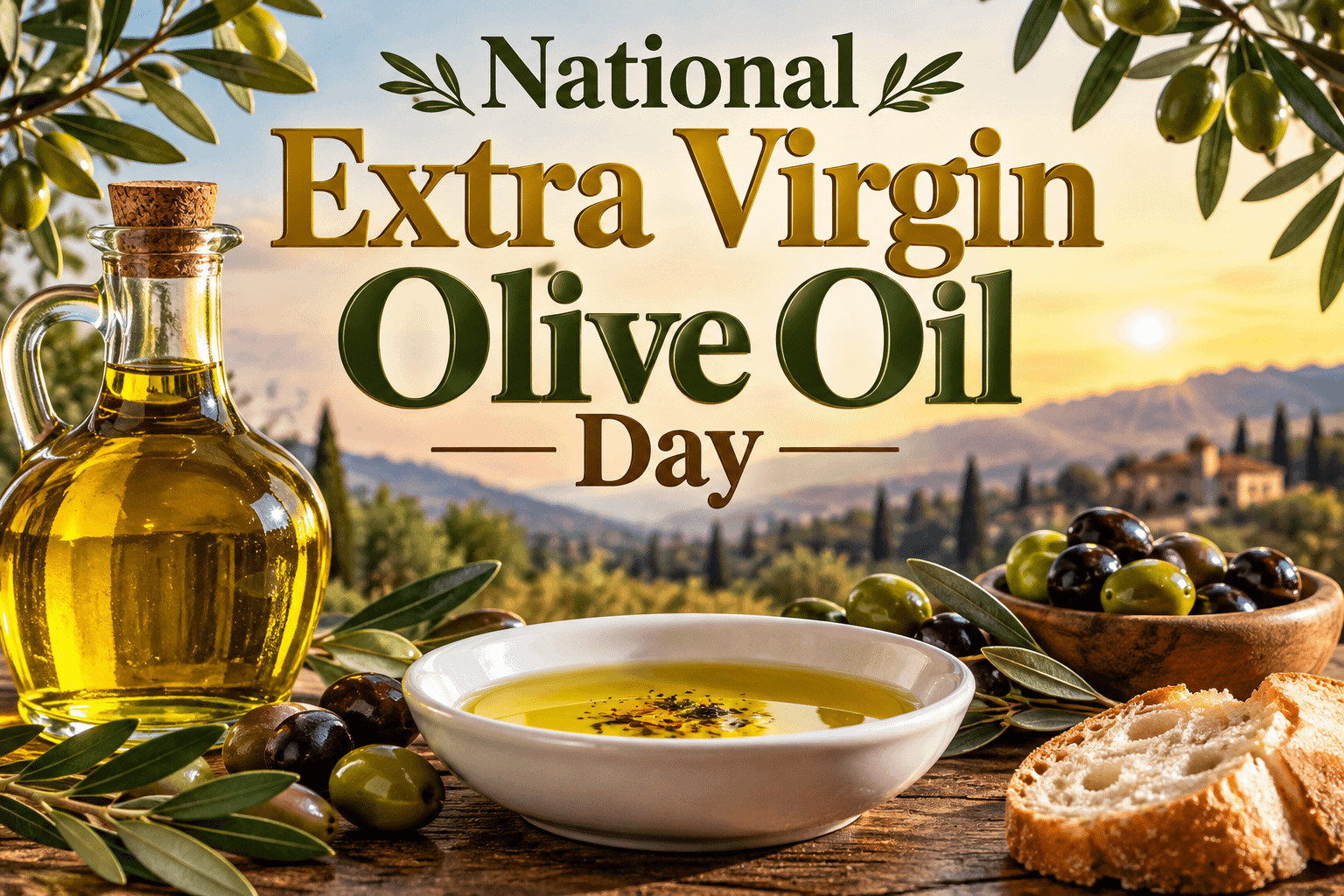
There are some ingredients that seem almost magical in their simplicity. They can transform an ordinary meal, bring different flavors together, and become a staple you reach for almost every day. Extra virgin olive oil is one of those ingredients.
National Extra Virgin Olive Oil Day, celebrated each year on September 30, gives food lovers an opportunity to appreciate one of the world’s most beloved culinary ingredients.
From drizzling it over warm bread to whisking it into salad dressing, using it in marinades, or finishing roasted vegetables with a splash of golden oil, extra virgin olive oil has earned a permanent place in kitchens around the world.
But this day isn’t simply about cooking with olive oil. It’s also an opportunity to learn what makes extra virgin olive oil different, appreciate the long tradition behind olive cultivation, and experiment with new ways to use it.
What Is Extra Virgin Olive Oil?
Extra virgin olive oil—often shortened to EVOO—is the highest recognized grade of virgin olive oil.
Unlike refined oils that undergo substantial chemical or heat processing, virgin olive oils are obtained from olives through mechanical or other physical means under conditions that do not alter the oil.
The result is an oil that can retain the natural aromas and flavors of the olives from which it was produced.
Depending on the olives, growing region, harvest timing, and production methods, extra virgin olive oil can taste remarkably different from bottle to bottle.
Some oils are mild and buttery.
Others are grassy, fruity, peppery, bitter, or even slightly spicy.
That variety is part of what makes extra virgin olive oil so interesting. Much like coffee, chocolate, cheese, or wine, its flavor can reflect the agricultural product and the way it was produced.
A Tradition Thousands of Years Old
Olive trees have played an important role in Mediterranean civilizations for thousands of years.
Olive oil historically served purposes extending far beyond the kitchen. It was used for food, lighting, religious ceremonies, cosmetics, medicines, and everyday household needs.
Ancient Mediterranean societies placed tremendous value on the olive tree.
Over generations, olive cultivation became deeply connected with the cuisines and cultures of countries including Greece, Italy, Spain, Portugal, Turkey, and others throughout the Mediterranean region.
Today, olive oil is enjoyed far beyond the Mediterranean.
You can find it in restaurants, grocery stores, bakeries, home kitchens, and professional kitchens around the world.
National Extra Virgin Olive Oil Day celebrates both that remarkable history and the ingredient’s continuing role in modern cooking.
What Makes Extra Virgin Olive Oil Special?
One of the greatest qualities of extra virgin olive oil is versatility.
You don’t need complicated techniques to enjoy it.
Sometimes the simplest preparation is the best.
Pour a small amount into a shallow dish, add freshly cracked black pepper and herbs, and serve it alongside crusty bread.
Drizzle it over tomatoes with fresh mozzarella and basil.
Add it to pasta.
Use it to roast vegetables.
Whisk it with vinegar or lemon juice for a homemade dressing.
A good extra virgin olive oil can contribute flavor rather than simply acting as cooking fat.
That is especially noticeable when the oil is used as a finishing ingredient.
A small drizzle over soup, grilled vegetables, pasta, beans, pizza, or toasted bread can add another layer of flavor to the finished dish.
Extra Virgin Olive Oil and the Mediterranean Diet
Olive oil is famously associated with Mediterranean-style eating patterns.
The Mediterranean diet generally emphasizes foods such as vegetables, fruits, legumes, whole grains, nuts, seeds, fish, and olive oil while limiting some highly processed foods.
Extra virgin olive oil is particularly notable because it is rich in monounsaturated fat and also contains naturally occurring compounds such as polyphenols.
That doesn’t mean olive oil should be treated as a miracle food. It is still calorie-dense, and overall eating patterns matter more than any single ingredient.
However, replacing certain sources of saturated fat with unsaturated fats can be part of a heart-conscious eating pattern.
National Extra Virgin Olive Oil Day can therefore be more than an excuse to cook something delicious. It can also encourage people to think about the ingredients they regularly use in their kitchens.
Easy Ways to Celebrate National Extra Virgin Olive Oil Day
The easiest celebration is also the most obvious:
Cook with extra virgin olive oil.
You don’t need to prepare an elaborate Mediterranean feast. Try incorporating EVOO into something you already enjoy.
You could roast potatoes with olive oil, garlic, rosemary, salt, and pepper.
You could prepare bruschetta with toasted bread, tomatoes, basil, garlic, and a generous drizzle of extra virgin olive oil.
Make a simple vinaigrette by combining olive oil with vinegar or lemon juice, herbs, and seasonings.
You could even create an olive oil tasting.
Pour several varieties into separate dishes and taste them with small pieces of bread. Pay attention to differences in aroma, fruitiness, bitterness, and pepperiness.
You may be surprised by how different two bottles of extra virgin olive oil can taste.
Try a Simple Olive Oil Bread Dip
One of the easiest ways to appreciate extra virgin olive oil is with fresh bread.
Ingredients
- 1/4 cup extra virgin olive oil
- 1 small garlic clove, finely minced
- 1/2 teaspoon dried oregano
- 1/2 teaspoon dried basil
- Pinch of crushed red pepper flakes
- Freshly ground black pepper
- Small pinch of salt
- Optional grated Parmesan cheese
- Crusty bread for dipping
Directions
Pour the extra virgin olive oil into a shallow serving dish.
Add the garlic, oregano, basil, red pepper flakes, black pepper, and salt.
Allow the mixture to sit for several minutes so the flavors begin blending into the oil.
Sprinkle Parmesan over the top if desired.
Serve with slices of warm, crusty bread.
It’s incredibly simple, but that’s exactly the point. Extra virgin olive oil doesn’t always need to be hidden inside a complicated recipe. Sometimes it deserves to be the main flavor.
Make Homemade Salad Dressing
National Extra Virgin Olive Oil Day is also a perfect excuse to skip bottled dressing and make your own.
A basic vinaigrette can begin with approximately three parts olive oil to one part vinegar, although you can adjust the proportions to your taste.
Try combining:
Extra virgin olive oil, balsamic vinegar, Dijon mustard, garlic, black pepper, and a small amount of honey.
Shake everything together in a jar until emulsified.
Within minutes, you have a flavorful homemade dressing that works beautifully with leafy greens, tomatoes, cucumbers, grilled vegetables, or grain bowls.
Use It as a Finishing Oil
Many people think of olive oil primarily as something used during cooking.
Don’t forget about using it afterward.
A drizzle of flavorful extra virgin olive oil can finish dishes such as:
Pizza, pasta, tomato soup, hummus, roasted vegetables, grilled chicken, grilled fish, beans, mashed potatoes, avocado toast, bruschetta, and fresh salads.
The key is moderation.
You don’t need to drown the dish in oil. Sometimes a teaspoon or small drizzle is enough to provide noticeable flavor.
Can You Cook With Extra Virgin Olive Oil?
One persistent misconception is that extra virgin olive oil should never be heated.
In reality, extra virgin olive oil can be used for many everyday cooking techniques, including sautéing, roasting, and baking.
As with any cooking fat, however, temperature matters. Avoid unnecessarily overheating oil until it smokes heavily.
For most ordinary home-cooking applications, extra virgin olive oil can be a practical and flavorful choice.
And don’t overlook baking.
Olive oil can replace other fats in certain cakes, muffins, breads, and desserts while contributing moisture and, depending on the oil, a subtle fruity character.
How to Store Extra Virgin Olive Oil
Buying good olive oil is only half the battle.
You also need to store it properly.
Three major enemies of olive oil are light, heat, and oxygen.
Keep your bottle somewhere cool and dark rather than directly beside a hot stove or in bright sunlight.
Dark glass bottles and tins can help protect oil from light.
Close the container tightly after using it.
And remember that olive oil isn’t something that necessarily improves by sitting around for years.
Freshness matters.
Instead of buying an enormous container that takes forever to finish, consider purchasing an amount you’ll realistically use while it’s still fresh and flavorful.
Explore Different Olive Oils
If you usually purchase whichever olive oil happens to be on sale, National Extra Virgin Olive Oil Day provides a good opportunity to experiment.
Try oils made from different olive varieties or regions.
Taste them side by side.
One might taste grassy and peppery.
Another might seem smoother and fruitier.
You may discover that you prefer different oils for different purposes.
A bold, peppery oil might be fantastic over grilled vegetables or hearty bread, while a milder oil could work beautifully in baking or delicate dishes.
There isn’t necessarily one perfect olive oil for everything.
Part of the fun is discovering what you enjoy.
Host an Olive Oil Tasting
Want to turn the celebration into something social?
Invite friends or family members to participate in a blind olive oil tasting.
Choose three or four extra virgin olive oils and place them in numbered dishes without revealing the brands.
Provide bread or another simple tasting food.
Have everyone smell and taste each oil before describing what they notice.
Is it fruity?
Peppery?
Grassy?
Smooth?
Bitter?
Mild?
You don’t have to be an olive oil expert. The goal is simply to pay attention to flavor.
At the end, reveal the bottles and compare everyone’s favorites.
It can turn an ordinary ingredient into a surprisingly entertaining food experience.
Celebrate the People Behind the Bottle
National Extra Virgin Olive Oil Day can also remind us that every bottle begins with agriculture.
Olives must be grown, harvested, transported, crushed, processed, stored, bottled, and distributed before the oil reaches your kitchen.
Weather conditions, olive varieties, harvest timing, farming practices, and production techniques can all influence the final product.
Whenever possible, learn about the producer behind the olive oil you’re purchasing.
Look at where the olives were grown and where the oil was produced.
Food becomes more interesting when we understand where it comes from.
A Golden Ingredient Worth Celebrating
Extra virgin olive oil proves that some of the best ingredients don’t need to be complicated.
Olives are harvested and transformed into an ingredient that has been valued across civilizations for thousands of years.
Today, that golden oil continues appearing on kitchen counters and restaurant tables around the world.
It can help roast vegetables.
It can become salad dressing.
It can add richness to pasta.
It can transform bread into an appetizer.
It can finish pizza, soup, hummus, or grilled food with a simple drizzle.
And sometimes, all you need is a good piece of bread and a small dish of flavorful olive oil.
On September 30, celebrate National Extra Virgin Olive Oil Day by opening a bottle, trying something new, and appreciating an ingredient that connects modern kitchens with thousands of years of culinary tradition.
What’s your favorite way to use extra virgin olive oil—cooking, dipping bread, salad dressing, roasting vegetables, or something completely different?
Leave a Reply