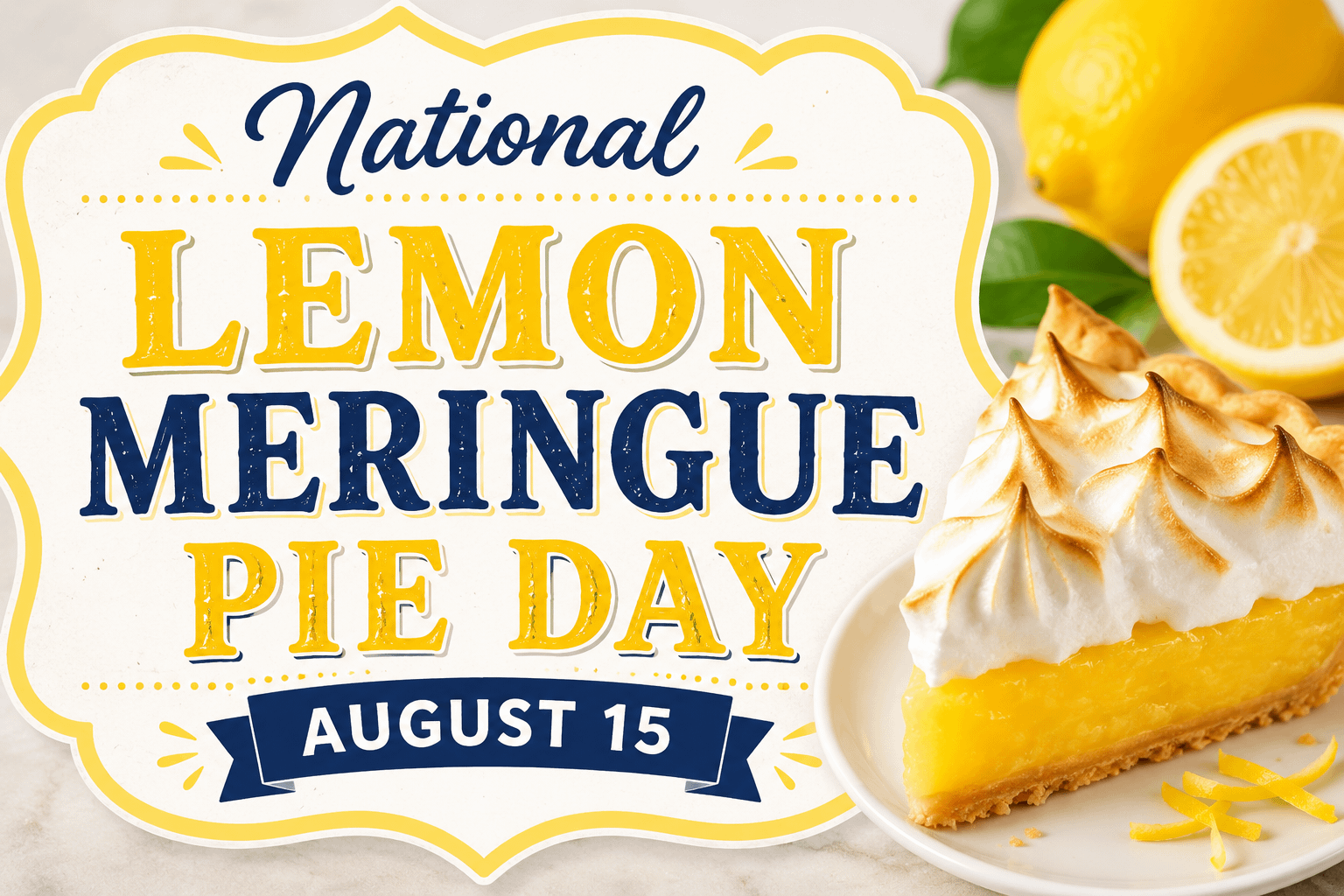
Every year on August 15, dessert lovers have an especially sweet—and slightly tart—reason to celebrate: National Lemon Meringue Pie Day.
Few desserts are as instantly recognizable as a beautiful lemon meringue pie. A flaky, buttery crust supports a smooth, vibrant lemon filling, while a generous cloud of meringue rises above it all. The top is lightly toasted until golden peaks appear, creating a dessert that looks every bit as impressive as it tastes.
Lemon meringue pie brings together flavors and textures that seem made for one another. The lemon filling is bright and tangy. The meringue is light and sweet. The crust adds buttery richness and just enough crispness to complete every bite.
It’s the kind of dessert that can feel nostalgic and elegant at the same time.
For some people, lemon meringue pie brings back memories of Sunday dinners, holidays, family reunions, neighborhood bakeries, or visits to an old-fashioned diner. For others, it’s simply one of those classic desserts that deserves to be enjoyed whenever the opportunity presents itself.
And on August 15, you don’t even need an excuse.
So grab a fork and get ready to celebrate one of America’s classic pies.
What Is National Lemon Meringue Pie Day?
National Lemon Meringue Pie Day is an unofficial food holiday celebrated annually on August 15.
The day is dedicated to enjoying and appreciating the famous dessert made from three main components:
- A flaky pastry crust
- A tart and creamy lemon filling
- A fluffy meringue topping
Although the origins of the observance itself aren’t particularly clear, the dessert it celebrates has a fascinating culinary history.
Like many food holidays, the celebration doesn’t require complicated traditions. You can participate simply by enjoying a slice of lemon meringue pie.
But if you’re feeling adventurous, August 15 is also a great opportunity to learn how to make one yourself.
What Makes Lemon Meringue Pie So Special?
At first glance, lemon meringue pie appears fairly simple.
Crust.
Lemon filling.
Meringue.
But those three components create an impressive collection of contrasting flavors and textures.
The Crust
A traditional pastry crust provides the foundation.
When properly baked, it should be flaky, slightly crisp, and buttery enough to complement the filling without overpowering it.
The Lemon Filling
Then comes the heart of the dessert.
The lemon filling typically combines fresh lemon juice, lemon zest, sugar, egg yolks, water, butter, and a thickening ingredient such as cornstarch.
It should be smooth, creamy, bright, and unmistakably lemony.
Most importantly, it needs balance.
A great lemon meringue pie shouldn’t taste overwhelmingly sour, but it shouldn’t be so sweet that the lemon disappears either.
The Meringue
Finally, there’s the part that gives the dessert its dramatic appearance.
Meringue is traditionally made by beating egg whites and sugar until the mixture becomes glossy and capable of forming peaks.
It’s then spread generously over the lemon filling.
Once browned, those peaks develop beautiful golden edges while the inside remains light and airy.
Put everything together and one bite can deliver crisp, creamy, tart, sweet, buttery, and fluffy textures and flavors.
That’s a lot happening in a single slice of pie.
A Brief History of Lemon Meringue Pie
Lemon meringue pie didn’t suddenly appear from a single recipe. Instead, it developed gradually as different culinary traditions came together.
Lemons had already been used in European cooking for centuries. Their bright acidity made them particularly valuable for desserts, sauces, beverages, preserves, and custards.
Lemon custards and puddings eventually became popular dessert preparations.
Pastry, of course, had an even longer history.
Meringue added the final piece.
European cooks discovered that beating egg whites could create a light foam that became even more stable and sweet when sugar was added.
Eventually, pastry, lemon custard, and meringue found their way onto the same dessert.
And something wonderful happened.
Elizabeth Goodfellow and Early American Lemon Desserts
One name frequently associated with the development of lemon meringue-style desserts in America is Elizabeth Goodfellow.
Goodfellow was a respected Philadelphia pastry cook and cooking instructor during the early 19th century.
She operated a pastry shop and cooking school and became known for teaching women culinary techniques that would influence American cooking.
Her students recorded recipes and methods associated with her instruction, helping preserve parts of her culinary legacy.
Desserts involving lemon custard and meringue eventually became increasingly recognizable throughout the 1800s.
Over time, recipes evolved into what we now recognize as lemon meringue pie.
Why Lemon and Meringue Work So Well Together
One reason lemon meringue pie has endured is the balance between acidity and sweetness.
Imagine eating the lemon filling by itself.
Depending on the recipe, it could be intensely tart.
Now imagine eating a large spoonful of sweet meringue.
Delicious—but potentially very sweet.
Put them together and they balance each other.
The lemon cuts through the sweetness of the meringue, while the meringue softens the sharpness of the citrus.
Then the pastry crust adds another layer of richness.
It’s a great example of how contrasting flavors can create something better together than they would separately.
The Importance of Fresh Lemons
If you’re making lemon meringue pie from scratch, lemons obviously play the starring role.
Fresh lemon juice delivers acidity and brightness.
But don’t forget the zest.
The outer yellow portion of a lemon’s peel contains aromatic oils that provide powerful lemon fragrance and flavor.
That’s why many recipes use both lemon juice and lemon zest.
The juice provides tartness.
The zest provides aroma.
Together, they create that unmistakable citrus flavor.
Just remember to zest only the yellow exterior. The white portion beneath the peel, known as the pith, can be bitter.
The Science Behind Meringue
Meringue looks almost magical.
You begin with ordinary egg whites, whip them, and suddenly they expand into a fluffy white cloud several times their original volume.
But there’s science behind the transformation.
Egg whites contain proteins.
As the whites are whipped, those proteins unfold and form structures around tiny air bubbles. The more air incorporated into the mixture, the larger and fluffier it becomes.
Sugar helps stabilize the foam while adding sweetness.
The result is a glossy mixture capable of forming those signature peaks.
However, meringue can be temperamental.
Even a small amount of grease or egg yolk can make it difficult for egg whites to whip properly.
That’s why bakers often make sure bowls and beaters are extremely clean before preparing meringue.
Soft Peaks vs. Stiff Peaks
If you’ve ever followed a meringue recipe, you’ve probably encountered terms such as soft peaks and stiff peaks.
But what do they actually mean?
Soft peaks occur when you lift your whisk or beaters and the meringue forms a peak that gently folds over.
Stiff peaks stand upright and hold their shape.
For lemon meringue pie, the egg whites are generally whipped until they can create strong, glossy peaks capable of supporting the decorative topping.
That’s what creates those beautiful mountains and swirls you see on professionally prepared pies.
Why the Meringue Has Golden Peaks
One of the most attractive parts of lemon meringue pie is its toasted appearance.
The meringue begins bright white.
After baking or browning, the raised portions turn golden brown.
The result is a dramatic mixture of white, cream, caramel, and golden tones across the top.
Some bakers create tall peaks with a spoon.
Others make smooth waves.
Professional pastry chefs may pipe elaborate patterns onto the pie.
Whatever method is used, browning the meringue transforms a relatively simple topping into the dessert’s signature feature.
A Classic Homemade Lemon Meringue Pie Recipe
Want to celebrate National Lemon Meringue Pie Day in the kitchen?
Try making your own.
Ingredients
For the Pie
- 1 baked 9-inch pastry crust
- 1 1/2 cups granulated sugar
- 1/3 cup cornstarch
- 1 1/2 cups water
- 4 large egg yolks
- 1/2 cup fresh lemon juice
- 1 tablespoon finely grated lemon zest
- 2 tablespoons butter
For the Meringue
- 4 large egg whites
- 1/2 teaspoon cream of tartar
- 1/2 cup granulated sugar
- 1/2 teaspoon vanilla extract
Directions
Step 1: Prepare the Crust
Bake your favorite homemade or prepared 9-inch pie crust according to its instructions.
The crust should be completely baked before adding the lemon filling.
Set it aside while preparing the remaining components.
Step 2: Make the Lemon Filling
Combine the sugar and cornstarch in a medium saucepan.
Gradually whisk in the water.
Cook over medium heat while stirring regularly until the mixture begins thickening.
Meanwhile, lightly beat the egg yolks in a separate bowl.
Slowly whisk a small amount of the hot sugar mixture into the egg yolks.
This process is called tempering.
It gradually raises the temperature of the egg yolks so they don’t immediately scramble when introduced to the hot filling.
Once tempered, slowly whisk the egg yolk mixture back into the saucepan.
Continue cooking briefly while stirring.
Remove from the heat.
Stir in the fresh lemon juice, lemon zest, and butter.
Your filling should be smooth, glossy, and beautifully yellow.
Pour the warm lemon mixture into the baked pie crust.
Step 3: Prepare the Meringue
Place the egg whites in a clean mixing bowl.
Add the cream of tartar.
Beat until the egg whites become foamy and begin forming soft peaks.
Gradually add the sugar while continuing to beat.
Don’t dump all the sugar in at once.
Slowly incorporating it helps produce smoother, more stable meringue.
Continue beating until stiff, glossy peaks form.
Add the vanilla extract and mix briefly.
Step 4: Top the Pie
Spread the meringue over the warm lemon filling.
Make sure the meringue reaches all the way to the crust around the edge.
This helps create a seal.
Use the back of a spoon or spatula to create decorative swirls and peaks.
Step 5: Bake
Bake at approximately 350°F until the meringue develops a beautiful golden color.
Watch it carefully.
Meringue can go from beautifully toasted to overly browned surprisingly quickly.
Remove the pie from the oven and allow it to cool.
For clean slices, give the filling plenty of time to set before cutting.
Common Lemon Meringue Pie Problems
Making lemon meringue pie can sometimes test a baker’s patience.
Several things can go wrong, but understanding them can help you create a better pie.
Runny Lemon Filling
A lemon filling that doesn’t set properly may not have cooked long enough or may have an incorrect balance of liquid and thickener.
Give the filling enough time to thicken during cooking and allow the finished pie to cool completely before judging its consistency.
Meringue That Shrinks
Sometimes meringue pulls away from the crust as the pie cools.
Spreading the meringue all the way to the crust can help create a better seal.
Meringue That Weeps
Tiny droplets can sometimes appear on meringue.
This is often called “weeping.”
Careful preparation, proper sugar incorporation, and avoiding overbaking can help produce a more stable topping.
A Soggy Crust
Nobody wants a soggy bottom crust.
Fully baking the crust before adding the filling helps create a sturdier foundation for the finished pie.
Creative Lemon Meringue Variations
Traditional lemon meringue pie is wonderful, but creative bakers have developed plenty of variations.
Mini Lemon Meringue Tarts
Make individual tart shells and fill each one with lemon filling and meringue.
They’re perfect for parties because everyone gets their own dessert.
Graham Cracker Crust
Replace traditional pastry with a sweet graham cracker crust.
It creates a slightly different texture and flavor while still pairing beautifully with lemon.
Lemon Meringue Bars
Turn the traditional pie into portable dessert bars.
A shortbread-style crust, lemon filling, and toasted meringue can deliver the same flavors in an easier-to-serve format.
Lime Meringue Pie
Swap lemon for lime to create a different citrus experience.
Meyer Lemon Meringue Pie
Meyer lemons tend to have a sweeter and less sharply acidic flavor than many standard lemons.
Using them can create a softer citrus profile.
What to Serve With Lemon Meringue Pie
Lemon meringue pie already has plenty happening, so it doesn’t require much accompaniment.
A good cup of coffee works beautifully.
So does hot tea.
On a warm August afternoon, consider serving it alongside:
- Iced tea
- Fresh-brewed coffee
- Iced coffee
- Sparkling water with lemon
- Fresh berries
- Strawberries
- Blueberries
- Raspberries
Fresh berries are particularly good because they complement the citrus flavor without overwhelming it.
Why Lemon Desserts Are Perfect for Summer
National Lemon Meringue Pie Day falls right in the middle of August, making its timing especially appropriate.
Summer is citrus dessert season.
When temperatures rise, many people gravitate toward bright, refreshing flavors.
Lemon delivers exactly that.
Think about some of the desserts commonly enjoyed during warmer months:
Lemon bars.
Lemon cookies.
Lemon cake.
Lemon cheesecake.
Lemon sorbet.
Lemon icebox pie.
And, of course, lemon meringue pie.
The citrus flavor brings a refreshing quality that feels especially appropriate after a summer barbecue or outdoor meal.
Lemon Meringue Pie at Family Gatherings
Certain foods become connected to memories.
You may not remember every conversation from a family dinner years ago, but you might remember the food sitting on the table.
Maybe someone in your family always made lemon meringue pie.
Maybe you remember watching a parent or grandparent carefully whip egg whites.
Perhaps there was always one pie sitting beside the chocolate cake, cookies, and other desserts at holiday gatherings.
Food can become part of a family’s history.
Recipes are handed down.
Handwritten recipe cards become treasured possessions.
Techniques are taught from one generation to another.
Eventually, a dessert becomes more than dessert.
It becomes part of the story.
The Classic American Diner Pie
Lemon meringue pie also has strong connections to traditional American diner culture.
Picture an old-fashioned diner.
There’s coffee brewing behind the counter.
A row of stools faces the kitchen.
And somewhere near the register sits a glass display case filled with pies.
Apple.
Cherry.
Chocolate cream.
Coconut cream.
And towering above them all might be a lemon meringue pie with golden peaks reaching toward the glass.
Pie and coffee became a classic diner combination for generations of Americans.
Even as food trends change, there’s something wonderfully nostalgic about sitting down with a cup of coffee and a slice of pie.
Fun Facts About Lemons
Lemon meringue pie wouldn’t exist without its signature citrus fruit.
Here are a few interesting things about lemons:
- Lemon trees are evergreen and can produce fruit throughout much of the year under suitable growing conditions.
- Lemon juice contains citric acid, which creates its distinctive sour taste.
- Lemon zest contains aromatic oils responsible for much of the fruit’s fragrance.
- Lemons are used in both sweet and savory cooking.
- Lemon juice is commonly used in beverages, marinades, sauces, desserts, and salad dressings.
- Citrus fruits have traveled around the world through centuries of cultivation and trade.
- California is one of the major lemon-growing regions in the United States.
Fun Facts About Meringue
Meringue deserves some attention of its own.
There are several major styles of meringue used in baking.
French Meringue
This is one of the simplest styles.
Sugar is gradually beaten into whipped egg whites.
Swiss Meringue
Egg whites and sugar are gently heated together before being whipped.
The result is typically smooth and glossy.
Italian Meringue
Hot sugar syrup is gradually poured into whipping egg whites.
This creates a particularly stable meringue frequently used in professional pastry making.
Traditional home-style lemon meringue pie is commonly associated with straightforward whipped meringue techniques, although bakers can choose different approaches.
How to Celebrate National Lemon Meringue Pie Day
You don’t need to organize a huge event to enjoy August 15.
Here are several ways to celebrate.
Bake a Homemade Pie
If you’ve never made lemon meringue pie before, today is the perfect excuse to try.
Don’t worry if your first pie doesn’t look bakery-perfect.
Homemade desserts don’t have to be perfect to be delicious.
Visit a Local Bakery
Stop by a neighborhood bakery and see whether lemon meringue pie is available.
It’s a delicious way to celebrate while supporting a local business.
Have Pie and Coffee With Someone
Invite a friend, neighbor, coworker, or family member to share a slice.
Sometimes the best celebrations are simply an excuse to spend time together.
Have a Pie-Baking Contest
Challenge friends or relatives to make their best lemon meringue pie.
Then conduct a taste test.
Categories could include:
Best Flavor
Best Crust
Best Meringue
Most Beautiful Pie
Best Overall
Of course, everyone wins because everyone gets pie.
Try a New Lemon Dessert
If lemon meringue pie isn’t available, celebrate lemon flavor in another way.
Make lemon bars, lemon cookies, lemon cupcakes, or another citrus-inspired treat.
Share Your Pie Online
Take a picture of your lemon meringue pie before cutting it.
Those toasted peaks deserve their moment.
Use hashtags such as #NationalLemonMeringuePieDay, #LemonMeringuePie, #PieLovers, and #DessertLovers.
Turn August 15 Into a Lemon Dessert Celebration
If you’re hosting friends or family, why stop at one dessert?
Create a lemon-themed dessert table.
Serve lemon meringue pie alongside lemon bars, lemon cookies, lemon cupcakes, lemon pound cake, lemon cheesecake bites, and fresh lemonade.
Add bowls of fresh berries for color.
You could even have guests vote for their favorite lemon dessert.
It turns a quirky food holiday into a memorable late-summer gathering.
National Lemon Meringue Pie Day Is About Simple Enjoyment
Not every celebration needs to be serious.
Some days are simply about appreciating life’s small pleasures.
National Lemon Meringue Pie Day is one of them.
It’s an excuse to visit your favorite bakery.
It’s an excuse to pull out an old family recipe.
It’s an excuse to learn something new in the kitchen.
It’s an excuse to invite someone over for dessert.
And yes, it’s an excellent excuse to eat pie.
Sometimes sharing dessert with someone can create a memory that lasts much longer than the dessert itself.
A Slice of Nostalgia
There’s something comforting about classic desserts.
Food trends constantly change. New flavors appear, social media introduces elaborate creations, and restaurants continually reinvent familiar dishes.
Yet the classics remain.
Apple pie remains apple pie.
Chocolate cake remains chocolate cake.
And lemon meringue pie continues to stand proudly with its bright yellow filling and golden peaks.
Maybe that’s because classic desserts aren’t simply about taste.
They’re connected to memories.
They’re connected to family.
They’re connected to celebrations.
They’re connected to people.
A familiar flavor can suddenly remind us of a kitchen we haven’t seen in decades or someone who once sat beside us at the table.
That’s one of the remarkable things about food.
It doesn’t simply feed us.
Sometimes it helps us remember.
Celebrate National Lemon Meringue Pie Day on August 15
On August 15, take a moment to appreciate one of the most recognizable desserts around.
Enjoy the buttery crust.
Taste the bright lemon filling.
Dig into that fluffy meringue.
Maybe make your own pie.
Maybe support your neighborhood bakery.
Maybe invite someone over and split a slice.
Or maybe sit quietly with a cup of coffee and enjoy the whole experience yourself.
However you choose to celebrate, National Lemon Meringue Pie Day is a reminder that sometimes happiness can be surprisingly simple.
Sometimes it’s conversation around the kitchen table.
Sometimes it’s discovering an old family recipe.
Sometimes it’s baking something from scratch.
And sometimes it’s nothing more complicated than a beautiful slice of lemon meringue pie waiting on a plate.
Happy National Lemon Meringue Pie Day!
Here’s to flaky crusts, tart lemon filling, towering golden meringue, treasured recipes, sweet memories, and one more reason to enjoy dessert on August 15.
Read More Holidays & National Days
Leave a Reply