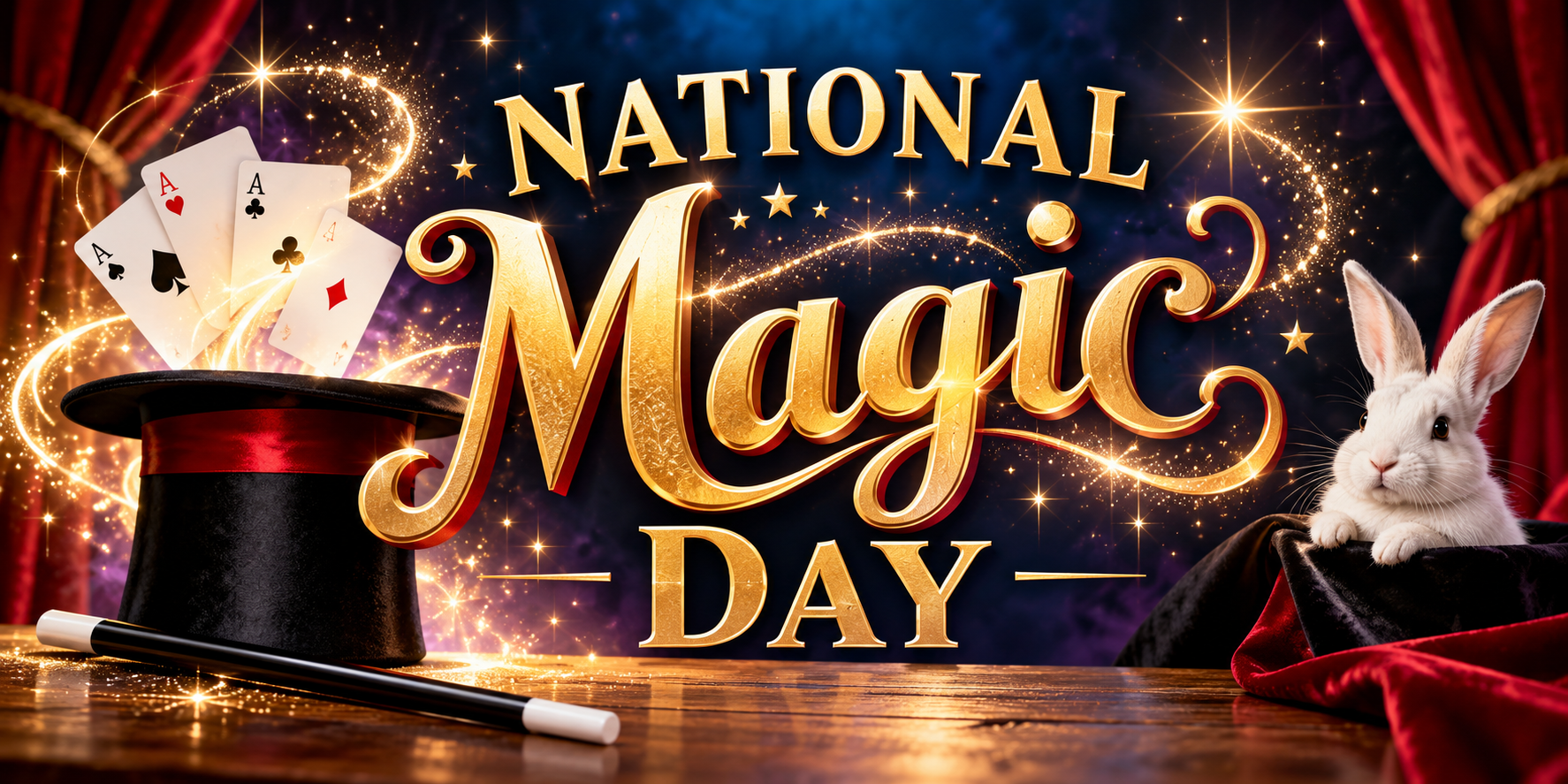
Every year on October 31, while millions of people celebrate Halloween with costumes, candy, and spooky decorations, another fascinating celebration takes place: National Magic Day. This special occasion honors the extraordinary world of magic, the talented performers who bring illusions to life, and the legendary magician Harry Houdini, whose influence continues to inspire generations.
Magic has fascinated people for centuries. Whether it is a magician pulling a rabbit out of a hat, making an object disappear, escaping from seemingly impossible situations, or performing an unbelievable card trick, magic has a remarkable ability to capture our attention and awaken our imagination.
National Magic Day reminds us that the world still has room for wonder, curiosity, creativity, and mystery.
But why is National Magic Day celebrated on Halloween? What does Harry Houdini have to do with this holiday? And how can you celebrate the art of magic yourself?
Let’s explore the fascinating history, traditions, and significance of National Magic Day.
What Is National Magic Day?
National Magic Day is observed annually on October 31 to celebrate the art of magic and recognize the performers who have dedicated their lives to entertaining audiences through illusion, sleight of hand, and extraordinary demonstrations of skill.
Unlike the supernatural magic portrayed in fantasy movies and Halloween stories, the magic celebrated on this day primarily involves theatrical entertainment.
Professional magicians use creativity, psychology, misdirection, storytelling, specialized equipment, and years of practice to create experiences that appear impossible.
Some of the most popular forms of performance magic include:
-
Close-up magic: Tricks performed directly in front of spectators using cards, coins, and everyday objects.
-
Stage illusions: Large-scale performances featuring disappearing assistants, levitation, and elaborate theatrical effects.
-
Escape artistry: Performances involving seemingly impossible escapes from locks, restraints, and confined spaces.
-
Mentalism: Entertainment that creates the illusion of mind reading, prediction, or extraordinary psychological abilities.
-
Street magic: Interactive performances conducted in public places.
-
Comedy magic: Performances combining humor, audience participation, and surprising illusions.
Although these styles differ, they share one important goal: creating a sense of amazement.
National Magic Day celebrates the dedication and imagination required to make those moments possible.
When Is National Magic Day Celebrated?
ANNUAL OBSERVANCE
OCT
31
October 31 — Every Year
National Magic Day shares its date with Halloween and commemorates the death of legendary escape artist Harry Houdini in 1926.
The date is especially meaningful because Houdini became one of the most influential figures in the history of performance magic.
Although Halloween is traditionally associated with ghosts, witches, and supernatural mysteries, National Magic Day focuses on the remarkable artistry behind magical entertainment.
The connection between these celebrations makes October 31 an especially fitting day to explore the mysterious and entertaining world of illusion.
The History of National Magic Day
The origins of National Magic Day are closely connected to Harry Houdini and the efforts of magicians to preserve his legacy.
Houdini died on October 31, 1926, in Detroit, Michigan, at the age of 52.
His death marked the end of an extraordinary career that had transformed escape artistry and theatrical magic.
In the years following his death, members of the magic community organized commemorations to honor his achievements.
One important early observance was Houdini Day in 1927. Over time, the commemoration developed into a broader celebration of the magical arts.
The Society of American Magicians, an organization with which Houdini was closely associated, helped promote the tradition of honoring magicians and their contributions.
Today, National Magic Day continues to recognize Houdini’s legacy while celebrating performers of every generation.
It is an opportunity to appreciate not only famous magicians but also the countless entertainers who perform at birthday parties, theaters, community events, festivals, and schools.
Who Was Harry Houdini?
Harry Houdini remains one of the most recognizable names in the history of magic.
Born Erik Weisz on March 24, 1874, in Budapest, Hungary, Houdini immigrated to the United States with his family as a child.
He developed an interest in performance and eventually adopted the stage name Harry Houdini, inspired by the famous French magician Jean-Eugène Robert-Houdin.
Although Houdini performed traditional magic tricks early in his career, he became internationally famous for his astonishing escape performances.
His ability to escape from handcuffs, locked containers, restraints, and dangerous situations captured the imagination of audiences around the world.
Houdini’s Most Famous Escapes
Some of Houdini’s most memorable performances included:
1. The Chinese Water Torture Cell
Houdini was suspended upside down inside a water-filled cabinet, with his ankles secured in restraints. The dramatic escape became one of his signature performances.
2. The Milk Can Escape
Houdini was locked inside a large milk can filled with water. Audiences watched anxiously as he attempted to escape before running out of air.
3. The Straightjacket Escape
Houdini escaped from tightly secured straightjackets, sometimes while suspended high above city streets.
4. Handcuff Challenges
He invited police officers and others to provide handcuffs and restraints from which he would attempt to escape.
5. The Buried Alive Escape
Houdini experimented with escapes involving burial or confinement beneath the ground, demonstrating both the physical and psychological challenges of his craft.
These performances required extensive preparation, physical conditioning, specialized techniques, and exceptional showmanship.
They were also extremely dangerous, and they should never be attempted without professional expertise and appropriate safety precautions.
Why Did Harry Houdini Become So Famous?
Houdini was much more than a talented escape artist.
He understood the importance of suspense, storytelling, publicity, and audience engagement.
Instead of simply performing a trick, he created an experience.
Audiences were not just watching a man escape from handcuffs. They were witnessing what appeared to be an impossible challenge.
Houdini built anticipation by emphasizing the difficulty of each escape.
He also traveled extensively, performed public challenges, and attracted newspaper attention.
His success demonstrated that magic was not merely about technical skill. It was also about creating an emotional connection with an audience.
That combination of skill, mystery, and theatrical presentation helped make Houdini a household name.
Even a century after his death, his name remains associated with extraordinary escapes and seemingly impossible accomplishments.
The Connection Between National Magic Day and Halloween
At first glance, National Magic Day and Halloween might seem like completely different celebrations.
However, they share several fascinating connections.
Halloween is associated with mystery, imagination, costumes, storytelling, and the unexpected.
Magic performances rely on many of those same elements.
Both celebrations encourage people to temporarily set aside ordinary expectations and experience something surprising.
Halloween creates an atmosphere where mysterious events feel especially entertaining.
National Magic Day celebrates the performers who use illusion and creativity to produce that feeling of wonder.
The date also carries historical significance because Houdini died on Halloween.
Interestingly, Houdini spent part of his later career investigating and exposing fraudulent spiritualists who claimed to communicate with the dead.
Although he was a master illusionist, he was also deeply skeptical of supernatural claims presented as genuine.
This contrast between theatrical illusion and supposed supernatural abilities adds another fascinating dimension to his legacy.
The Different Types of Magic
Magic has developed into a diverse form of entertainment with many specialized styles.
1. Close-Up Magic
Close-up magic involves performing illusions near spectators.
Card tricks, disappearing coins, and unexpected object transformations are common examples.
Because the audience is so close to the performer, these tricks require exceptional precision and practice.
2. Stage Magic
Stage magic involves theatrical productions performed for larger audiences.
These performances may feature elaborate lighting, music, costumes, props, and dramatic illusions.
Some stage magicians specialize in making large objects disappear or creating the appearance of levitation.
3. Escape Magic
Escape artists attempt to free themselves from restraints or confinement.
Harry Houdini popularized this form of entertainment, although other performers have developed their own escape techniques and theatrical styles.
4. Mentalism
Mentalists create the appearance of extraordinary mental abilities.
Performances may involve predictions, psychological illusions, apparent mind reading, or seemingly impossible demonstrations of memory and observation.
5. Comedy Magic
Comedy magicians combine illusion with jokes, audience interaction, and playful surprises.
Their performances often emphasize laughter as much as amazement.
6. Digital Magic
Modern technology has introduced new opportunities for magical entertainment.
Performers may incorporate video projection, smartphones, augmented reality, and interactive digital effects into their shows.
Although the equipment has changed, the underlying goal remains the same: surprising the audience with something unexpected.
Famous Magicians Who Helped Shape the Art
Harry Houdini is one of the most celebrated figures in magic, but many other performers have helped shape the industry.
David Copperfield
David Copperfield became internationally famous for large-scale illusions and theatrical storytelling.
His performances have included making the Statue of Liberty appear to disappear and creating the illusion of walking through the Great Wall of China.
Penn & Teller
Penn Jillette and Teller are known for combining magic, comedy, skepticism, and creative presentations.
Their performances often explore how audiences perceive illusion and deception.
David Blaine
David Blaine helped popularize modern street magic through close-up performances and television specials.
He is also known for endurance challenges that test physical and mental limits.
Criss Angel
Criss Angel became famous for combining theatrical illusion with dramatic visual effects and television entertainment.
His performances introduced magic to audiences through a contemporary, highly stylized presentation.
Jean-Eugène Robert-Houdin
Often described as a foundational figure in modern theatrical magic, Robert-Houdin helped transform magic into a sophisticated stage entertainment during the nineteenth century.
His influence extended to Houdini and generations of performers who followed.
Each of these magicians contributed something distinctive to the art, demonstrating how magic continues to evolve.
Why Do People Love Magic?
One of the most fascinating things about magic is its ability to entertain people of different ages, cultures, and backgrounds.
A child watching a coin disappear may experience the same sense of astonishment as an adult witnessing an elaborate stage illusion.
But why does magic have such a powerful effect?
Magic Awakens Curiosity
Human beings naturally want to understand how things work.
When a magician performs something that appears impossible, our minds immediately begin searching for an explanation.
That curiosity makes magic engaging.
Magic Encourages Imagination
Magic invites audiences to consider possibilities beyond everyday expectations.
Even when spectators know they are watching an illusion, they can still enjoy the experience.
Magic Creates Shared Experiences
A successful magic trick often produces laughter, surprise, applause, and conversation.
These reactions bring people together.
Magic Reminds Us That Surprises Still Exist
Daily routines can sometimes make life feel predictable.
Magic interrupts that predictability.
For a few moments, audiences experience something unexpected and exciting.
That sense of wonder is one of the reasons magic remains popular across generations.
How to Celebrate National Magic Day
National Magic Day offers plenty of opportunities for families, friends, schools, and communities to enjoy the magical arts.
Here are ten ways to participate.
-
Watch a magic show. Attend a performance at a theater, community event, or entertainment venue.
-
Learn a simple card trick. Practice a beginner-friendly illusion and perform it for family or friends.
-
Read about Harry Houdini. Explore his fascinating life, accomplishments, and influence on modern magic.
-
Watch a documentary about magic. Discover the history and creativity behind famous illusions.
-
Host a magic-themed party. Combine decorations, costumes, games, and family-friendly performances.
-
Support a local magician. Attend a show or recommend a talented performer to others.
-
Teach children about illusion. Explain how practice, creativity, and attention can create amazing entertainment.
-
Explore the history of magic. Learn how ancient performers, traveling entertainers, and theatrical magicians developed the art.
-
Share your favorite magic memory. Talk about a performance that amazed you or inspired your imagination.
-
Create a magic challenge. Invite friends or family members to learn and demonstrate a safe, simple trick.
You do not have to be a professional magician to participate.
Sometimes a simple card trick or a surprising optical illusion is enough to make the day memorable.
Fun Facts About Magic
The world of magic contains fascinating stories, traditions, and historical achievements.
Magic has existed for thousands of years. Performers have entertained audiences with tricks and illusions since ancient times.
The word “abracadabra” has a long history. It appeared in ancient writings and was historically associated with protective charms before becoming a familiar expression in stage magic.
Houdini was also an aviation pioneer. In 1910, he made an early powered flight in Australia, an achievement separate from his career as an escape artist.
Magicians use psychology. Attention, expectation, memory, and perception can all influence how audiences experience illusions.
Not all magic requires expensive equipment. Some impressive effects can be performed with ordinary household objects.
Magic organizations have existed for more than a century. The Society of American Magicians was founded in 1902.
Practice is essential. Even tricks that appear effortless may require countless hours of rehearsal.
These facts demonstrate that magic is not simply about secrecy. It is an art built on creativity, discipline, and an understanding of human perception.
The Importance of Magic in Childhood
For children, magic can be especially meaningful.
A simple illusion can inspire questions, imagination, and creative exploration.
Learning age-appropriate magic tricks can also help children develop useful skills.
Practicing a trick may improve hand coordination, patience, concentration, and confidence.
Performing in front of others provides opportunities to practice communication and presentation.
Magic can also introduce children to scientific concepts involving optics, perception, mathematics, and problem-solving.
For example, certain card tricks rely on mathematical patterns rather than complicated sleight of hand.
Other illusions demonstrate how the brain interprets visual information.
When presented in an educational setting, magic can make learning feel exciting.
Most importantly, it can create positive memories between children and the adults who share those experiences with them.
The Role of Magic in Modern Entertainment
Although magic has existed for centuries, it continues to evolve.
Television competitions, online videos, live theater, and social media have introduced magical entertainment to new audiences.
Modern performers often combine traditional techniques with contemporary technology.
A magician might use a smartphone instead of a deck of cards or incorporate digital projections into a stage illusion.
However, technology alone does not create a successful performance.
Storytelling, personality, timing, audience participation, and creativity remain essential.
The strongest magic performances do more than surprise spectators.
They create memorable experiences.
As long as people enjoy mystery and imagination, magic will continue to have a place in entertainment.
What Can Magic Teach Us About Life?
Although stage magic is designed to entertain, its principles can offer valuable lessons.
Not Everything Is What It Seems
Magic demonstrates how easily our expectations can influence perception.
What appears obvious may not always represent the full picture.
This reminds us of the importance of curiosity and careful observation.
Practice Can Make the Impossible Seem Possible
Professional magicians spend years developing their skills.
What appears effortless onstage is often the result of dedication and repetition.
Their achievements demonstrate the value of persistence.
Creativity Can Change Our Perspective
Magicians frequently transform ordinary objects into extraordinary experiences.
A deck of cards, a coin, or a piece of rope becomes part of something memorable.
This reminds us that creativity can help us see familiar things differently.
Wonder Is Worth Preserving
As adults, we sometimes become so focused on responsibilities that we forget to appreciate small moments of amazement.
Magic encourages us to remain curious.
It reminds us that laughter, surprise, and imagination can still brighten an ordinary day.
Why National Magic Day Matters
National Magic Day is more than a celebration of disappearing objects and impressive illusions.
It recognizes an artistic tradition that has entertained audiences for generations.
It honors performers who dedicate themselves to developing their craft.
It preserves the legacy of Harry Houdini and other influential magicians.
It also reminds us of the importance of imagination in everyday life.
In a world filled with technology, information, and constant distractions, the ability to create a genuine moment of wonder remains valuable.
Magic brings people together through curiosity and shared excitement.
It encourages us to ask questions, explore possibilities, and appreciate creativity.
Whether performed on a grand theater stage or at a family gathering, magic has the ability to turn an ordinary moment into a lasting memory.
Final Thoughts: Keep the Wonder of Magic Alive
Every October 31, National Magic Day gives us an opportunity to celebrate mystery, creativity, and the extraordinary performers who make the impossible appear possible.
From Harry Houdini’s legendary escapes to modern magicians using technology and theatrical storytelling, the art of magic continues to inspire audiences around the world.
The holiday also reminds us that wonder does not have to disappear as we grow older.
Sometimes all it takes is a surprising trick, an imaginative performance, or a moment of curiosity to remind us how fascinating the world can be.
This Halloween, while enjoying costumes, decorations, and seasonal traditions, take a moment to appreciate the remarkable art of magic.
Watch a performance, learn something new, share a laugh, and celebrate the creativity that makes magic special.
Because sometimes the greatest magic is not making something disappear. It is bringing back the sense of wonder we thought we had lost.
What is the most amazing magic trick or illusion you have ever witnessed, and did you ever figure out how it was done?


Leave a Reply