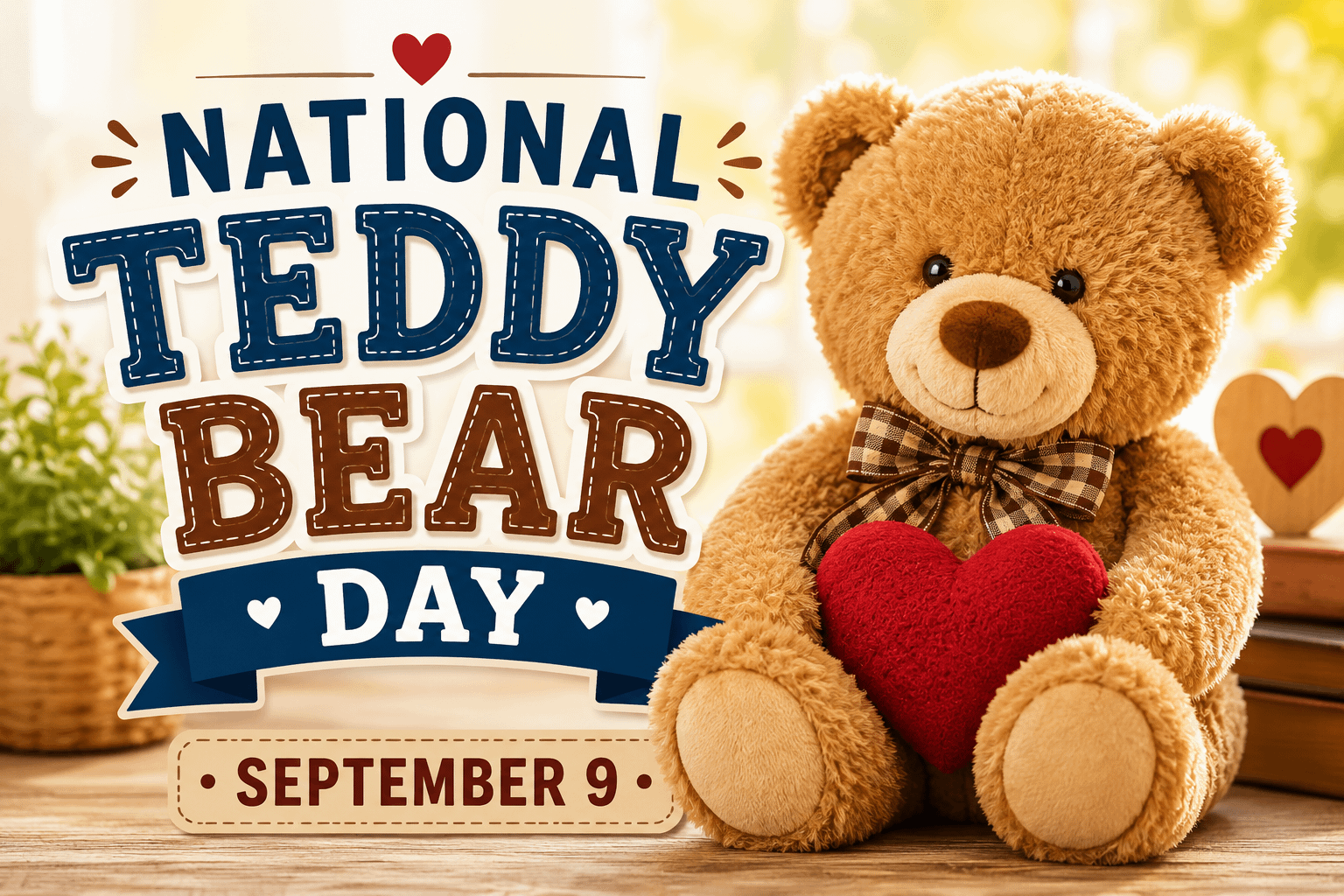
Every year on September 9, National Teddy Bear Day celebrates one of the most recognizable and beloved toys ever created—the teddy bear.
For generations, teddy bears have been tucked into cribs, carried on family vacations, squeezed tightly during thunderstorms, brought to hospital rooms, displayed on bedroom shelves, and saved for decades as reminders of childhood. They are simple stuffed animals, yet the emotions attached to them can be anything but simple.
A teddy bear can represent childhood innocence, friendship, security, comfort, love, and memory. For some people, an old teddy bear is one of the few possessions they still have from their earliest years. For others, a teddy bear reminds them of a parent, grandparent, child, sibling, spouse, or friend who gave it to them.
National Teddy Bear Day gives us an opportunity to appreciate those memories while also learning how the teddy bear became such an enduring part of American culture.
When Is National Teddy Bear Day?
National Teddy Bear Day is celebrated annually on September 9.
The day encourages people of all ages to appreciate teddy bears, share childhood memories, give teddy bears as gifts, donate stuffed animals to children, or simply find that old bear stored somewhere in the house and remember the stories connected to it.
Although teddy bears are usually associated with children, there is certainly no age limit on appreciating them.
Many adults collect teddy bears, preserve bears from childhood, or keep a special stuffed animal because of the person who gave it to them.
Sometimes the sentimental value of an object matters far more than its monetary value.
The Teddy Bear’s Presidential Connection
The story behind the teddy bear begins with an American president: Theodore Roosevelt.
Roosevelt, often called “Teddy,” became president in 1901 following the assassination of President William McKinley. Roosevelt was known for his energetic personality, interest in the outdoors, and enthusiasm for hunting.
In November 1902, Roosevelt participated in a hunting trip in Mississippi.
During the hunt, Roosevelt’s companions and guides encountered a bear. According to historical accounts, the animal was restrained so Roosevelt could shoot it.
Roosevelt refused.
He believed shooting a captured animal would be unsportsmanlike.
The incident quickly attracted public attention.
Political cartoonist Clifford Berryman created a cartoon depicting Roosevelt refusing to shoot the bear. The cartoon helped turn the episode into a memorable piece of American popular culture.
And that little bear would soon inspire something much bigger.
How the “Teddy’s Bear” Was Born
After seeing the famous Roosevelt bear cartoon, Brooklyn shopkeepers Morris and Rose Michtom created a stuffed bear.
The Michtoms reportedly displayed the bear in their shop window and called it “Teddy’s Bear.”
The toy became extremely popular.
Morris Michtom eventually helped establish the Ideal Novelty and Toy Company, which became an important American toy manufacturer.
Around the same period, German toy manufacturer Steiff was also producing stuffed bears. The early development of the teddy bear therefore involved important contributions on both sides of the Atlantic.
By the early 20th century, stuffed bears were becoming a sensation.
What began as a political cartoon and a creative toy idea quickly developed into one of the most enduring toy traditions in history.
Why Teddy Bears Became So Popular
Many toys become popular for a few years and then disappear.
The teddy bear has survived for more than a century.
One reason may be its simplicity.
A teddy bear doesn’t need batteries.
It doesn’t require an internet connection.
There are no complicated instructions.
A teddy bear simply waits to be held.
Children can give their teddy bears names, personalities, adventures, and entire imaginary lives. One bear might become a brave explorer while another becomes a bedtime companion.
The child’s imagination does the rest.
But perhaps the greatest reason teddy bears remain popular is the sense of comfort they can provide.
When a child is scared, lonely, tired, sick, or away from home, holding something familiar can be reassuring.
That emotional connection can become incredibly strong.
The Teddy Bear as a Symbol of Comfort
There is something meaningful about the way people instinctively give stuffed animals during difficult moments.
Teddy bears are frequently given to children in hospitals, shelters, emergency situations, and other stressful environments.
They can provide something soft and familiar to hold when life suddenly feels uncertain.
A teddy bear cannot solve a problem or take away pain, but sometimes comfort doesn’t need to come with words.
Sometimes comfort is simply having something to hold.
That is one reason teddy bears have become associated with compassion and kindness.
A donated teddy bear may seem like a small gesture to the person giving it.
To the child receiving it, however, that bear could become a treasured companion.
Teddy Bears and Childhood Memories
Think about the toys you had when you were young.
You probably don’t remember every one of them.
But there may be one stuffed animal you remember clearly.
Perhaps it sat beside you every night.
Maybe you carried it everywhere until its fur became worn and one of its eyes nearly fell off.
Perhaps a parent had to repair it repeatedly because you refused to replace it.
Those imperfections often become part of what makes an old teddy bear special.
A brand-new teddy bear may be beautiful.
A well-loved teddy bear tells a story.
The faded fur, loose stitching, flattened stuffing, missing ribbon, or repaired paw can represent years of childhood adventures.
Those marks aren’t necessarily damage.
They’re memories.
Why Adults Keep Their Childhood Teddy Bears
Opening an old box and discovering a childhood teddy bear can immediately bring back memories.
You may remember your childhood bedroom.
You may remember your parents or grandparents.
You might remember Christmas mornings, birthdays, family vacations, or nights when that bear was sitting beside you.
Objects can become connected to particular moments and people in our lives.
That is why throwing away an old stuffed animal can sometimes feel surprisingly difficult.
Technically, it may only be fabric and stuffing.
Emotionally, it can represent an entire chapter of life.
Some adults keep their childhood teddy bears for decades and eventually give them to their own children or grandchildren.
In that way, a simple toy can become a family keepsake.
Teddy Bears as Gifts of Love
Teddy bears aren’t limited to childhood.
They have also become popular symbols of affection.
Walk through almost any store around Valentine’s Day and you’ll probably find teddy bears holding hearts, carrying roses, or wearing messages about love.
They’re also given for anniversaries, birthdays, graduations, baby showers, births, get-well wishes, and other special occasions.
Part of their appeal is their emotional simplicity.
Giving someone a teddy bear can quietly communicate:
“I care about you.”
“I’m thinking about you.”
“I hope this brings you comfort.”
“I want you to remember me.”
Those messages help explain why teddy bears remain popular gifts even in an age filled with sophisticated technology.
Teddy Bears Can Hold Powerful Memories
Sometimes a teddy bear becomes more meaningful because of who gave it to us.
A bear received from a parent may become priceless after that parent is gone.
A stuffed animal belonging to a child may become one of the most treasured possessions a parent keeps.
A teddy bear from a grandparent can bring back memories of their home, voice, hugs, or traditions.
This is where ordinary possessions can become extraordinary.
The object itself hasn’t changed.
Its meaning has.
That is one of the powerful things about memory. We attach moments, people, emotions, and stories to the things around us.
Years later, simply seeing those objects can transport us back to another time.
Teddy Bears in Popular Culture
The teddy bear eventually became much more than a toy.
Bears have appeared throughout children’s literature, television, movies, advertising, and popular culture.
Some of the world’s most recognizable fictional bears demonstrate how naturally the animal fits stories about childhood, friendship, adventure, and imagination.
From gentle storybook bears to mischievous characters getting into trouble, bears have occupied an enormous place in children’s entertainment.
The traditional teddy bear itself has also changed dramatically.
Today you can find bears in almost every imaginable style.
There are miniature teddy bears, enormous teddy bears, handmade bears, collectible bears, personalized bears, memory bears, holiday bears, sports-themed bears, and bears designed to resemble particular characters.
Despite all those variations, the basic idea remains remarkably similar to the bears children loved generations ago.
The Rise of Collectible Teddy Bears
Teddy bear collecting eventually became a serious hobby.
Some collectors search for antique bears from famous manufacturers, while others specialize in particular brands, artists, periods, or designs.
Vintage bears can be especially fascinating because they provide a glimpse into the history of toy manufacturing.
Materials, facial designs, joints, stuffing, clothing, and construction methods have changed considerably over the decades.
Collectors often pay close attention to details such as labels, buttons, stitching, materials, and manufacturing marks when determining the history of an old bear.
But not every valuable teddy bear is valuable because of money.
The most important bear in someone’s collection might be worth very little financially.
It may simply be the bear their mother gave them when they were five years old.
Sentimental value can’t always be measured with a price tag.
Memory Bears Create Something Special From Clothing
One particularly meaningful modern variation is the memory bear.
Memory bears can be created using clothing or fabric associated with someone special.
For example, a bear might be made from a loved one’s favorite shirt, pajamas, uniform, blanket, or another meaningful piece of fabric.
These bears can become treasured keepsakes.
For families grieving someone they love, a memory bear can provide a physical reminder of that person’s life.
It doesn’t replace the person or remove grief.
But it can preserve something familiar in a new form.
A shirt that once hung in a closet becomes something that can be held.
For some people, that can carry enormous emotional significance.
Teddy Bears and Acts of Kindness
National Teddy Bear Day can also be about giving.
Consider purchasing a new teddy bear or stuffed animal and donating it to an organization serving children.
Depending on local policies and needs, children’s charities, shelters, hospitals, emergency-response programs, foster-care organizations, and holiday toy drives may accept new stuffed animals.
Always check an organization’s donation requirements before bringing items because some facilities have specific health and safety rules.
A small act of generosity could create a comforting moment for a child experiencing a difficult situation.
And sometimes small moments matter more than we realize.
Ways to Celebrate National Teddy Bear Day
There are plenty of ways to enjoy September 9.
Find your childhood teddy bear.
If you still have it, take it out of storage and remember the stories connected to it.
Share an old photograph.
Post a childhood picture featuring your favorite stuffed animal and tell the story behind it.
Give a teddy bear to a child.
A simple surprise could become one of their favorite childhood possessions.
Donate a new stuffed animal.
Find a local organization that accepts new teddy bears for children who need comfort.
Create a memory bear.
Consider transforming meaningful clothing into a keepsake honoring someone important in your life.
Start a family tradition.
Parents and grandparents can use the holiday as an opportunity to share childhood stories with younger generations.
Read a favorite bear story.
Celebrate the day by reading a classic children’s story featuring a beloved bear character.
Visit a toy or teddy bear museum.
Some museums and collections preserve historic toys and demonstrate how teddy bears have changed through generations.
Give someone a bear “just because.”
You don’t always need a birthday, anniversary, or holiday to remind someone that you care.
A Toy That Crosses Generations
One of the most remarkable things about teddy bears is their ability to connect generations.
Your grandparents may have played with teddy bears.
Your parents may have had one.
You may have had one.
Your children or grandchildren may have one today.
The designs have changed, but the emotional connection remains surprisingly familiar.
That gives the teddy bear a kind of timeless quality.
Children living in completely different generations can understand the comfort of hugging a favorite stuffed animal before going to sleep.
Technology may change.
Entertainment may change.
Childhood itself changes.
But the desire for comfort, imagination, friendship, and security remains.
More Than Stuffing and Fabric
National Teddy Bear Day might sound like a lighthearted celebration of a children’s toy.
And it certainly can be.
But when you look deeper, the teddy bear represents something much larger.
It represents childhood.
It represents imagination.
It represents comfort during frightening moments.
It represents gifts from people we love.
It represents memories we refuse to throw away.
And sometimes it represents someone who is no longer physically beside us.
A teddy bear sitting quietly on a shelf may carry decades of stories that no one else can see.
That is what makes sentimental objects so powerful.
Their meaning exists in the memories surrounding them.
Celebrating National Teddy Bear Day on September 9
On September 9, take a moment to appreciate one of the simplest toys ever created.
Find the old teddy bear packed away in the closet.
Look at the childhood photographs.
Tell your children about the stuffed animal you couldn’t sleep without.
Donate a bear to someone who could use a little comfort.
Give someone you love a new one.
Or simply remember the person who once placed a special teddy bear into your hands.
More than a century after teddy bears first became popular, they continue to provide something people will always need: a little comfort, a little imagination, and a reminder that sometimes the smallest things can hold the biggest memories.
Do you still have a teddy bear or stuffed animal from your childhood, and what memory makes it special to you?
Leave a Reply