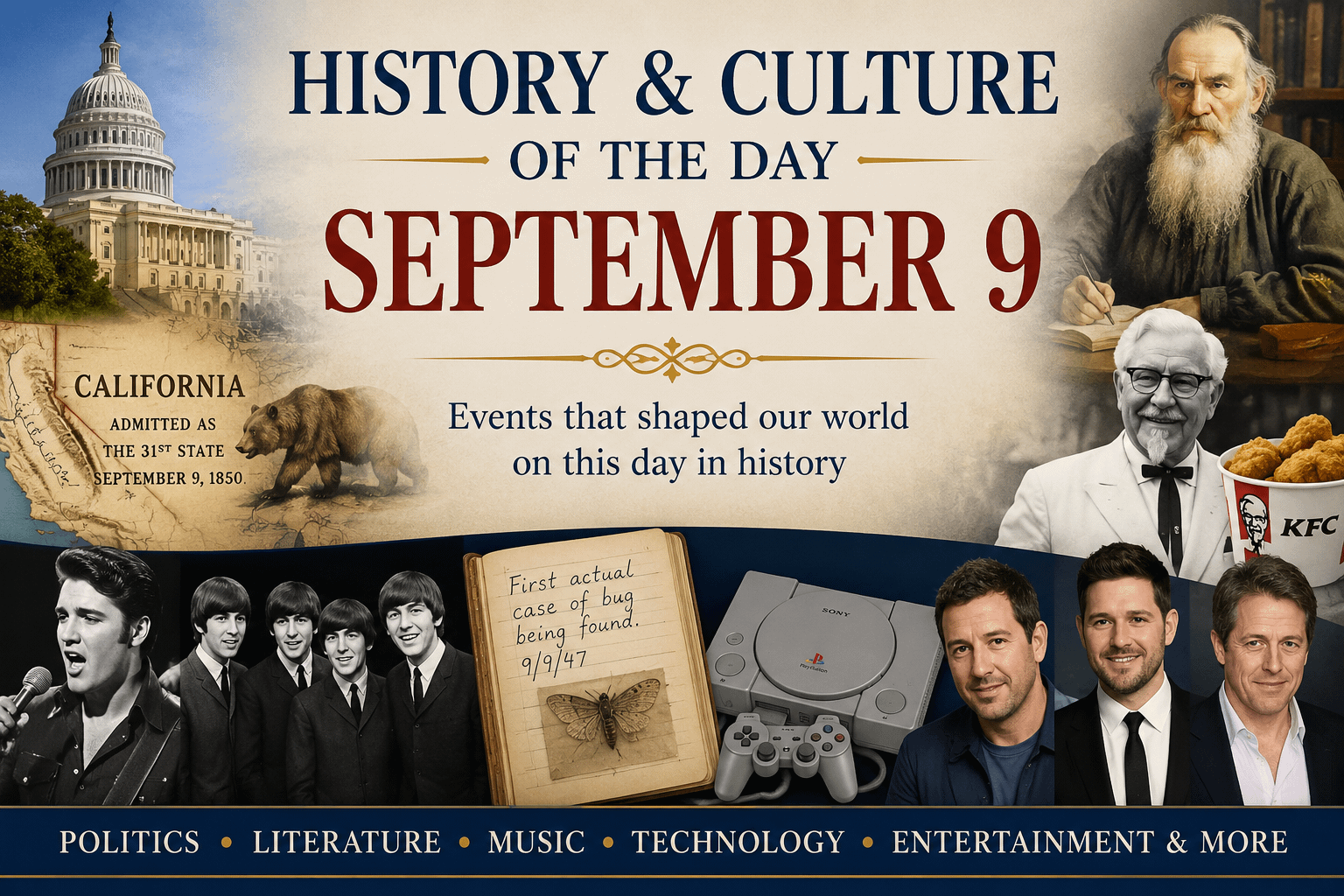
Every date on the calendar carries stories from the past, and September 9 is filled with moments that have influenced politics, exploration, science, entertainment, technology, and popular culture.
From the creation of a new American state and the birth of one of literature’s most famous writers to the rise of rock-and-roll royalty and major developments in computing, September 9 offers a fascinating look at how individual moments become part of our shared history.
Here is a journey through some of the notable events, people, achievements, and cultural milestones associated with September 9.
California Becomes the 31st State – 1850
One of the most significant events in American history connected to September 9 occurred in 1850, when California officially became the 31st state of the United States.
California’s path to statehood was accelerated dramatically by the discovery of gold at Sutter’s Mill in 1848. The California Gold Rush brought hundreds of thousands of people to the region from across the United States and around the world.
Towns expanded almost overnight. San Francisco transformed from a relatively small settlement into a booming commercial center, while mining communities appeared throughout the Sierra Nevada foothills.
The rapid population growth made the question of California’s political future increasingly important.
California was admitted to the Union as a free state as part of the Compromise of 1850, a collection of laws intended to address growing tensions between free and slave states.
Its admission changed the political balance of the country and added another layer to the national conflict over slavery that would eventually contribute to the Civil War.
Today, September 9 is recognized in California as Admission Day, commemorating the state’s entrance into the Union.
California would eventually become the most populous state in the country and one of the world’s most influential centers of agriculture, entertainment, technology, trade, and cultural innovation.
The Compromise of 1850 Reshapes American Politics
California’s admission was part of a much larger political struggle.
On September 9, 1850, several measures associated with the Compromise of 1850 became law. The compromise attempted to resolve disputes over whether slavery would be permitted in territories acquired after the Mexican-American War.
The measures included California’s admission as a free state and changes involving Texas and territories in the American West.
Additional legislation connected with the compromise followed during September.
Rather than permanently solving the nation’s disagreements over slavery, however, the compromise largely postponed the conflict.
Within little more than a decade, the United States would be engulfed in the Civil War.
September 9 therefore represents not only California’s beginning as a state but also an important chapter in the complicated political events leading toward one of the defining periods in American history.
Washington, D.C., Is Named for George Washington – 1791
Another important American milestone occurred on September 9, 1791, when commissioners overseeing the creation of the new federal capital announced that the city would be called Washington, honoring President George Washington.
The surrounding federal district became known as the District of Columbia.
The establishment of a permanent national capital had been authorized through the Residence Act of 1790.
George Washington selected an area along the Potomac River for the new federal district.
French-born engineer and architect Pierre Charles L’Enfant developed an ambitious plan for the city featuring broad avenues, public spaces, and monumental government buildings.
Washington, D.C., would eventually become one of the world’s most recognizable capital cities.
Today it is home to the White House, United States Capitol, Supreme Court, Smithsonian museums, national monuments, memorials, and countless institutions representing American government and history.
The name announced in 1791 remains permanently connected with the nation’s first president.
Leo Tolstoy Is Born – 1828
September 9 is also the birthday of one of the most influential writers in world literature.
Leo Tolstoy was born on September 9, 1828, according to the modern Gregorian calendar, at Yasnaya Polyana in the Russian Empire.
Tolstoy became internationally famous for novels exploring human relationships, morality, war, society, faith, and the meaning of life.
His best-known works include:
- War and Peace
- Anna Karenina
- The Death of Ivan Ilyich
- Resurrection
War and Peace remains one of literature’s most celebrated novels, blending fictional characters with historical events surrounding Napoleon’s invasion of Russia.
Tolstoy’s influence extended far beyond literature.
Later in life, his writings increasingly focused on religion, nonviolence, morality, social inequality, and resistance to oppression.
His philosophy of nonviolent resistance influenced future leaders and activists around the world.
More than a century after his death, Tolstoy’s novels continue to be read, studied, translated, adapted, and debated.
Colonel Sanders Is Born – 1890
One of the most recognizable figures in American food culture was born on September 9, 1890.
Harland David Sanders, better known as Colonel Sanders, was born near Henryville, Indiana.
His life is particularly remarkable because his greatest business success came relatively late.
Sanders worked numerous jobs throughout his life before becoming known for serving fried chicken at a roadside restaurant in Kentucky.
He developed a distinctive method of preparing chicken and promoted a recipe featuring a secret blend of herbs and spices.
Instead of building restaurants entirely on his own, Sanders traveled around the country offering restaurant owners the opportunity to sell chicken using his recipe in exchange for a franchise fee or royalty arrangement.
That approach helped create what eventually became Kentucky Fried Chicken, better known worldwide as KFC.
Colonel Sanders became the public face of the company.
His white suit, black string tie, white hair, and goatee became instantly recognizable elements of American advertising.
His story also became an enduring example of achieving significant success later in life.
The First Computer “Bug” Becomes a Famous Technology Story – 1947
September 9 has an unusual place in computer history because of one of technology’s most famous stories.
On September 9, 1947, engineers working with the Harvard Mark II computer documented a moth discovered inside part of the machine.
The insect had become trapped in a relay and was taped into a logbook with a note referring to it as the “first actual case of bug being found.”
The incident is frequently associated with computer pioneer Grace Hopper, although she did not personally coin the term “bug.”
The word had already been used for years to describe technical or mechanical problems.
What made the Mark II incident memorable was that engineers had literally found an insect inside the computer.
The story became part of computing folklore.
Today, programmers routinely use the terms bug and debugging when referring to errors in software and the process of correcting them.
The moth incident remains a humorous reminder of the early days of computing, when computers filled entire rooms and mechanical components could sometimes be disrupted by something as small as an insect.
Elvis Presley Makes His First Appearance on The Ed Sullivan Show – 1956
American popular culture experienced an unforgettable television moment on September 9, 1956.
That evening, Elvis Presley appeared for the first time on The Ed Sullivan Show.
Elvis was already becoming a sensation among young audiences, but his television appearances helped transform him into a national cultural phenomenon.
His energetic performance style, distinctive voice, fashion, and stage presence represented a dramatic shift from many mainstream entertainers of the era.
Millions of viewers reportedly watched the broadcast.
Interestingly, Ed Sullivan himself was recovering from injuries suffered in an automobile accident, so actor Charles Laughton served as guest host.
Elvis performed from Hollywood rather than appearing in the New York studio.
His appearance represented more than simply another television performance.
It demonstrated the growing power of television to create national celebrities almost instantly.
Elvis would become one of the most influential performers in popular music history and a defining figure in the development of rock and roll.
The Cultural Revolution of Rock and Roll
The rise of Elvis Presley reflected broader changes occurring throughout American society during the 1950s.
Rock and roll combined influences from rhythm and blues, country music, gospel, and other musical traditions.
Young listeners embraced the new sound enthusiastically.
Parents, broadcasters, religious leaders, and cultural critics sometimes viewed the music with suspicion because it challenged traditional expectations surrounding entertainment, youth behavior, fashion, and race.
Television accelerated the cultural transformation.
A performance that once might have reached hundreds or thousands of people in a concert venue could suddenly be watched by millions of families across the country.
Elvis’ September 9 appearance became one of the clearest examples of television’s growing ability to shape American popular culture.
The Beatles Reach America Through Their Music – 1963
September 9 also has a connection with another group that transformed popular music.
In 1963, the Beatles’ recording of “She Loves You” was released as a single in the United States by Swan Records.
At the time, the song initially received relatively little attention from American audiences.
That situation would change dramatically.
By early 1964, Beatlemania had crossed the Atlantic, and the Beatles became one of the biggest musical sensations in American history.
Their arrival helped launch the British Invasion, during which numerous British rock groups became enormously popular in the United States.
The Beatles influenced music, fashion, hairstyles, youth culture, songwriting, recording techniques, and attitudes toward celebrity.
The early American release of “She Loves You” offers an interesting reminder that cultural revolutions do not always become obvious immediately.
Sometimes history-changing trends begin quietly.
The Sony PlayStation Launches in North America – 1995
A major moment in video game culture occurred on September 9, 1995, when Sony released the original PlayStation in North America.
The console entered a competitive gaming market dominated by established companies such as Nintendo and Sega.
Sony’s PlayStation helped push gaming further into the era of three-dimensional graphics and CD-based games.
The system became associated with popular franchises and titles including Final Fantasy VII, Resident Evil, Metal Gear Solid, Gran Turismo, Crash Bandicoot, and Tekken.
The PlayStation brand eventually became one of the most successful names in video gaming.
Its arrival also reflected a larger cultural shift.
Video games were becoming more than children’s entertainment. Gaming increasingly developed into a mainstream entertainment industry attracting teenagers and adults as well as younger players.
Today, the video game industry rivals or exceeds many traditional entertainment industries in cultural and economic influence.
Adam Sandler Is Born – 1966
Actor, comedian, writer, and producer Adam Sandler was born on September 9, 1966, in Brooklyn, New York.
Sandler became widely known during the early 1990s as a cast member on Saturday Night Live.
He later became one of Hollywood’s most commercially successful comedy stars.
His films include:
- Billy Madison
- Happy Gilmore
- The Wedding Singer
- The Waterboy
- Big Daddy
- 50 First Dates
- Grown Ups
While best known for comedy, Sandler has also received praise for dramatic performances in movies such as Punch-Drunk Love, Uncut Gems, and Hustle.
His career demonstrates the lasting influence of comedy on American popular culture, particularly during the 1990s and 2000s.
Michael Bublé Is Born – 1975
Canadian singer Michael Bublé was born on September 9, 1975, in Burnaby, British Columbia.
Bublé became internationally known for blending traditional pop standards, jazz influences, and contemporary music.
His success helped introduce classic songs and big-band-inspired arrangements to younger generations.
His recordings of standards associated with artists such as Frank Sinatra, Dean Martin, and Tony Bennett helped renew interest in traditional pop music during the 2000s.
Bublé has also become closely associated with Christmas music, with his holiday recordings becoming seasonal favorites around the world.
Hugh Grant Is Born – 1960
British actor Hugh Grant, born September 9, 1960, became one of the most recognizable romantic-comedy actors of the 1990s and early 2000s.
His international breakthrough came with Four Weddings and a Funeral.
He later appeared in films including Notting Hill, Bridget Jones’s Diary, Love Actually, and About a Boy.
Grant’s performances helped define the modern British romantic comedy and made him an internationally recognized figure in film culture.
Later in his career, he increasingly moved toward darker, comedic, and character-driven roles.
Otis Redding Is Born – 1941
Soul music legend Otis Redding was born on September 9, 1941, in Dawson, Georgia.
Redding became one of the defining voices of 1960s soul music.
His passionate singing style influenced generations of performers.
Among his most famous recordings are Try a Little Tenderness, I’ve Been Loving You Too Long, and (Sittin’ On) The Dock of the Bay.
Tragically, Redding died in a plane crash in December 1967 at only 26 years old.
“(Sittin’ On) The Dock of the Bay” was released after his death and became one of his most enduring recordings.
Despite his short career, Redding left an extraordinary musical legacy and remains one of the most respected performers in American soul music history.
Why September 9 Matters
September 9 connects remarkably different chapters of history.
It represents the expansion of the United States through California statehood.
It recalls the establishment of Washington, D.C.’s identity as the nation’s capital.
It marks the birth of literary greatness through Leo Tolstoy.
It celebrates cultural figures ranging from Colonel Sanders and Otis Redding to Hugh Grant, Adam Sandler, and Michael Bublé.
It reminds us of the transformation of American popular culture through Elvis Presley and rock and roll.
It even connects with the evolution of technology through the famous computer moth of 1947 and the arrival of the Sony PlayStation in North America in 1995.
Each event belongs to a different world, yet together they illustrate something important about history.
History is not created only through wars, presidents, and political decisions.
It is also created through books people read, music they dance to, inventions they use, foods they share, movies they watch, games they play, and ideas that change how society thinks.
September 9 Through the Years
Here is a quick look at several notable September 9 milestones:
1791 – The name Washington is selected for the new federal capital of the United States.
1828 – Russian author Leo Tolstoy is born.
1850 – California becomes the 31st state of the United States.
1890 – Harland “Colonel” Sanders is born.
1941 – Soul singer Otis Redding is born.
1947 – A moth found in the Harvard Mark II computer becomes part of the famous story behind the term “computer bug.”
1956 – Elvis Presley makes his first appearance on The Ed Sullivan Show.
1960 – Actor Hugh Grant is born.
1963 – The Beatles’ “She Loves You” is released in the United States by Swan Records.
1966 – Actor and comedian Adam Sandler is born.
1975 – Singer Michael Bublé is born.
1995 – Sony launches the original PlayStation in North America.
A Day Connecting Politics, Literature, Music, Technology, and Entertainment
Few things demonstrate the richness of history better than looking closely at a single date.
September 9 contains stories stretching from America’s earliest years as a nation to the modern digital entertainment era.
The political decisions of 1791 and 1850 helped shape the physical and political landscape of the United States.
The literary achievements of Tolstoy influenced generations of readers.
The music of Otis Redding, Elvis Presley, the Beatles, and Michael Bublé reflects how musical styles continuously evolve while borrowing inspiration from earlier generations.
The computer moth of 1947 represents the beginnings of a technological revolution that would eventually transform almost every part of modern life.
And the arrival of the PlayStation in 1995 shows how rapidly new forms of entertainment can become major parts of global culture.
Final Thoughts
History is often remembered through enormous events, but culture is built through countless moments—some political, some technological, some artistic, and some simply entertaining.
September 9 reminds us that history and culture are constantly being created together.
A state joining the Union can reshape a nation.
A writer can influence generations through words.
A singer appearing on television can help redefine popular culture.
A moth trapped inside a computer can become part of technology folklore.
And a new video game console can help transform how millions of people experience entertainment.
Looking back at September 9 gives us more than a collection of interesting facts. It provides a snapshot of how politics, creativity, innovation, music, literature, entertainment, and everyday life combine to create the larger story of human history.
Which September 9 moment do you think had the greatest influence on the world we live in today?
Leave a Reply