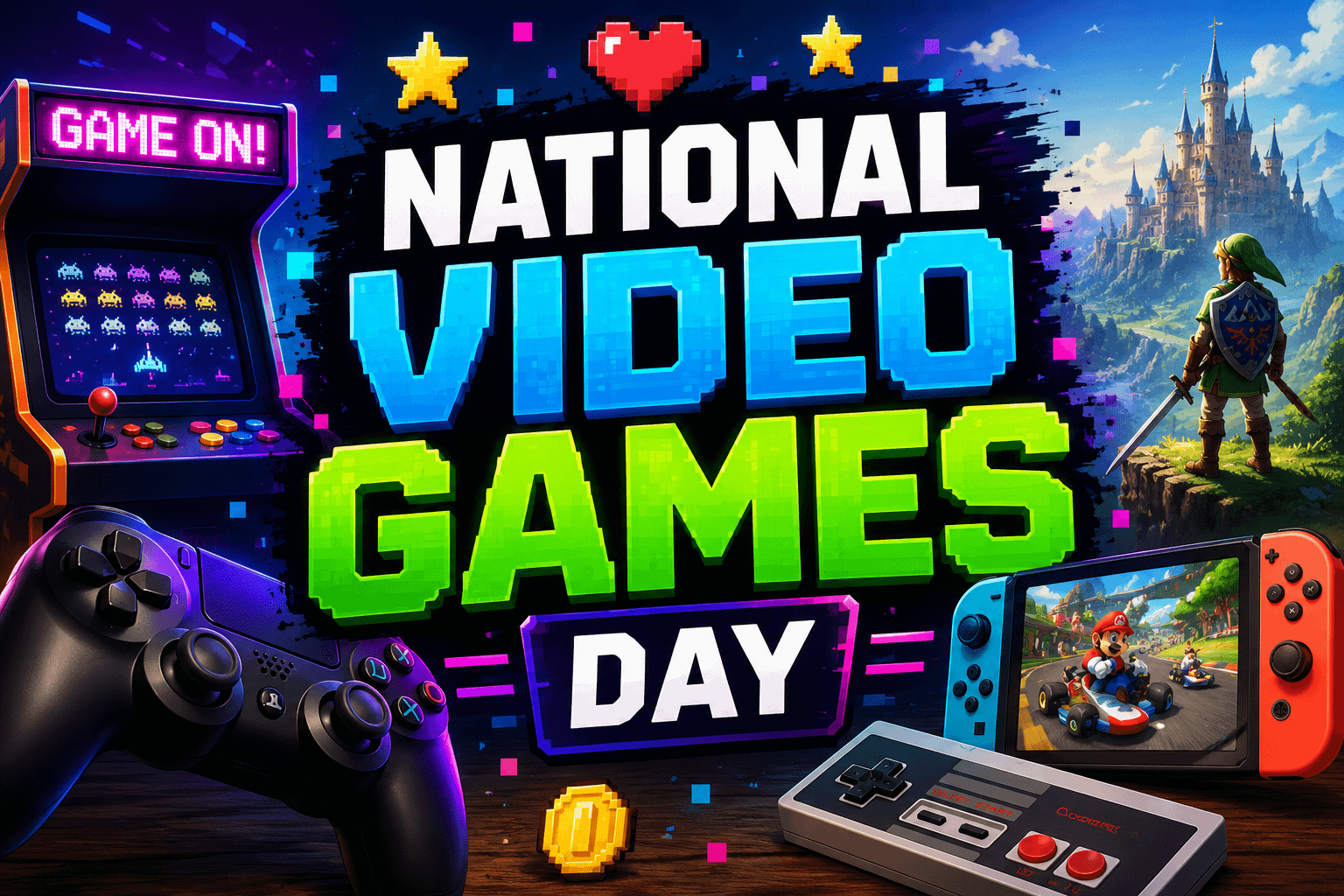
Every year on September 12, gamers have an extra reason to pick up a controller, sit down at a computer, power up a handheld system, or revisit a favorite game from years gone by. It’s National Video Games Day, a celebration of one of the world’s most popular forms of entertainment.
Video games have come an incredibly long way.
What began as simple dots, lines, spaceships, and pixelated characters has grown into an enormous entertainment industry filled with breathtaking virtual worlds, competitive esports, unforgettable stories, online communities, and games capable of bringing millions of people together.
For some people, video games are simply a fun way to spend an evening. For others, gaming is a serious hobby, a competitive pursuit, a creative outlet, or even a career.
And for many of us, video games are also connected to memories.
Maybe you remember standing in an arcade with a pocket full of quarters. Perhaps your childhood included blowing into a game cartridge hoping it would finally work. You might remember getting a new console for Christmas, spending summer afternoons playing games with friends, or staying up far later than you were supposed to because you were determined to beat one more level.
Today’s games may look dramatically different from the classics, but the excitement of playing remains.
National Video Games Day is an opportunity to celebrate that excitement, revisit some gaming memories, discover something new, and appreciate just how much video games have changed entertainment and popular culture.
When Is National Video Games Day?
National Video Games Day is celebrated annually on September 12.
It should not be confused with National Video Game Day, another unofficial gaming observance commonly associated with July 8.
September’s celebration provides the perfect excuse to spend some time with your favorite game, introduce someone to a classic, organize a multiplayer gaming night, or finally start that game you’ve been meaning to play.
Whether you prefer retro arcade machines, home consoles, PCs, handheld systems, mobile games, virtual reality, racing simulators, sports titles, role-playing adventures, strategy games, or online multiplayer competitions, National Video Games Day is for you.
The Early History of Video Games
The history of video games stretches back much further than many people realize.
During the 1950s and 1960s, researchers and computer scientists began experimenting with interactive electronic games. These early creations were primarily demonstrations of what computers could accomplish rather than commercial entertainment products.
One famous early example was Spacewar!, developed in the early 1960s at the Massachusetts Institute of Technology. Two players controlled spacecraft while attempting to destroy one another while dealing with the gravitational pull of a star.
Technology continued advancing, and by the early 1970s, video games were beginning their transformation from laboratory experiments into commercial entertainment.
Then came a game that would help introduce millions of people to gaming.
Pong Changes Everything
In 1972, Atari released Pong, an extremely simple table-tennis-style arcade game.
By today’s standards, Pong is incredibly basic.
Two vertical paddles.
One square ball.
A black screen.
Yet its simplicity was part of its appeal.
Players could immediately understand what they were supposed to do. Move the paddle, hit the ball, and try to get it past your opponent.
Pong became enormously popular and helped demonstrate that people were willing to pay money to play electronic games.
The commercial video game industry was beginning to take shape.
The Golden Age of Arcades
By the late 1970s and early 1980s, arcades were becoming cultural gathering places.
Rows of colorful machines filled arcades, pizza restaurants, shopping malls, convenience stores, bowling alleys, and other businesses.
Games such as Space Invaders, Asteroids, Donkey Kong, Galaga, and Pac-Man became enormously popular.
High scores mattered.
Players would sometimes spend countless quarters trying to beat their friends—or the mysterious initials sitting at the top of the machine’s leaderboard.
Arcade gaming also introduced characters that became cultural icons.
Pac-Man, for example, became one of the most recognizable video game characters ever created.
The arcade era established something that continues today: gaming could be both entertainment and competition.
Video Games Come Home
Arcades were exciting, but gamers increasingly wanted to play without leaving home.
Early home consoles began appearing during the 1970s, but the industry expanded dramatically as technology improved.
The Atari 2600 became one of the most influential early home gaming systems, allowing players to swap cartridges and play different games on the same console.
Suddenly, families could experience arcade-inspired entertainment from their living rooms.
However, the North American video game industry encountered serious problems in the early 1980s. Too many consoles, inconsistent game quality, and an overcrowded marketplace contributed to what became known as the video game crash of 1983.
Some observers wondered whether home video gaming was merely a temporary fad.
Then Nintendo arrived.
Nintendo Revives Home Gaming
The Nintendo Entertainment System became a major success in North America during the mid-1980s and helped restore confidence in home video games.
It also introduced millions of players to franchises and characters that remain famous today.
Super Mario Bros. became one of the defining games of the era.
Mario wasn’t alone.
Gamers explored the world of The Legend of Zelda, battled robots in Mega Man, fought through Contra, experienced Metroid, and discovered countless other adventures.
Nintendo helped transform video games from a struggling industry into a major part of childhood entertainment.
For an entire generation, hearing the words “Nintendo” and “video games” practically meant the same thing.
The Console Wars Begin
Competition intensified during the late 1980s and 1990s.
Sega emerged as a major challenger to Nintendo.
The rivalry between the Super Nintendo Entertainment System and Sega Genesis became one of gaming’s most famous battles.
Nintendo had Mario.
Sega had Sonic the Hedgehog.
Gamers debated which console had better graphics, better games, better controllers, and better characters.
Those debates were serious business on playgrounds.
The competition helped push companies to innovate, creating better hardware and increasingly ambitious games.
Meanwhile, another company was preparing to reshape the industry.
The PlayStation Era
Sony entered the console market with the original PlayStation during the 1990s.
The system helped accelerate gaming’s transition toward three-dimensional environments and CD-based games.
Titles including Final Fantasy VII, Metal Gear Solid, Resident Evil, Gran Turismo, Crash Bandicoot, and Tekken demonstrated how much gaming was evolving.
Characters became more detailed.
Stories became longer.
Music became more cinematic.
Virtual worlds became larger.
Video games were increasingly capable of delivering experiences that could keep players engaged for dozens—or even hundreds—of hours.
Microsoft Enters Gaming
Microsoft joined the console competition with the Xbox in 2001.
One of the system’s most important games was Halo: Combat Evolved, which helped demonstrate how effectively first-person shooters could work on consoles.
The Xbox brand would later play an important role in expanding online console gaming.
Xbox Live allowed players to compete and communicate with people far beyond their living rooms.
Instead of needing everyone sitting on the same couch, players could compete against friends—and strangers—around the world.
Online gaming was becoming mainstream.
Gaming Becomes Social
Video games were once stereotyped as solitary entertainment.
Modern gaming has largely destroyed that stereotype.
Millions of players regularly interact through online multiplayer games.
Friends can cooperate on missions despite living thousands of miles apart.
Families can play together.
Players can join teams, clans, guilds, leagues, and gaming communities.
Games such as Minecraft, Fortnite, Roblox, Call of Duty, and countless others have become digital gathering spaces as much as traditional games.
For many people, logging into a favorite game isn’t only about completing objectives.
It’s also about spending time with friends.
The Rise of PC Gaming
While consoles have played an enormous role in gaming history, computers have developed their own incredibly diverse gaming culture.
PC gaming has helped popularize strategy games, simulations, first-person shooters, massively multiplayer online role-playing games, competitive esports, and independent games.
Digital distribution also changed how people purchased games.
Instead of visiting a store and buying a physical box, players increasingly began downloading games directly to their computers and consoles.
Independent developers gained new opportunities to reach audiences without needing the massive resources traditionally required to distribute physical games.
As a result, today’s gaming marketplace includes everything from enormous blockbuster productions to small experimental projects created by tiny development teams.
Mobile Gaming Brings Games Everywhere
Smartphones dramatically expanded the number of people who play video games.
Suddenly, millions of people who would never consider themselves traditional “gamers” were playing games every day.
Mobile gaming made games incredibly accessible.
People could play while waiting for an appointment, sitting on a train, relaxing during lunch, or spending a few minutes at home.
Games no longer required a television, console, arcade machine, or gaming computer.
The gaming device was already in your pocket.
The Growth of Esports
Competitive gaming has existed almost as long as video games themselves, but esports has transformed competition into a global spectacle.
Professional players compete in tournaments watched by enormous online audiences.
Some events fill arenas.
Teams have coaches, sponsors, analysts, training schedules, and dedicated fan bases.
Games including League of Legends, Counter-Strike, Dota 2, Valorant, Rocket League, and various fighting games have developed major competitive communities.
The idea of becoming a professional gamer might once have sounded unrealistic.
Today, esports is an established part of gaming culture.
Streaming Changes How We Experience Games
Gaming is no longer limited to playing.
Millions of people also enjoy watching other people play.
Livestreaming and video platforms created an entirely new form of gaming entertainment.
Some viewers watch highly skilled competitive players.
Others watch creators because they are funny, entertaining, educational, or simply enjoyable to spend time with.
Walkthroughs, reviews, speedruns, challenges, reaction videos, tutorials, and livestreams have all become important parts of gaming culture.
For younger generations especially, watching gaming content can be almost as normal as watching television.
Why People Love Video Games
There isn’t one single reason people enjoy gaming.
Different games satisfy different interests.
Some people enjoy competition.
Others enjoy exploration.
Some want challenging puzzles.
Others want emotional stories.
Sports fans may enjoy recreating their favorite leagues and teams.
Car enthusiasts may love racing games.
Creative players can build entire worlds.
Strategy fans can manage civilizations.
Adventure fans can explore fantasy kingdoms.
Video games provide something few other entertainment formats can offer: participation.
You aren’t simply watching the hero.
You control the hero.
Your decisions influence what happens next.
That interaction can make gaming incredibly engaging.
Video Games Can Create Powerful Memories
Sometimes the most memorable part of a game isn’t the game itself.
It’s who was sitting beside you.
Maybe you remember playing Mario Kart with your siblings.
Perhaps you spent Friday nights playing fighting games with friends.
Maybe a parent taught you how to play an old arcade game.
You might remember receiving a console you desperately wanted for Christmas.
Or perhaps you made friendships online with people you never would have met otherwise.
Video games often become connected to particular periods of our lives.
Returning to an old game years later can instantly bring back memories.
The music starts.
The opening screen appears.
Suddenly you’re remembering exactly where you were when you first played it.
Retro Gaming Is Still Popular
New video games continue becoming more technologically impressive, but old games haven’t disappeared.
Retro gaming has developed a passionate following.
Players collect vintage consoles and cartridges, restore arcade machines, purchase miniature retro systems, and replay games from decades ago.
There is something appealing about the simplicity of classic games.
You don’t always need a hundred-hour storyline or enormous open world.
Sometimes you just want to eat dots in Pac-Man, clear lines in Tetris, rescue a princess in Mario, or chase another high score.
Great gameplay doesn’t necessarily become obsolete.
How to Celebrate National Video Games Day
There are plenty of ways to celebrate on September 12.
Start with the obvious one:
Play a video game.
Pick your favorite game and give yourself some time to enjoy it.
You could also revisit something from your childhood. Dig out an older console or find a modern way to play a classic title that brings back memories.
Another great option is organizing a multiplayer gaming night with friends or family. Choose a racing game, fighting game, sports game, party game, or cooperative adventure and turn gaming into a social event.
You could try a genre you’ve never played before.
Normally play sports games? Try an RPG.
Love shooters? Try a puzzle game.
Usually play single-player adventures? Try cooperative multiplayer.
You might discover something completely unexpected.
National Video Games Day can also be a great opportunity for parents and children to play together.
Ask your kids to show you their favorite game.
Then show them one you loved when you were younger.
They may laugh at the graphics.
You may laugh when they discover the old game is much harder than expected.
Have a Retro Gaming Challenge
Want to make the celebration more interesting?
Create a retro gaming challenge.
Pick several classic-style games and see who can achieve the highest score.
You could include games inspired by classics such as:
- Pac-Man
- Tetris
- Donkey Kong
- Space Invaders
- Galaga
- Frogger
- Street Fighter
- Sonic the Hedgehog
- Super Mario Bros.
Add snacks, pizza, and a simple tournament bracket and you’ve got your own home arcade night.
Remember to Keep Gaming Balanced
Video games can be a wonderful form of entertainment, but like most hobbies, balance matters.
Long gaming sessions can mean spending hours sitting in the same position.
Take occasional breaks.
Stretch.
Walk around.
Rest your eyes.
Drink some water.
And don’t forget about responsibilities outside the game.
The goal is for gaming to remain something enjoyable rather than something that interferes with everyday life.
From Pixels to Virtual Worlds
Perhaps the most amazing thing about video games is how quickly the technology has evolved.
Compare Pong with today’s massive open-world adventures.
The difference is extraordinary.
Games now feature realistic lighting, enormous environments, cinematic storytelling, sophisticated artificial intelligence, online worlds populated by thousands of players, motion controls, virtual reality, and increasingly immersive experiences.
Yet the fundamental reason we play hasn’t changed very much.
Games are fun.
They challenge us.
They entertain us.
They give us something to accomplish.
They allow us to explore places that don’t exist.
And sometimes they simply give us a reason to sit down with people we care about and enjoy some friendly competition.
Happy National Video Games Day!
National Video Games Day on September 12 celebrates much more than consoles and computers.
It celebrates decades of creativity, technological innovation, unforgettable characters, friendly competition, and shared memories.
From arcade cabinets filled with quarters to cartridges, discs, downloads, smartphones, online multiplayer worlds, esports arenas, and virtual reality, video games have continuously reinvented themselves.
Some people will celebrate by exploring the newest blockbuster release.
Others will return to the games they played decades ago.
And somewhere, someone will probably insist that they’re only going to play for another five minutes—before realizing two hours have passed.
Whatever generation of gaming you grew up with, September 12 is a perfect day to press start, choose your character, and enjoy another adventure.
What video game brings back the strongest memories for you, and what made it so unforgettable?
Leave a Reply