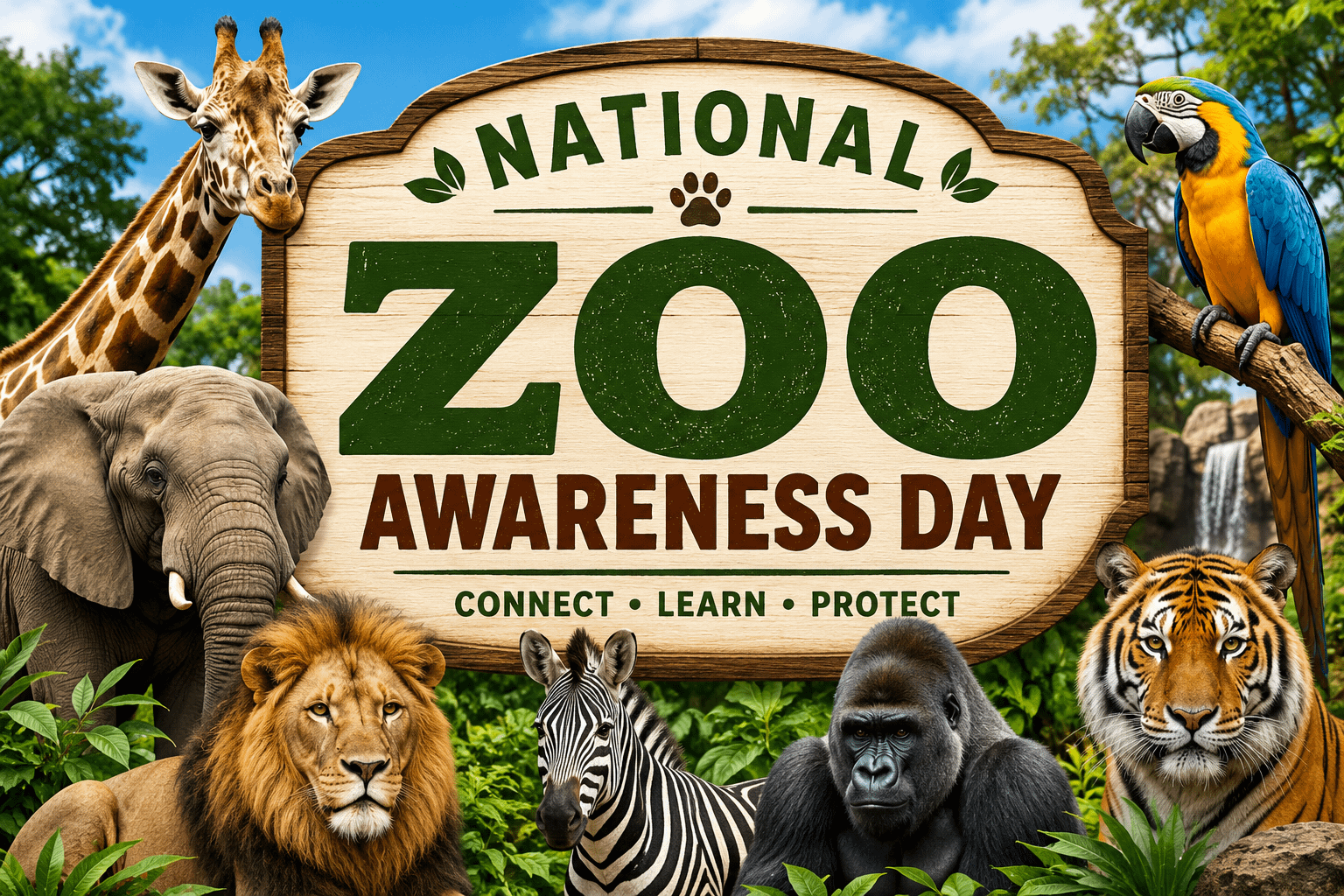
National Zoo Awareness Day is a time to celebrate the incredible diversity of wildlife found around the world while recognizing the responsibility humans have to protect animals and the environments they depend on.
For generations, zoos have introduced people to animals they might otherwise never encounter. A child may see a towering giraffe for the first time, watch an elephant carefully pick up food with its trunk, hear the roar of a lion, observe monkeys interacting with one another, or become fascinated by a brightly colored tropical bird.
Those experiences can create lifelong memories.
But National Zoo Awareness Day is about much more than simply visiting a zoo and looking at animals.
It is an opportunity to learn about wildlife conservation, endangered species, animal welfare, scientific research, habitat destruction, biodiversity, and the ways our everyday decisions can affect animals thousands of miles away.
It can also encourage us to ask thoughtful questions about the institutions that keep wild animals in human care.
What does responsible animal care look like?
How can zoos contribute to conservation?
What should visitors expect from reputable zoological organizations?
And perhaps most importantly, what can each of us do to help protect wildlife?
National Zoo Awareness Day gives us an opportunity to explore those questions while celebrating the extraordinary animals that share our planet.
The Wonder of Seeing Wildlife Up Close
There is something powerful about seeing an animal with your own eyes.
Photographs, books, documentaries, and online videos can teach us a tremendous amount about wildlife, but encountering an animal in person can create a completely different emotional connection.
Imagine standing near a giraffe and realizing just how tall it truly is.
Imagine watching a gorilla carefully examine its surroundings.
Imagine seeing a rhinoceros slowly walk across its habitat.
Or imagine watching a tiger quietly disappear behind vegetation before suddenly appearing again somewhere else.
These moments remind us that animals are not simply pictures in books or characters in movies.
They are living creatures.
Each species has its own behaviors, physical adaptations, communication methods, social structures, diets, habitats, and ecological roles.
A thoughtful zoo experience can transform curiosity into appreciation.
And appreciation can become the beginning of conservation awareness.
Zoos Have Changed Over Time
The concept of keeping exotic animals has existed for thousands of years, although the purposes and standards have changed dramatically.
Historically, collections of unusual animals were sometimes maintained by rulers and wealthy individuals as symbols of power or prestige. Later, public zoological gardens became places where people could observe species from around the world.
Early zoo exhibits often looked very different from the habitats found at many modern institutions.
Animals might have been kept in small cages or simple concrete enclosures designed primarily to make them easy for visitors to see.
Over time, greater scientific understanding of animal behavior and welfare contributed to changes in zoo design and management.
Many contemporary zoos increasingly emphasize environments that allow animals to engage in behaviors associated with their species.
Modern habitat design may incorporate vegetation, climbing structures, water features, hiding areas, elevated platforms, natural substrates, temperature-controlled spaces, and opportunities for animals to choose where they spend their time.
The evolution of zoos demonstrates an important principle:
Our understanding of animal welfare should continue to improve.
Conservation Is One of the Most Important Missions
One of the strongest arguments for responsible modern zoos is their potential contribution to wildlife conservation.
Around the world, wildlife populations face numerous threats.
Habitat destruction remains one of the greatest challenges.
Forests may be cleared for development or agriculture. Wetlands may disappear. Rivers can become polluted. Grasslands can be converted into farmland or cities.
As habitats shrink or become fragmented, animals may struggle to find food, reproduce, migrate, or avoid conflict with humans.
Other threats include climate change, illegal wildlife trafficking, poaching, pollution, invasive species, disease, and unsustainable hunting or fishing.
These problems can become particularly dangerous when a species already has a small population.
Conservation-focused zoos can contribute resources, expertise, funding, education, and research to efforts designed to protect vulnerable wildlife.
Understanding Endangered Species
Not every animal faces the same level of risk.
Some species have healthy populations while others are declining rapidly.
When populations become extremely small, species may become vulnerable to extinction.
Extinction means something permanent.
Once a species disappears completely, it cannot simply be recreated.
The loss can also affect other organisms within the ecosystem.
Predators help regulate prey populations.
Pollinators help plants reproduce.
Seed-dispersing animals help forests regenerate.
Scavengers help recycle nutrients.
Every ecosystem contains complicated relationships that scientists are still working to understand.
Losing one species can sometimes create consequences throughout an ecosystem.
That is why protecting biodiversity is so important.
Conservation Breeding Programs
Some zoos participate in carefully managed breeding programs designed to maintain healthy populations of particular species under human care.
These programs can involve detailed recordkeeping and cooperation among multiple zoological institutions.
Scientists and animal-care professionals may consider genetics, age, health, compatibility, and other factors when planning breeding recommendations.
Maintaining genetic diversity is especially important when populations are small.
In certain circumstances, animals raised through conservation programs may contribute to carefully planned reintroduction efforts.
However, breeding programs are only one piece of conservation.
An animal cannot successfully return to the wild if there is nowhere safe for it to live.
That is why habitat conservation remains essential.
Protecting Animals Means Protecting Habitats
Saving wildlife ultimately requires protecting ecosystems.
A tiger needs more than protection from poaching.
It needs habitat.
An orangutan needs forests.
A sea turtle needs healthy oceans and suitable nesting beaches.
A frog needs clean wetlands.
A pollinating insect needs appropriate plants.
Wild animals exist within complicated environmental systems.
Conservation efforts therefore often involve protecting land, restoring damaged habitats, reducing pollution, working with communities, preventing illegal wildlife trafficking, and finding solutions that allow people and wildlife to coexist.
When visitors learn about these connections, a zoo trip can become a lesson about the entire planet.
Animal Welfare Must Come First
National Zoo Awareness Day should also encourage honest conversations about animal welfare.
Simply calling a facility a “zoo,” “sanctuary,” “wildlife park,” or “animal experience” does not automatically guarantee high standards.
Visitors should learn how to evaluate the organizations they support.
Responsible facilities should prioritize the physical and psychological well-being of their animals.
That means providing appropriate veterinary care, nutrition, shelter, environmental conditions, social arrangements, enrichment, and opportunities to engage in species-appropriate behaviors.
Animals should also have areas where they can retreat from visitors when needed.
The needs of the animal should take priority over a visitor’s desire for constant visibility or entertainment.
What Is Animal Enrichment?
Animal enrichment is an important part of modern zoological care.
Imagine living in the same environment every day without anything new to investigate.
Animals need opportunities for physical and mental stimulation.
Enrichment programs may encourage animals to search for food, solve problems, investigate unfamiliar scents, manipulate objects, climb, dig, swim, explore, or interact socially when appropriate.
Food may sometimes be hidden rather than simply placed in a bowl.
A predator might follow a scent trail.
A primate might receive a puzzle requiring manipulation to access food.
Bears might be given objects to investigate.
Birds may have opportunities to forage.
Different species require different forms of enrichment.
The objective is not merely to keep an animal “busy.”
Thoughtful enrichment encourages behaviors that are meaningful for the species.
The Important Role of Zoo Keepers
Zoo keepers develop close professional familiarity with the animals under their care.
Their responsibilities can include preparing food, cleaning habitats, observing behavior, providing enrichment, participating in training, maintaining records, and communicating changes to veterinary staff.
One of the most important responsibilities is observation.
Animals cannot verbally tell keepers that something feels wrong.
A subtle change in appetite, movement, social behavior, posture, or activity could potentially indicate a health problem.
Experienced caregivers learn what is normal for individual animals.
That knowledge can help veterinary teams identify potential problems earlier.
Veterinary Care for Zoo Animals
Zoo veterinary medicine can be incredibly complex.
Veterinary professionals may care for mammals, reptiles, birds, amphibians, fish, and countless other species.
Each animal can have different nutritional, physiological, medical, and behavioral needs.
Routine care may include examinations, dental care, vaccinations where appropriate, diagnostic testing, parasite prevention, reproductive monitoring, and treatment of injuries or illnesses.
Modern animal training techniques can sometimes allow animals to voluntarily participate in aspects of their own healthcare.
For example, an animal might be trained to present a paw, tail, wing, or other body part for examination.
This type of cooperative care can reduce stress and sometimes reduce the need for anesthesia.
Scientific Research and Wildlife
Zoos can also contribute to scientific research.
Researchers may study animal behavior, reproduction, nutrition, genetics, cognition, communication, veterinary medicine, and physiology.
Research conducted responsibly with animals under human care can sometimes provide information that would be difficult to collect from wild populations.
Knowledge gained through these studies may improve animal care and, in some cases, contribute to conservation programs.
Research should always be conducted according to appropriate ethical and welfare standards.
Zoos as Outdoor Classrooms
For children, zoos can become enormous outdoor classrooms.
A single visit can introduce subjects ranging from biology and geography to environmental science and ecology.
Instead of simply asking children which animal they like best, parents and teachers can encourage deeper questions.
Where does this animal live naturally?
What does it eat?
Is it a predator or prey animal?
How does it protect itself?
Does it live alone or in groups?
What adaptations help it survive?
Is the species endangered?
What threatens its habitat?
These questions encourage observation and critical thinking.
A zoo visit can inspire a child to become interested in science, veterinary medicine, wildlife biology, environmental conservation, or animal care.
Teaching Children Respect for Animals
Zoo visits also offer an opportunity to teach children how humans should behave around animals.
Children should learn that animals deserve respect.
Visitors should never bang on glass, yell at animals to get their attention, throw objects into habitats, cross safety barriers, or attempt to feed animals unless participating in an authorized feeding experience.
Animals are not performers obligated to entertain visitors.
Sometimes an animal may be sleeping.
Sometimes it may hide.
Sometimes it may simply sit quietly.
That is perfectly normal.
Teaching children to patiently observe animals rather than demanding a reaction encourages empathy and respect.
Ethical Questions About Zoos
Discussions about zoos can involve legitimate ethical concerns.
Some people believe keeping wild animals in captivity is inherently problematic. Others argue that well-managed zoological institutions can provide important conservation, research, rescue, and educational benefits.
National Zoo Awareness Day can provide space for thoughtful discussion rather than pretending these questions do not exist.
The important distinction is that animal facilities vary dramatically.
Standards of care, conservation participation, transparency, habitat quality, animal sourcing, educational programs, and welfare practices can differ.
Visitors can make informed decisions about the institutions they support.
Look for organizations that demonstrate meaningful commitments to animal welfare and conservation rather than simply using animals for entertainment.
Wildlife Should Never Exist Only for Entertainment
Animals can be fascinating and entertaining to watch naturally, but entertainment should never become more important than their welfare.
Responsible wildlife education encourages people to appreciate natural behavior.
A lion does not need to perform tricks to be impressive.
An elephant does not need to entertain an audience.
A gorilla simply being a gorilla is fascinating enough.
Animals have value regardless of whether they are entertaining humans.
National Zoo Awareness Day can remind us to appreciate animals for what they are rather than what we want them to do.
Behind the Scenes of a Zoo
Visitors usually see only part of what happens at a zoo.
Long before the gates open, employees may already be preparing diets, inspecting habitats, cleaning facilities, monitoring animals, checking equipment, and coordinating veterinary care.
A modern zoological organization can involve many different careers.
These may include:
- Animal keepers
- Veterinarians
- Veterinary technicians
- Wildlife biologists
- Conservation scientists
- Nutrition specialists
- Educators
- Researchers
- Horticulturists
- Behavioral specialists
- Maintenance teams
- Administrative employees
- Guest-service workers
- Volunteers
Each person contributes in different ways to the operation of the facility.
National Zoo Awareness Day provides an opportunity to recognize these professionals and the responsibility involved in caring for wildlife.
Small Creatures Matter Too
Visitors naturally gravitate toward famous animals such as lions, elephants, giraffes, gorillas, bears, rhinos, and tigers.
But conservation is not limited to large mammals.
Reptiles, amphibians, insects, fish, birds, and small mammals are equally important components of ecosystems.
A tiny frog may be critically important to its environment.
A bee can contribute to pollination.
A bat may consume enormous numbers of insects or help disperse seeds.
A beetle can help break down organic material.
Every creature occupies a place within the natural world.
Sometimes the smallest animals tell the biggest conservation stories.
Learning About Wildlife in Your Own Backyard
You do not have to travel to Africa, Asia, South America, or another distant region to discover fascinating wildlife.
Nature exists all around us.
Local parks, forests, wetlands, rivers, beaches, gardens, and even backyards can provide habitats for wildlife.
National Zoo Awareness Day can inspire people to learn about species native to their own communities.
What birds migrate through your area?
Which butterflies are native?
Are there threatened amphibians nearby?
What mammals live in local open spaces?
Which plants provide food for native pollinators?
Learning about local biodiversity helps transform conservation from a distant concept into something personal.
Make Your Yard More Wildlife-Friendly
People with yards, gardens, patios, or community gardening spaces can take steps to support local wildlife.
Native plants can provide food and shelter for birds, butterflies, bees, and other animals.
Reducing unnecessary pesticide use can protect beneficial insects.
Providing appropriate water sources can help birds and pollinators.
Avoiding invasive plants can protect local ecosystems.
Even small spaces can become valuable habitat.
A few carefully selected native plants can make a difference.
Reduce Plastic and Litter
Pollution can harm wildlife on land and in water.
Animals may accidentally consume plastic or become trapped in discarded materials.
Reducing disposable plastic use when practical, recycling appropriately, disposing of trash responsibly, and participating in community cleanup events are simple ways people can contribute.
The bottle or wrapper dropped on a city street can eventually travel through storm drains and waterways.
Everything is connected.
Learn Before Buying Wildlife Products
Illegal wildlife trafficking threatens many species around the world.
Consumers can unintentionally contribute when purchasing exotic pets, souvenirs, jewelry, traditional products, decorative items, or other goods made from wildlife.
Before purchasing anything that may involve wild animals or plants, learn where it came from and whether it was obtained legally and sustainably.
Consumer demand can influence wildlife exploitation.
Being informed is part of responsible conservation.
Responsible Tourism Matters
Wildlife tourism is popular around the world.
Unfortunately, not every animal attraction prioritizes welfare.
Travelers should research wildlife experiences carefully.
Be cautious about attractions that encourage inappropriate physical contact with wild animals, force animals to perform unnatural behaviors, or appear to prioritize photographs and entertainment over welfare.
Responsible wildlife tourism should respect animals and support conservation rather than exploitation.
Celebrate Without Visiting a Zoo
You do not necessarily have to visit a zoo to participate in National Zoo Awareness Day.
You could watch a wildlife documentary.
Read about an endangered species.
Support a conservation organization.
Visit a natural history museum.
Explore a local wildlife refuge.
Volunteer for habitat restoration.
Participate in a neighborhood cleanup.
Plant native flowers.
Teach children about biodiversity.
Share educational information about conservation.
Even spending an afternoon observing birds in a local park can help develop a greater appreciation for wildlife.
Choose an Animal to Learn About
One fun National Zoo Awareness Day activity is to select one species and become a wildlife researcher for the day.
Choose an animal you have always found interesting.
Then discover:
Where does it naturally live?
What does it eat?
How long does it typically live?
How does it communicate?
Does it live alone or socially?
How does it raise its young?
What predators does it face?
What role does it play in the ecosystem?
Is its population stable or declining?
What threats does it face?
What conservation programs are working to protect it?
You may be surprised by what you discover.
Support Reputable Conservation Programs
Another meaningful way to celebrate is by supporting organizations working to protect wildlife.
Before donating, research the organization.
Look at how it uses donations, what conservation projects it supports, how transparent it is about its work, and whether its programs produce measurable results.
Supporting wildlife conservation can help fund habitat protection, anti-poaching efforts, scientific research, wildlife rehabilitation, education, and community-based conservation.
Even small contributions can become meaningful when many people participate.
Take Plenty of Photos—but Learn Something Too
Taking photographs is part of the fun of visiting a zoo.
Capture the giraffe.
Take a picture of the tiger.
Get a family photo near your favorite exhibit.
But before leaving, challenge yourself to learn at least one new fact about every animal you photograph.
That transforms your photo collection into something more meaningful.
When you share your pictures online, include something you learned.
Instead of simply posting:
“Look at this beautiful elephant!”
You might share a conservation fact about elephants and encourage others to learn more.
Social media can become an educational tool.
Appreciate the Animals You Cannot See
Sometimes visitors become disappointed when an animal is hiding.
But an animal having the ability to retreat can actually be a positive feature of habitat design.
Animals should not always be forced into public view.
If you cannot see an animal, read the educational information nearby.
Learn about its natural habitat.
Come back later.
Watch another species.
Respecting an animal’s ability to choose where it spends its time is part of viewing wildlife responsibly.
The Connection Between Climate and Wildlife
Climate change can alter ecosystems in ways that affect wildlife.
Changes in temperature and rainfall can influence food availability, migration patterns, breeding seasons, ocean conditions, wildfire patterns, and habitat ranges.
Some species may adapt.
Others may struggle.
Animals already threatened by habitat loss can become particularly vulnerable when additional environmental pressures occur.
Understanding these connections can help visitors recognize that conservation is not about protecting individual animals alone.
It is about protecting entire ecosystems.
Every Species Has a Story
One of the most beautiful lessons of National Zoo Awareness Day is that every species has a story.
Some animals have survived dramatic environmental changes.
Some migrate thousands of miles.
Some form complicated social relationships.
Some communicate through sounds humans can barely hear.
Some navigate using Earth’s magnetic field.
Some can regenerate parts of their bodies.
Some survive in extreme deserts.
Others thrive in freezing environments.
The natural world contains extraordinary diversity.
The more we learn about animals, the more remarkable they become.
From Awareness to Action
Awareness is valuable, but awareness becomes more powerful when it inspires action.
You do not have to become a wildlife biologist to help animals.
You can reduce litter.
You can support habitat conservation.
You can plant native plants.
You can teach children to respect wildlife.
You can make informed consumer decisions.
You can support responsible zoological institutions.
You can learn about endangered species.
You can volunteer.
You can share accurate conservation information.
Small actions may seem insignificant individually.
Together, they can create meaningful change.
Why Future Generations Matter
Imagine a child decades from now asking what a tiger was.
Imagine elephants existing only in historical videos.
Imagine coral reefs becoming something people know only from photographs.
That is the future conservation efforts are trying to prevent.
Future generations deserve the opportunity to experience the extraordinary biodiversity that exists today.
They deserve forests filled with wildlife.
They deserve healthy oceans.
They deserve wetlands filled with birds and amphibians.
They deserve opportunities to see animals thriving in their natural habitats.
The decisions humans make today will influence whether those opportunities remain possible.
A Day of Wonder, Learning, and Responsibility
National Zoo Awareness Day can begin with something simple: wonder.
The wonder of watching a giraffe move gracefully across its habitat.
The wonder of seeing the enormous size of a rhinoceros.
The wonder of watching a primate solve a problem.
The wonder of seeing colorful birds, reptiles, amphibians, fish, insects, and mammals representing ecosystems from around the world.
But wonder should lead somewhere.
Wonder can lead to curiosity.
Curiosity can lead to knowledge.
Knowledge can lead to respect.
Respect can lead to responsibility.
And responsibility can lead to conservation.
Final Thoughts
National Zoo Awareness Day is ultimately about more than zoos.
It is about our relationship with wildlife.
Zoos can provide opportunities for people to encounter animals, learn about biodiversity, understand conservation challenges, and develop greater respect for the natural world. Responsible zoological organizations can also contribute to research, conservation, education, veterinary science, and efforts to protect threatened species.
At the same time, visitors should remain informed and thoughtful about animal welfare and the institutions they choose to support.
Animals deserve more than our fascination.
They deserve our respect.
They deserve healthy habitats.
They deserve responsible care when living under human supervision.
And wild populations deserve the opportunity to survive and thrive in the ecosystems where they belong.
Celebrate National Zoo Awareness Day by learning something new.
Visit a reputable zoo or wildlife center. Discover an endangered species. Support a conservation project. Teach a child about wildlife. Plant something for native pollinators. Reduce waste. Explore nature in your own community.
Most importantly, remember that conservation is not simply the responsibility of scientists, zoo professionals, or wildlife organizations.
Every person can play a part.
The animals we admire today are part of an extraordinary natural heritage that belongs not only to us, but also to generations that have not yet been born.
National Zoo Awareness Day reminds us to appreciate wildlife today—and work toward protecting it for tomorrow.
National Zoo Awareness Day Question
If you could spend an entire day safely observing one animal in the world, which animal would you choose and why?
Leave a Reply