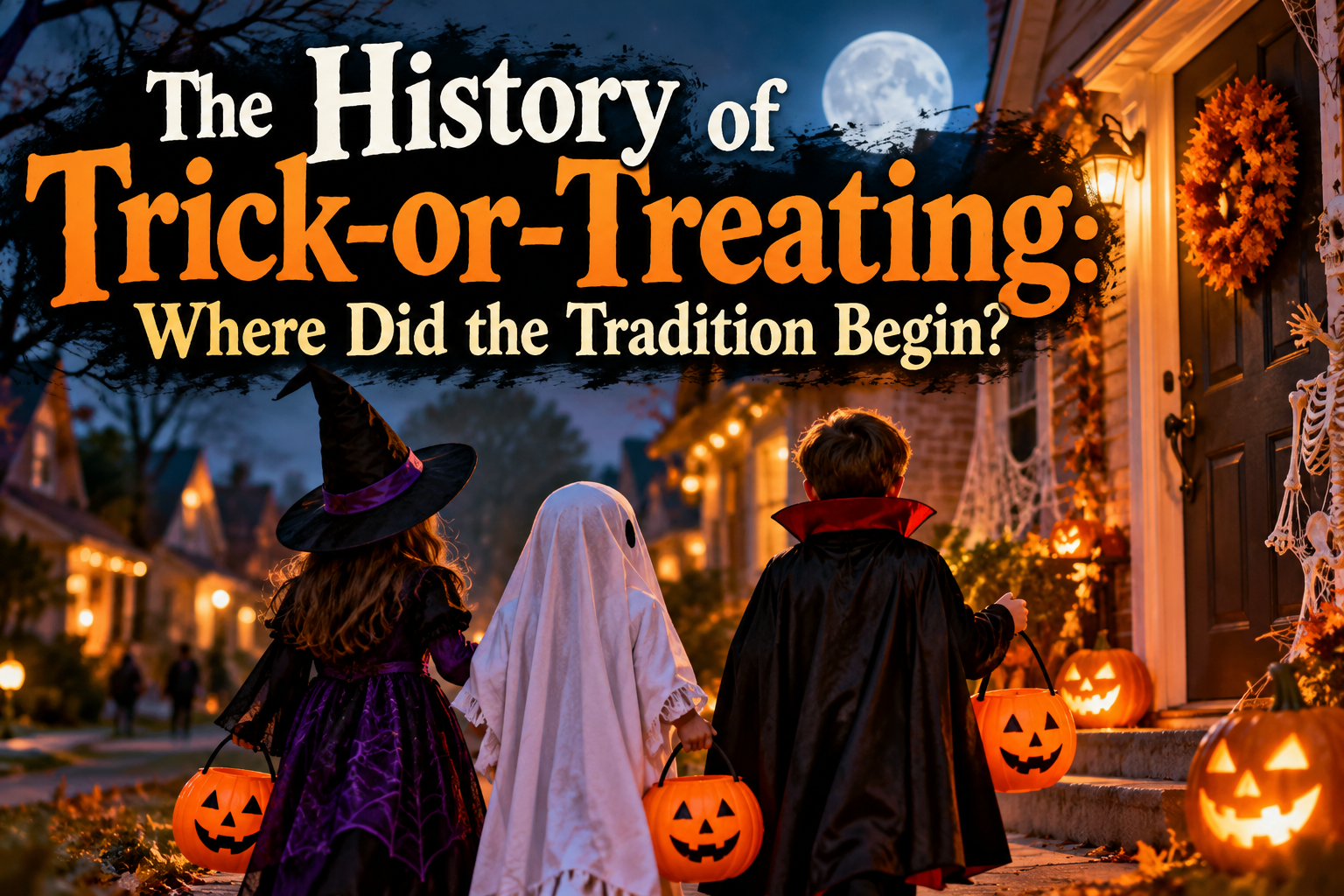
Every October 31, neighborhoods across America come alive with children dressed as ghosts, witches, superheroes, princesses, and monsters. With candy bags in hand, they travel from house to house, knocking on doors and calling out three familiar words: “Trick or treat!”
For many families, trick-or-treating is one of the most exciting traditions of Halloween. Children look forward to collecting candy, showing off their costumes, and enjoying a night filled with spooky decorations and neighborhood fun.
But have you ever wondered where trick-or-treating actually began?
The tradition did not originate in modern America, nor did it begin with candy companies or Halloween costume manufacturers. Its history reaches back centuries, connecting ancient Celtic celebrations, medieval European customs, religious observances, and the changing traditions of immigrant communities.
What started as rituals involving spirits, prayers, food, and disguises eventually evolved into the candy-filled Halloween celebration we recognize today.
Understanding the history of trick-or-treating reveals how different cultures and generations helped shape one of Halloween’s most beloved customs.
The Ancient Celtic Roots of Halloween
To understand trick-or-treating, we first need to explore the ancient Celtic festival known as Samhain.
More than 2,000 years ago, Celtic communities in areas that are now Ireland, Scotland, and parts of Britain celebrated Samhain around the transition from October to November.
Samhain marked the end of the harvest season and the beginning of winter, a time associated with darkness, uncertainty, and the changing cycle of life.
For these communities, the transition into winter held spiritual significance.
According to traditions recorded in later centuries, Samhain was associated with a time when the boundary between the living and the supernatural world became less distinct.
People believed that spirits and other supernatural beings might move among the living during this seasonal transition.
Why did people wear disguises?
One commonly suggested connection between Samhain and modern Halloween involves costumes and disguises.
Some historical interpretations suggest that people used disguises during seasonal festivities to represent supernatural beings or protect themselves from unwanted spiritual encounters.
However, historians cannot establish a direct, uninterrupted line from ancient Celtic disguises to modern trick-or-treat costumes.
Many familiar descriptions of ancient Samhain rituals come from sources written long after the pre-Christian period.
Nevertheless, the festival’s association with supernatural activity, seasonal change, and the coming of winter contributed to the broader cultural background from which Halloween traditions developed.
How Christianity Influenced Halloween Traditions
As Christianity spread throughout Europe, celebrations honoring saints and remembering the dead became important parts of the religious calendar.
November 1 became associated with All Saints’ Day, also called All Hallows’ Day, while November 2 became All Souls’ Day in Western Christian traditions.
October 31, the evening before All Saints’ Day, became known as All Hallows’ Eve.
Over time, the name evolved into Halloween.
These religious observances contributed important customs involving remembrance, prayer, charity, and the exchange of food.
Some of those practices bear a closer resemblance to modern trick-or-treating than the ancient Samhain celebrations themselves.
Souling: One of the Earliest Precursors to Trick-or-Treating
During the Middle Ages and later periods in parts of Britain and Ireland, a custom known as souling developed around All Souls’ Day.
Souling involved people traveling from house to house, requesting food in exchange for prayers for the dead.
In some communities, the visitors were poor people or children who received small baked goods called soul cakes.
These cakes were often associated with remembrance and prayers for departed souls.
What were soul cakes?
Soul cakes were small baked treats traditionally made with ingredients such as flour, spices, dried fruit, and sugar or other sweeteners.
Recipes varied across regions and historical periods.
The exchange carried religious meaning. Those receiving food might promise to pray for deceased relatives or others remembered by the household.
The custom created a connection between visiting homes, receiving treats, and observing the season associated with the dead.
Although souling was not identical to trick-or-treating, it helped establish a recognizable pattern:
People went from door to door, participated in a seasonal custom, and received something to eat.
That pattern would later become central to Halloween.
Guising: The Scottish and Irish Tradition of Dressing Up
Another major influence on modern trick-or-treating was a custom called guising.
Guising became especially associated with Scotland and Ireland.
Unlike souling, which often emphasized religious prayers, guising involved people wearing disguises and visiting neighboring homes.
Children or other participants might dress in costumes, perform songs, recite poems, tell jokes, or entertain householders in exchange for small rewards.
These rewards could include fruit, nuts, coins, or other treats.
How was guising different from trick-or-treating?
Modern trick-or-treating usually requires little more than wearing a costume, knocking on a door, and saying “trick or treat.”
Traditional guising often required a performance.
A child might sing a song, recite a verse, or demonstrate a talent before receiving a reward.
This made the exchange more interactive and connected the custom to community entertainment.
Guising offers one of the clearest historical parallels to today’s Halloween practice because it combined three familiar elements: costumes, house-to-house visits, and rewards.
It also helps explain why Halloween became a celebration where dressing up and receiving treats are closely connected.
How Trick-or-Treating Came to America
Halloween traditions arrived in North America through several cultural influences, including immigration from Ireland and Scotland.
During the nineteenth century, particularly amid large waves of Irish immigration, customs associated with Halloween became increasingly visible in American communities.
Immigrants brought traditions involving seasonal gatherings, costumes, games, storytelling, and supernatural folklore.
However, trick-or-treating did not immediately become the nationwide children’s activity we know today.
For many years, American Halloween celebrations looked considerably different.
Halloween in nineteenth-century America
Halloween festivities often included parties, fortune-telling games, apple bobbing, storytelling, and community gatherings.
Young people also participated in pranks and mischief.
Some pranks were relatively harmless, such as moving household objects or playing jokes on neighbors.
Others involved property damage and vandalism.
As Halloween became more popular, communities faced the challenge of balancing celebration with disorder.
This would eventually help shape the development of organized Halloween activities for children.
The Rise of Halloween Mischief and Pranks
During the late nineteenth and early twentieth centuries, Halloween became increasingly associated with practical jokes in parts of the United States.
Young people sometimes overturned outdoor furniture, damaged property, interfered with gates, or played tricks on unsuspecting neighbors.
In some communities, Halloween mischief became a serious concern.
The problem intensified in certain places during the early twentieth century, when destructive Halloween activities attracted attention from residents and local officials.
Community leaders began encouraging supervised celebrations as alternatives to vandalism.
Schools, churches, civic organizations, and neighborhood groups organized parties, parades, and other activities intended to give children a safer way to celebrate.
Door-to-door Halloween customs gradually became part of this changing holiday culture.
Rather than treating every costumed visitor as a potential troublemaker, households could participate by offering small gifts or treats.
This helped Halloween move toward a more organized, family-centered celebration.
When Did Trick-or-Treating Actually Begin?
One of the most interesting questions about Halloween history is when children first began saying “trick or treat.”
The answer is more complicated than many people realize.
The familiar phrase emerged in North America during the early twentieth century.
One of the earliest widely cited printed appearances comes from a 1927 newspaper report in Blackie, Alberta, Canada.
The report described young Halloween visitors making demands for treats while threatening tricks.
This early reference shows that the recognizable trick-or-treat exchange existed by the 1920s.
However, it does not mean the entire custom began in that town or that year.
Similar door-to-door Halloween activities had developed in different communities, and the phrase became more common over subsequent decades.
Why the words “trick or treat”?
The phrase presented householders with a playful choice.
Give the visiting children a treat, or risk becoming the target of a trick.
In practice, the threat was usually symbolic, especially as trick-or-treating became a supervised children’s activity.
The expression reflected Halloween’s older association with mischief while transforming it into a more friendly neighborhood exchange.
By the middle of the twentieth century, the phrase had become an essential part of American Halloween culture.
The Great Depression and Halloween Celebrations
The Great Depression of the 1930s affected nearly every aspect of American life, including holiday celebrations.
Families faced economic hardship, and communities searched for affordable ways to provide entertainment.
Halloween gatherings, neighborhood events, and homemade costumes offered inexpensive opportunities for children to enjoy themselves.
At the same time, concerns about Halloween vandalism encouraged some communities to promote more organized activities.
Door-to-door customs continued developing during this period, although their popularity varied by location.
Not every neighborhood practiced trick-or-treating, and the tradition was far from universal.
The Depression-era years helped establish some of the social conditions that encouraged community-based Halloween celebrations.
However, the custom’s widespread national popularity would come later.
World War II Temporarily Changed Halloween
During World War II, American families faced shortages and rationing.
Sugar rationing affected candy production and availability, making the generous distribution of sweets more difficult.
Halloween celebrations continued in many communities, but wartime conditions limited certain activities.
The years following the war brought significant changes.
As rationing ended and the economy expanded, candy became more accessible.
Suburban neighborhoods grew, families moved into new housing developments, and children’s activities became an increasingly prominent part of community life.
These developments created favorable conditions for trick-or-treating to expand.
The 1950s: When Trick-or-Treating Became an American Tradition
The 1950s were especially important in transforming trick-or-treating into a familiar nationwide custom.
During the postwar baby boom, millions of American families were raising young children.
Growing suburban neighborhoods provided streets where children could walk between nearby houses.
Halloween became increasingly focused on children’s entertainment rather than adult parties or destructive pranks.
Television programs, magazines, schools, and popular culture helped spread the practice.
How television helped popularize trick-or-treating
A notable moment came in 1952, when the Disney cartoon Trick or Treat, featuring Donald Duck and his nephews, brought the custom to audiences through animated entertainment.
The tradition also appeared in popular television programs, including a 1952 episode of The Adventures of Ozzie and Harriet.
These portrayals reflected and reinforced trick-or-treating’s growing popularity.
By the end of the decade, many American families recognized Halloween as a night when costumed children visited neighbors to collect treats.
The holiday was becoming a major annual celebration for children.
When Did Candy Become the Main Halloween Treat?
Today, Halloween and candy seem inseparable.
Chocolate bars, lollipops, gummy candies, candy corn, and other sweets fill store shelves weeks before October 31.
But candy was not always the main reward for Halloween visitors.
Earlier generations of children might receive homemade cookies, apples, nuts, popcorn balls, coins, or other small gifts.
Some households offered baked goods or whatever treats they could afford.
How candy companies changed Halloween
As trick-or-treating became more popular during the mid-twentieth century, candy manufacturers recognized an opportunity.
Individually wrapped sweets were convenient, easy to distribute, and relatively inexpensive.
Companies increasingly marketed candy for Halloween.
Commercial advertising helped establish candy as the expected reward for visiting children.
By the 1970s, packaged candy had become a dominant feature of American trick-or-treating.
Concerns about food safety and unfamiliar homemade treats also contributed to many parents preferring commercially packaged candy.
Although stories about tampered Halloween candy received considerable attention, widespread stranger-caused candy poisoning has not been supported by the historical evidence.
Nevertheless, those fears influenced public attitudes and reinforced the popularity of individually wrapped treats.
How Halloween Costumes Changed Over Time
Costumes have always been one of the most recognizable parts of Halloween, but their appearance and purpose have changed dramatically.
Earlier costumes often reflected supernatural folklore.
Ghosts, witches, devils, skeletons, and other frightening figures were popular choices.
Homemade disguises might consist of old clothing, masks, face paint, or simple household materials.
As Halloween became more commercialized, manufactured costumes became increasingly common.
The influence of movies and television
During the twentieth century, popular entertainment transformed Halloween fashion.
Children began dressing as characters from cartoons, movies, comic books, and television programs.
Superheroes, princesses, cowboys, astronauts, and fictional monsters joined traditional Halloween figures.
By the late twentieth century, costume stores offered an enormous variety of choices.
Today, costumes reflect nearly every aspect of popular culture.
Some children still prefer traditional ghosts and witches, while others dress as athletes, video game characters, movie villains, or their favorite celebrities.
Despite these changes, the central tradition remains recognizable: dressing up and visiting homes to receive treats.
Why Do People Decorate Their Homes for Trick-or-Treaters?
Halloween decorations help create the atmosphere that makes trick-or-treating exciting.
Pumpkins, skeletons, spiderwebs, tombstones, ghosts, and glowing lights transform ordinary neighborhoods into seasonal attractions.
Many decorations have connections to older Halloween customs.
For example, the tradition of carving frightening faces into vegetables developed in Ireland and Britain, where turnips and other root vegetables were sometimes used.
In North America, pumpkins became a popular alternative because they were widely available and easier to carve.
Over time, the illuminated jack-o’-lantern became one of Halloween’s most famous symbols.
Decorations also serve a practical purpose.
A lit porch, decorated doorway, or glowing pumpkin often signals that a household welcomes trick-or-treaters.
The result is a shared neighborhood experience where families participate in creating a festive environment.
Trick-or-Treating Around the World
Although trick-or-treating is strongly associated with the United States and Canada, related Halloween customs exist in several countries.
Ireland
Ireland has deep connections to Halloween’s history. Modern children commonly dress in costumes and go trick-or-treating, while traditional games and seasonal foods remain part of some celebrations.
Scotland
Scottish guising continues to be remembered as an important precursor to trick-or-treating. In some communities, children still perform songs, jokes, or other entertainment to earn treats.
England
Trick-or-treating became more widespread in England during the later twentieth century, influenced partly by American popular culture. Its popularity varies among communities.
Canada
Canada played an important role in the documented history of the phrase “trick or treat.” Halloween remains a popular holiday, with costumes, decorated houses, and neighborhood candy collecting.
Australia
Trick-or-treating has grown in popularity in some Australian neighborhoods, although participation varies and Halloween is not as universally observed as in North America.
These differences show how traditions can spread internationally while adapting to local cultures.
How Trick-or-Treating Has Changed in Modern Times
Trick-or-treating continues to evolve as communities develop new ways to celebrate Halloween.
Traditional door-to-door candy collecting remains popular, but alternative activities have become increasingly common.
Some churches, schools, and community organizations host trunk-or-treat events, where families distribute candy from decorated vehicles in parking lots.
Shopping centers and downtown business districts sometimes organize daytime trick-or-treating.
Other communities hold costume parades, festivals, haunted attractions, and family-friendly Halloween parties.
These events provide additional ways for children to enjoy the holiday.
Safety and accessibility
Modern Halloween celebrations also place greater emphasis on safety and inclusion.
Parents often accompany younger children, while neighborhoods may establish recommended trick-or-treating hours.
Reflective clothing, flashlights, and well-lit walking routes can help improve visibility.
Some families also participate in initiatives intended to make Halloween more welcoming for children with disabilities, sensory sensitivities, or food allergies.
For example, the Teal Pumpkin Project encourages households to offer nonfood treats as an option for children who cannot safely enjoy certain candies.
These developments demonstrate how a centuries-old collection of customs continues to adapt to changing community needs.
Why Trick-or-Treating Remains So Popular
Despite changes in costumes, candy, and celebrations, trick-or-treating continues to capture the imagination of children and adults.
Part of its appeal comes from the excitement of dressing up and exploring the neighborhood after dark.
For children, Halloween offers an opportunity to become someone or something completely different for an evening.
For parents, it can create memories of costumes, laughter, and family traditions.
For neighbors, it provides an opportunity to interact with families they might otherwise rarely see.
The exchange of candy is simple, but the experience represents something larger.
It brings people together through a shared celebration.
Even as technology and entertainment habits change, the familiar sight of costumed children walking from door to door remains a powerful symbol of Halloween.
Interesting Facts About the History of Trick-or-Treating
Several historical details help illustrate how much this tradition has changed.
-
Trick-or-treating did not begin with candy. Earlier house-to-house customs involved prayers, performances, fruit, nuts, and baked goods.
-
The phrase has Canadian roots in its documented history. A 1927 Alberta newspaper report is among the earliest widely cited printed references.
-
Scottish guising included performances. Children often entertained householders before receiving rewards.
-
Halloween was once closely associated with pranks. Community efforts to reduce mischief helped encourage organized celebrations.
-
World War II affected candy availability. Sugar rationing limited sweets during the war.
-
The 1950s helped establish the modern tradition. Suburban growth, the baby boom, and popular entertainment contributed to widespread participation.
-
Commercial candy became dominant later. Packaged sweets gradually replaced many homemade treats during the mid-to-late twentieth century.
-
Halloween continues to evolve. Community events and inclusive celebrations have expanded the ways families participate.
Is Trick-or-Treating Really an Ancient Tradition?
The answer depends on how we define the tradition.
Modern trick-or-treating, with children wearing costumes, knocking on doors, saying “trick or treat,” and collecting commercially packaged candy, is primarily a twentieth-century North American development.
However, several of its recognizable elements have much older histories.
Seasonal festivals associated with the supernatural existed in Celtic communities.
Medieval and later European customs included door-to-door visits, food exchanges, prayers, disguises, and performances.
Immigration brought some of these practices to North America, where they interacted with local Halloween celebrations and changing social conditions.
Rather than emerging from one single event, trick-or-treating developed through a long process of cultural adaptation.
This is what makes its history so fascinating.
A tradition that now seems uniquely American carries influences from multiple centuries and communities.
The True Meaning Behind Trick-or-Treating
Although Halloween is often associated with frightening decorations and sugary treats, trick-or-treating also reflects traditions of generosity, hospitality, and community participation.
Historically, visiting households and exchanging food could carry religious, social, or festive significance.
Today, those meanings have changed, but the basic act of giving remains central.
Families purchase candy not because they expect something in return, but because they want children in their communities to enjoy the holiday.
Neighbors decorate their homes to create excitement.
Parents help children prepare costumes, and families gather to share the experience.
For many people, Halloween becomes an opportunity to connect with others and create lasting memories.
That sense of connection may be one reason trick-or-treating has survived and continued to grow.
Final Thoughts: From Ancient Customs to Modern Halloween Nights
The history of trick-or-treating is a fascinating journey through centuries of cultural change.
Its background includes the ancient Celtic festival of Samhain, Christian observances honoring the dead, the European customs of souling and guising, and the development of American Halloween celebrations.
During the twentieth century, these influences combined with neighborhood traditions, changing family life, commercial candy production, and popular entertainment to create the modern practice.
What once involved prayers, performances, disguises, and seasonal rituals eventually became a night of costumes, candy, and community celebration.
Today, when children knock on doors and shout “trick or treat,” they participate in a tradition shaped by generations of people who celebrated the changing seasons in different ways.
And while most children are probably more interested in chocolate bars than medieval customs, the history behind their Halloween adventure makes the celebration even more meaningful.
The next time you hand out candy or accompany children through the neighborhood, remember that this familiar Halloween ritual carries echoes of traditions much older than the holiday as we celebrate it today.
What is your favorite trick-or-treating memory from childhood, and how has Halloween changed since you were young?

Leave a Reply