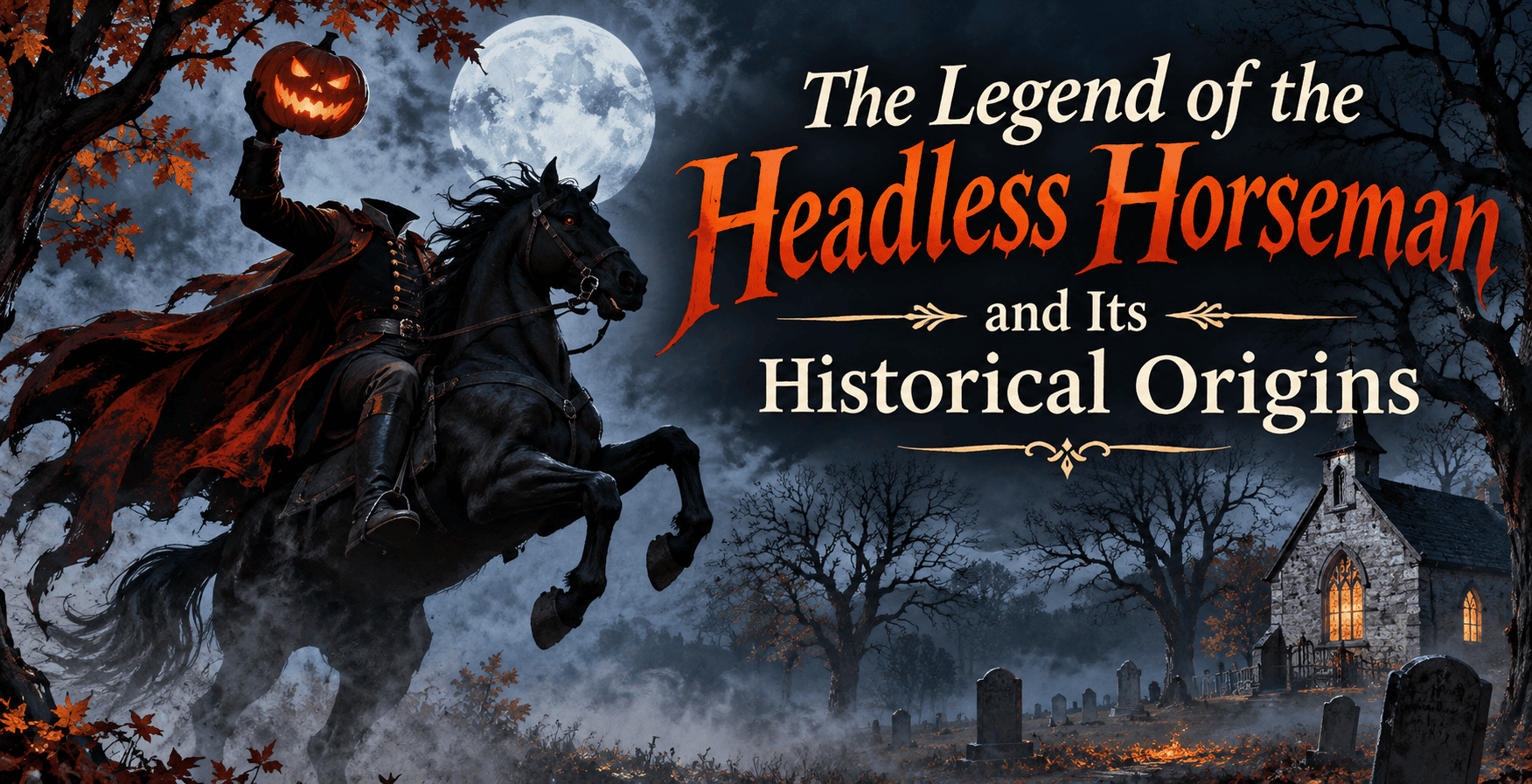
Few figures in American folklore are as mysterious, terrifying, and unforgettable as the Headless Horseman. Riding through the darkness on a powerful black horse, carrying a weapon or his own severed head, this ghostly rider has haunted imaginations for generations. His story has become one of the most recognizable legends associated with Halloween, supernatural folklore, and early American literature.
Most people know the Headless Horseman from The Legend of Sleepy Hollow, the famous short story written by Washington Irving in 1820. However, the history behind this frightening character reaches much further into the past. The legend draws upon European ghost stories, colonial American traditions, Revolutionary War history, and the fears of communities living in the Hudson Valley of New York.
But was the Headless Horseman based on a real person? Did a soldier actually lose his head during the American Revolution? And why did Washington Irving choose the quiet village of Sleepy Hollow as the setting for one of America’s most enduring ghost stories?
To understand the legend, we must explore the history, folklore, and imagination that brought the Headless Horseman to life.
What Is the Legend of the Headless Horseman?
The Headless Horseman is a supernatural figure traditionally described as a ghostly rider who travels through the night without a head. Depending on the version of the story, he may carry his missing head, search for it, or chase anyone unfortunate enough to cross his path.
In Washington Irving’s famous tale, the Horseman is believed to be the ghost of a Hessian soldier who fought during the American Revolutionary War.
According to local legend within the story, the soldier lost his head when a cannonball struck him during battle. His body was supposedly buried in a churchyard near Sleepy Hollow, but his spirit could not rest.
Every night, the ghost reportedly rode through the countryside searching for his missing head. Before daybreak, he had to return to his grave.
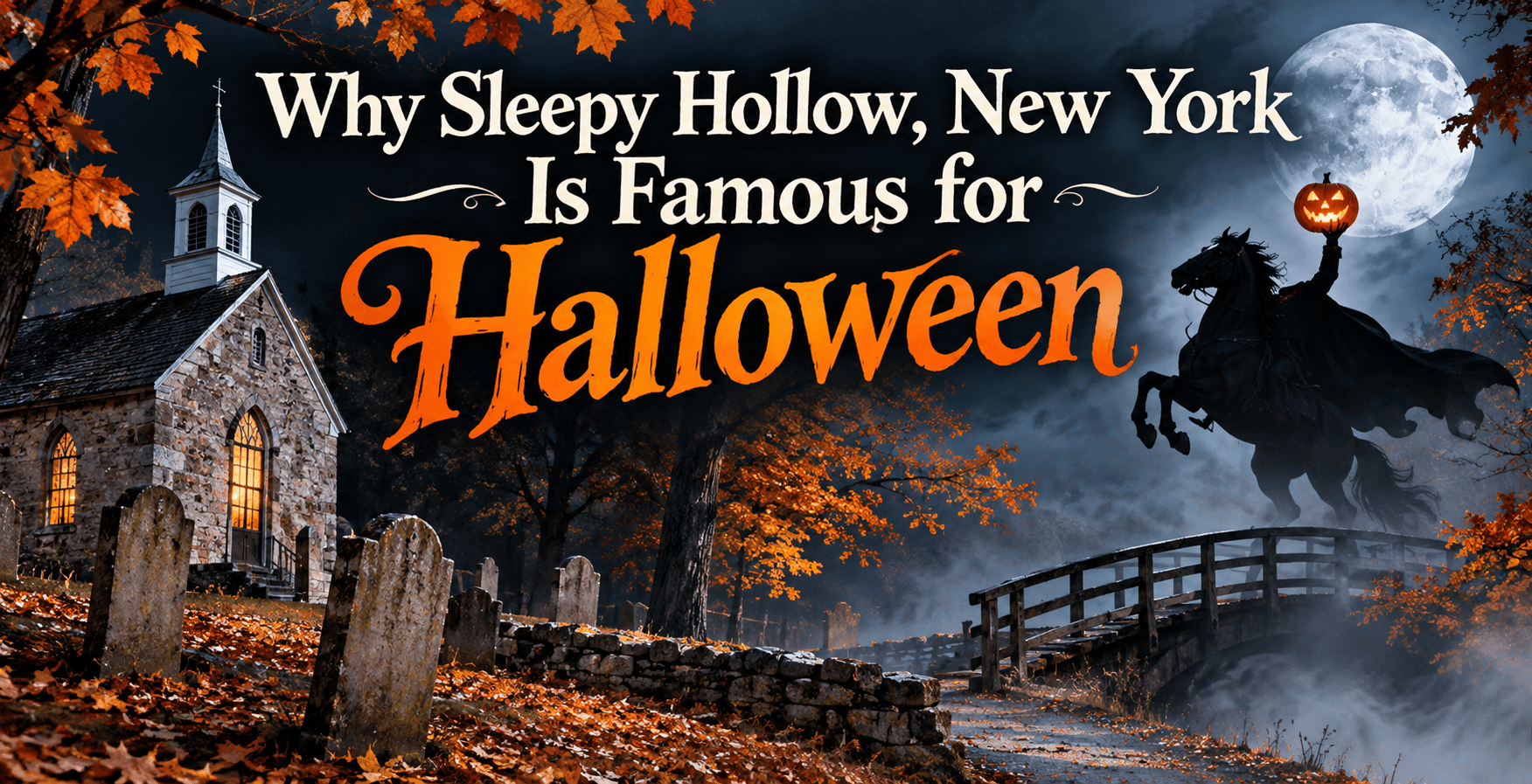
The Horseman was especially feared near a wooden bridge close to the Old Dutch Church. According to the tale, this bridge marked a boundary beyond which the ghost supposedly could not pursue his victims.
The combination of a restless spirit, a tragic death, and a lonely nighttime road created the perfect foundation for a terrifying American ghost story.
The Historical Origins of the Headless Horseman
Although the Headless Horseman became famous through American literature, stories of headless ghosts existed in Europe long before Washington Irving wrote his tale.
For centuries, European folklore featured supernatural riders, wandering spirits, and ghostly figures associated with violent deaths.
Many of these legends reflected traditional beliefs that people who died suddenly, violently, or without proper burial might return as restless spirits.
A missing head was particularly disturbing because it symbolized an unnatural death and the loss of personal identity.
The Irish Legend of the Dullahan
One of the most fascinating figures associated with headless-rider folklore is the Dullahan, a supernatural being from Irish tradition.
The Dullahan is commonly described as a headless rider traveling on a dark horse, sometimes carrying his severed head.
In traditional accounts, the creature is associated with death and frightening nighttime appearances.
Some versions describe the Dullahan using a whip made from a human spine, while others portray him as an omen announcing someone’s approaching death.
Unlike Washington Irving’s Horseman, who is believed to be searching for his missing head, the Dullahan generally possesses his head but carries it separately from his body.
The similarities are striking, although there is no definitive evidence that Irving directly modeled his character on the Dullahan.
Both figures belong to a broader tradition of supernatural riders associated with death, darkness, and fear.
German Folklore and the Headless Rider
German folklore also contains stories of ghostly hunters, spectral horsemen, and headless riders.
These traditions are particularly important because Washington Irving spent time in Europe and was familiar with German literature and storytelling.
German ghost stories often featured restless spirits appearing on deserted roads, in forests, or near burial grounds.
One relevant literary example is Gottfried August Bürger’s ballad The Wild Huntsman, which explores supernatural punishment and ghostly pursuit.
Another important work is The Wild Hunter, a tale by German writer Johann Karl August Musäus that has been discussed in connection with Irving’s literary influences.
The broader European tradition of the Wild Hunt described ghostly riders or hunters traveling through the night, sometimes accompanied by supernatural forces.
Although the Wild Hunt and the Headless Horseman are not identical legends, their shared imagery helps explain the cultural atmosphere from which Irving drew inspiration.
The Headless Horseman and the American Revolutionary War
One of the most intriguing elements of the Sleepy Hollow legend is its connection to the American Revolutionary War.
Irving’s story identifies the Horseman as a Hessian soldier who lost his head during the conflict.
But who were the Hessians?
Who Were the Hessian Soldiers?
During the American Revolution, Great Britain hired thousands of German auxiliary troops to fight against the American colonies.
These soldiers came from several German states, including Hesse-Cassel, which is why Americans commonly referred to them collectively as Hessians.
The soldiers were professional military men serving under agreements between British authorities and German rulers.
They fought in numerous Revolutionary War battles and campaigns, including operations in New York.
Their distinctive uniforms, foreign language, and reputation as disciplined fighters made them memorable figures in American wartime accounts.
In later folklore, Hessian soldiers sometimes became associated with frightening stories and mysterious battlefield deaths.
This historical background helped make Irving’s fictional ghost seem believable to readers familiar with Revolutionary War history.
Did a Hessian Soldier Really Lose His Head?
The story claims that the Headless Horseman was a Hessian trooper whose head was carried away by a cannonball during an unnamed battle.
Such an injury was certainly possible during eighteenth-century warfare. Cannonballs caused devastating wounds, and soldiers often died violently on battlefields.
However, there is no verified historical evidence establishing that a particular headless Hessian soldier became the ghost described in Irving’s story.
The character should therefore be understood as a literary creation rooted in historical circumstances and older folklore rather than a documented supernatural event.
Irving’s use of Revolutionary War history gave the legend an appearance of authenticity without requiring the ghost itself to be real.
Why Sleepy Hollow, New York, Became the Setting
Sleepy Hollow’s real landscape and colonial history helped make Irving’s fictional haunting memorable.
Sleepy Hollow is a real community located along the Hudson River in Westchester County, New York.
During Washington Irving’s lifetime, the surrounding area contained farms, wooded roads, old churches, and communities shaped by Dutch colonial traditions.
The landscape was ideal for ghost stories.
Quiet valleys, isolated pathways, and misty evenings created an atmosphere in which supernatural tales could flourish.
Irving knew the Hudson Valley from his youth and used its distinctive geography and cultural history in his writing.
The region also had strong connections to the American Revolution, making the Hessian soldier’s supposed origins especially appropriate.
The Old Dutch Church of Sleepy Hollow
One of the most important historical landmarks associated with the legend is the Old Dutch Church of Sleepy Hollow.
Built in the seventeenth century, the church is among the area’s most recognizable historic structures.
Its surrounding burial ground became an important location in Irving’s story.
According to the fictional legend, the Headless Horseman returned to the churchyard before sunrise.
The old church and its cemetery contributed to the eerie atmosphere of the narrative.
Although the church is real, the Horseman’s supposed grave is part of the legend rather than an authenticated burial site.
The connection between the actual building and the fictional ghost helped blur the boundaries between history and storytelling.
Washington Irving and the Creation of an American Legend
Washington Irving was born in New York City in 1783, the same year the Treaty of Paris formally ended the American Revolutionary War.
He grew up during a period when the United States was developing its own national identity, including its literature, traditions, and folklore.
American writers often looked toward Europe for inspiration, but Irving helped establish stories that felt distinctly American.
In 1820, he published The Legend of Sleepy Hollow as part of The Sketch Book of Geoffrey Crayon, Gent.
The story combined European supernatural traditions with the landscapes, history, and cultural customs of New York’s Hudson Valley.
Irving did not simply repeat an existing ghost story. He transformed familiar supernatural themes into something that reflected early American life.
His Headless Horseman was not a medieval knight or an ancient mythical creature. He was supposedly a soldier from America’s own Revolutionary War.
That historical connection made the story especially memorable.
The Story of Ichabod Crane and the Headless Horseman
At the center of The Legend of Sleepy Hollow is Ichabod Crane, a schoolteacher who arrives in a small Dutch-American community.
Ichabod is intelligent, imaginative, and deeply superstitious.
He enjoys listening to ghost stories and believes many of the supernatural tales told by local residents.
He also becomes interested in Katrina Van Tassel, the beautiful daughter of a wealthy farmer.
Unfortunately for Ichabod, Katrina has another admirer.
Brom Bones and the Rivalry for Katrina
Abraham Van Brunt, better known as Brom Bones, is a strong, confident, and mischievous young man.
He is popular in the community and known for his practical jokes.
Brom considers Ichabod a rival for Katrina’s affection and attempts to embarrass or frighten him.
Their rivalry becomes an important part of the story’s mystery.
The Frightening Ride Through Sleepy Hollow
One autumn evening, Ichabod attends a gathering at the Van Tassel home.
During the celebration, guests share frightening stories about local ghosts, including the Headless Horseman.
Afterward, Ichabod leaves alone on horseback.
The road is dark, the trees cast strange shadows, and his imagination fills the silence with frightening possibilities.
As he travels, he encounters a mysterious rider.
The stranger appears unusually large and remains silent.
Eventually, Ichabod realizes that the rider has no head.
Even more terrifying, the missing head seems to be resting on the rider’s saddle.
Ichabod desperately urges his horse forward, hoping to escape.
The mysterious Horseman follows.
As they approach the bridge near the church, Ichabod believes he may finally reach safety.
Instead, the rider rises in his stirrups and throws what appears to be his severed head directly at Ichabod.
The object strikes him, and everything goes dark.
The following morning, Ichabod has disappeared.
Searchers discover his horse, his abandoned hat, and a shattered pumpkin.
But there is no sign of the schoolteacher.
Was the Headless Horseman Really Brom Bones?
One of the most fascinating aspects of Irving’s story is that it never definitively reveals the identity of the mysterious rider.
The shattered pumpkin strongly suggests that someone may have disguised himself as the Headless Horseman.
Brom Bones is the most obvious suspect.
He was an experienced horseman, enjoyed practical jokes, and had a clear reason to frighten Ichabod away.
His suspicious amusement whenever Ichabod’s disappearance is discussed adds to the possibility that he was responsible.
However, Irving deliberately leaves room for uncertainty.
Perhaps Brom staged the entire encounter.
Perhaps Ichabod became so frightened that his imagination transformed an ordinary rider into something supernatural.
Or perhaps the ghost really did appear.
The uncertainty is one reason the story remains effective more than two centuries after its publication.
Rather than providing a simple explanation, Irving allows readers to decide what they believe.
Why Is the Headless Horseman Associated With Pumpkins?
Today, the Headless Horseman is frequently depicted holding a glowing jack-o’-lantern.
This familiar image has become a Halloween tradition.
However, the original story is slightly different.
In Irving’s narrative, the object thrown at Ichabod is initially mistaken for the Horseman’s severed head.
The discovery of a shattered pumpkin the following morning suggests that the terrifying projectile may have been an ordinary vegetable.
The original story does not explicitly describe the Horseman carrying a carved, glowing jack-o’-lantern.
That popular image developed through later illustrations, theatrical productions, films, and Halloween interpretations.
As jack-o’-lanterns became increasingly associated with Halloween, they fit naturally into the Horseman’s appearance.
The glowing pumpkin eventually became one of his most recognizable features.
The Connection Between the Headless Horseman and Halloween
Interestingly, The Legend of Sleepy Hollow was not originally written specifically as a Halloween story.
When Irving published it in 1820, Halloween had not yet developed into the widely celebrated American holiday familiar today.
The story’s autumn setting, supernatural themes, and frightening nighttime encounter eventually made it a natural fit for Halloween celebrations.
Several elements helped strengthen the connection.
The Horseman appears after dark, creating a sense of danger and uncertainty.
His missing head represents death and the supernatural.
The isolated roads and shadowy trees evoke the atmosphere of a haunted autumn landscape.
The pumpkin discovered after Ichabod’s disappearance connects the story with one of Halloween’s most familiar symbols.
As Halloween celebrations became more popular in the United States, the Headless Horseman became an ideal character for seasonal storytelling.
Today, his image appears in haunted attractions, decorations, costumes, television specials, and horror films.
How the Legend Changed Over Time
The Headless Horseman has undergone numerous transformations since Irving introduced him to American readers.
In the original story, he is primarily a mysterious figure whose existence remains uncertain.
Later adaptations often portray him as a genuinely supernatural creature.
Some versions depict him as a violent spirit seeking revenge.
Others transform him into a terrifying warrior who hunts victims and collects their heads.
One particularly influential adaptation was Disney’s animated version of The Legend of Sleepy Hollow, released in 1949 as part of The Adventures of Ichabod and Mr. Toad.
The animated sequence helped establish the dramatic image of the Horseman pursuing Ichabod through a dark forest.
In 1999, director Tim Burton released Sleepy Hollow, starring Johnny Depp as Ichabod Crane.
The film significantly changed Irving’s original story, turning the Horseman into a more explicitly supernatural and violent character.
Although these adaptations differ from the original tale, they have introduced the legend to new generations.
Is Sleepy Hollow Really Haunted?
Sleepy Hollow’s reputation as a haunted destination comes largely from its literary history and longstanding folklore.
The community contains genuine historic sites connected with Washington Irving’s story.
Visitors can explore the Old Dutch Church, the surrounding burial ground, and other locations associated with the legend.
Sleepy Hollow Cemetery is also where Washington Irving is buried.
During the Halloween season, the community embraces its famous ghost story through special events, storytelling, and seasonal attractions.
Although visitors may enjoy hearing accounts of supernatural encounters, there is no reliable scientific evidence establishing that the Headless Horseman actually haunts the area.
The village’s reputation is best understood as a combination of real history, local tradition, and literary imagination.
What Does the Headless Horseman Symbolize?
Beyond its frightening appearance, the Headless Horseman can represent several deeper ideas.
The Fear of Death
A rider without a head is an unsettling reminder of mortality.
The figure reflects the human fear of violent death and the unknown world beyond it.
The Unfinished Business of the Dead
In the legend, the Horseman searches endlessly for his missing head.
This can symbolize the idea that a spirit cannot rest until something lost or unresolved has been recovered.
The Power of Superstition
Ichabod Crane’s fear is intensified by the ghost stories he has heard.
His experience demonstrates how strongly imagination and belief can influence a person’s perception of reality.
The Lasting Effects of War
The Horseman’s supposed death during the American Revolution connects the supernatural legend with the violence of actual history.
The ghost can be interpreted as a reminder that the consequences of war may linger long after the fighting has ended.
Why the Headless Horseman Remains Popular Today
More than 200 years after the publication of The Legend of Sleepy Hollow, the Headless Horseman remains one of the most recognizable figures in American ghost stories.
His enduring popularity comes from the way the legend combines several powerful storytelling elements.
There is mystery surrounding his identity.
There is historical intrigue connected to the Revolutionary War.
There is supernatural terror in the image of a headless rider racing through the darkness.
And there is the unresolved question of whether the terrifying encounter was real or merely an elaborate trick.
Unlike stories that explain every mystery, Irving’s tale leaves readers wondering.
That uncertainty allows each generation to reinterpret the Horseman according to its own fears and imagination.
The legend also connects Americans with a period when isolated communities, dark country roads, and oral storytelling played important roles in everyday life.
Interesting Facts About the Headless Horseman
-
Washington Irving published The Legend of Sleepy Hollow in 1820.
-
The Headless Horseman is also called the Galloping Hessian.
-
Hessian soldiers were German troops who served alongside British forces during the American Revolution.
-
Headless-rider legends existed in European folklore long before Irving’s story.
-
The Old Dutch Church of Sleepy Hollow is a real historic building.
-
The original story never conclusively proves that Ichabod Crane encountered a ghost.
-
The famous pumpkin provides an important clue about the Horseman’s possible identity.
-
Washington Irving is buried in Sleepy Hollow Cemetery.
-
The New York village formerly called North Tarrytown officially adopted the name Sleepy Hollow in 1996.
-
Although strongly associated with Halloween today, Irving’s original story was not specifically written for the holiday.
The Lasting Legacy of the Headless Horseman
The Headless Horseman is much more than a frightening Halloween character.
He represents the meeting point of ancient folklore, American history, and literary imagination.
European traditions supplied the image of the supernatural rider. The American Revolutionary War provided a historical background. The Hudson Valley contributed its distinctive landscape and colonial heritage.
Washington Irving brought these elements together to create a story that became an enduring part of American culture.
The legend also demonstrates how stories evolve.
What began as a mysterious tale about a schoolteacher, a romantic rivalry, and a ghostly Hessian soldier eventually became one of the defining images of Halloween.
The Horseman has changed through books, movies, artwork, and popular culture, but the central mystery remains.
Was he a restless soldier searching for his missing head?
Was he a clever prankster using local superstition to frighten a rival?
Or was he simply a terrifying creation of Ichabod Crane’s imagination?
Perhaps the true power of the legend lies in never knowing for certain.
Conclusion: The Legend That Continues to Ride
The historical origins of the Headless Horseman reveal a fascinating combination of European mythology, Revolutionary War memories, Dutch-American folklore, and Washington Irving’s imagination.
Although no evidence proves that a supernatural Hessian soldier ever rode through Sleepy Hollow, the historical world surrounding the legend was very real.
Soldiers fought and died during the American Revolution. Communities shared ghost stories around their firesides. Travelers crossed dark country roads where fear and imagination could easily turn ordinary sights into something terrifying.
From these historical realities, Irving created a legend that has survived for more than two centuries.
Today, the Headless Horseman continues to gallop through Halloween celebrations, horror stories, and the imaginations of people around the world.
And somewhere in the shadows of Sleepy Hollow, the legend invites us to imagine the sound of approaching hoofbeats, the silhouette of a mysterious rider, and the terrifying possibility that the Horseman is still searching for his missing head.
If you were traveling alone through Sleepy Hollow on a dark Halloween night and heard hoofbeats approaching behind you, would you turn around to look?
Leave a Reply