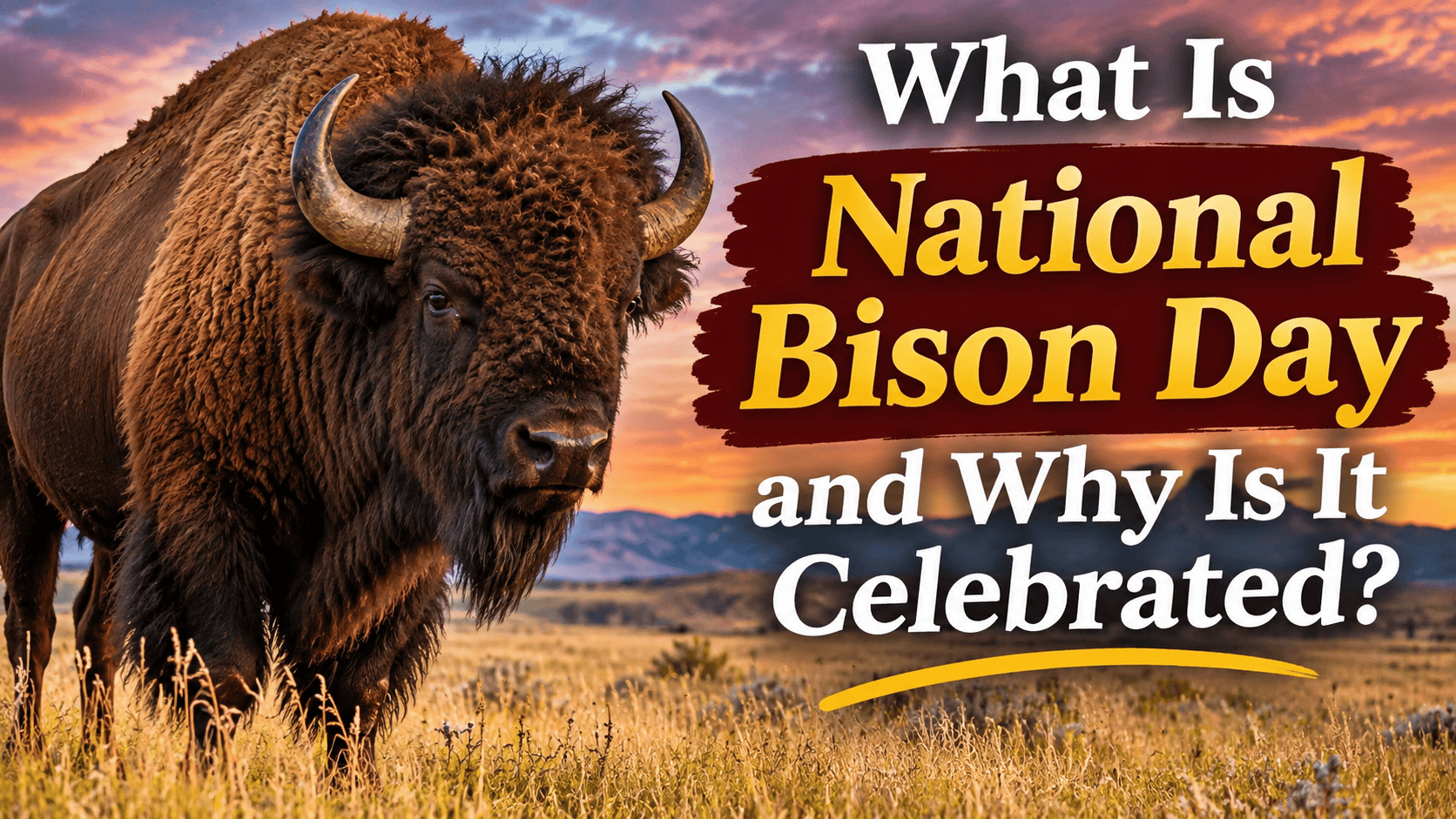
Every year, Americans celebrate National Bison Day to recognize one of the most iconic animals in the nation’s history. The American bison represents strength, resilience, freedom, and the natural beauty of the American landscape. Once roaming the Great Plains in enormous herds, these magnificent animals played an essential role in the lives of Native American communities and helped shape the history of the United States.
National Bison Day is more than a celebration of an impressive animal. It is an opportunity to reflect on American history, recognize the importance of wildlife conservation, and appreciate the remarkable recovery of a species that nearly disappeared forever.
From the grasslands of Yellowstone National Park to conservation herds across the country, the American bison continues to symbolize the enduring spirit of the American West.
But what exactly is National Bison Day, when is it celebrated, and why is this animal so important to American history?
When Is National Bison Day Celebrated?
National Bison Day is observed annually on the first Saturday in November.
In 2026, National Bison Day falls on Saturday, November 7.
The observance encourages Americans to learn about bison, recognize their historical and ecological significance, and support efforts to protect and restore these remarkable animals.
National Bison Day also highlights the relationship between bison and the cultural traditions of Native American nations, many of which have maintained deep spiritual, historical, and practical connections with the species for generations.
Although the celebration takes place on one day each year, its message extends far beyond November. Protecting wildlife, preserving natural habitats, and understanding American history are responsibilities that deserve attention throughout the year.
What Is National Bison Day?
National Bison Day is an annual American observance dedicated to celebrating the American bison and recognizing its importance to the country’s history, culture, environment, and conservation efforts.
The American bison, scientifically known as Bison bison, is the largest living land mammal native to North America.
These powerful animals are recognizable by their massive shoulders, shaggy brown coats, curved horns, and distinctive humps.
Adult male bison can weigh more than 2,000 pounds, making them among the most impressive mammals found on the North American continent.
Despite their enormous size, bison can run surprisingly fast and are capable of reaching speeds of approximately 35 miles per hour.
National Bison Day celebrates several important aspects of the species, including its historical significance, ecological contributions, cultural importance, and extraordinary survival story.
It also reminds Americans that conservation efforts can make a meaningful difference when communities, governments, scientists, and organizations work together.
Why Is National Bison Day Celebrated?
National Bison Day is celebrated because the American bison represents an important part of the nation’s natural and cultural heritage.
For centuries, bison shaped the ecosystems of North America and supported the lives and traditions of numerous Indigenous peoples.
However, during the nineteenth century, widespread commercial hunting, deliberate destruction, habitat loss, and government policies contributed to the near extinction of these animals.
The survival and recovery of the American bison became one of the most significant wildlife conservation stories in American history.
Today, National Bison Day recognizes that remarkable recovery while emphasizing the importance of continued protection.
The celebration serves several purposes.
First, it honors the American bison as a symbol of the nation’s natural heritage.
Second, it recognizes the historical relationship between bison and Native American cultures.
Third, it raises awareness about wildlife conservation and habitat restoration.
Finally, it encourages future generations to appreciate and protect America’s native wildlife.
The central message of National Bison Day is simple: preserving the natural world is essential to protecting the history, identity, and future of the United States.
The History of the American Bison in North America
Long before European settlers arrived in North America, millions of American bison inhabited the continent.
Their historical range extended across vast grasslands, prairies, and other habitats, from portions of present-day Canada into Mexico.
Estimates suggest that approximately 30 million bison once lived in North America, although historical population estimates vary.
These enormous herds influenced the environment in countless ways.
As bison traveled across grasslands, their grazing patterns helped shape plant communities and maintain prairie ecosystems.
Their movements also contributed to nutrient cycling, seed dispersal, and habitat diversity.
For many Native American nations, particularly those of the Great Plains, bison were central to everyday life.
They provided food, clothing, shelter materials, tools, and other essential resources.
Bison also held profound cultural and spiritual significance.
However, the arrival and expansion of European American settlement dramatically changed the future of the species.
During the nineteenth century, commercial hunting and organized slaughter devastated bison populations.
Railroad expansion made previously remote herds easier to reach, while the demand for hides and other products encouraged widespread killing.
The destruction of bison was also connected to federal policies and military strategies that undermined the food supplies and independence of Plains Indigenous nations.
By the late 1800s, the species had been reduced to a tiny fraction of its former population.
The American bison stood dangerously close to extinction.
How Did the American Bison Almost Become Extinct?
The near extinction of the American bison remains one of the most troubling chapters in American wildlife history.
Several factors contributed to the catastrophic population decline.
Commercial hunters killed enormous numbers of bison for their hides, meat, and other products.
The expansion of railroads and settlements disrupted migration routes and reduced available habitat.
Unregulated hunting accelerated the destruction of large herds.
Government policies and campaigns that encouraged bison destruction also contributed to the devastation, particularly because bison were essential to the survival and independence of many Plains tribes.
By the 1880s, only a small number of wild bison remained.
The disappearance of these animals caused ecological damage and contributed to the profound disruption of Indigenous communities whose lives had long been connected to the herds.
Fortunately, the story did not end there.
A combination of private conservation efforts, Indigenous stewardship, public protection, and later government programs helped prevent the complete extinction of the American bison.
Their recovery demonstrates both the destructive consequences of human activity and the possibilities created by determined conservation efforts.
How Did National Bison Day Begin?
The movement to establish National Bison Day gained momentum in 2012 when conservation organizations, Native American representatives, bison producers, and wildlife advocates began working together to increase national recognition of the American bison.
Their efforts encouraged Americans to appreciate the animal’s historical importance and support its continued recovery.
The United States Senate began adopting resolutions recognizing National Bison Day, helping establish the first Saturday in November as the annual observance.
A major milestone occurred on May 9, 2016, when President Barack Obama signed the National Bison Legacy Act.
This legislation officially designated the North American bison as the national mammal of the United States.
In September 2026, the United States Senate also adopted a resolution designating November 7, 2026, as National Bison Day.
GovInfo+1
The recognition reflected the bison’s importance to American history, Indigenous cultures, wildlife conservation, and the nation’s identity.
Why Is the American Bison the National Mammal of the United States?
The American bison became the official national mammal because of its extraordinary historical, cultural, and ecological significance.
For generations, the bison has represented the American frontier and the vast landscapes of the Great Plains.
Its physical strength and ability to survive harsh conditions have also made it a symbol of endurance and resilience.
However, the decision to recognize the bison as the national mammal was about more than its appearance.
The designation acknowledged the species’ importance to Native American communities and its remarkable recovery from near extinction.
The American bison now shares a special place among the country’s national symbols alongside the bald eagle, which remains the national bird.
The recognition also reminds Americans of their responsibility to protect the natural heritage represented by these animals.
Why Are Bison Important to Native American Culture?
For many Native American nations, particularly those of the Great Plains, the bison has long been essential to cultural identity, survival, and spiritual traditions.
Historically, bison provided food and materials necessary for everyday life.
Their hides were used to make clothing, blankets, shelters, and other important items.
Bones and horns were fashioned into tools and household objects.
Other parts of the animal were used for practical purposes, reflecting traditions that emphasized making careful use of available resources.
Beyond these material contributions, bison held deep spiritual significance for many Indigenous communities.
Ceremonies, teachings, and cultural practices involving bison continue to carry meaning today, although traditions differ among Native American nations.
The destruction of bison herds during the nineteenth century therefore represented far more than the loss of wildlife.
It also contributed to the disruption of Indigenous economies, food systems, cultural traditions, and ways of life.
Today, Tribal bison restoration programs are helping reconnect communities with this important part of their heritage.
National Bison Day provides an opportunity to recognize those ongoing efforts and appreciate the important role Indigenous leadership plays in conservation.
Why Are Bison Important to the Environment?
Bison are sometimes described as a keystone species because their activities influence the structure and health of grassland ecosystems.
Their grazing patterns help create areas of vegetation with different heights and densities.
This diversity can benefit prairie birds, insects, and other wildlife.
Bison also contribute to grassland ecosystems through their movement and natural behaviors.
For example, bison frequently roll in shallow depressions in the ground, a behavior known as wallowing.
Over time, these depressions can create small habitats that collect rainwater and support different plants and organisms.
Their grazing and movement also influence nutrient cycling and soil conditions.
Because bison evolved alongside North America’s grasslands, restoring appropriate herds can help support broader prairie conservation goals.
Protecting bison therefore means more than preserving one species. It can also contribute to the protection of entire ecosystems.
Where Can You See American Bison Today?
Although wild bison no longer roam across North America in the enormous numbers they once did, they can still be found in national parks, wildlife refuges, Tribal lands, conservation areas, and privately managed herds.
One of the best-known places to observe bison is Yellowstone National Park.
Yellowstone is especially significant because its bison population includes descendants of animals that survived the nineteenth-century population collapse.
Other locations where visitors may encounter bison include Badlands National Park in South Dakota, Wind Cave National Park in South Dakota, and Theodore Roosevelt National Park in North Dakota.
Bison can also be seen in conservation areas and wildlife facilities throughout the United States.
Visitors should remember that bison are powerful, unpredictable wild animals.
Despite their calm appearance, they can move quickly and become dangerous when approached.
Anyone visiting a bison habitat should follow park regulations, maintain a safe distance, and never attempt to touch or feed the animals.
What Is the Difference Between a Bison and a Buffalo?
Many Americans use the words bison and buffalo interchangeably.
However, the American bison and true buffalo belong to different groups of animals.
American bison are native to North America and are characterized by their large shoulder humps, thick fur, and massive heads.
True buffalo, including African buffalo and Asian water buffalo, have different physical characteristics and live in other regions of the world.
The term buffalo became commonly associated with American bison through historical usage.
Today, both names are frequently used in American culture, although bison is the more scientifically accurate term for the North American species.
Interesting Facts About American Bison
The American bison is a remarkable animal with several fascinating characteristics.
Bison are the largest native land mammals in North America. Adult males can weigh approximately 2,000 pounds or more.
Bison can run surprisingly fast. Despite their size, they can reach speeds of around 35 miles per hour.
Both male and female bison have horns. These horns are used for defense and interactions with other bison.
Bison calves are often reddish-brown. Young calves are sometimes affectionately called red dogs because of their distinctive coloring.
Bison are well adapted to cold weather. Their thick winter coats help them survive freezing temperatures and severe prairie weather.
Bison communicate through sounds and body language. Grunts, movements, and postures help them interact within their herds.
Bison are social animals. They often live in groups, although herd structure changes depending on the season, age, and sex of the animals.
Bison played an important role in American currency. The famous Buffalo nickel, produced from 1913 through 1938, featured an American bison on its reverse side.
These characteristics help explain why bison have fascinated Americans for generations.
How Can You Celebrate National Bison Day?
National Bison Day offers several meaningful ways for individuals, families, schools, and communities to celebrate.
One of the simplest ways to participate is by learning more about the American bison and sharing that knowledge with others.
Families can explore the history of bison in North America, including their importance to Indigenous cultures and their remarkable conservation story.
Visiting a national park, wildlife refuge, museum, or educational center that features bison can provide another memorable experience.
Teachers can use National Bison Day to introduce students to American history, environmental science, and wildlife conservation.
Individuals can also support organizations working to protect bison habitats and restore healthy herds.
Learning about Tribal bison restoration programs is another meaningful way to recognize the day.
For those who enjoy sharing educational content online, National Bison Day provides an opportunity to highlight fascinating bison facts, historical information, and conservation achievements.
Even a simple conversation about the importance of wildlife protection can help spread awareness.
The goal is not necessarily to organize a large celebration.
It is to recognize the significance of an animal that has contributed so much to the history and environment of North America.
Why Does National Bison Day Matter Today?
National Bison Day remains relevant because the challenges facing wildlife have not disappeared.
Although American bison have recovered significantly from their historic population collapse, conservation challenges remain.
Many bison live in managed herds rather than large, freely roaming populations.
Habitat fragmentation, limited genetic diversity in some herds, disease-management concerns, and competing land uses continue to complicate restoration efforts.
Conservation programs must balance the needs of wildlife, local communities, agricultural operations, and Indigenous nations.
Restoring bison to suitable landscapes requires long-term planning, cooperation, and scientific understanding.
National Bison Day encourages Americans to recognize these challenges while celebrating the progress already achieved.
It also reminds us that successful conservation is not simply about preventing extinction.
It is about creating conditions in which wildlife can thrive for generations to come.
Frequently Asked Questions About National Bison Day
Is National Bison Day a federal holiday?
No. National Bison Day is a recognized annual observance, but it is not a federal public holiday. Government offices, schools, and businesses generally operate according to their normal Saturday schedules.
What day is National Bison Day in 2026?
National Bison Day is Saturday, November 7, 2026.
Is National Bison Day celebrated every year?
Yes. National Bison Day is observed annually on the first Saturday in November.
When did National Bison Day first begin?
The annual celebration began in 2012, with organizations and supporters working to increase awareness of the American bison and its importance to the United States.
Why was the bison chosen as America’s national mammal?
The bison was chosen because of its historical, cultural, ecological, and symbolic importance to the United States, along with its remarkable recovery from near extinction.
Are American bison still endangered?
The American bison is not currently classified as an endangered species under the U.S. Endangered Species Act. However, conservationists continue working to protect genetically diverse herds, restore suitable habitats, and expand ecologically functioning populations.
What does the American bison symbolize?
The American bison commonly symbolizes strength, resilience, endurance, freedom, and the natural heritage of North America. It also holds distinct cultural and spiritual meanings for many Indigenous nations.
Final Thoughts: Celebrating the Strength and Legacy of the American Bison
National Bison Day is an opportunity to honor one of the most extraordinary animals in American history.
The American bison once roamed the continent in enormous herds, shaped the grasslands of North America, and supported generations of Native American communities.
Its near extinction stands as a reminder of the devastating consequences that human actions can have on the natural world.
Yet its survival demonstrates what determined conservation efforts can accomplish.
Today, the bison continues to represent strength, resilience, and the enduring connection between America’s people, history, and landscapes.
As National Bison Day arrives on November 7, 2026, Americans have an opportunity to reflect on the importance of preserving wildlife and protecting the natural heritage that future generations deserve to experience.
The American bison is more than a symbol of the past. It is a living reminder that even after devastating losses, recovery and renewal are possible.



Leave a Reply