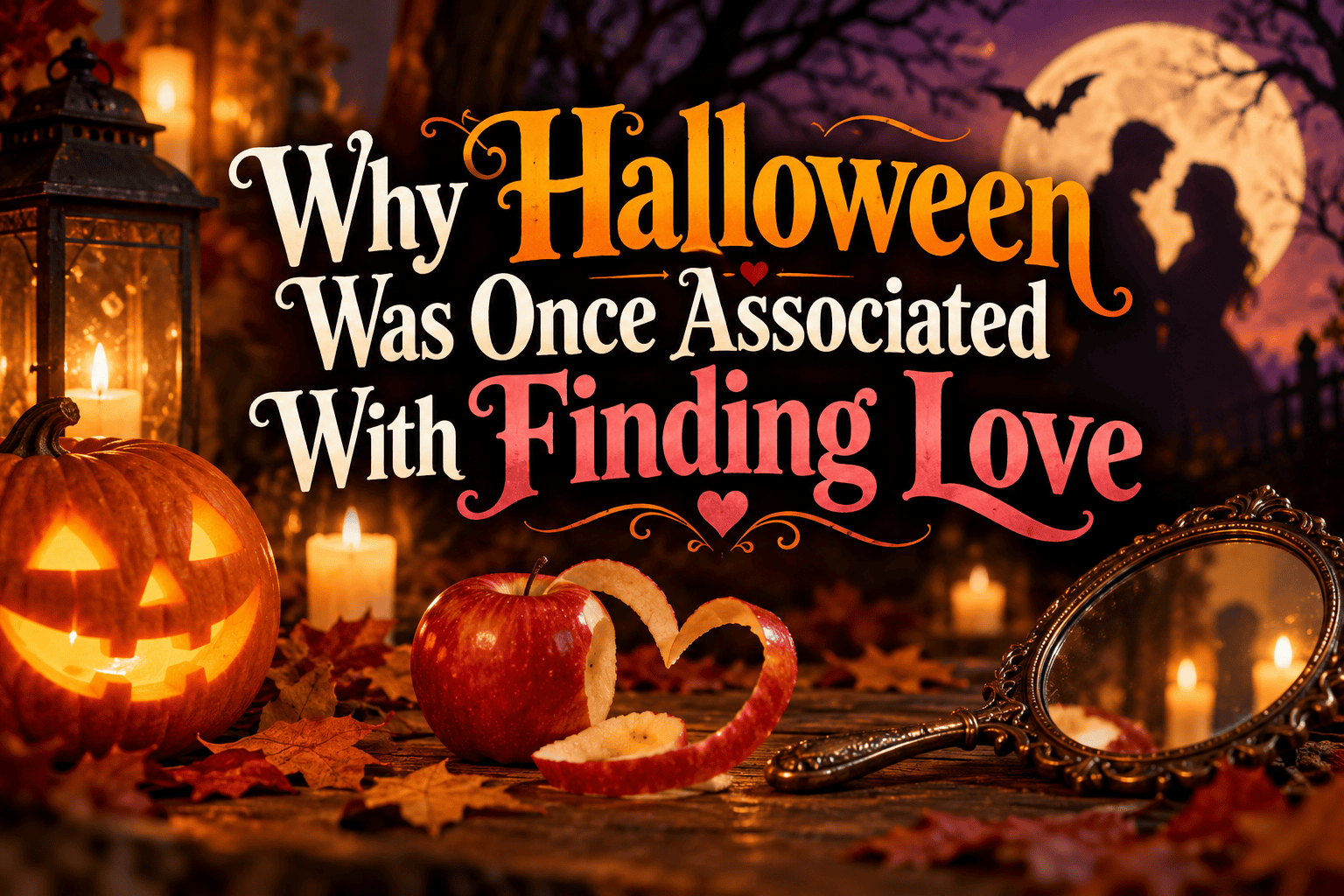
When most people think of Halloween, they imagine haunted houses, scary costumes, jack-o’-lanterns, trick-or-treating, and ghost stories. However, long before Halloween became a holiday centered around candy and frightening decorations, it had another surprising association: finding love.
For generations, Halloween was considered one of the most mysterious and romantic nights of the year. Young people, especially unmarried women, participated in unusual traditions and superstitions believed to reveal the identity of their future spouse, predict marriage, or offer clues about their romantic destiny.
From peeling apples in candlelit rooms to staring into mirrors at midnight, Halloween romance rituals were once an important part of autumn celebrations.
But why was Halloween associated with finding love in the first place? The answer lies in ancient seasonal beliefs, European folklore, marriage customs, and the fascinating history of Halloween in America.
The Ancient Connection Between Halloween and Romance
Halloween’s romantic traditions developed from a combination of ancient seasonal celebrations and later European folk customs.
One of the holiday’s historical roots is Samhain, a Gaelic festival marking the transition from the harvest season into winter.
Traditionally observed around October 31 and November 1, Samhain was associated with seasonal change, supernatural beliefs, and the boundary between the living and the dead.
In later folklore, this mysterious atmosphere made Halloween an especially suitable occasion for divination, or attempts to predict the future.
People wanted answers to important questions about their lives, including whether they would marry, whom they would marry, and what their future might hold.
Marriage was particularly significant in earlier centuries because it often influenced financial security, family relationships, property, and social standing.
For young unmarried people, discovering clues about a future husband or wife could be both exciting and comforting.
Although Halloween’s romantic customs are sometimes connected to ancient Celtic beliefs, many specific love-divination games are documented much later, particularly in Scottish, Irish, and British folklore.
Over time, these traditions helped establish Halloween as a night when romance and mystery went hand in hand.
1. Apple Peeling Was Supposed to Reveal Your Future Spouse
One of the most popular Halloween love traditions involved something surprisingly ordinary: an apple.
Young women would attempt to peel an apple in one continuous strip without breaking the skin.
Once the peeling was complete, they would throw the long strip over their shoulder.
According to folklore, the peel would land in a shape resembling the first initial of their future husband’s name.
For example, a peel resembling the letter J might suggest that a woman’s future husband would have a name beginning with that letter.
Of course, the results depended entirely on imagination and chance.
Nevertheless, the game became a popular Halloween activity because it combined suspense, laughter, and romantic curiosity.
Apples were especially appropriate for Halloween celebrations because they were plentiful during the autumn harvest.
The tradition also demonstrated how ordinary household objects could become part of elaborate seasonal superstitions.
2. Looking Into a Mirror Could Reveal Your Future Husband
Perhaps one of the eeriest Halloween romance traditions involved standing in front of a mirror.
According to certain versions of the superstition, an unmarried woman could see the face of her future husband by looking into a mirror on Halloween night.
Some versions instructed participants to stand in a darkened room holding a candle.
Others involved eating an apple or performing a particular ritual while watching the reflection.
The belief was that the image of a future husband might appear behind the woman’s shoulder.
However, some versions of the folklore included a frightening possibility.
Instead of seeing a future spouse, a participant might supposedly see a skull or another ominous image, interpreted as a sign of misfortune.
These stories combined romance with the supernatural atmosphere that made Halloween distinctive.
Today, such a ritual might sound like something from a horror movie, but it was once a familiar element of Halloween folklore.
The practice also appeared in Halloween-themed illustrations and postcards during the late nineteenth and early twentieth centuries.
3. Bobbing for Apples Was Once Connected to Romance
Apple bobbing is still recognized as a traditional Halloween party game.
Participants attempt to grab floating apples from a basin of water using only their mouths.
Although modern versions are usually played for entertainment, some historical variations were associated with courtship and romantic predictions.
In certain customs, apples were marked or associated with particular individuals.
Successfully catching an apple could supposedly reveal information about a potential romantic partner.
Other versions involved competition, luck, or predictions about who would marry first.
The exact rules varied by region and period, and not every historical apple-bobbing game was romantic.
Nevertheless, apples became strongly associated with Halloween courtship traditions.
Their seasonal availability made them inexpensive and convenient for gatherings.
The games also provided opportunities for young people to interact in a festive social environment.
4. Chestnuts Were Used to Predict Romantic Compatibility
Another unusual Halloween tradition involved roasting chestnuts beside a fire.
In one version of the custom, a person would choose two chestnuts to represent themselves and someone they loved.
The chestnuts were placed together near the heat.
Their behavior supposedly revealed the future of the relationship.
If they roasted peacefully together, the couple might enjoy a harmonious romance.
If one chestnut cracked, jumped, or separated dramatically from the other, it could be interpreted as a sign of disagreement or separation.
These predictions were not based on anything supernatural, of course.
The chestnuts reacted to heat and moisture.
But the game offered a playful way for people to discuss romantic interests without openly declaring their feelings.
The tradition was sufficiently familiar to appear in historical descriptions of Halloween celebrations, including Scottish folklore.
5. Cabbage and Kale Could Predict Marriage
Vegetables also played a surprising role in Halloween romance traditions.
In parts of Scotland and Ireland, young people participated in customs involving cabbage or kale plants.
One traditional game involved entering a garden, sometimes blindfolded, and pulling a plant from the ground.
The plant’s appearance supposedly revealed characteristics of a future spouse.
A straight stalk might suggest an attractive or well-proportioned partner, while a crooked stalk could be interpreted differently.
The amount of soil attached to the roots was sometimes believed to indicate the future spouse’s wealth.
In some versions, tasting the plant could supposedly predict whether the future partner would have a pleasant or difficult temperament.
These customs were especially associated with rural communities where gardens and harvest crops were part of everyday life.
What seems strange today was once a playful form of fortune-telling that reflected people’s hopes and anxieties about marriage.
6. Halloween Games Predicted Who Would Marry First
Not every Halloween romance tradition attempted to identify a future spouse.
Some focused on a simpler question: Who would get married first?
One traditional game involved placing several objects in separate dishes.
The objects might include a ring, a coin, and other symbolic items.
Participants would select a dish while blindfolded.
Finding a ring was commonly interpreted as a sign of marriage.
Other objects could symbolize wealth, remaining unmarried, or different life circumstances.
The exact meanings varied according to local tradition.
Games like these were particularly entertaining at Halloween gatherings because they created suspense and friendly competition.
They also allowed participants to laugh about marriage predictions without treating the results too seriously.
7. Dreams Were Believed to Reveal Future Love
Halloween love predictions were not limited to games played during parties.
Some traditions involved performing rituals before going to sleep.
According to folklore, a young woman might eat a particular food, place an object beneath her pillow, or follow a special nighttime routine in the hope of dreaming about her future husband.
In certain traditions, salty foods were associated with dreams in which a future spouse would offer water.
Other customs involved symbolic objects or carefully prescribed actions before bedtime.
These beliefs reflected a wider tradition of dream interpretation and love divination found throughout European folklore.
Halloween’s reputation as a mysterious night made it a natural setting for such practices.
For participants, the excitement often came from wondering whether a dream would reveal something meaningful about their romantic future.
8. Halloween Was Once a Popular Holiday for Courtship
During the nineteenth century, Halloween celebrations increasingly included organized social gatherings.
In communities where Halloween traditions were practiced, parties offered young adults opportunities to meet, socialize, and participate in group activities.
Romantic fortune-telling games were especially well suited to these gatherings.
They provided a socially acceptable way to express curiosity about relationships and marriage.
In an era when courtship could be governed by strict social expectations, playful Halloween rituals allowed romantic feelings to be discussed indirectly.
A young woman might jokingly discover the initial of a future husband.
A young man might participate in a game that predicted marriage.
Friends could tease one another about romantic possibilities.
These activities helped transform Halloween into a holiday associated not only with supernatural mystery but also with social connection.
9. Halloween Romance Became Popular in Victorian Culture
The Victorian era, spanning much of the nineteenth century, played an important role in preserving and popularizing Halloween traditions.
Victorian society placed considerable emphasis on marriage, family life, and social customs.
At the same time, people enjoyed parlor games, seasonal gatherings, folklore, and supernatural stories.
Halloween brought many of these interests together.
Traditional fortune-telling activities could be adapted into entertaining party games.
Apple peeling, chestnut roasting, and other marriage predictions fit naturally into the festive atmosphere.
However, Halloween customs were not universal across Victorian society. Their popularity differed by region, community, and cultural background.
Scottish and Irish traditions were particularly influential in shaping the romantic folklore later associated with American Halloween celebrations.
By the end of the nineteenth century, Halloween entertainment was increasingly becoming part of American popular culture.
10. Vintage Halloween Postcards Often Featured Romance
One of the clearest reminders of Halloween’s romantic past can be found in vintage Halloween postcards.
During the early twentieth century, Halloween greeting cards frequently featured romantic predictions, marriage symbolism, and playful scenes involving young couples.
Some illustrations depicted women looking into mirrors in hopes of seeing their future husbands.
Others showed apples, hearts, candles, or fortune-telling games.
Romantic verses and humorous messages were also common.
These postcards reflected a version of Halloween that many modern Americans would barely recognize.
Instead of focusing entirely on monsters, skeletons, and frightening creatures, some Halloween greetings celebrated love, luck, and future marriage.
The imagery demonstrates how closely romance and Halloween were connected in popular entertainment during that period.
Vintage postcards remain valuable historical reminders of how holiday traditions change over time.
11. Halloween Parties Once Focused More on Games Than Scares
In the late nineteenth and early twentieth centuries, many American Halloween parties emphasized games, refreshments, costumes, and seasonal entertainment.
Romantic fortune-telling was often part of the program.
Guests might participate in apple games, perform symbolic rituals, or listen to stories about marriage predictions.
These gatherings could be hosted in private homes, schools, churches, or community spaces.
Halloween was not exclusively a romantic holiday, and frightening themes were already part of its traditions.
However, the balance of activities could be quite different from modern celebrations.
For many partygoers, Halloween was an opportunity to socialize, laugh, and enjoy playful predictions about the future.
The romantic games helped make the occasion memorable.
12. Why Finding a Spouse Was Such an Important Theme
To understand Halloween’s historical connection with love, it helps to consider the importance of marriage in earlier societies.
Marriage could influence nearly every aspect of a person’s adult life.
It often affected economic security, social position, family responsibilities, and household arrangements.
Women in particular frequently faced significant social and financial pressures surrounding marriage, although experiences differed widely across social classes and communities.
As a result, questions about future spouses carried more weight than simple romantic curiosity.
Would someone find a suitable partner?
Would the marriage be happy?
Would the future household be financially comfortable?
Would a person marry soon or remain unmarried?
Halloween fortune-telling games offered imaginary answers to questions that could otherwise produce considerable uncertainty.
Even when participants understood the activities were merely entertainment, the games provided a way to express their hopes.
13. How Irish and Scottish Immigrants Influenced American Halloween
Irish and Scottish immigration contributed significantly to the development of Halloween customs in the United States.
Immigrants brought seasonal traditions, folk beliefs, games, and community celebrations that helped shape American observances.
Among these customs were various forms of marriage divination.
Apple peeling, nut roasting, and predictions involving household objects were preserved or adapted in new communities.
As Halloween celebrations spread, the traditions mixed with other American entertainment practices.
Newspapers, magazines, party guides, and greeting cards helped popularize Halloween activities beyond the communities where they had originated.
By the early twentieth century, Halloween had developed a recognizable place in American seasonal culture.
Its romantic traditions were one part of that development.
14. Why Halloween Romance Traditions Eventually Faded
If Halloween was once associated with finding love, why did those traditions become less prominent?
The answer involves several changes in American culture.
During the twentieth century, Halloween increasingly became associated with children’s activities, costumes, neighborhood celebrations, and trick-or-treating.
Commercial candy production, popular entertainment, and holiday marketing helped reinforce these themes.
Horror movies, haunted attractions, and elaborate decorations also strengthened Halloween’s frightening identity.
Meanwhile, romantic fortune-telling games gradually lost their central place in many celebrations.
Changing attitudes toward marriage and courtship also made some older predictions feel outdated.
Young people had more ways to meet potential partners, and traditional marriage expectations evolved.
Valentine’s Day became the holiday most strongly associated with romantic love in American popular culture.
Halloween did not lose its romantic elements entirely, but they became less visible.
Today, many people are surprised to discover that love predictions were once a familiar part of Halloween entertainment.
15. Some Halloween Love Traditions Still Survive
Although most people no longer peel apples to discover a future spouse’s initial, traces of Halloween’s romantic past remain.
Apple bobbing continues at some seasonal gatherings.
Vintage Halloween decorations occasionally feature fortune-telling imagery.
Couples attend costume parties together, and Halloween-themed weddings have become a distinctive choice for some people.
Modern Halloween celebrations also provide opportunities for socializing and meeting new people.
The romantic fortune-telling rituals themselves are now more likely to be treated as historical curiosities or nostalgic party games.
Nevertheless, they remain part of the holiday’s cultural heritage.
They remind us that Halloween was never exclusively about fear.
It has also been about curiosity, possibility, community, and the mysteries of the future.
The Difference Between Halloween Love Traditions and Valentine’s Day
Halloween and Valentine’s Day may seem completely different today, but both have histories involving romantic expectations and social customs.
Valentine’s Day became increasingly associated with expressions of affection, romantic messages, and gift-giving.
Halloween’s romantic traditions were different.
Rather than celebrating an existing relationship, Halloween fortune-telling often focused on discovering a relationship that had not yet begun.
Valentine’s Day asked people to express love.
Halloween invited them to imagine who they might someday love.
That distinction helps explain why marriage predictions were such a natural part of Halloween folklore.
The holiday’s mysterious atmosphere made the unknown future seem especially intriguing.
What Halloween’s Forgotten Love Traditions Tell Us About the Past
The history of Halloween romance reveals more than a collection of unusual superstitions.
It offers a glimpse into the emotional lives of people who lived generations before us.
They worried about finding companionship.
They wondered whether someone loved them.
They hoped to build happy marriages.
They imagined what their futures might look like.
Although the rituals were often playful, the feelings behind them were deeply human.
A young woman peeling an apple in a nineteenth-century parlor was expressing a curiosity that remains familiar today.
A group of friends laughing over chestnuts beside a fire was enjoying the same mixture of hope, uncertainty, and amusement that accompanies romantic conversations in any era.
The traditions may have disappeared from everyday life, but the emotions behind them have not.
How to Recreate Old-Fashioned Halloween Love Traditions Today
Anyone interested in historical Halloween celebrations can bring some of these forgotten customs back as harmless party entertainment.
An old-fashioned Halloween gathering might include apple-peeling contests, symbolic fortune-telling games, or historical stories about marriage superstitions.
Guests could attempt to identify letters formed by apple peels or discover the traditional meanings of objects hidden beneath cups.
A host might also display reproductions of vintage Halloween postcards featuring romantic imagery.
These activities can be presented as folklore rather than genuine predictions.
They offer an entertaining way to explore holiday history while introducing guests to traditions that are no longer widely practiced.
For people interested in Victorian culture, American history, or forgotten seasonal customs, Halloween romance games provide an especially unusual theme.
Frequently Asked Questions About Halloween and Love
Was Halloween originally a holiday for finding love?
No. Halloween developed from several religious, seasonal, and folk traditions. Finding love was not its sole or original purpose. However, romantic fortune-telling became an important part of some Halloween celebrations, especially in Irish, Scottish, and later American customs.
Why did women look into mirrors on Halloween?
According to certain folk beliefs, looking into a mirror while performing a special Halloween ritual could reveal the face of a future husband. The practice was a superstition rather than a reliable prediction.
What did apples symbolize in Halloween romance traditions?
Apples were associated with several forms of seasonal entertainment and fortune-telling. Their use in Halloween love games reflected both their availability during autumn and their place in traditional folklore.
Did Victorian people celebrate Halloween romantically?
Some Victorian-era Halloween celebrations included marriage predictions, parlor games, and romantic fortune-telling. However, customs varied across communities, and not all Victorian households celebrated Halloween in the same way.
When did Halloween become less associated with romance?
Romantic fortune-telling gradually became less prominent during the twentieth century as children’s activities, trick-or-treating, costumes, commercial celebrations, and horror entertainment became more dominant features of American Halloween.
Were Halloween marriage predictions taken seriously?
Attitudes varied. Some participants may have attached genuine meaning to the predictions, while others treated them as amusing party games. Historical accounts often present these customs as a mixture of folklore, entertainment, and superstition.
Final Thoughts: When Halloween Was About Love as Much as Mystery
Halloween has changed dramatically over the centuries.
Today, it is difficult to imagine a Halloween party where the biggest excitement comes from discovering the initial of a future spouse or watching chestnuts roast beside a fire.
Yet these were once familiar traditions in communities that celebrated the holiday.
Before Halloween became dominated by candy, elaborate costumes, haunted houses, and horror entertainment, it also offered opportunities to dream about romance and the future.
The holiday’s connection to love grew from a fascinating combination of seasonal folklore, marriage expectations, supernatural beliefs, and social entertainment.
Its forgotten customs remind us that Halloween has always been more complicated than a simple celebration of frightening things.
For earlier generations, the mystery of Halloween was not always about ghosts lurking in the darkness.
Sometimes, the greatest mystery was the identity of the person they might someday marry.
And perhaps that is what makes these old traditions so interesting.
Long before Halloween became a night for pretending to be someone else, it was also a night when people hoped to discover who might someday hold their heart.
What do you think about these forgotten Halloween traditions? Would you try an old-fashioned Halloween love prediction just for fun?

Leave a Reply