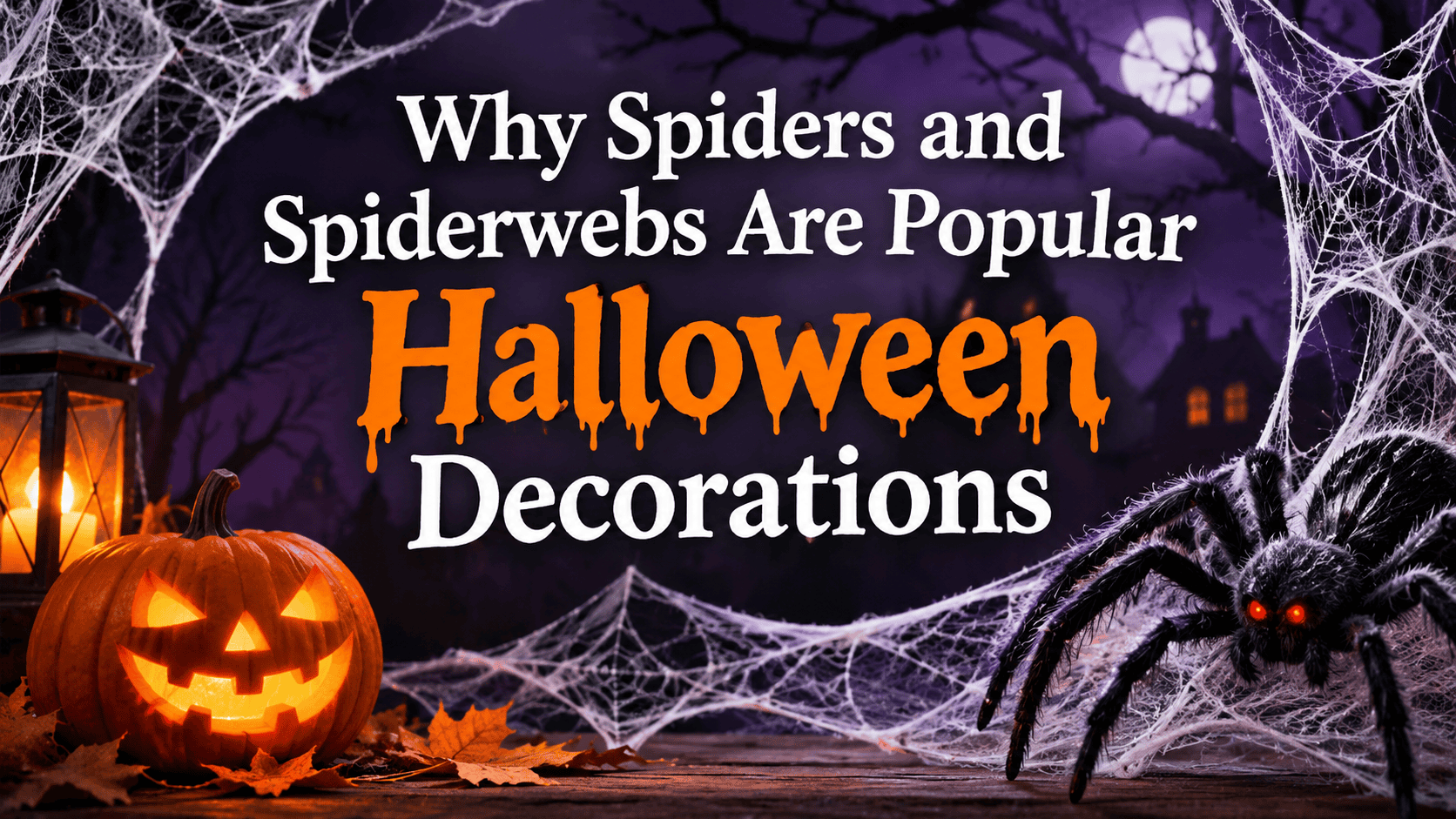
When Halloween arrives, spiders and spiderwebs seem to appear everywhere. From fake cobwebs stretched across front porches to giant spiders crawling up houses, these eight-legged creatures have become some of the most recognizable symbols of the spooky season.
Whether decorating a haunted house, preparing for a Halloween party, or creating a frightening front-yard display, spiders and spiderwebs are among the most popular decorations. Their creepy appearance, mysterious symbolism, and long association with darkness make them a natural fit for Halloween.
But have you ever wondered why spiders became such an important part of Halloween decorating?
The answer involves centuries of folklore, ancient superstitions, haunted-house imagery, and our natural fear of things that crawl in the shadows.
The Historical Connection Between Spiders and Halloween
Spiders have been associated with mystery, danger, and supernatural beliefs for centuries.
Long before Halloween became a holiday filled with costumes, candy, and decorations, people across different cultures connected spiders with magic, fate, and the unknown.
In European folklore, spiders sometimes appeared in stories involving witches, supernatural creatures, and mysterious happenings. Their ability to create intricate webs seemingly out of nowhere made them especially fascinating.
Spiders were also common inhabitants of dark corners, abandoned buildings, barns, and cellars. These locations eventually became familiar settings in ghost stories and haunted-house traditions.
As Halloween celebrations developed, spiders naturally became part of the holiday’s frightening imagery.
Their association with mysterious places, combined with their unsettling appearance, helped establish them as classic Halloween symbols.
Why Spiderwebs Are Associated With Haunted Houses
One of the biggest reasons spiderwebs became popular Halloween decorations is their connection to abandoned and neglected places.
Imagine walking into an old mansion that has been empty for decades.
The furniture is covered in dust. The windows are broken. The floors creak with every step. Thick spiderwebs stretch across doorways, ceilings, and forgotten corners.
This familiar image has appeared in countless ghost stories, horror movies, and haunted-house attractions.
Spiderwebs suggest that a place has been undisturbed for a long time.
They create the impression that nobody has entered the building recently, making the location feel isolated, mysterious, and potentially dangerous.
Although spiders can build webs in occupied and well-maintained buildings, popular storytelling frequently uses cobwebs to represent abandonment.
Halloween decorators adopted this visual tradition because it immediately transforms ordinary spaces into spooky environments.
A few artificial spiderwebs can make a clean living room resemble an abandoned mansion or a forgotten dungeon.
That simple transformation explains much of their popularity.
The Connection Between Spiders and Witches
Witches are among Halloween’s most recognizable characters, and spiders have long appeared alongside them in popular supernatural imagery.
In certain European traditions, spiders were associated with witchcraft, magical practices, and mysterious powers.
Their unusual behavior contributed to these beliefs.
Spiders could appear suddenly, disappear into tiny cracks, and construct elaborate webs without any visible tools.
To people who did not understand their biology, these abilities could seem almost magical.
Some folklore connected spiders with witches’ homes or supernatural activities, although these associations varied considerably across regions and historical periods.
Over time, popular illustrations, Halloween decorations, and horror entertainment strengthened the relationship between spiders and witches.
Today, a Halloween witch’s house might feature bubbling cauldrons, black cats, bats, and enormous spiderwebs.
Together, these decorations create a familiar atmosphere of magic and mystery.
Why People Find Spiders So Frightening
Spiders are effective Halloween decorations because many people find them unsettling.
Their eight legs, quick movements, and ability to appear unexpectedly can trigger feelings of fear or discomfort.
Some people experience arachnophobia, an intense fear of spiders that can interfere with everyday life.
Others simply dislike encountering them.
Several characteristics make spiders particularly effective in frightening decorations.
Their Sudden Movements
Spiders can move quickly and unexpectedly.
A spider crawling across a wall or dropping from a ceiling may startle someone, even when the creature poses no actual danger.
Halloween decorations often imitate this behavior using hanging spiders, moving props, and motion-activated displays.
Their Unusual Appearance
With eight legs and multiple eyes in many species, spiders look very different from familiar household animals.
Their distinctive body shape makes them easy to recognize, even when decorations exaggerate their size.
Their Ability to Hide
Spiders frequently occupy corners, cracks, vegetation, and other sheltered locations.
The possibility of encountering one unexpectedly contributes to their frightening reputation.
Their Association With Venom
Many spiders possess venom used to subdue prey, but most species do not pose a serious threat to humans.
Nevertheless, the existence of medically significant species has helped shape the spider’s intimidating image in popular culture.
Halloween decorations take these familiar fears and exaggerate them for entertainment.
How Spiderwebs Became Traditional Halloween Decorations
Spiderweb decorations grew in popularity as Halloween celebrations increasingly emphasized haunted houses, frightening displays, and elaborate party settings.
By the nineteenth and early twentieth centuries, Halloween imagery in the United States included supernatural characters, eerie nighttime scenes, and decorations inspired by ghost stories.
As commercial Halloween decorations became more widely available during the twentieth century, spiders and webs became convenient additions to seasonal displays.
Artificial spiderweb materials allowed homeowners to create the appearance of an abandoned building without much effort.
Decorators could stretch lightweight material across furniture, doorways, fences, and bushes.
Adding a few plastic spiders completed the effect.
The combination was inexpensive, recognizable, and easy to customize.
Today, spiderweb decorations range from small indoor displays to enormous outdoor installations covering entire houses.
Why Giant Spiders Are Popular Halloween Decorations
Giant spiders have become especially popular because they turn an ordinary fear into an exaggerated Halloween spectacle.
A real spider might be only an inch or two across, but Halloween decorations often feature spiders several feet wide.
Some oversized decorations stretch across rooftops, cling to garage doors, or appear to crawl down the sides of houses.
Their popularity comes from several factors.
First, giant spiders are immediately noticeable. A large spider positioned above a doorway can attract attention from across the street.
Second, they create a dramatic visual effect without requiring complicated decorations.
Third, oversized spiders fit naturally into haunted-house themes, monster displays, and outdoor Halloween scenes.
Finally, their exaggerated appearance makes them both frightening and entertaining.
Children and adults may enjoy the playful thrill of encountering a spider that looks like it belongs in a monster movie.
The Symbolic Meaning of Spiderwebs
Spiderwebs have represented many different ideas throughout history.
Depending on the culture and context, webs can symbolize patience, creativity, destiny, connection, or entrapment.
Their intricate patterns demonstrate the spider’s remarkable ability to construct complex structures.
In some traditions, spiders have been viewed positively as symbols of creativity and persistence.
In darker storytelling, however, spiderwebs can represent danger, confinement, or something waiting to capture an unsuspecting victim.
Halloween primarily draws from these more unsettling interpretations.
A spiderweb stretched across a doorway can suggest that visitors are entering a place filled with hidden dangers.
A large spider sitting in the center of its web can create the impression that something is waiting in the darkness.
This symbolic flexibility helps explain why spiderwebs work so well in Halloween displays.
Spiders in Horror Movies and Popular Culture
Horror entertainment has played an important role in strengthening the spider’s association with Halloween.
Movies, television shows, books, and haunted attractions frequently use spiders to create suspense.
Giant spiders are especially common in monster stories and fantasy adventures.
Films such as Tarantula (1955) helped popularize the image of enormous spiders as terrifying creatures.
Later fantasy films and television productions continued using oversized spiders, web-covered environments, and spider-filled chambers to create frightening scenes.
These fictional portrayals have influenced Halloween decorations.
Animated spiders that descend from ceilings, mechanical spiders that move toward visitors, and giant spiders positioned in dark corners all borrow from familiar horror imagery.
Even people who are not especially afraid of real spiders may find these exaggerated decorations entertaining.
Why Orange, Black, and Purple Spider Decorations Are Popular
Halloween spiders are often displayed in colors traditionally associated with the holiday.
Black spiders are particularly common because black has long been connected with darkness, mystery, and nighttime imagery.
Against orange pumpkins or glowing Halloween lights, black spider decorations create a striking contrast.
Purple spiders and spiderwebs are also popular in modern Halloween designs.
Purple is frequently used to suggest magic, mystery, and supernatural themes.
Orange adds a seasonal connection to autumn, pumpkins, and harvest celebrations.
Together, these colors make spider decorations feel distinctly Halloween-themed.
Some decorators prefer realistic brown or black spiders, while others choose colorful, glitter-covered, or cartoon-style versions.
This variety allows spiders to fit everything from frightening haunted houses to family-friendly Halloween parties.
Why Spiderwebs Are So Easy to Use in Halloween Decorating
One practical reason spiderwebs remain popular is their versatility.
They can be incorporated into nearly any Halloween decorating style.
Artificial spiderwebs can cover mantels, stretch between furniture, hang across windows, or surround Halloween centerpieces.
Outdoor displays often feature webs attached to fences, porch railings, and decorative structures.
Some homeowners create enormous web patterns using rope or string.
Others use projected spiderweb designs or light displays to create an eerie atmosphere.
Spiderwebs also work well with other Halloween decorations, including skeletons, tombstones, ghosts, bats, and witches.
Because webs can fill empty spaces, they help connect separate decorations into one cohesive scene.
However, loose synthetic webbing can trap birds and other wildlife outdoors. It is safer to use tightly secured rope-web designs or indoor-only webbing and keep decorations away from animal pathways.
Are Spiders Considered Good Luck or Bad Luck on Halloween?
Interestingly, spiders have not always been considered symbols of bad luck.
Different cultures have developed very different beliefs about them.
In some traditions, spiders are associated with prosperity, creativity, protection, or good fortune.
In others, they are viewed as warnings or symbols of misfortune.
Halloween folklore sometimes includes the belief that seeing a spider on Halloween night means the spirit of a deceased loved one is watching over you.
This is a modern, widely repeated superstition whose precise historical origin is uncertain, rather than a universally established ancient tradition.
Other stories suggest that encountering spiders may carry mysterious messages.
These beliefs are examples of folklore, not evidence that spiders can predict events or communicate with spirits.
Still, such stories add another layer of mystery to their Halloween reputation.
Why Spiders and Spiderwebs Remain Halloween Favorites
Halloween decorations change from generation to generation, but spiders and spiderwebs have remained remarkably recognizable.
Their lasting popularity comes from a combination of history, symbolism, fear, and practicality.
They are easy to recognize, inexpensive to reproduce, and suitable for nearly every Halloween theme.
A single spiderweb can make a room feel neglected and mysterious.
A large artificial spider can transform an ordinary porch into a frightening attraction.
And when spiders are combined with witches, skeletons, pumpkins, and haunted-house decorations, they contribute to the familiar atmosphere people associate with Halloween.
Unlike decorations that depend on a particular movie or popular character, spiders have a timeless quality.
Their connection to dark places, mysterious movements, and centuries of storytelling ensures that they continue to capture the imagination.
Fun Facts About Spiders and Spiderwebs
Beyond their Halloween reputation, real spiders are fascinating creatures.
-
Spiders are arachnids, not insects, and generally have eight legs.
-
Scientists have described more than 50,000 spider species worldwide.
-
Not all spiders build webs to capture prey. Some actively hunt their food.
-
Spider silk is remarkably strong for its weight.
-
Orb-weaver spiders create some of the intricate circular webs commonly depicted in Halloween decorations.
-
Many spiders help control insect populations.
-
Most spiders prefer to avoid humans rather than confront them.
-
Spiderwebs can be difficult to notice until sunlight, moisture, or dust makes their strands visible.
These facts reveal that the creatures behind Halloween’s frightening decorations also play valuable roles in nature.
Final Thoughts: The Lasting Mystery of Halloween Spiders
Spiders and spiderwebs have become Halloween classics because they combine natural mystery with centuries of storytelling.
Their connections to witches, haunted houses, abandoned buildings, and supernatural folklore make them ideal symbols for a holiday built around the strange and unexplained.
At the same time, their unusual appearance and unpredictable movements tap into fears that many people recognize.
Whether hanging from a porch ceiling, crawling across a fake tombstone, or stretching an enormous web across a front yard, spiders continue to add excitement and atmosphere to Halloween celebrations.
What began as an association between real creatures, dark corners, and mysterious folklore has evolved into one of Halloween’s most enduring decorating traditions.
And every October, as spiderwebs cover porches and giant spiders appear on rooftops, these eight-legged Halloween icons remind us that sometimes the simplest decorations can create the biggest scares.
Do you decorate your home with spiders and spiderwebs for Halloween, or do you find real spiders too creepy to enjoy even the fake ones?
Leave a Reply