When most people imagine a witch, they picture a mysterious figure wearing a pointed black hat, flying through the night sky on a broomstick. This familiar image has become one of the most recognizable symbols of Halloween, appearing in movies, decorations, costumes, books, and countless spooky stories.
But have you ever wondered why witches are shown riding broomsticks in the first place?
After all, a broom is an ordinary household cleaning tool. It seems like an unusual choice for magical transportation, especially when witches are supposedly capable of casting spells, brewing potions, and performing supernatural feats.
The answer lies in a fascinating mixture of medieval superstition, European folklore, religious persecution, household symbolism, and centuries of storytelling.
The connection between witches and broomsticks did not develop overnight. Instead, it evolved over hundreds of years as beliefs about witchcraft changed and artists began creating the images that would eventually define the modern Halloween witch.
Understanding this history reveals how something as ordinary as a broom became associated with one of Halloween’s most mysterious figures.
The Origins of Witches Riding Broomsticks
The association between witches and broomsticks became especially prominent in Europe during the late Middle Ages and early modern period.
During these centuries, many Europeans believed that witches possessed supernatural abilities granted through their relationships with evil spirits or the Devil.
Among these supposed abilities was the power to travel through the air.
Stories described witches flying to secret gatherings, traveling enormous distances overnight, and visiting mysterious locations where they performed magical rituals.
However, early accounts did not always describe witches using broomsticks.
Depending on the region and the story, witches were believed to travel on animals, sticks, household objects, or through supernatural means without any physical transportation.
Broomsticks gradually became one of the most recognizable objects associated with these imaginary journeys.
By the fifteenth and sixteenth centuries, illustrations and written accounts increasingly connected witches with flying brooms.
Over time, the image became so popular that it overshadowed many other forms of magical transportation.
Why Were Broomsticks Associated With Women?
One important explanation involves the broom’s traditional role in European households.
During the Middle Ages and early modern period, household cleaning was commonly associated with women’s domestic responsibilities.
Brooms were ordinary tools used to sweep floors, clean homes, and maintain living spaces.
Because women were frequently responsible for these activities, broomsticks became recognizable symbols of domestic life.
At the same time, accusations of witchcraft disproportionately targeted women in many European communities.
This created an opportunity for everyday household objects to become incorporated into stories about supposed magical activities.
A broom could symbolize a woman’s ordinary domestic role while also being transformed into something mysterious or threatening.
In folklore, the idea of a woman using a familiar household tool to perform impossible supernatural acts created a striking contrast.
The ordinary became extraordinary.
A simple broom, normally used to sweep dirt from the floor, was imagined carrying its owner across the night sky.
This transformation helped make the broomstick a memorable symbol of witchcraft.
However, it is important to recognize that the connection was shaped by historical stereotypes about women rather than evidence that accused witches actually practiced such activities.
The Connection Between Broomsticks and Ancient Fertility Traditions
Another frequently discussed explanation involves agricultural and fertility customs.
Some historians and folklore writers have suggested that broomstick imagery may have been influenced by older European traditions involving ceremonial jumping, dancing, or riding symbolic objects.
According to this interpretation, participants in certain agricultural rituals may have used sticks, poles, or brooms while celebrating fertility and hoping for successful harvests.
The theory proposes that later generations reinterpreted some of these practices as evidence of witchcraft.
However, there is an important distinction between a popular explanation and a historically established fact.
Direct evidence connecting specific ancient fertility rituals to the later image of witches flying on broomsticks is limited.
The theory remains an interesting possibility rather than a proven origin.
What historians can establish more confidently is that European witchcraft folklore eventually combined ordinary objects, supernatural travel, and beliefs about secret magical gatherings.
These elements helped establish the broomstick as a symbol of witches.
The Role of Medieval Witchcraft Beliefs
During the late medieval period, European attitudes toward witchcraft became increasingly influenced by religious fears and accusations of supernatural wrongdoing.
Some religious authorities and writers promoted the belief that witches participated in secret gatherings involving the Devil.
These supposed meetings later became widely known as witches’ sabbaths.
According to the stories, witches traveled to remote locations at night to participate in forbidden ceremonies.
The idea of flying provided a convenient supernatural explanation for how they supposedly reached these gatherings.
A person accused of witchcraft might be imagined traveling across mountains, forests, and villages while everyone else slept.
Broomsticks became one of several objects associated with these journeys.
The stories were often repeated in sermons, legal proceedings, popular literature, and illustrations.
Unfortunately, these beliefs also contributed to real persecution.
Thousands of people were executed during European witch trials, and many more experienced imprisonment, torture, public humiliation, or social exclusion.
The familiar Halloween image of a flying witch therefore has connections to a much darker period of European history.
One of the Earliest Images of a Witch Riding a Broomstick
One of the earliest surviving European illustrations clearly depicting a witch riding a broom appears in a fifteenth-century manuscript.
The illustration is associated with Le Champion des Dames, a work written by French author Martin Le Franc during the 1440s.
The manuscript includes images of women identified as witches traveling through the air.
One rides a broom, while another rides a different household implement.
This illustration is significant because it demonstrates that the association between witches and flying household objects was already established in European imagery by the fifteenth century.
It does not necessarily represent the first time anyone imagined a witch riding a broomstick.
Earlier stories and oral traditions may have existed without surviving illustrations.
Nevertheless, the manuscript provides valuable historical evidence of how the familiar image developed.
As printed books and illustrations became more widespread, depictions of flying witches reached larger audiences.
Artists increasingly portrayed witches traveling through the air on brooms, sticks, and other objects.
These illustrations helped transform scattered folklore into recognizable visual traditions.
Did People Believe Witches Could Actually Fly?
Many people in medieval and early modern Europe believed that witches possessed the ability to travel supernaturally.
However, beliefs differed considerably.
Some people believed witches could physically fly through the air.
Others thought witches experienced dreams, visions, or spiritual journeys rather than actual bodily flight.
Religious writers also disagreed about whether such journeys were real or illusions.
Some argued that supposed flights were deceptive experiences caused by supernatural forces.
Others treated stories of witches flying to secret gatherings as descriptions of actual events.
These disagreements reveal that historical beliefs about witchcraft were far more complicated than modern Halloween imagery suggests.
There is no credible evidence that people possessed supernatural flying abilities.
The stories reflect historical fears, religious interpretations, folklore, and the human imagination.
What Were Witches’ Flying Ointments?
One of the strangest elements of historical witchcraft folklore involves substances sometimes called flying ointments.
Certain European accounts claimed that witches applied special preparations to their bodies or objects before undertaking supernatural journeys.
These preparations were described as magical mixtures containing herbs and other ingredients.
Some historical recipes and later interpretations mention plants containing powerful psychoactive or poisonous compounds.
This has led to theories suggesting that altered states of consciousness may have influenced stories about supernatural flight.
However, the historical evidence is complicated.
Many descriptions of flying ointments appeared in hostile accounts written by people who believed in witchcraft or sought to condemn it.
These writings cannot automatically be treated as reliable descriptions of actual practices.
Furthermore, the popular claim that witches routinely applied hallucinogenic ointments to broomsticks has not been established as the origin of the flying-broom tradition.
Although flying ointments form an interesting part of European witchcraft history, they should not be confused with a proven explanation for why witches became associated with broomsticks.
Why Did Witches Fly at Night?
Nighttime has long played an important role in supernatural folklore.
Darkness creates uncertainty because familiar surroundings become difficult to recognize.
Before modern electric lighting, nighttime could make forests, fields, roads, and isolated buildings especially mysterious.
People often associated darkness with spirits, supernatural beings, and unexplained events.
Witchcraft legends reflected these fears.
Stories frequently described witches leaving their homes after sunset and traveling secretly while their neighbors slept.
Flying through the darkness also made witches appear capable of escaping ordinary human limitations.
They could supposedly cross rivers, climb mountains, and reach distant places without being seen.
The night sky therefore became the perfect setting for stories about magical transportation.
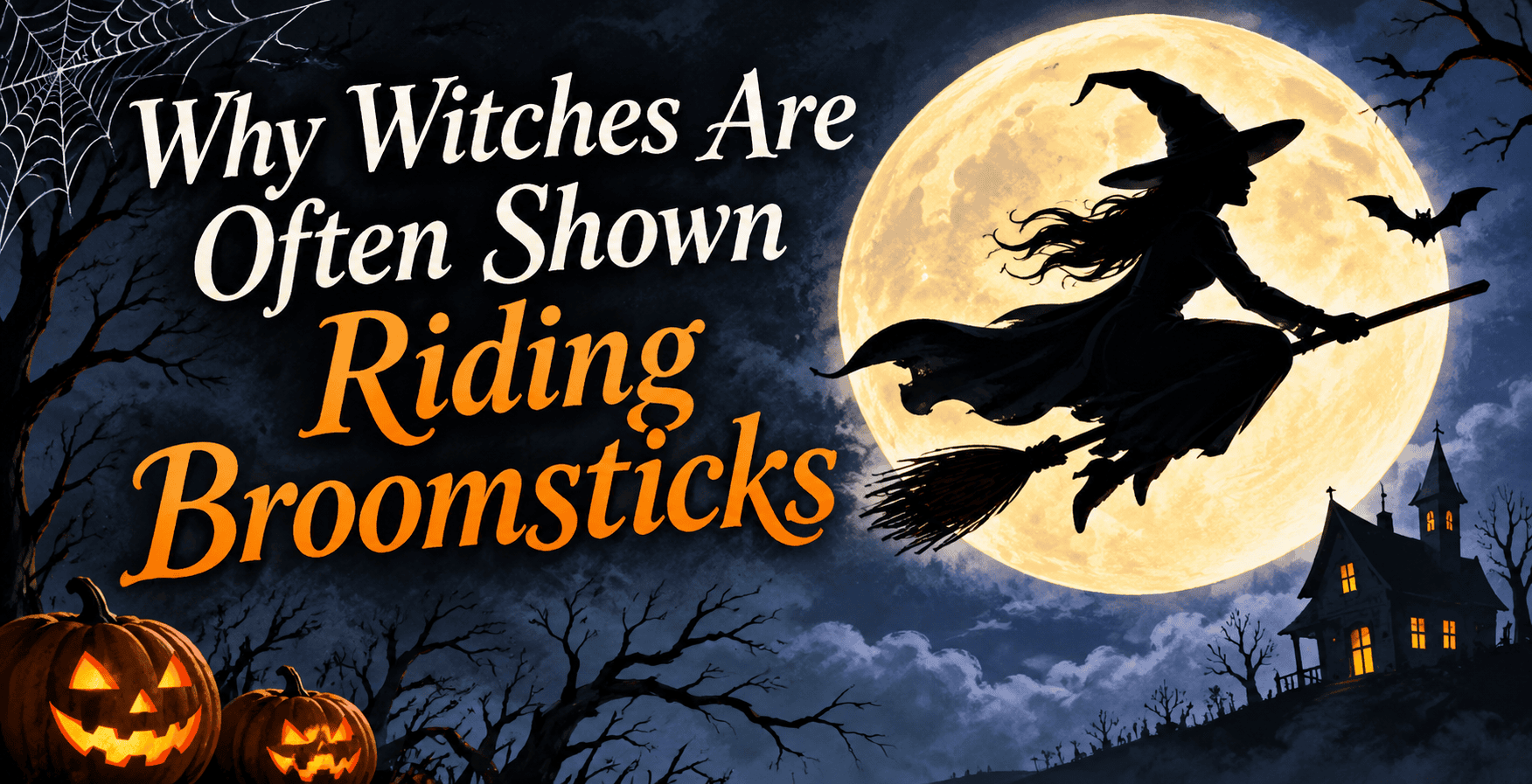
This imagery later became especially important in Halloween decorations, where a witch’s silhouette flying across a glowing moon creates an instantly recognizable spooky scene.
How the Witch’s Broomstick Became a Halloween Symbol
The modern association between witches, broomsticks, and Halloween developed gradually.
Halloween has historical connections to seasonal traditions, including the Gaelic festival of Samhain and Christian observances surrounding All Saints’ Day and All Souls’ Day.
Over time, popular Halloween customs incorporated supernatural figures such as ghosts, spirits, skeletons, black cats, and witches.
By the nineteenth and twentieth centuries, Halloween imagery increasingly featured recognizable characters and decorations.
Witches became particularly popular because they combined several elements associated with the holiday.
They were mysterious, connected to supernatural powers, and often depicted as active during the night.
Their broomsticks provided an instantly recognizable visual symbol.
A witch flying across the moon could be identified even when shown only as a black silhouette.
This made the image especially useful for postcards, advertisements, decorations, and illustrations.
As Halloween celebrations became more commercialized, the flying witch appeared on everything from greeting cards to candy packaging.
Eventually, the broomstick became almost inseparable from the traditional Halloween witch.
Why Are Witches Often Shown Flying Across the Full Moon?
One of Halloween’s most recognizable images is a witch flying on a broomstick in front of a large, glowing full moon.
This image combines several powerful visual traditions.
The moon has been associated with mystery, nighttime activity, and supernatural beliefs across many cultures.
A full moon provides a dramatic background against which a flying figure can be clearly seen.
For artists, this creates a simple but effective composition.
The bright circular moon contrasts with the dark silhouette of the witch and her broomstick.
The result is both eerie and visually memorable.
Although there is no universal historical tradition requiring witches to fly during a full moon, the image became especially popular through illustrations, Halloween decorations, and entertainment.
Today, it is difficult to imagine traditional Halloween artwork without the familiar silhouette of a witch crossing the moonlit sky.
The Influence of Fairy Tales and Folklore
European fairy tales also helped shape modern ideas about witches.
In many traditional stories, witches were portrayed as mysterious women who lived in forests, possessed magical powers, or threatened unsuspecting travelers.
Some were dangerous villains, while others were knowledgeable figures associated with spells, potions, or supernatural wisdom.
Not every fairy-tale witch rode a broomstick.
However, as different stories and artistic traditions influenced one another, the flying broom became an increasingly convenient symbol.
It allowed storytellers to demonstrate a witch’s supernatural abilities without lengthy explanations.
A character who could fly through the sky on an ordinary household broom was clearly no ordinary person.
This image also added a sense of adventure and fantasy to stories involving magic.
As children’s literature developed, broomstick-riding witches became familiar figures in illustrated books and fairy tales.
The image gradually moved beyond frightening folklore and entered the world of imaginative entertainment.
How Movies Made Flying Witches Famous
Film and television played an enormous role in popularizing the modern broomstick-riding witch.
During the twentieth century, witches appeared in fantasy films, animated productions, television programs, and Halloween specials.
One of the most influential portrayals was the Wicked Witch of the West in the 1939 film The Wizard of Oz.
Her green skin, pointed hat, dark clothing, and flying broomstick helped establish a visual style that influenced generations of Halloween costumes and decorations.
Later movies and television programs introduced witches who were frightening, humorous, friendly, or heroic.
The broomstick remained a familiar accessory even as portrayals changed.
In some stories, broomsticks became magical vehicles capable of extraordinary speed.
In others, they were ordinary cleaning tools transformed through spells.
Modern fantasy stories have even imagined broomsticks as equipment used for magical sports and competitions.
These creative interpretations helped preserve the traditional image while introducing it to new audiences.
Why Do Witches Ride Broomsticks Instead of Other Objects?
Witches were not always imagined traveling on brooms.
Historical folklore includes stories of supernatural travel involving animals, sticks, poles, and other household implements.
So why did the broomstick become the most famous?
Several factors likely contributed.
First, the broom was a familiar household object that audiences could immediately recognize.
Second, its long handle made it easy for artists to depict someone riding through the air.
Third, its association with domestic work connected it to historical stereotypes surrounding women and witchcraft.
Finally, repeated illustrations, stories, and later movies reinforced the same image.
Once the broomstick became widely recognized, artists and storytellers continued using it because audiences already understood what it represented.
The more frequently the image appeared, the stronger the association became.
Eventually, the flying broomstick became a defining feature of the traditional witch.
Were All Historical Witches Women?
Although popular Halloween imagery usually depicts witches as women, historical accusations of witchcraft affected both women and men.
Women represented the majority of people prosecuted for witchcraft in many European regions, but the proportions varied significantly by location.
In some areas, men made up a substantial percentage of those accused.
Iceland, for example, experienced witchcraft prosecutions in which men were particularly prominent.
This historical diversity is often overlooked in modern depictions.
The familiar image of an elderly woman riding a broomstick reflects particular European stereotypes rather than the full history of witchcraft accusations.
Modern witchcraft traditions are also diverse and include people of different genders.
Many contemporary practitioners view witchcraft through spiritual, religious, or symbolic frameworks that differ greatly from the frightening legends of earlier centuries.
Are Broomsticks Still Important in Modern Witchcraft?
Brooms continue to hold symbolic meaning in some modern Pagan and witchcraft traditions.
A ceremonial broom is sometimes called a besom.
Rather than being used for supernatural flight, a besom may symbolize purification, protection, or the removal of unwanted influences.
Some practitioners use ceremonial sweeping as part of spiritual rituals.
The action represents clearing a space symbolically rather than simply removing physical dirt.
Brooms may also appear in handfasting ceremonies or other traditions involving symbolic transitions.
However, practices vary widely, and not everyone who identifies as a witch uses a ceremonial broom.
The modern symbolic use of brooms should not be mistaken for proof that medieval flying-broom legends accurately described historical rituals.
Interesting Facts About Witches and Broomsticks
The history of flying witches includes several surprising details.
1. Witches were not always depicted riding brooms. Early folklore also described supernatural travel on animals, sticks, and other objects.
2. One of the earliest surviving illustrations dates to the fifteenth century. Images associated with Le Champion des Dames show witches traveling through the air on household implements.
3. Broomsticks were connected to everyday domestic life. Their association with household work likely helped make them recognizable symbols in stories about women accused of witchcraft.
4. Historical beliefs about flying varied. Some people imagined physical flight, while others interpreted supernatural journeys as dreams or illusions.
5. Flying ointments appeared in historical witchcraft accounts. However, their relationship to broomstick legends remains uncertain.
6. The full moon became an artistic favorite. Its bright circular shape provides a dramatic background for the silhouette of a flying witch.
7. Halloween helped preserve the image. Seasonal decorations, postcards, costumes, and entertainment made broomstick-riding witches familiar worldwide.
8. Modern ceremonial brooms are symbolic. In some contemporary spiritual traditions, they represent cleansing or protection rather than transportation.
How the Meaning of the Flying Witch Has Changed
The meaning of the broomstick-riding witch has changed dramatically over the centuries.
During periods of intense witchcraft persecution, images of flying witches often reflected fear, suspicion, and accusations of supernatural wrongdoing.
People accused of witchcraft could face devastating consequences because others believed such stories.
Over time, however, witches became characters in folklore, literature, and popular entertainment.
Their image gradually developed new meanings.
Some stories continued portraying witches as frightening villains.
Others presented them as wise, independent, humorous, misunderstood, or heroic figures.
Today, the flying witch is often more playful than terrifying.
Children dress as witches for Halloween, families decorate their homes with broomsticks, and animated witches fly across television screens.
The broomstick has become a symbol of imagination, magic, and seasonal fun.
What was once associated with fear and persecution has been transformed into one of Halloween’s most beloved traditions.
Why the Flying Witch Remains So Popular Today
Few Halloween symbols are as immediately recognizable as a witch riding a broomstick.
The image combines simplicity, mystery, and imagination.
It takes an ordinary household object and gives it an extraordinary purpose.
It also represents the idea of escaping everyday limitations.
A broom that normally remains on the ground suddenly becomes a magical vehicle capable of soaring above rooftops and forests.
This transformation appeals to the imagination because it turns something familiar into something impossible.
The flying witch also works perfectly as a Halloween decoration.
Whether displayed against a full moon, hanging from a porch, or printed on a festive greeting card, the image communicates Halloween almost instantly.
Its popularity has endured because it can be frightening, whimsical, humorous, or magical depending on how it is portrayed.
Final Thoughts: Why Witches Ride Broomsticks on Halloween
The reason witches are often shown riding broomsticks is rooted in centuries of European folklore, historical superstition, artistic traditions, and popular storytelling.
Brooms were familiar household objects associated with domestic life, while medieval and early modern witchcraft legends imagined witches traveling through the air to secret gatherings.
As artists illustrated these stories, the broomstick became an increasingly recognizable symbol of supernatural flight.
Later, fairy tales, Halloween traditions, movies, and television transformed the image into the familiar flying witch we know today.
Although the exact origin of the association cannot be traced to a single event, its development reveals how folklore can turn an ordinary object into a lasting cultural symbol.
The next time you see a witch flying across the Halloween moon on her broomstick, remember that the image carries hundreds of years of history.
Behind that familiar silhouette lies a story of superstition, imagination, persecution, artistic creativity, and changing cultural beliefs.
And perhaps that is what makes the flying witch such an enduring Halloween symbol.
After all, only in folklore could something as ordinary as a household broom become a magical ride through the midnight sky.
What do you think makes the image of a witch flying on a broomstick such an unforgettable part of Halloween?
Leave a Reply