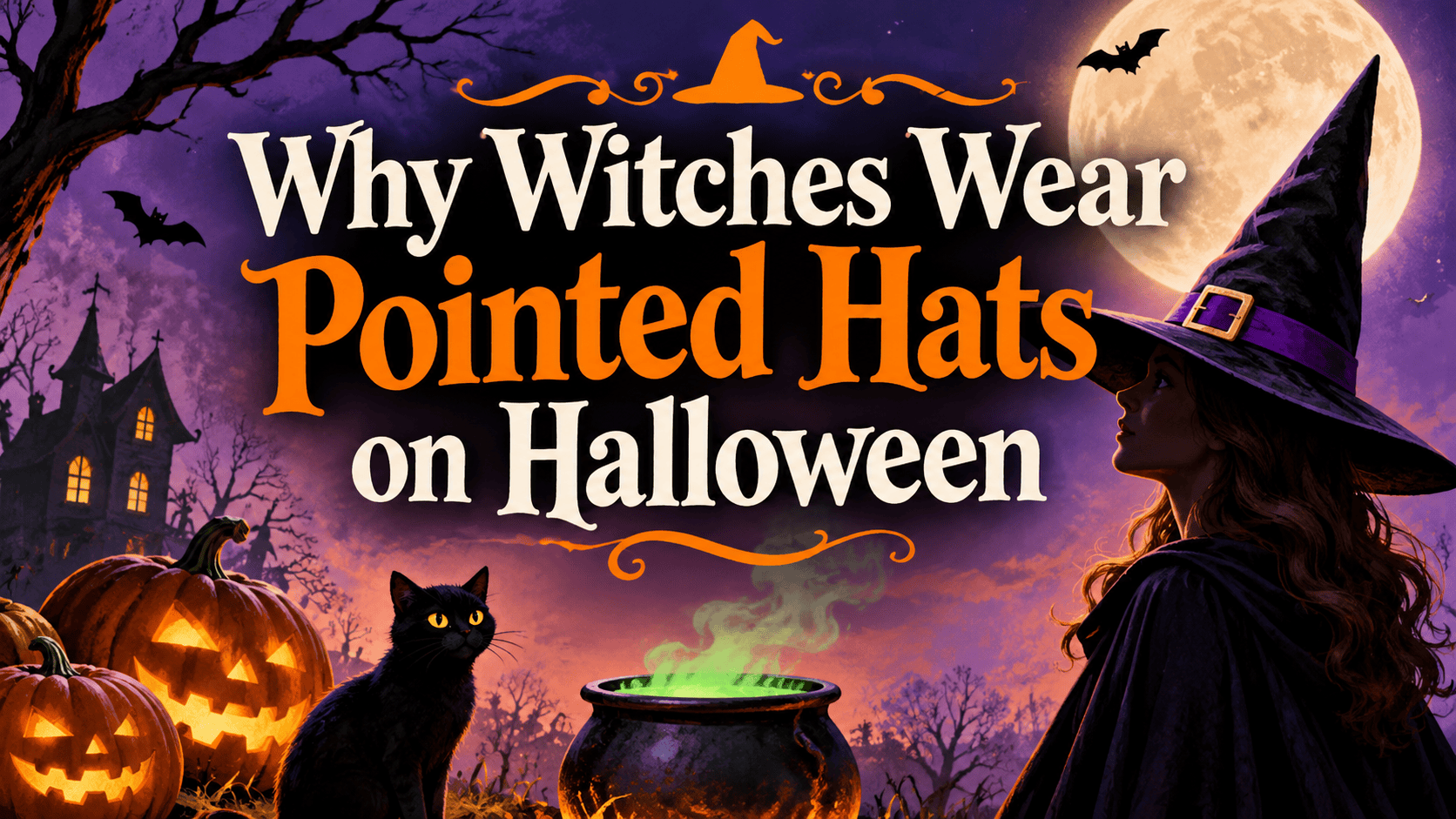
When you picture a witch on Halloween, one of the first things that probably comes to mind is a tall, pointed black hat. Along with broomsticks, bubbling cauldrons, black cats, and mysterious spells, the pointed witch hat has become one of the most recognizable symbols of Halloween.
But have you ever wondered why witches wear pointed hats in the first place?
The answer is more complicated than you might expect. The famous witch hat did not originate from one single tradition or historical event. Instead, it developed over centuries through European folklore, religious prejudice, changing fashion, illustrations, literature, and popular entertainment.
Today, the pointed witch hat is a fun Halloween accessory. However, its history reveals fascinating connections between superstition, fear, fashion, and the way society once portrayed people accused of practicing witchcraft.
The Origins of the Pointed Witch Hat
The exact origins of the pointed witch hat remain uncertain. Historians have proposed several explanations, but no single theory has been conclusively proven.
During medieval and early modern European history, people wore many different styles of hats. Some were tall, some were pointed, and others featured wide brims.
Over time, certain styles became associated with unusual or threatening figures in artwork and popular imagination.
The familiar Halloween witch hat combines three distinctive features:
-
A tall, cone-shaped crown
-
A wide, circular brim
-
A dark color, usually black
Although these features seem inseparable from witches today, historical records do not establish that people accused of witchcraft regularly wore this particular style.
Instead, the recognizable witch hat gradually emerged as an artistic symbol.
1. Pointed Hats Were Popular in Medieval European Fashion
One possible influence on the modern witch hat comes from medieval European clothing.
During the Middle Ages, pointed headwear appeared in several forms.
One famous example was the hennin, a tall, cone-shaped headdress worn by some wealthy European women during the 15th century.
These fashionable headdresses could be extremely tall and were sometimes decorated with veils.
Although hennins were generally symbols of status and fashion rather than witchcraft, their distinctive silhouettes have been suggested as one possible visual influence on later depictions of witches.
However, there is no clear historical evidence establishing that the Halloween witch hat directly descended from the hennin.
The connection remains an interesting possibility rather than a proven explanation.
2. Witches Were Often Portrayed as Outsiders
Throughout European history, accusations of witchcraft were frequently connected to fear, suspicion, and social conflict.
People accused of witchcraft were often ordinary members of their communities. Many were women, although men were also accused and prosecuted.
Popular stories and illustrations increasingly portrayed witches as frightening figures who lived outside accepted social boundaries.
Artists exaggerated their appearances to communicate danger, mystery, and supernatural power.
Unusual clothing, distorted facial features, and distinctive headwear helped make these fictional figures immediately recognizable.
A tall, pointed hat eventually became one of the visual shortcuts used to identify a witch.
Rather than representing the actual clothing of accused individuals, the hat became part of a fictional stereotype.
3. The Connection Between Pointed Hats and Religious Prejudice
One frequently discussed theory connects the witch hat to historical depictions of Jewish people in medieval Europe.
During parts of the Middle Ages, Jewish people were sometimes depicted wearing distinctive pointed hats, commonly known as Jewish hats or Judenhuts.
In certain regions and periods, authorities also imposed discriminatory clothing requirements on Jewish communities.
These hats appeared in medieval artwork and were used to distinguish Jewish figures from Christians.
Some modern interpretations suggest that this visual tradition may have influenced later images of witches, especially because European antisemitism sometimes falsely connected Jewish people with sorcery or other threatening stereotypes.
However, the direct connection between the medieval Jewish hat and the modern witch hat is not firmly established.
It is important to distinguish documented historical discrimination from theories about how particular artistic symbols developed.
The broader history does show that distinctive clothing was sometimes used to portray marginalized groups as outsiders.
4. The Quaker Hat Theory
Another popular explanation suggests that the witch hat was influenced by hats worn by Quaker women and men during the 17th century.
Early Quakers, members of the Religious Society of Friends, sometimes wore broad-brimmed hats with relatively tall crowns.
Their religious beliefs and practices also challenged established social expectations.
Because Quakers faced persecution in England and colonial America, some writers have suggested that hostile portrayals of Quakers may have contributed to the imagery associated with witches.
The resemblance between certain historical hats and the familiar witch hat makes this theory appealing.
However, historians have not established a direct line connecting Quaker fashion to the pointed Halloween witch hat.
It remains one of several speculative explanations.
5. Why the Witch Hat Became Black
Black is now the traditional color of the Halloween witch hat.
The association makes sense when considering the symbolism of black in European folklore and later Gothic storytelling.
Black clothing was often used in art and literature to suggest darkness, death, secrecy, mourning, or supernatural danger.
As witches became increasingly associated with nighttime rituals, mysterious powers, and frightening stories, black became a convenient color for artists and costume designers.
However, black clothing itself was never reliable evidence that someone practiced witchcraft.
People throughout history wore dark clothing for ordinary reasons, including fashion, practicality, and personal preference.
The black witch hat is primarily a product of visual storytelling rather than an established historical dress code.
6. Witch Trials Helped Shape the Frightening Image of Witches
Between approximately the 15th and 18th centuries, witch hunts and trials occurred across Europe and parts of colonial North America.
Thousands of people were executed following accusations of witchcraft.
Fear of supernatural harm, religious tensions, local disputes, and legal systems that accepted questionable evidence all contributed to these persecutions.
Printed pamphlets, woodcuts, and other illustrations helped spread frightening ideas about witches.
Artists sometimes depicted witches as elderly women, monstrous figures, or people participating in imagined supernatural gatherings.
However, early witch-trial illustrations did not consistently show witches wearing the modern pointed hat.
Some witches appeared bareheaded, while others wore ordinary head coverings.
The witch trials contributed to the broader stereotype of the dangerous witch, but they do not provide a definitive explanation for the pointed hat itself.
7. Folklore and Fairy Tales Made Witch Hats More Recognizable
As European folklore developed, witches became familiar characters in legends, fairy tales, and children’s stories.
These fictional witches were often portrayed as mysterious women who possessed magical knowledge.
Some were dangerous villains, while others were wise, helpful, or misunderstood.
Artists needed visual details that would immediately identify a character as a witch.
A pointed hat provided a memorable silhouette that could distinguish a witch from other figures.
During the 18th and 19th centuries, illustrated books, theatrical productions, and popular prints helped standardize many familiar supernatural characters.
The witch’s pointed hat became increasingly recognizable through repeated artistic use.
Over time, the public began to associate the hat with witches even when the original historical influences were forgotten.
8. The Victorian Era Helped Popularize the Classic Witch Image
The Victorian era played an important role in shaping modern Halloween imagery.
During the 19th century, interest in folklore, ghost stories, supernatural legends, and Gothic literature became widespread.
Illustrated magazines, greeting cards, and books featured witches alongside ghosts, black cats, bats, and other mysterious creatures.
As Halloween celebrations became more popular in Britain and North America, artists began using familiar supernatural symbols in seasonal decorations.
The pointed witch hat was particularly useful because its distinctive shape could be recognized immediately.
By the late 19th and early 20th centuries, witches wearing pointed hats appeared in Halloween postcards, illustrations, and decorations.
These images helped establish the visual traditions that remain familiar today.
9. Halloween Postcards Made the Witch Hat Famous
Before television and modern digital entertainment, postcards were an important way to exchange holiday greetings.
Halloween postcards became especially popular during the late 19th and early 20th centuries.
Many featured witches flying on broomsticks, stirring cauldrons, telling fortunes, or standing beside black cats.
Their hats were often tall, pointed, and dark.
Interestingly, not every vintage Halloween witch was frightening.
Some postcards portrayed witches as cheerful, fashionable, or playful characters.
Others connected witches with romance, fortune-telling, and predicting future relationships.
These images helped transform witches from purely frightening figures into familiar Halloween characters.
The pointed hat became a symbol that could represent mystery, magic, humor, or holiday fun.
10. The Wizard of Oz Helped Establish the Modern Witch Hat
One of the most influential portrayals of a witch in popular culture appeared in the 1939 film The Wizard of Oz.
The Wicked Witch of the West wore a tall, pointed black hat that became one of the most recognizable costume designs in movie history.
Her dark clothing, dramatic appearance, and intimidating personality reinforced the image of the traditional wicked witch.
Although pointed witch hats already existed in artwork and costumes before the film, The Wizard of Oz helped introduce the look to generations of moviegoers.
The character’s appearance became a major influence on later Halloween costumes, cartoons, television programs, and decorations.
For many people, the Wicked Witch of the West became the defining image of what a Halloween witch should look like.
11. Why Are Witch Hats Pointed Instead of Round?
The pointed shape is one of the most interesting features of the traditional witch hat.
Some modern explanations suggest that the cone represents magical energy, spiritual power, or a connection between the earth and the heavens.
However, there is little historical evidence that the familiar Halloween witch hat was originally designed to channel supernatural energy.
A more practical explanation involves visual design.
A pointed hat creates a dramatic silhouette.
It makes a character appear taller, more unusual, and instantly recognizable.
In illustrations, theater, and movies, exaggerated shapes help audiences identify characters quickly.
The tall cone also separates the witch from ordinary people wearing everyday hats.
While magical interpretations are popular in modern discussions, the hat’s distinctive appearance is better understood as the result of evolving artistic traditions.
12. Did Real Witches Actually Wear Pointed Hats?
There is no reliable historical evidence that people accused of witchcraft generally wore tall, pointed black hats.
During the European witch trials, accused individuals typically dressed according to the clothing customs of their communities.
Their appearance varied depending on location, occupation, social status, and historical period.
Some wore bonnets, caps, scarves, or other ordinary head coverings.
Others may have worn hats common to their region.
The idea that witches traditionally wore a specific magical uniform is largely fictional.
Modern practitioners of witchcraft and contemporary Pagan traditions also do not have a universal requirement to wear pointed hats.
Some choose to wear them for ceremonies, celebrations, personal expression, or Halloween, while many do not.
The pointed hat is therefore much more closely connected to popular culture than to the actual history of witchcraft.
13. Why Witches Wear Pointed Hats on Halloween Today
Today, the pointed witch hat is one of Halloween’s most recognizable accessories.
It appears in costumes, decorations, party supplies, artwork, movies, and seasonal merchandise.
Its popularity comes from several simple characteristics.
First, it is immediately recognizable. Even without a broomstick or cauldron, a tall black pointed hat strongly suggests a witch.
Second, it is easy to create. A basic witch hat can be made from fabric, felt, cardboard, or other inexpensive materials.
Third, it works with many costume styles. A witch can appear frightening, glamorous, humorous, mysterious, or friendly while wearing the same general hat shape.
Finally, the pointed hat connects modern Halloween celebrations with centuries of supernatural storytelling.
It has become a symbol of Halloween itself rather than merely an accessory associated with one character.
14. How Witch Hats Became a Halloween Fashion Tradition
Halloween costumes have changed dramatically over the years, and witch hats have evolved with them.
Traditional costumes often featured plain black hats with wide brims.
Modern designs include glitter, lace, feathers, ribbons, flowers, metallic fabrics, and colorful decorations.
Some hats are intentionally crooked or oversized to create a humorous appearance.
Others feature elegant designs inspired by fantasy stories or Gothic fashion.
Children often wear playful witch hats decorated with stars, moons, or bright colors.
Adults may choose elaborate designs that complement historical, fantasy, or theatrical costumes.
Despite these variations, the classic pointed silhouette remains almost universally recognizable.
This flexibility has helped the witch hat survive changing Halloween trends.
15. Interesting Facts About Witch Hats
The history of witch hats includes several surprising details.
The pointed witch hat has no single confirmed origin. Historians continue to discuss several possible influences, including historical fashion, religious stereotypes, and artistic traditions.
Early witch illustrations did not always include pointed hats. The now-familiar design became more standardized over time.
Not all fictional witches wear black hats. Fantasy stories and modern Halloween costumes feature witch hats in almost every color.
The Wizard of Oz did not invent the pointed witch hat. The movie helped popularize an image that had already developed.
Witch hats were not standard clothing for accused witches. Historical witch-trial records do not support the idea of a universal witch costume.
Vintage Halloween postcards helped spread the image. Their illustrations made the pointed hat a familiar seasonal symbol.
Modern witch hats can represent many different personalities. The same accessory can suggest a frightening villain, a friendly magical character, or a playful Halloween costume.
16. The Meaning of the Witch Hat Has Changed Over Time
Perhaps the most fascinating part of the witch hat’s history is how its meaning has changed.
In earlier European traditions, witches were frequently portrayed as dangerous figures associated with supernatural fears.
These stereotypes contributed to a culture in which accusations of witchcraft could have devastating consequences.
As folklore moved into literature, theater, and entertainment, the fictional witch became a more flexible character.
Witches could be frightening villains, mysterious fortune-tellers, wise magical figures, or humorous personalities.
Modern Halloween celebrations have transformed the pointed hat into a playful symbol of imagination and creativity.
For some people, it also represents independence, personal power, and an appreciation for magical or fantasy traditions.
The same hat that once appeared in frightening imagery can now be worn simply for fun.
17. Why the Pointed Witch Hat Remains a Halloween Favorite
Halloween is a holiday built around recognizable symbols.
Pumpkins, ghosts, skeletons, bats, black cats, and witches all help create its familiar atmosphere.
The pointed witch hat has remained popular because it communicates an entire character through one simple shape.
A black pointed hat resting on a chair can immediately suggest that a witch is nearby.
A hat hanging beside a broomstick can create a Halloween decoration without requiring anything else.
Even a small drawing of a pointed hat can instantly communicate the idea of witchcraft or Halloween magic.
Few costume accessories have maintained such strong cultural recognition for so long.
The witch hat continues to appear in Halloween celebrations because it is simple, versatile, mysterious, and deeply connected to popular storytelling.
Final Thoughts: Why Do Witches Wear Pointed Hats on Halloween?
The traditional pointed witch hat is not the result of one ancient magical custom or a documented uniform worn by historical witches.
Instead, it developed through a combination of European fashion, folklore, social stereotypes, artistic imagination, and popular entertainment.
Medieval pointed headwear, historical prejudice, early illustrations, Victorian Halloween traditions, vintage postcards, and famous movie characters have all been discussed as influences on the image we recognize today.
Although some proposed origins remain unproven, one thing is clear: the pointed black hat became a powerful visual symbol of the fictional witch.
What was once associated with fear and supernatural mystery eventually became a beloved part of Halloween celebrations.
Today, people wear pointed witch hats not because witches throughout history necessarily wore them, but because generations of stories, illustrations, and movies have made the design instantly recognizable.
The next time you see someone wearing a tall black witch hat on Halloween, remember that this simple costume accessory carries a fascinating history shaped by centuries of changing beliefs and traditions.
What do you think of when you see a pointed witch hat: a frightening Halloween witch, a magical fairy-tale character, or a fun holiday costume?
Leave a Reply