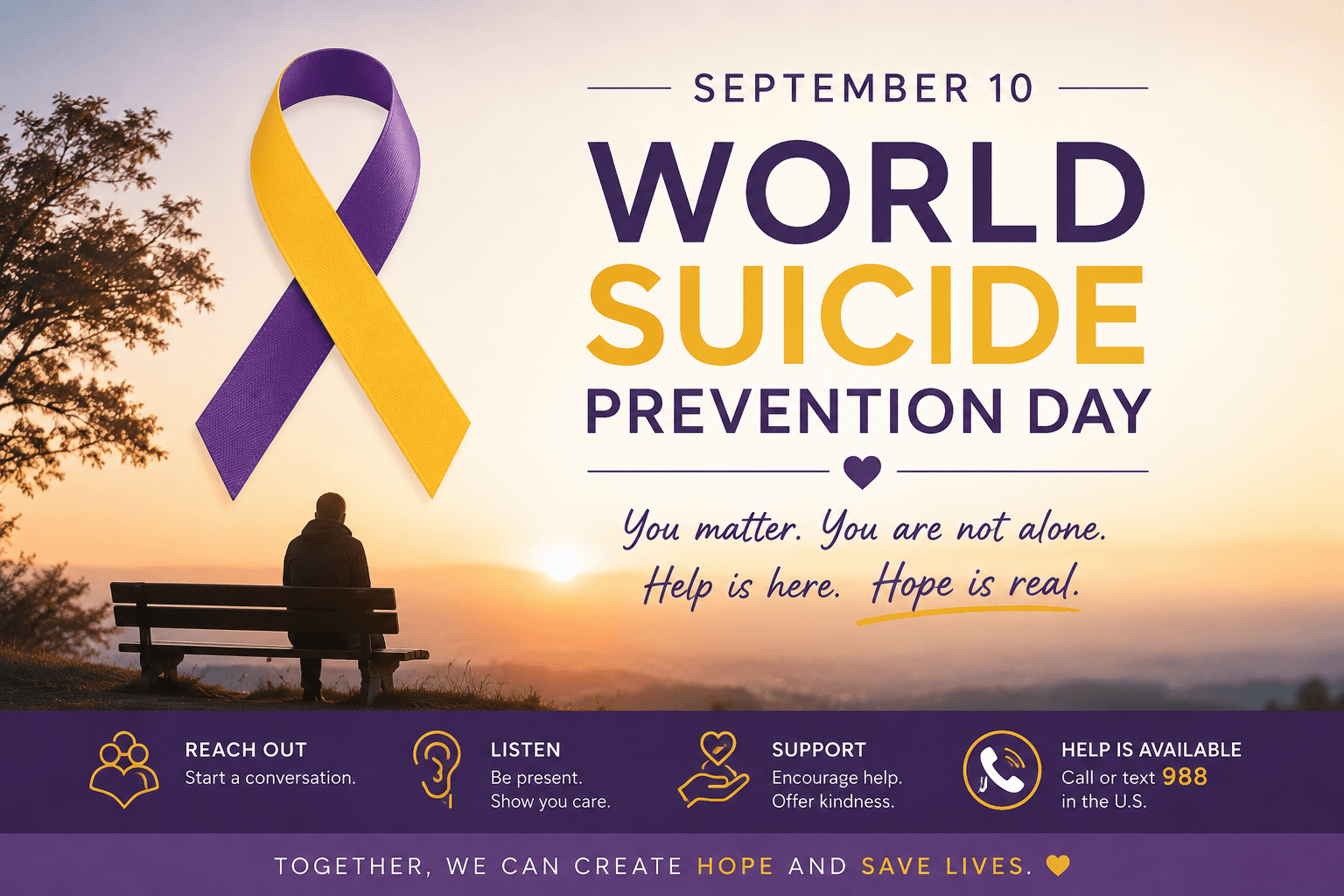
Every year on September 10, people around the world recognize World Suicide Prevention Day, a day dedicated to raising awareness about suicide prevention, reducing stigma, encouraging meaningful conversations, and reminding people that support and human connection can make a difference.
It is also a day to remember those whose lives have been lost to suicide, acknowledge the families and friends who carry that loss, and stand beside people who may currently be struggling.
Suicide is a difficult subject. Many people avoid talking about it because they are afraid of saying the wrong thing or making someone uncomfortable. Others may carry their struggles quietly because they fear judgment, rejection, or being seen differently.
But silence can deepen isolation.
World Suicide Prevention Day encourages something different: conversation, compassion, listening, understanding, and hope.
Sometimes helping begins with something as simple as letting another person know:
You matter. I am here. You do not have to face this moment alone.
Why World Suicide Prevention Day Matters
World Suicide Prevention Day was established to bring global attention to suicide prevention and encourage individuals, communities, organizations, and governments to take meaningful action.
But awareness should extend beyond statistics.
Behind every number is a human being.
Someone’s son.
Someone’s daughter.
Someone’s father or mother.
Someone’s brother or sister.
Someone’s spouse, partner, friend, coworker, neighbor, classmate, or loved one.
Every person has a story, relationships, dreams, struggles, and people whose lives are connected to theirs.
That is why suicide prevention cannot simply be viewed as a mental health issue discussed once a year. It is a human issue requiring compassion throughout our communities.
World Suicide Prevention Day reminds us that we all have opportunities to make the world a little less lonely.
People Can Hide Tremendous Pain
One of the most important lessons surrounding mental health is that we cannot always tell what someone is experiencing by looking at them.
A person can smile while struggling.
They can go to work every morning while feeling overwhelmed inside.
They can laugh with friends while privately battling despair.
They can post happy pictures online while experiencing tremendous emotional pain away from the screen.
They can continue helping everyone around them while quietly wondering who would help them if they finally admitted they were struggling.
People become very good at hiding pain.
Sometimes they do it because they don’t want to worry anyone.
Sometimes they believe they are supposed to handle everything themselves.
Sometimes they are ashamed of what they are feeling.
Sometimes previous attempts to open up were dismissed.
And sometimes they simply don’t know how to put what they are experiencing into words.
This is one reason compassion matters so much.
We never completely know what another person is carrying.
Asking for Help Is a Sign of Strength
There remains a damaging misconception that people should be able to handle emotional struggles by themselves.
They may hear:
“Just stay positive.”
“Other people have it worse.”
“You need to be stronger.”
“Get over it.”
Statements like these may be intended as encouragement, but they can make someone feel even more alone.
Mental and emotional pain deserves to be taken seriously.
There is nothing shameful about reaching out to someone you trust, speaking with a counselor, contacting a crisis service, or seeking professional mental health care.
Asking for help means recognizing that what you are experiencing deserves attention and support.
Sometimes the strongest sentence someone can say is:
“I’m not okay, and I need help.”
Those words can become the beginning of a different chapter.
The Power of Simply Listening
When someone tells you they are struggling, you do not need to have perfect advice.
You do not need to solve everything.
You do not need to deliver an inspirational speech.
Sometimes you simply need to listen.
Give the person your attention.
Allow them to speak without immediately interrupting.
Take what they say seriously.
Avoid comparing their pain to someone else’s experience.
Don’t pressure them to “look on the bright side.”
Instead, acknowledge what they are experiencing.
You might tell them that you’re glad they trusted you enough to speak about it and that you want to help them find support.
Being heard does not magically erase someone’s problems, but genuine human connection can reduce the feeling that they are facing everything alone.
Check on the People Who Seem Strong
We often check on people when something visibly goes wrong.
But we should also check on the people who appear to have everything together.
Check on the friend who is always making everyone laugh.
Check on the person everyone depends upon.
Check on the father who believes he has to stay strong for his family.
Check on the mother carrying responsibilities nobody sees.
Check on the coworker who has become unusually quiet.
Check on the friend who suddenly stopped answering messages.
Check on the person who constantly says, “I’m fine.”
Sometimes the people who spend the most time helping everyone else have difficulty admitting when they need help themselves.
A sincere message can matter:
“I was thinking about you today. How are you really doing?”
And if they answer honestly, listen.
Men Need Permission to Talk About Pain
World Suicide Prevention Day also provides an opportunity to challenge harmful expectations surrounding men and emotional pain.
Many men grow up hearing messages such as:
“Be tough.”
“Don’t cry.”
“Handle your problems.”
“Don’t show weakness.”
Those messages can follow men into adulthood.
A man may experience grief, depression, loneliness, heartbreak, financial pressure, family problems, anxiety, or tremendous emotional exhaustion while believing he must remain silent.
He may continue saying he is okay because admitting otherwise feels like failure.
It isn’t.
Men need places where they can speak honestly without being mocked, dismissed, or treated as weak.
Strength is not pretending nothing hurts.
Sometimes strength is admitting that something does.
Grief Can Make Life Feel Incredibly Heavy
For people who have experienced a devastating loss, World Suicide Prevention Day carries another important message.
Grief can change almost every part of life.
After losing someone deeply loved, a person may struggle with loneliness, anger, guilt, exhaustion, confusion, fear, and questions about how life can possibly continue.
There may be days when getting through ordinary routines requires enormous effort.
People grieving a spouse, parent, sibling, friend, or child may need support long after everyone else assumes they should be “doing better.”
There is no simple timetable for grief.
We should never assume someone’s grief has disappeared simply because time has passed.
Continue checking on grieving people.
Remember difficult anniversaries.
Say the person’s name.
Listen to their memories.
And when someone is struggling deeply, encourage them to connect with appropriate professional or crisis support.
Nobody should have to carry unbearable grief entirely alone.
Small Acts of Kindness Matter
We may never know the full impact of our kindness.
A phone call.
A text message.
An invitation to coffee.
Sitting beside someone.
Listening without judgment.
Offering a ride to an appointment.
Helping someone find professional support.
Checking in again tomorrow.
These actions may appear small from the outside, but to someone who feels forgotten or isolated, they can mean much more.
Kindness cannot replace professional mental health care when it is needed, but compassion can help create the connection that encourages someone to seek that help.
Never underestimate the importance of showing someone that they matter.
Learn to Recognize Concerning Changes
Not everyone experiencing suicidal thoughts will display obvious warning signs, and warning signs can differ significantly between people.
However, significant changes in someone’s behavior, mood, communication, or everyday functioning should not automatically be ignored.
Someone may begin withdrawing from people they normally spend time with. They may express hopelessness, talk about feeling trapped or like a burden, display dramatic changes in mood, or begin behaving in ways that concern the people who know them.
If something feels seriously wrong, take it seriously.
You don’t need to diagnose the person.
You can simply reach out.
Ask how they are doing.
Listen carefully.
And when necessary, help connect them with professional or emergency support.
If you believe someone is in immediate danger, treat the situation as an emergency rather than leaving them to handle it alone.
We Need to Remove the Stigma Around Mental Health
Imagine if people felt as comfortable saying:
“I’m struggling emotionally.”
as they did saying:
“My back hurts.”
Mental health is health.
Yet many people still hesitate to discuss depression, anxiety, trauma, grief, loneliness, suicidal thoughts, or other emotional struggles because they fear how others will react.
Changing that culture requires all of us.
We can stop using mental health struggles as insults.
We can stop telling people to simply “get over” serious emotional pain.
We can stop treating counseling as something embarrassing.
We can listen without judgment.
We can encourage people to seek help without making them feel ashamed for needing it.
Every time we make an honest conversation about mental health safer, we make it easier for someone else to speak.
Hope Does Not Always Feel Like Happiness
When someone is experiencing tremendous emotional pain, telling them simply to “have hope” may feel impossible.
Hope does not always mean feeling happy.
Sometimes hope is smaller.
Hope can mean getting through the next hour.
Hope can mean making one phone call.
Hope can mean telling someone the truth about how badly you are hurting.
Hope can mean agreeing to stay with someone instead of isolating yourself.
Hope can mean scheduling an appointment.
Hope can mean accepting help even when part of you wants to push everyone away.
Sometimes hope begins before a person actually feels hopeful.
It begins with one decision to keep going.
Creating Hope Through Action
Awareness is valuable, but awareness becomes more powerful when it leads to action.
World Suicide Prevention Day gives us an opportunity to consider what we can personally do.
Reach out to someone you haven’t heard from recently.
Learn about suicide prevention resources in your community.
Talk openly about mental health.
Encourage counseling and professional support when appropriate.
Support organizations working in suicide prevention.
Be patient with people experiencing grief or depression.
Take concerning statements seriously.
And continue checking on people after the immediate crisis appears to have passed.
Prevention isn’t only about one dramatic intervention.
Often it involves creating communities where people feel safe enough to say they are struggling before they reach a crisis.
If You Are Struggling Today
If today feels unbearably heavy, please don’t make yourself carry everything privately.
You do not need to solve your entire life today.
You do not need to know exactly what tomorrow will look like.
Your job right now can simply be getting through this moment and connecting with another human being.
Tell someone you trust what is happening.
Contact a counselor or mental health professional.
Reach out to a crisis service.
If you are in the United States, you can call or text 988 to reach the 988 Suicide & Crisis Lifeline. Support is available for people experiencing suicidal thoughts, emotional distress, mental health struggles, or concern about someone they care about.
If you believe you may act on suicidal thoughts or are in immediate danger, call 911 or go to the nearest emergency department.
If you live outside the United States, contact your country’s emergency services or a local crisis support organization.
You do not have to wait until things become worse before asking for help.
Remembering Those We Have Lost
World Suicide Prevention Day is also a day of remembrance.
Families and friends who have lost someone to suicide may carry questions that never receive complete answers.
Their grief deserves compassion too.
They may replay conversations.
They may wonder whether they missed something.
They may experience anger, confusion, guilt, sadness, or all of those emotions at different times.
People grieving a suicide loss need space to mourn without judgment.
The person they lost was more than the circumstances surrounding their death.
They were a human being with memories, relationships, personality, laughter, accomplishments, imperfections, dreams, and people who loved them.
Their life deserves to be remembered.
One Conversation Can Matter
We cannot always see the battles happening inside another person’s mind.
That is why kindness matters.
Listening matters.
Checking in matters.
Mental health care matters.
Community matters.
And conversations matter.
You may not always know exactly what to say.
That’s okay.
Sometimes the most meaningful thing you can offer another person isn’t advice.
It is presence.
“I’m here.”
“I’m listening.”
“You matter to me.”
“We’ll find help together.”
Those words cannot solve every problem, but they can open a door that isolation was trying to close.
World Suicide Prevention Day — September 10
World Suicide Prevention Day reminds us that suicide prevention belongs to all of us.
We can create families where people feel safe discussing their emotions.
We can create friendships where someone doesn’t have to pretend everything is okay.
We can create workplaces where mental health is taken seriously.
We can create communities where seeking counseling is treated as responsible rather than shameful.
And we can become people who notice, listen, care, and reach out.
On September 10, remember those we have lost.
Support those who are grieving.
Stand beside those who are struggling.
Check on the people you love.
And continue the conversation long after World Suicide Prevention Day ends.
Because sometimes the most important thing we can give another person is the reminder that their story is still being written, their presence matters, and they do not have to face their darkest moments alone.
Who is someone in your life you could check on today—not because you know they are struggling, but simply because you want them to know they matter?
Leave a Reply