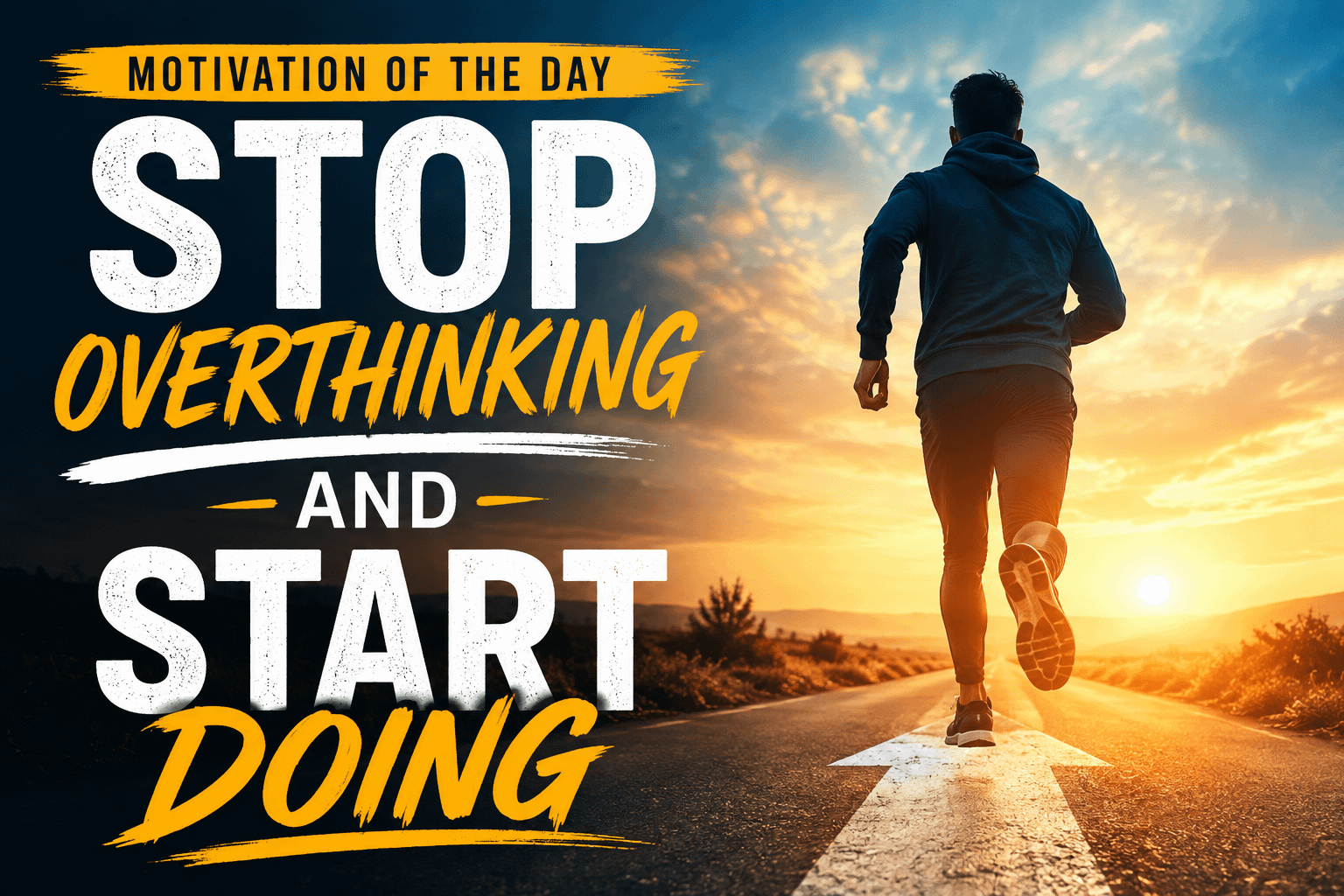
There are moments in life when thinking carefully is exactly what we need to do. Important decisions deserve consideration. Big changes deserve planning. We should think about consequences, weigh our options, and make thoughtful choices.
But there is also a point when thinking stops helping us and starts holding us back.
You think about what could go wrong.
Then you think about what might happen if it goes right.
Then you wonder whether you’re ready.
Then you question whether you’re making the right decision.
Then you decide you need more time.
Tomorrow becomes next week. Next week becomes next month. Before you know it, you’ve spent more time thinking about doing something than it would have taken to simply begin.
Today’s message is a reminder that sometimes you have to get out of your own head.
Stop overthinking and start doing.
You don’t need every answer.
You don’t need a perfect plan.
You don’t need complete confidence.
You don’t need to know exactly how everything will turn out.
Sometimes you simply need enough courage to take the next step.
When Thinking Becomes Overthinking
Thinking is productive when it helps you make a decision.
Overthinking becomes destructive when it prevents you from making one.
There is an important difference.
Productive thinking asks:
“What information do I need before moving forward?”
Overthinking asks:
“What if there’s something I haven’t considered?”
Productive thinking creates a plan.
Overthinking constantly rewrites the plan.
Productive thinking identifies reasonable risks.
Overthinking imagines every possible disaster.
Productive thinking eventually leads to action.
Overthinking often leads to more thinking.
That’s how people become stuck.
They aren’t necessarily lazy or unmotivated. Sometimes they care so much about making the right decision that they become afraid to make any decision at all.
The goal isn’t to stop thinking.
The goal is to recognize when you’ve thought enough.
At some point, you have to trust yourself and move.
Overthinking Often Comes From Wanting Certainty
Many of us want guarantees before taking risks.
We want to know the business will succeed before starting it.
We want to know the relationship will work before opening our hearts.
We want to know we’ll get the job before submitting the application.
We want to know we’ll reach our goal before committing to the journey.
We want certainty.
Life rarely offers it.
You can prepare carefully and still encounter surprises.
You can make a great decision and still experience difficulties.
You can do everything correctly and still have something unexpected happen.
That’s part of life.
Waiting for complete certainty can mean waiting forever.
Sometimes the healthiest decision is accepting:
“I don’t know exactly what will happen, but I’m willing to find out.”
You Don’t Need to See the Entire Road
Imagine driving at night.
Your headlights don’t illuminate the entire journey. They only show you a portion of the road ahead.
Yet that’s enough to keep moving.
You drive forward.
More of the road becomes visible.
Then you continue.
Life often works the same way.
We want to see the entire journey before beginning.
We want step 2, step 12, step 50, and step 100 figured out before taking step one.
But you don’t need to know everything that comes next.
You need to know your next step.
Once you take it, you’ll have more information.
Then you can decide what comes after that.
Action Creates Clarity
One of the most valuable lessons you can learn is that clarity often follows action.
You don’t always need clarity before starting.
Sometimes starting creates the clarity.
You begin writing and discover what you actually want to say.
You start exercising and discover which routines work for you.
You begin your project and realize which parts of the original plan need changing.
You have the conversation and finally understand where the other person stands.
You apply for opportunities and learn what employers are looking for.
You launch something and discover what your audience responds to.
Action gives you information that thinking alone cannot provide.
Sometimes you can’t think your way into the answer.
You have to experience your way into it.
Stop Trying to Predict Every Possible Outcome
Overthinking often convinces us that if we analyze enough possibilities, we can protect ourselves from disappointment.
But there are endless possibilities.
You could spend all day imagining them.
“What if I fail?”
“What if people judge me?”
“What if nobody cares?”
“What if I make the wrong choice?”
“What if I’m embarrassed?”
“What if I waste my time?”
Those possibilities might exist.
But so do others.
What if you succeed?
What if someone says yes?
What if people support you?
What if you discover you’re better at something than you expected?
What if one opportunity leads to another?
What if your life changes because you finally decided to try?
Fear tends to make us imagine negative possibilities while ignoring positive ones.
Don’t let your imagination become evidence against your future.
Perfectionism Can Become Procrastination
Perfectionism often sounds responsible.
“I just want to make sure it’s right.”
“I want everything prepared.”
“I want it to be the best it can be.”
Those intentions aren’t necessarily bad.
But perfectionism can quietly become another form of procrastination.
You keep editing.
Keep planning.
Keep researching.
Keep preparing.
Keep waiting.
Eventually, the pursuit of perfection prevents progress.
Your first attempt doesn’t have to be your best attempt.
It simply needs to exist.
You can improve something you’ve started.
You can edit something you’ve written.
You can strengthen something you’ve built.
You can adjust something you’ve launched.
But you can’t improve something that remains only an idea.
Progress requires imperfection.
Give Yourself Permission to Be a Beginner
One reason people hesitate is because they don’t want to look inexperienced.
They compare themselves to people who have been doing something for years and think:
“I’ll never be that good.”
Maybe not today.
But neither were they when they started.
Everyone begins somewhere.
The successful entrepreneur once had no customers.
The experienced writer once struggled through a first draft.
The athlete once had a first workout.
The confident speaker once felt nervous.
The expert once knew almost nothing about the subject they now understand deeply.
You are allowed to be new.
You are allowed to make mistakes.
You are allowed to ask questions.
You are allowed to learn.
You are allowed to improve slowly.
Don’t demand expert-level performance from beginner-level experience.
Start.
Then grow.
Confidence Is Often Built Through Action
People sometimes wait for confidence before doing something difficult.
But confidence frequently works in the opposite direction.
You take action first.
Then confidence grows.
Think about something you can do today that once made you nervous.
Driving.
Starting a new job.
Using new technology.
Speaking with customers.
Cooking something complicated.
Traveling somewhere unfamiliar.
At one point, you didn’t know exactly what you were doing.
Experience changed that.
You practiced.
You learned.
You became familiar with the situation.
Eventually, your confidence increased.
Confidence is often evidence you’ve collected from previous actions.
Every time you do something difficult, you’re giving yourself another reason to believe:
“I can handle this.”
Small Actions Are More Powerful Than Big Intentions
People often underestimate small steps because they don’t feel dramatic.
But most major accomplishments aren’t created through one enormous moment.
They’re created through repeated small actions.
One workout doesn’t transform your health.
But hundreds of workouts can.
One page doesn’t create a book.
But enough pages eventually do.
Saving a few dollars doesn’t create financial security overnight.
But consistent saving can change your financial future.
One healthy meal doesn’t change everything.
But thousands of better choices can.
One article doesn’t build an audience.
But consistently creating valuable work can.
Never underestimate what happens when small actions are repeated.
Consistency turns small efforts into significant results.
Make the Goal Smaller
Sometimes you’re not avoiding the goal because you’re afraid.
Sometimes the goal simply feels too big.
“Get healthy.”
“Change careers.”
“Write a book.”
“Start a business.”
“Fix my finances.”
“Organize my life.”
Those goals can feel overwhelming because they’re enormous.
Instead of focusing on the entire goal, shrink it.
Don’t ask:
“How am I going to accomplish all of this?”
Ask:
“What’s one useful thing I can do today?”
Write 300 words.
Walk for 15 minutes.
Research one opportunity.
Send one email.
Make one phone call.
Organize one drawer.
Save a small amount of money.
Complete one application.
Create one page.
One step feels manageable.
And manageable steps create momentum.
The Five-Minute Rule
If you’re struggling to begin something, tell yourself:
“I’ll do it for five minutes.”
Five minutes feels manageable.
Write for five minutes.
Clean for five minutes.
Exercise for five minutes.
Research for five minutes.
Organize for five minutes.
Work on your project for five minutes.
You may stop after five minutes.
But something interesting often happens once you begin.
Starting reduces resistance.
Five minutes becomes ten.
Ten becomes twenty.
Suddenly, you’ve accomplished more than you expected.
The hardest part is frequently not the work itself.
It’s beginning.
Stop Waiting for Motivation
Motivation is useful, but unreliable.
Some mornings you’ll wake up excited.
Other days you’ll feel tired.
Some days you’ll feel inspired.
Other days you’ll question everything.
If you only work toward your goals when you feel motivated, progress becomes inconsistent.
That’s where discipline becomes important.
Discipline says:
“I may not feel like doing this, but I know why it matters.”
You don’t need to feel motivated before every action.
Sometimes you take the action first.
Then motivation follows.
You start walking and begin feeling better.
You start writing and ideas appear.
You begin cleaning and want to finish.
You start working and become focused.
Action can create energy.
Stop Comparing Your Beginning to Someone Else’s Middle
Comparison can fuel overthinking.
You see someone successful and think:
“They’re so far ahead.”
“They’re better than me.”
“I should already be where they are.”
But you don’t know their entire journey.
You may be looking at someone’s tenth year while you’re standing in your first month.
Their experience doesn’t invalidate your beginning.
Use other people’s success as evidence that improvement is possible—not evidence that you’re behind.
Your journey belongs to you.
Focus on becoming better than you were yesterday.
Fear of Failure Can Keep You From Success
Failure is uncomfortable.
Nobody enjoys disappointment.
But trying to avoid failure completely can create a bigger problem:
You avoid opportunity too.
If you never try, you may avoid failing.
But you also eliminate your chance of succeeding.
Failure isn’t always the opposite of success.
Sometimes failure is part of the process that eventually creates success.
You learn.
You adjust.
You become wiser.
You try again.
A failed attempt can teach you something that endless planning never could.
Failure Isn’t the Only Risk
When considering a decision, people often ask:
“What happens if I try and fail?”
That’s reasonable.
But there’s another question worth asking:
“What happens if I never try?”
Imagine looking back five years from now.
Would you regret trying and learning?
Or would you regret never discovering what might have happened?
Sometimes staying where you are carries its own risk.
There is risk in action.
But there can also be risk in doing nothing.
Don’t Let Other People’s Opinions Control Your Future
Another reason we overthink is because we’re worried about what other people will say.
People might criticize you.
They might misunderstand you.
They might question your decisions.
They might think your dream is unrealistic.
But other people’s opinions aren’t instructions for your life.
Listen to thoughtful advice.
Learn from people you trust.
Consider constructive criticism.
But don’t allow fear of judgment to prevent you from becoming who you’re capable of becoming.
The people criticizing your first step aren’t the ones who have to live with the consequences of never taking it.
Stop Replaying Past Mistakes
Overthinking isn’t always about the future.
Sometimes it’s about the past.
You replay conversations.
You think about what you should have said.
You revisit decisions.
You imagine how things might have turned out differently.
Reflection can teach you.
Rumination can trap you.
You cannot return to yesterday and change what happened.
But you can decide what yesterday teaches you about today.
Ask:
“What can I learn from this?”
Then use that lesson.
Your past should become wisdom—not a prison.
You Are Allowed to Change Direction
Taking action doesn’t mean you’re locked into one path forever.
Sometimes people hesitate because they’re afraid of choosing incorrectly.
But most decisions can be adjusted.
You can change strategies.
You can revise the plan.
You can learn something new.
You can stop doing what isn’t working.
You can try another approach.
Starting doesn’t mean surrendering your ability to adapt.
It simply gives you something real to evaluate.
Movement creates options.
Replace “What If?” With “Let’s Find Out”
Overthinking loves two words:
“What if?”
What if I fail?
What if I don’t know enough?
What if nobody supports me?
What if I’m wrong?
Try answering with three different words:
“Let’s find out.”
Maybe you’ll succeed.
Maybe you’ll struggle.
Maybe you’ll learn.
Maybe you’ll discover a completely different opportunity.
Maybe you’ll realize the original goal wasn’t actually what you wanted.
Every outcome can teach you something.
But you’ll never discover the answer while standing still.
Create Deadlines for Your Decisions
If you’re someone who tends to overthink, give your decisions boundaries.
Tell yourself:
“I’ll research this until Friday.”
“I’ll think about this tonight and decide tomorrow.”
“I’ll compare three options and choose one.”
Without boundaries, research can continue forever.
At some point, additional information stops helping.
Give yourself enough time to make a responsible decision.
Then decide.
Focus on What You Can Control
Overthinking often focuses on things outside your control.
You can’t control whether everyone likes you.
You can’t control every outcome.
You can’t control how people respond.
You can’t control every unexpected problem.
You can’t control the future.
But you can control your effort.
Your preparation.
Your attitude.
Your consistency.
Your response.
Your next decision.
Your next action.
Put your energy where it can actually make a difference.
Don’t Confuse Slow Progress With No Progress
Sometimes you begin taking action but become discouraged because results aren’t appearing quickly enough.
That’s when overthinking returns.
“Maybe this isn’t working.”
“Maybe I’m wasting my time.”
“Maybe I should quit.”
Remember that meaningful progress often takes longer than expected.
Seeds don’t become trees overnight.
Skills aren’t mastered after one practice session.
Relationships aren’t built through one conversation.
Businesses aren’t built through one customer.
Healthy habits aren’t created in one week.
Keep showing up.
Slow progress is still progress.
Your Daily Actions Become Your Future
Think about where you might be one year from now if you consistently take small steps.
Imagine writing one page every day.
Walking every day.
Learning something every day.
Saving something every week.
Creating something every day.
Improving one small part of your life at a time.
A year from now, those actions could add up to something remarkable.
Your future isn’t created in one giant decision.
It’s created through ordinary decisions repeated consistently.
What you do today matters.
Some Doors Only Open After You Start Walking
You may be waiting for an opportunity to appear before taking action.
Sometimes it works the other way around.
You begin moving, and opportunities appear.
You meet someone.
You learn something.
You discover a resource.
You develop a skill.
Someone notices your work.
One opportunity introduces you to another.
You couldn’t have predicted those possibilities from the starting line.
They became visible because you moved.
The Cost of Waiting
Waiting feels safe because nothing immediately goes wrong.
But waiting has a cost.
Time passes.
Opportunities disappear.
Motivation fades.
Ideas remain ideas.
Dreams remain dreams.
Eventually, you may realize you spent years preparing for a life you never actually started living.
There is nothing wrong with patience when patience has a purpose.
But don’t confuse patience with fear.
Sometimes you’re not waiting for the right moment.
You’re waiting to stop being afraid.
And that moment may never come.
You may have to move while fear is still present.
One Decision Can Change Your Direction
You don’t have to completely transform your life today.
You only need to change your direction.
A small turn today can put you somewhere completely different months or years from now.
One decision to begin exercising.
One decision to apply.
One decision to forgive.
One decision to walk away.
One decision to start creating.
One decision to learn.
One decision to ask for help.
One decision to believe you’re capable of something more.
Your next decision doesn’t have to change everything immediately.
It simply has to move you forward.
Today’s Motivation Challenge
Think about something you’ve been overthinking.
Be specific.
Maybe it’s a project.
A conversation.
A goal.
An application.
A lifestyle change.
A business idea.
A creative idea.
A decision you’ve delayed.
Now ask yourself three questions:
1. What am I actually afraid of?
Name the fear instead of allowing it to remain vague.
2. What’s the smallest meaningful action I can take?
Make the step small enough that you can realistically complete it.
3. Can I do that action today?
If the answer is yes, stop planning.
Do it.
Send the message.
Make the phone call.
Write the paragraph.
Take the walk.
Submit the application.
Create the account.
Research the opportunity.
Clean the room.
Start the project.
Have the conversation.
Take the first step.
You don’t need to finish today.
You need to begin.
A Reminder for the Days You Start Overthinking Again
You will probably overthink again.
Most people do.
When you notice yourself getting trapped in endless analysis, return to this simple question:
“What can I actually do about this right now?”
If there’s something you can do, do it.
If there isn’t, give yourself permission to stop mentally carrying something you cannot currently change.
Not every thought deserves unlimited attention.
Sometimes peace comes from deciding:
“I’ve thought about this enough.”
Final Thoughts: Stop Overthinking and Start Doing
Your life isn’t built only from your intentions.
It’s built from your actions.
You can think about becoming healthier.
Think about starting something new.
Think about improving your relationships.
Think about pursuing your dreams.
Think about changing your future.
But eventually, thinking must become doing.
You don’t need every answer before you begin.
You don’t need to eliminate every fear.
You don’t need everyone else’s approval.
You don’t need perfect timing.
You don’t need complete confidence.
You need one decision.
One action.
One step forward.
Then another.
Then another.
The path will become clearer as you walk it.
You’ll learn things you couldn’t have learned from the sidelines.
You’ll make mistakes.
You’ll adjust.
You’ll improve.
You’ll become stronger.
And one day you may look back and realize that the most important thing you did wasn’t creating the perfect plan.
It was finally deciding to begin.
So when your mind starts producing another hundred reasons to wait, remind yourself:
I don’t need to know everything.
I don’t need to feel completely ready.
I don’t need to be perfect.
I just need to take the next step.
Stop waiting for someday.
Stop waiting for perfect conditions.
Stop waiting until you’re fearless.
Stop overthinking and start doing.
Because the life you’re thinking about building can only begin when you take action.
Motivation of the Day
You don’t need to have everything figured out before you move forward. Take the next step, learn along the way, and trust yourself enough to keep going.
What’s one thing you’ve been overthinking that you’re ready to stop thinking about and finally start doing today?
Leave a Reply