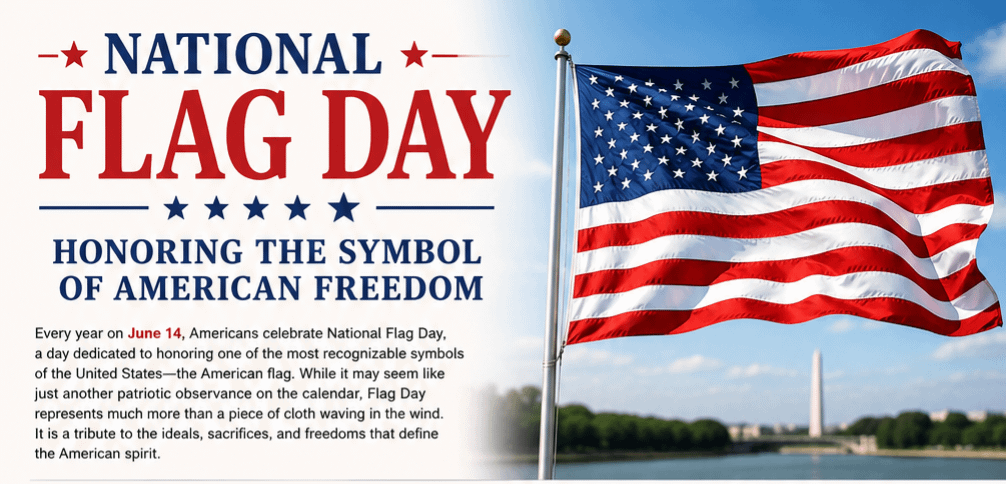
Every year on June 14, Americans celebrate National Flag Day, a day dedicated to honoring one of the most recognizable symbols of the United States—the American flag. While it may seem like just another patriotic observance on the calendar, Flag Day represents much more than a piece of cloth waving in the wind. It is a tribute to the ideals, sacrifices, and freedoms that define the American spirit.
For generations, the Stars and Stripes have flown over battlefields, schools, government buildings, homes, and places of remembrance. It has welcomed immigrants seeking a better life, comforted families during times of loss, and inspired citizens during moments of triumph and adversity. National Flag Day offers Americans an opportunity to reflect on the meaning of the flag and the values it represents.
The Origins of Flag Day
National Flag Day commemorates the adoption of the first official United States flag by the Continental Congress on June 14, 1777.
The resolution stated:
“Resolved, That the flag of the thirteen United States be thirteen stripes, alternate red and white; that the union be thirteen stars, white in a blue field, representing a new constellation.”
This historic decision came during the American Revolution, as the newly formed nation sought symbols that would distinguish it from Great Britain and unite the colonies under a common identity.
Although the design has evolved over the centuries as new states joined the Union, the spirit behind the flag remains unchanged. The stars represent the states, while the stripes honor the original thirteen colonies that fought for independence.
The Journey to Becoming a National Observance
While the flag was adopted in 1777, Flag Day was not immediately recognized as an official observance.
Several individuals and communities promoted celebrations honoring the American flag throughout the 1800s. One of the most notable advocates was Bernard J. Cigrand, a schoolteacher from Wisconsin often referred to as the “Father of Flag Day.” In 1885, he encouraged his students to celebrate June 14 as the flag’s birthday.
His efforts, along with those of many patriotic organizations, gradually gained national attention.
In 1916, President Woodrow Wilson issued a proclamation establishing June 14 as Flag Day.
Later, in 1949, President Harry S. Truman signed an Act of Congress officially designating June 14 as National Flag Day.
Although it is not a federal holiday, Americans across the country continue to observe it through ceremonies, parades, educational events, and displays of patriotism.
What the American Flag Represents
The American flag symbolizes far more than the nation itself. It represents ideals that generations of Americans have worked to preserve:
Freedom
The flag stands as a reminder of the freedoms guaranteed by the Constitution, including freedom of speech, religion, and the pursuit of opportunity.
Unity
Despite differences in background, beliefs, and experiences, the flag serves as a symbol of a united nation.
Sacrifice
Countless military members have served under the American flag, defending the country during times of war and peace. For many families, the flag represents loved ones who made the ultimate sacrifice.
Hope
Around the world, the American flag has often symbolized hope, democracy, and the possibility of a better future.
Understanding the Flag’s Colors
The colors of the American flag carry symbolic meaning that reflects the nation’s founding principles:
- Red symbolizes valor, courage, and sacrifice.
- White represents purity and innocence.
- Blue signifies vigilance, perseverance, and justice.
Together, these colors tell the story of a nation built on courage, guided by ideals, and strengthened through perseverance.
Proper Flag Etiquette
National Flag Day is also an excellent time to remember the proper ways to display and respect the flag.
According to the United States Flag Code:
- The flag should be displayed from sunrise to sunset whenever possible.
- When displayed at night, it should be properly illuminated.
- The flag should never touch the ground.
- A worn or damaged flag should be retired respectfully, often through a ceremonial burning conducted by veterans’ organizations or scouting groups.
- When the flag passes in a parade, citizens should stand, face the flag, and place their hand over their heart.
These traditions help preserve the dignity and significance of the nation’s most important symbol.
The Flag During Times of Crisis
Throughout American history, the flag has often become a source of strength during difficult moments.
Whether flying above battlefields during the American Revolution, being raised atop the island of Iwo Jima during World War II, or standing proudly after national tragedies, the flag has reminded Americans of their resilience.
In moments of uncertainty, many people look to the flag as a reminder that challenges can be overcome when citizens stand together.
Teaching Future Generations
One of the most important purposes of National Flag Day is education.
Children who learn about the history of the flag gain a deeper understanding of the nation’s story. They learn about the struggles, sacrifices, and achievements that shaped America.
Flag Day encourages conversations about citizenship, responsibility, and appreciation for the freedoms often taken for granted.
By passing these lessons to future generations, Americans help ensure that the values represented by the flag continue to endure.
Ways to Celebrate National Flag Day
There are many meaningful ways to observe National Flag Day:
- Display the American flag at your home.
- Attend a local Flag Day ceremony or parade.
- Visit a veterans memorial.
- Learn about the history of the flag.
- Teach children about the meaning of the stars and stripes.
- Thank a veteran or active-duty service member for their service.
- Reflect on the freedoms and opportunities available in America.
Even small acts of appreciation can help keep the spirit of Flag Day alive.
Why Flag Day Still Matters Today
In a rapidly changing world, National Flag Day remains a reminder of the principles that unite Americans.
The flag is not simply a symbol of government or politics. It represents the shared hopes, struggles, victories, and dreams of millions of people who have called America home throughout history.
When Americans gather beneath the Stars and Stripes, they celebrate more than a nation’s past. They celebrate the enduring ideals of liberty, opportunity, courage, and unity.
National Flag Day reminds us that while history may be written by previous generations, the responsibility to uphold those values belongs to each of us today.
As the American flag waves proudly against the sky, it continues to tell the story of a nation striving toward its highest ideals—one star, one stripe, and one generation at a time.
Read More Holidays & National Days
Leave a Reply