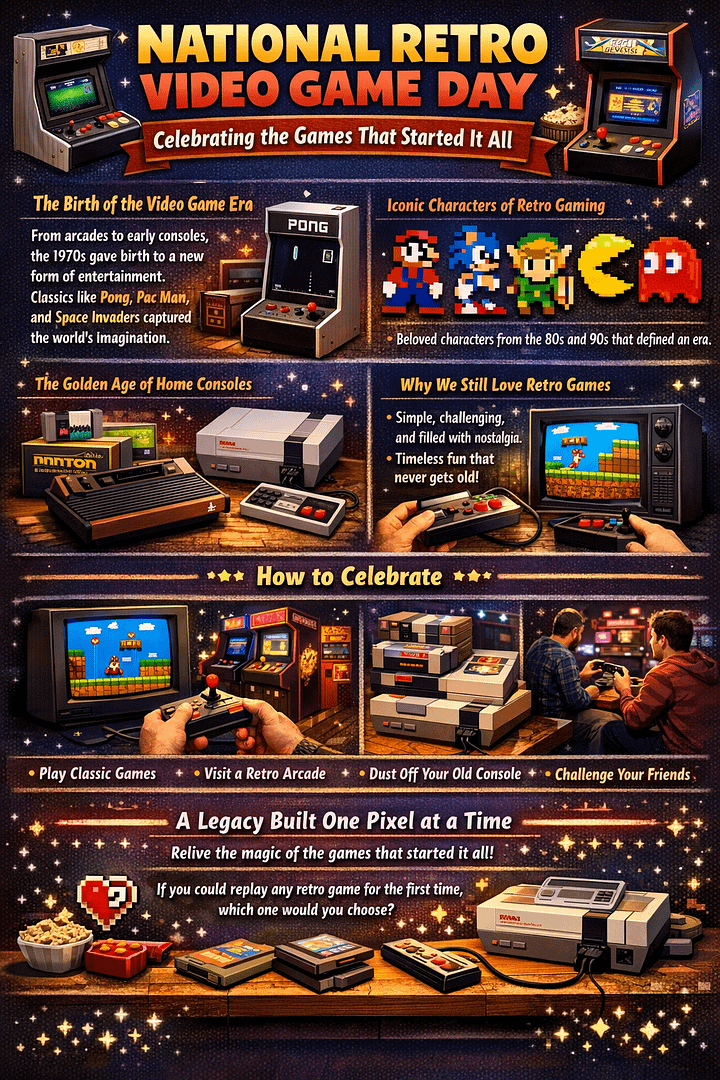
Every year on March 8, gamers around the world celebrate National Retro Video Game Day, a tribute to the classic games, consoles, and arcade machines that laid the groundwork for today’s massive gaming industry. Before photorealistic graphics, online multiplayer servers, and massive open-world adventures, there were simple pixels, blinking screens, and games that relied on creativity and skill rather than advanced technology.
Retro video games may seem primitive by modern standards, but they represent something deeply meaningful to millions of players: the roots of gaming culture. They remind us of a time when gaming was new, exciting, and full of possibilities. These early titles introduced unforgettable characters, imaginative worlds, and challenges that kept players coming back for “just one more try.”
National Retro Video Game Day isn’t just about nostalgia—it’s about recognizing the games that shaped an entire industry and inspired generations of players and developers.
The Birth of the Video Game Era
The roots of retro gaming go back to the 1970s, when video games began appearing in arcades and early home consoles. One of the earliest breakout hits was Pong, a simple tennis-style game that captured the public’s imagination and demonstrated that interactive entertainment could be incredibly engaging.
Arcades quickly became social hubs. Rows of machines filled with flashing lights and electronic sounds invited players to test their reflexes and compete for high scores. Titles like Pac-Man, Donkey Kong, Galaga, and Space Invaders became global sensations.
Around the same time, companies began bringing gaming into living rooms. Systems like the Atari 2600 allowed players to switch cartridges and experience different games at home—something revolutionary at the time.
These early developments transformed gaming from a novelty into a cultural movement.
The Golden Age of Home Consoles
The mid-1980s and early 1990s are often considered the golden age of retro gaming, when home consoles truly exploded in popularity.
The Nintendo Entertainment System (NES) revitalized the gaming industry after the video game crash of 1983. With memorable titles like Super Mario Bros., The Legend of Zelda, and Metroid, Nintendo introduced players to expansive adventures and iconic characters.
Soon after, competition heated up with the arrival of the Sega Genesis, which marketed itself with speed, attitude, and bold graphics. The rivalry between Nintendo and Sega became legendary among gamers and helped push innovation forward.
The Super Nintendo Entertainment System (SNES) built on Nintendo’s earlier success with richer colors, improved sound, and deeper gameplay experiences. Games became more cinematic, storytelling improved, and players began to feel truly immersed in digital worlds.
These consoles weren’t just entertainment devices—they became centerpieces of childhood memories for millions of people.
Iconic Characters Born in the Retro Era
The retro gaming era gave birth to characters who remain legendary decades later. These early heroes and mascots helped define gaming identity and continue to influence pop culture.
Some of the most recognizable figures include:
Mario, the mustached plumber who became Nintendo’s global mascot
Link, the heroic adventurer exploring the magical land of Hyrule
Sonic the Hedgehog, Sega’s fast-running blue rival to Mario
Pac-Man, the arcade icon who turned simple maze gameplay into a worldwide phenomenon
What made these characters special wasn’t just their appearance—it was the memorable gameplay experiences tied to them. Their adventures introduced puzzle solving, exploration, speed challenges, and storytelling that players still enjoy today.
The Unique Charm of Retro Games
Even with the rise of high-definition graphics and massive open-world games, retro titles still hold a special charm. Their simplicity often hides incredibly clever design.
Because early hardware had strict limitations, developers had to rely on ingenuity rather than technology. This led to gameplay that was tightly balanced, challenging, and endlessly replayable.
Retro games often share several characteristics that modern players still appreciate:
Simple but addictive gameplay
Many retro games could be learned in minutes but mastered only after hours of practice.
Creative design within limitations
Limited memory and graphics forced developers to focus on gameplay mechanics and level design.
Memorable music and sound effects
8-bit and 16-bit soundtracks remain iconic and instantly recognizable.
High challenge levels
Many classic games required patience, timing, and skill—qualities that made victory feel incredibly rewarding.
These elements give retro games a timeless appeal that continues to attract both longtime fans and new players.
The Rise of Retro Gaming Culture
Retro gaming isn’t just about revisiting old games—it has grown into a thriving community. Collectors search for rare cartridges, enthusiasts restore vintage consoles, and gaming conventions celebrate classic titles.
Online communities share speedruns, gameplay tips, and nostalgic memories of growing up with early gaming systems. Streaming platforms even feature retro game tournaments and challenges, proving that these classics remain exciting to watch and play.
Many modern developers also draw inspiration from retro design, creating “retro-style” indie games that replicate pixel art graphics and classic gameplay mechanics while introducing modern twists.
In many ways, retro gaming has become both a hobby and a cultural preservation effort.
How to Celebrate National Retro Video Game Day
There are many ways gamers can celebrate this nostalgic holiday:
🎮 Replay a classic game from your childhood
🕹 Visit a retro arcade and chase high scores
📺 Hook up an old console and relive the original experience
👾 Try a retro collection available on modern consoles
📚 Learn about gaming history and the pioneers who created these early titles
🏆 Challenge friends or family to a retro gaming tournament
For many people, the joy of retro gaming isn’t just about the games themselves—it’s about reconnecting with memories, friendships, and the excitement of discovery.
A Legacy Built One Pixel at a Time
National Retro Video Game Day reminds us that the gaming industry didn’t begin with powerful graphics cards and online worlds. It started with simple ideas, passionate developers, and players willing to explore new forms of entertainment.
Those early pixels became the foundation for a global industry worth billions today. Yet despite all the technological progress, the spirit of those early games still lives on every time someone picks up a controller and presses Start.
Retro games prove that sometimes the simplest experiences can leave the most lasting impact.
Read More Holidays & National Days
Leave a Reply