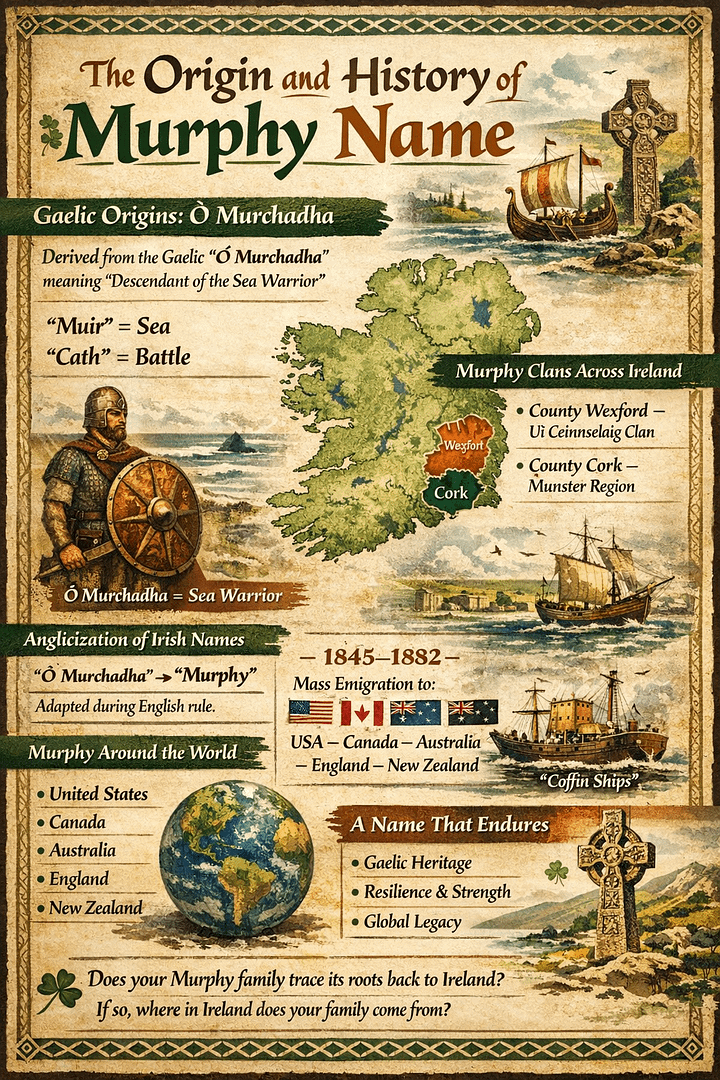
Few surnames carry the depth of history, cultural pride, and global recognition that the name Murphy does. Today, Murphy is one of the most common Irish surnames in the world, found throughout Ireland, the United States, Canada, Australia, and many other countries. Yet behind this familiar name lies a story that stretches back over a thousand years to ancient Gaelic Ireland, a time of clans, warriors, kings, and a deep connection to land and sea.
The history of the Murphy name is not just the story of a surname—it is a reflection of Irish heritage, resilience, and the journey of generations who carried their identity across continents.
Gaelic Origins: Ó Murchadha
The surname Murphy originates from the ancient Irish Gaelic name Ó Murchadha. In traditional Gaelic naming systems, surnames often described lineage. The prefix “Ó” means “descendant of,” indicating that those who carried the name were descendants of a man named Murchadh.
The personal name Murchadh is itself rich in meaning. It comes from two Gaelic elements:
“Muir” – meaning sea
“Cath” – meaning battle
Combined, the name can be interpreted as “sea warrior,” “warrior of the sea,” or “sea battler.” These meanings suggest strength, courage, and a powerful connection to Ireland’s coastal life, where the sea was both a resource and a force that shaped communities.
In ancient Ireland, names often reflected qualities admired in society—bravery, leadership, and connection to nature. The name Murchadh likely belonged to respected leaders or warriors whose descendants proudly carried the family identity forward.
Murphy Clans Across Ireland
Unlike some surnames that come from a single family line, the Murphy name developed among multiple independent Gaelic clans across Ireland. Over centuries, different branches of the Murphy family emerged in various regions, each with its own local influence and history.
Two of the most prominent Murphy lineages developed in:
County Wexford
The Murphy clan in Wexford was closely associated with the powerful Uí Ceinnselaig dynasty, a ruling family in southeastern Ireland. Members of this lineage were often local chiefs and landholders, playing important roles in regional politics and society.
County Cork
Another major Murphy clan grew in County Cork, particularly in the southern province of Munster. This branch became extremely widespread, and many Murphys in Ireland today trace their ancestry to this region.
Because the surname developed in different parts of the country, not all Murphys share a single ancestor. Instead, the name represents several families who independently adopted the Ó Murchadha lineage, all tied to the same Gaelic root.
Life in Medieval Ireland
During the medieval period, Irish society was organized around clans and kinship groups. A clan leader or chief represented the family, and loyalty to one’s extended kin was a central part of life.
Murphy families would have lived in small rural communities where agriculture, livestock, and fishing were essential to survival. Coastal regions in particular depended heavily on the sea, which may explain why the name connected to “sea warriors” held cultural significance.
Clan members protected their territories, maintained alliances, and sometimes fought rival groups. The identity tied to a surname like Ó Murchadha would have been deeply meaningful—it represented ancestry, loyalty, and belonging.
Anglicization of Irish Names
The transformation from Ó Murchadha to Murphy occurred during centuries of English rule in Ireland.
Beginning in the 16th century and continuing through the 17th and 18th centuries, English administrators and record keepers often altered Irish names to fit English spelling and pronunciation. Gaelic prefixes such as Ó and Mac were frequently dropped, simplified, or changed.
As a result:
Ó Murchadha → Murchadha → Murphy
This anglicized version became standardized in official records, including land ownership documents, church registries, and census lists.
Although the spelling changed, the cultural identity tied to the name remained strong among Irish families.
The Great Irish Famine and Global Migration
One of the most significant turning points in the history of the Murphy name came during the Great Irish Famine of the mid-19th century.
Between 1845 and 1852, a devastating potato blight destroyed crops across Ireland. Because so many people relied on potatoes as their primary food source, the famine led to widespread hunger, disease, and economic collapse.
During this period:
Over one million people died
More than two million emigrated
Many Murphys were among those forced to leave their homeland in search of survival and opportunity.
Irish immigrants traveled to:
The United States
Canada
Australia
England
New Zealand
Ships carrying Irish emigrants were sometimes called “coffin ships” because of the dangerous conditions onboard. Despite these hardships, many immigrants eventually established thriving communities abroad.
In the United States especially, the Murphy name became widespread. Today, it remains one of the most common Irish surnames among Americans of Irish descent.
Murphy Around the World
As Irish immigrants settled in new countries, they brought their traditions, culture, and surnames with them. Over generations, Murphy families became part of the social and cultural fabric of many nations.
Today the Murphy name appears in countless professions and fields, including:
Politics and public service
Literature and journalism
Film, television, and entertainment
Sports and athletics
Education and science
Though separated by geography, many Murphy families maintain pride in their Irish ancestry and heritage.
Cultural Identity and Irish Pride
For many people, the surname Murphy represents more than genealogy—it symbolizes Irish resilience and identity.
Irish culture places strong value on storytelling, family lineage, and remembrance of ancestors. A surname often serves as a link to those who came before.
In the case of Murphy, that link reaches back through centuries of Irish history—from ancient Gaelic clans to immigrant families who built new lives across the world.
A Name That Endures Through Generations
Today, the Murphy name continues to thrive across the globe. It carries echoes of ancient Gaelic warriors, medieval clan leaders, famine survivors, and immigrants who sought better futures for their families.
Every Murphy family has its own story, but all share a connection to a name that has traveled through history and across oceans.
From its roots as Ó Murchadha, meaning “descendant of the sea warrior,” the Murphy name stands as a lasting symbol of heritage, strength, and the enduring spirit of Ireland.
Leave a Reply