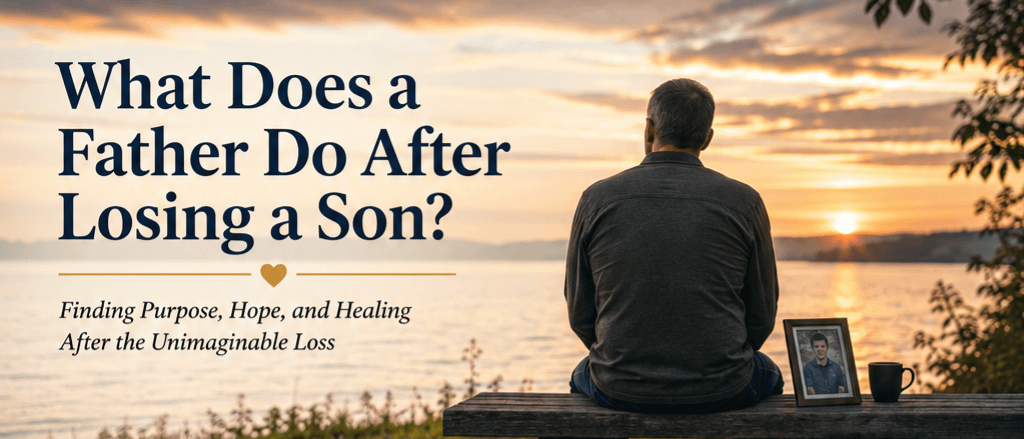
There is no pain quite like the loss of a child.
No matter how old your son was, no matter how much time has passed, losing him changes everything. It changes how you see the world. It changes how you see yourself. It changes every plan you made, every dream you carried, and every expectation you had about the future.
People often say that losing a parent is part of life. Losing a spouse is heartbreaking. Losing a friend can leave an empty space that never fully heals.
But losing a child feels different.
A child is supposed to outlive their parents. Fathers spend years protecting, teaching, guiding, and preparing their sons for adulthood. They imagine future birthdays, future holidays, future conversations, future grandchildren, and future memories.
When a son dies, all of those futures disappear in an instant.
The question many grieving fathers ask themselves is simple:
What do I do now?
The answer is not simple.
But it begins with understanding that surviving the loss of a son is not about getting over it. It is about learning how to carry it.
The First Days: Living Through the Unthinkable
The first days after losing a son often feel unreal.
You may wake up expecting it all to have been a nightmare.
For a brief moment, everything feels normal.
Then reality crashes down again.
The phone call happened.
The accident happened.
The illness happened.
The funeral happened.
Your son is gone.
During this period, many fathers feel numb. Others feel overwhelming sadness. Some feel anger. Some feel nothing at all.
All of these reactions are normal.
Grief does not follow a schedule. It does not arrive in neat stages. It does not behave the same way for everyone.
Some fathers cry constantly.
Some cannot cry at all.
Some throw themselves into work.
Others struggle to get out of bed.
There is no right way to grieve.
There is only your way.
The Weight of Being Strong
Many fathers feel pressure to be strong.
They believe they must hold everything together for their family.
They think they must stay composed during the funeral.
They think they must comfort everyone else while ignoring their own pain.
Society often teaches men that strength means hiding emotion.
But grief does not work that way.
Real strength is not pretending you are okay.
Real strength is allowing yourself to hurt.
Real strength is admitting that your heart has been shattered.
Real strength is crying when tears come.
Real strength is asking for help when you need it.
The strongest fathers are not the ones who hide their grief.
They are the ones who face it.
When the House Becomes Too Quiet
One of the hardest adjustments comes after everyone leaves.
The funeral is over.
The meals stop arriving.
The phone calls become less frequent.
Life slowly returns to normal for everyone else.
But not for you.
The empty bedroom remains.
The photographs remain.
The silence remains.
Many fathers discover that grief grows louder when the world becomes quiet.
You notice the absence everywhere.
The chair he sat in.
The games he played.
The coffee mug he used.
The text messages that will never come again.
Even ordinary moments become painful reminders.
You see a movie he would have loved.
You hear a song he used to play.
You drive past a place you visited together.
Every memory becomes both a gift and a wound.
Carrying the Guilt That Doesn’t Belong to You
Many grieving fathers carry guilt.
Sometimes it is obvious.
Sometimes it hides beneath the surface.
You may ask yourself:
“Could I have done more?”
“Should I have noticed something sooner?”
“Why wasn’t I there?”
“What if I had made a different decision?”
The mind searches endlessly for explanations because explanations feel easier than accepting loss.
But the truth is that most fathers blame themselves for things they could never control.
The love you had for your son is proof enough that you did everything you knew how to do.
Would you trade places with him if you could?
Without hesitation.
Would you have protected him if it were possible?
Without question.
The fact that you could not stop what happened does not mean you failed him.
It means you are human.
The Fear of Forgetting
One fear many fathers never talk about is the fear of forgetting.
You begin worrying that memories will fade.
You worry that his voice will become harder to remember.
You worry that details will disappear.
The way he laughed.
The way he walked.
The sound of his footsteps.
The expressions on his face.
The things that made him uniquely him.
This fear is common.
The reality is that memories evolve, but love preserves what matters most.
Many fathers keep journals.
Some create memory boxes.
Others save photos, videos, letters, and personal belongings.
There is comfort in preserving the pieces of a life that mattered so much.
Not because you are stuck in the past.
But because your son deserves to be remembered.
Learning to Live in a Different World
One of the most difficult truths after child loss is realizing that life continues.
The sun still rises.
People still laugh.
The world keeps moving forward.
At first, this can feel offensive.
How can everything continue when your world has stopped?
But eventually, you begin to understand something important.
The world moving forward does not mean your son mattered less.
It simply means life continues, even when our hearts are broken.
A grieving father must slowly learn how to live in a world he never wanted.
A world where his son exists in memory instead of presence.
A world where love remains but physical connection is gone.
That adjustment takes time.
Often years.
Sometimes a lifetime.
Finding Purpose After the Loss
One question eventually surfaces:
“What do I do with the rest of my life?”
This question can feel impossible.
Many fathers lose their sense of direction after losing a child.
The future they imagined vanished.
The role they cherished changed forever.
Purpose often disappears alongside hope.
Yet many grieving fathers discover that purpose eventually returns in unexpected ways.
Some become advocates.
Some write.
Some volunteer.
Some support other grieving parents.
Some become better husbands, fathers, brothers, friends, or community members.
Others simply decide to live in a way that honors their son’s memory.
Purpose does not erase pain.
But it gives pain somewhere meaningful to go.
Honoring Your Son Through the Way You Live
One of the greatest gifts a father can give his son after death is to continue living.
Not perfectly.
Not without tears.
Not without difficult days.
But intentionally.
Many fathers reach a moment when they realize something powerful:
“My son would not want my life to end because his did.”
That realization changes everything.
Honoring your son can mean:
- Speaking his name often.
- Sharing his stories.
- Helping others.
- Pursuing goals he believed in.
- Continuing family traditions.
- Becoming the man he thought you were.
Every act of love becomes a tribute.
Every step forward becomes a memorial.
Every life touched becomes part of his legacy.
Allowing Yourself to Feel Joy Again
One of the greatest struggles after child loss is learning to smile without guilt.
Many fathers feel guilty when happiness returns.
They wonder if laughing means they are forgetting.
They wonder if enjoying life means they are leaving their son behind.
It doesn’t.
Love and grief can exist together.
You can miss your son and still enjoy a sunset.
You can cry in the morning and laugh in the afternoon.
You can carry sorrow and gratitude in the same heart.
Joy does not replace grief.
It grows beside it.
Your son’s memory is not dishonored by your happiness.
If anything, your willingness to keep living becomes one of the greatest expressions of your love.
The Relationship Never Ends
One thing many people misunderstand is that death does not end the relationship between a father and son.
It changes it.
But it does not end it.
You still think about him.
You still talk to him.
You still celebrate his birthday.
You still wonder what he would say about certain things.
You still love him.
The bond remains.
Many fathers find comfort in understanding that grief is simply love with nowhere obvious to go.
The reason you hurt so deeply is because you loved so deeply.
The reason you miss him every day is because he mattered every day.
Love does not disappear because a life ends.
Love continues.
Final Thoughts
So what does a father do after losing a son?
He survives days he never thought he could survive.
He carries pain he never imagined he could endure.
He learns how to live with unanswered questions.
He remembers.
He honors.
He grieves.
He heals.
And somehow, one step at a time, he continues moving forward.
Not because the loss becomes smaller.
Not because he stops missing his son.
Not because the pain completely disappears.
But because love remains.
A father’s love does not end at the cemetery.
It does not end with a funeral.
It does not end with time.
It continues for every day he lives.
And in that love, he finds the strength to keep going.
Forever carrying his son in his heart.
Forever missing him.
Forever loving him.
A Father’s Guide to Surviving the Loss of a Child
Leave a Reply