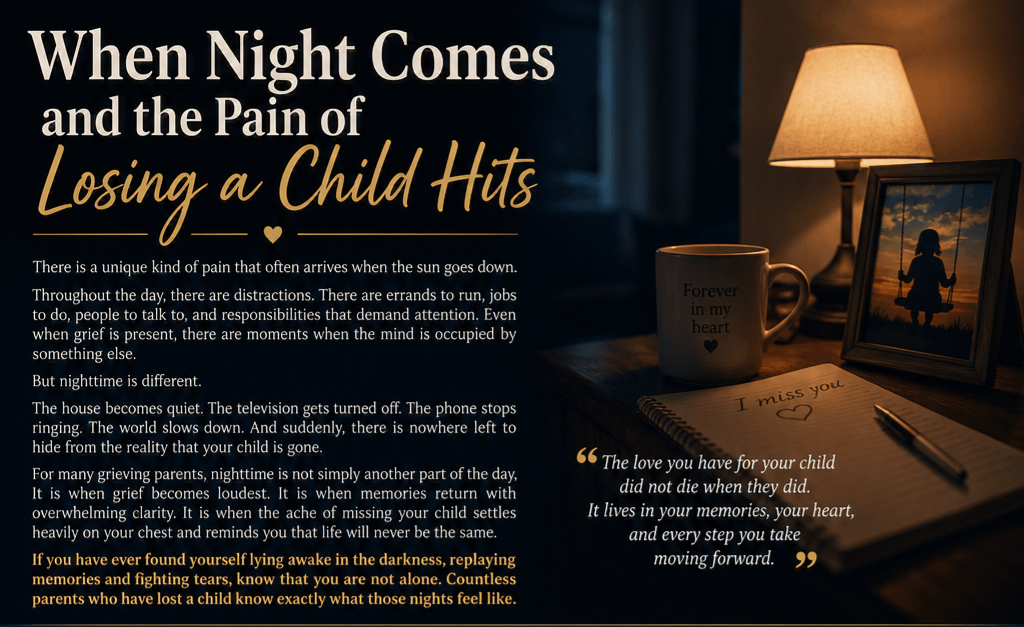
There is a unique kind of pain that often arrives when the sun goes down.
Throughout the day, there are distractions. There are errands to run, jobs to do, people to talk to, and responsibilities that demand attention. Even when grief is present, there are moments when the mind is occupied by something else.
But nighttime is different.
The house becomes quiet.
The television gets turned off.
The phone stops ringing.
The world slows down.
And suddenly, there is nowhere left to hide from the reality that your child is gone.
For many grieving parents, nighttime is not simply another part of the day. It is when grief becomes loudest. It is when memories return with overwhelming clarity. It is when the ache of missing your child settles heavily on your chest and reminds you that life will never be the same.
If you have ever found yourself lying awake in the darkness, replaying memories and fighting tears, know that you are not alone. Countless parents who have lost a child know exactly what those nights feel like.
The Day Can Distract You, But Night Forces You to Feel
Many grieving parents become experts at surviving the daytime.
They go to work.
They attend family gatherings.
They smile when expected.
They complete daily tasks.
From the outside, they may appear to be coping well.
But grief does not disappear simply because a parent is functioning.
Often, grief waits patiently beneath the surface until the quiet moments arrive.
Night removes the distractions.
The responsibilities fade.
The noise disappears.
And what remains is a heart carrying an unimaginable loss.
This is why many bereaved parents say they are strongest during the day and most vulnerable at night.
The pain that was pushed aside throughout the day finally has room to emerge.
The Empty Bedroom Never Stops Hurting
One of the hardest realities of losing a child is seeing the physical reminders they left behind.
At night, those reminders seem more noticeable.
The empty bedroom.
The favorite chair.
The sports trophies.
The photographs hanging on the wall.
The clothes that still carry memories.
Many parents find themselves standing in their child’s room late at night, remembering a time when that room was full of life.
They remember hearing laughter from behind the door.
They remember bedtime conversations.
They remember hearing footsteps down the hallway.
Now there is silence.
A silence that can feel almost unbearable.
The room remains.
The memories remain.
But the child is gone.
That reality can hit with extraordinary force during the quiet hours of the night.
When Memories Refuse to Let You Sleep
Nighttime often becomes a theater of memories.
The mind begins replaying moments from years ago.
A first day of school.
A birthday party.
A family vacation.
A graduation.
A holiday dinner.
A simple afternoon spent laughing together.
Some memories bring smiles.
Others bring tears.
Many bring both.
Parents often discover that the moments they miss most are not always the major milestones.
Sometimes they miss the ordinary things.
The sound of their child’s voice saying “Dad.”
The random text messages.
The late-night conversations.
The arguments they would gladly have again.
The everyday moments that once seemed insignificant suddenly become priceless treasures.
When night comes, those memories can flood the mind and make sleep impossible.
The Questions That Keep You Awake
Many grieving parents spend countless nights wrestling with questions.
Why did this happen?
Why my child?
Why couldn’t it have been different?
Could I have done something more?
Did I miss something important?
Could I have prevented it?
These questions are part of grief.
They arise because parents are protectors by nature.
From the moment a child is born, a parent feels responsible for their safety and well-being.
When a child dies, that instinct does not disappear.
Instead, it often turns inward.
Parents replay events repeatedly, searching for answers.
Searching for explanations.
Searching for something that will make sense of the tragedy.
Unfortunately, some losses simply do not make sense.
No explanation feels sufficient.
No answer removes the pain.
No amount of questioning changes what happened.
Learning to live with unanswered questions is one of the most difficult parts of grieving a child.
The Loneliness Few People Understand
Nighttime often magnifies loneliness.
Friends may care deeply, but most eventually return to their own lives.
Family members may offer support, but they cannot carry your grief for you.
The world keeps moving.
Meanwhile, a grieving parent may feel completely frozen in time.
Many fathers especially experience profound isolation.
Society often expects men to stay strong.
To remain composed.
To hide their emotions.
To continue functioning no matter how much pain they carry.
As a result, many grieving fathers cry alone.
They break down after everyone else has gone to sleep.
They sit in dark rooms carrying burdens they rarely discuss.
They suffer silently because they fear becoming a burden to others.
Nighttime can become the place where all those hidden emotions finally emerge.
Missing Them Never Gets Old
People sometimes assume grief fades after enough time passes.
Bereaved parents know differently.
The intensity may change.
The frequency may change.
But the love remains.
And because the love remains, the missing remains.
Years later, parents still wonder what their child would look like today.
They imagine birthdays that never happened.
They wonder about careers, marriages, grandchildren, and futures that were stolen.
Every milestone becomes a reminder.
Every holiday carries an empty chair.
Every family gathering contains someone missing.
Nighttime often becomes the place where those thoughts surface.
A parent may find themselves staring at the ceiling imagining what life would have been if their child were still here.
That longing never completely disappears.
Because love never completely disappears.
The Tears That Come After Dark
Many grieving parents discover they can hold themselves together all day only to fall apart at night.
The tears arrive unexpectedly.
A photograph triggers a memory.
A song plays on the radio.
A birthday approaches.
An anniversary passes.
Or perhaps there is no obvious trigger at all.
The tears simply come.
And when they do, it is important to remember something.
Tears are not weakness.
They are love expressed through grief.
Every tear represents a relationship that mattered.
Every tear reflects a heart that refuses to forget.
Every tear is evidence of a bond that death could not destroy.
The Physical Weight of Nighttime Grief
Grief is not only emotional.
It is physical.
Many bereaved parents experience:
- Difficulty sleeping
- Anxiety at bedtime
- Racing thoughts
- Chest tightness
- Exhaustion
- Headaches
- Muscle tension
- Restlessness
- Panic attacks
Nighttime often intensifies these symptoms.
The body remembers trauma.
The nervous system remains on alert.
Sleep becomes difficult because the mind refuses to quiet itself.
Many parents find themselves awake long after everyone else has fallen asleep, trapped in cycles of memories and emotions.
This is a common experience among grieving parents.
It does not mean something is wrong with you.
It means your heart is carrying something extraordinarily heavy.
Finding God in the Darkness
Some of the most honest prayers ever spoken happen in the middle of the night.
Not polished prayers.
Not rehearsed prayers.
Just broken hearts crying out to God.
Many grieving parents have sat in darkness asking questions through tears.
Some have been angry.
Some have been confused.
Some have felt abandoned.
Others have simply begged for enough strength to survive another day.
The Bible is filled with people who cried out to God during seasons of suffering.
God is not frightened by our grief.
He is not offended by our questions.
He is not distant from our pain.
While faith does not remove grief, it can provide comfort in the midst of it.
It can remind us that our children are known by God.
It can remind us that death does not have the final word.
It can remind us that love is stronger than the grave.
What To Do When the Night Feels Unbearable
If tonight is one of those difficult nights, consider giving yourself permission to do what you need.
Look through photographs.
Write a letter to your child.
Say their name out loud.
Pray.
Journal.
Listen to calming music.
Read Scripture.
Talk to someone you trust.
Or simply sit quietly and allow yourself to feel.
There is no right or wrong way to survive these nights.
The goal is not to eliminate grief.
The goal is to make it through the night.
One hour at a time.
One breath at a time.
One step at a time.
To Every Parent Lying Awake Tonight
If you are reading this while carrying the pain of losing a child, know this:
Your grief is a reflection of your love.
You are not weak because you cry.
You are not broken because you struggle.
You are not failing because you still miss them years later.
You are a parent.
And parents never stop loving their children.
Not after birthdays pass.
Not after years go by.
Not even after death.
The nights may still hurt.
The memories may still bring tears.
The longing may still feel overwhelming.
But your child’s life mattered.
Their story mattered.
Their love mattered.
And the love you carry for them continues to live within you every single day.
Final Thoughts
When night comes and the pain of losing a child hits, it can feel as though the entire weight of the world has settled upon your heart.
The silence becomes louder.
The memories become stronger.
The loneliness becomes deeper.
But so does the love.
And that love is the reason your child will never truly be forgotten.
Though grief may visit in the darkness, love remains.
It remains in every memory.
It remains in every tear.
It remains in every story you tell.
And it remains in the unbreakable bond between a parent and child—a bond that even death cannot erase.
A Father’s Guide to Surviving the Loss of a Child
Leave a Reply