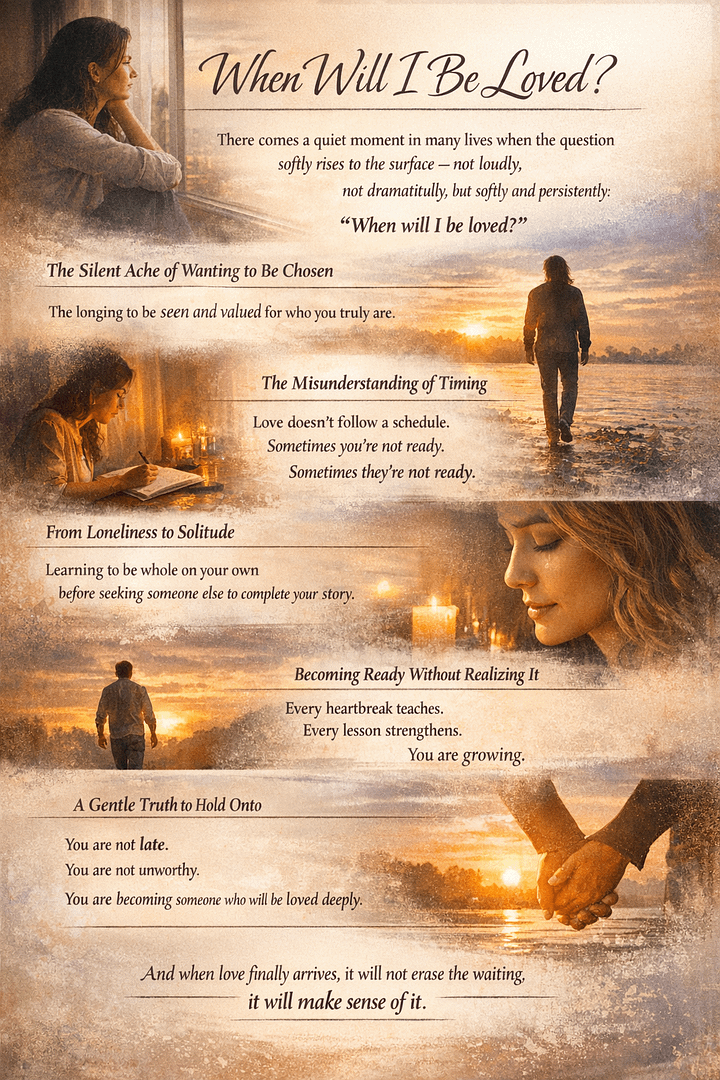
There comes a quiet moment in many lives when the question finally rises to the surface — not loudly, not dramatically, but softly and persistently:
“When will I be loved?”
It is a question whispered during sleepless nights, asked after another failed connection, or felt while watching others experience the companionship we deeply desire. It is not simply about romance; it is about belonging, being chosen, and feeling seen in a world that can sometimes feel emotionally distant.
This question lives inside people of every age, background, and story. And while it may feel lonely, it is one of the most human questions we can ask.
The Silent Ache of Wanting to Be Chosen
At its core, the longing to be loved is not about needing someone to complete us. It is about wanting to share life with someone who recognizes our worth without hesitation.
Many people know the experience of giving love freely — supporting others, showing kindness, being emotionally present — while secretly wondering why that same energy has not returned to them in the way they hope.
You may become the strong one.
The listener.
The dependable heart everyone leans on.
Yet when the day ends, you sit with a quiet thought:
Who chooses me?
This ache is rarely visible to others. From the outside, you may appear confident, independent, or fulfilled. But internally, there is a space reserved for connection — a space that remains patiently open.
The Misunderstanding of Timing
We often believe love operates on fairness: good people should find love quickly, loyal hearts should be rewarded, and genuine intentions should naturally attract the right person.
But love does not move according to fairness or logic.
Timing in love is influenced by countless invisible factors:
emotional maturity,
personal healing,
life circumstances,
readiness to receive rather than just give.
Sometimes two people meet too early — before growth has taken place. Sometimes love passes close by but cannot stay because one or both hearts are still learning lessons they cannot yet see.
What feels like delay may actually be alignment happening slowly behind the scenes.
The Fear That Grows While Waiting
Waiting for love can slowly create dangerous beliefs:
Maybe I’m too much.
Maybe I’m not enough.
Maybe love isn’t meant for me.
These thoughts are understandable, but they are not truths — they are wounds speaking.
The longer we wait, the easier it becomes to measure our worth by relationship status. Social media, movies, and cultural expectations amplify this pressure, presenting love as something everyone else has already figured out.
But love is not a race with winners and losers. It is a deeply personal journey shaped by individual growth.
Your timeline is not broken simply because it looks different.
Learning the Difference Between Loneliness and Solitude
One of the hidden gifts of waiting is discovering yourself outside of partnership.
Loneliness says:
I am incomplete alone.
Solitude says:
I am whole, but I still desire connection.
This transformation is powerful. When you learn to enjoy your own company — your thoughts, passions, and peace — you stop seeking love out of desperation and begin seeking it from intention.
Healthy love grows best in two complete lives choosing to walk together, not in two people trying to escape emptiness.
Why Some Hearts Take Longer to Find Love
People who feel deeply often take longer to find lasting love. Not because they are difficult to love, but because they are unwilling to settle for something shallow.
They want:
emotional safety,
honesty,
consistency,
connection beyond surface attraction.
And those qualities require emotional readiness from both people involved.
Sometimes the delay exists because your heart recognizes what it deserves — even when your loneliness tries to convince you otherwise.
Becoming Ready Without Realizing It
While asking “When will I be loved?”, something important is happening quietly:
You are evolving.
Every disappointment teaches discernment.
Every heartbreak strengthens boundaries.
Every period alone builds self-awareness.
You learn:
how you want to be treated,
what you will no longer tolerate,
how to communicate your needs,
and how to protect your peace.
One day, you may look back and realize the waiting period was shaping you into someone capable of receiving a deeper, healthier kind of love.
Love Often Arrives Differently Than Expected
Many imagine love arriving dramatically — instant chemistry, overwhelming passion, undeniable certainty.
But lasting love often feels different.
It feels calm.
Safe.
Consistent.
It may begin as friendship. It may grow slowly. It may not resemble the intense stories we were taught to expect.
Real love frequently replaces anxiety with peace. Instead of wondering where you stand, you simply know.
And sometimes that quiet certainty is what makes it real.
The Moment the Question Changes
There is a turning point that happens subtly.
You stop asking, “When will I be loved?” and begin living fully regardless of the answer.
You pursue passions.
You build friendships.
You invest in personal growth.
And ironically, it is often during this stage — when love is no longer the center of your identity — that connection finds its way into your life.
Not because you stopped wanting love, but because you stopped believing you were incomplete without it.
A Gentle Truth to Hold Onto
If you are still waiting for love, consider this:
Your capacity to love is evidence that love belongs in your life. The desire itself is not random; it reflects something real within you.
You are not late.
You are not overlooked.
You are not unworthy.
You are simply living a chapter that has not yet reached its introduction to the person who will understand your heart.
And when love finally arrives, it will not erase the waiting — it will make sense of it.
Final Reflection
“When will I be loved?” is ultimately a question about hope.
It is proof that despite disappointment, your heart still believes in connection. And that belief is powerful. It means you have not allowed cynicism to replace your humanity.
Love is not always immediate, but it is often meaningful precisely because it takes time to find.
Until that day comes, remember:
You are already becoming someone worth loving — including by yourself.
Read More Of Love & Relationships
Leave a Reply