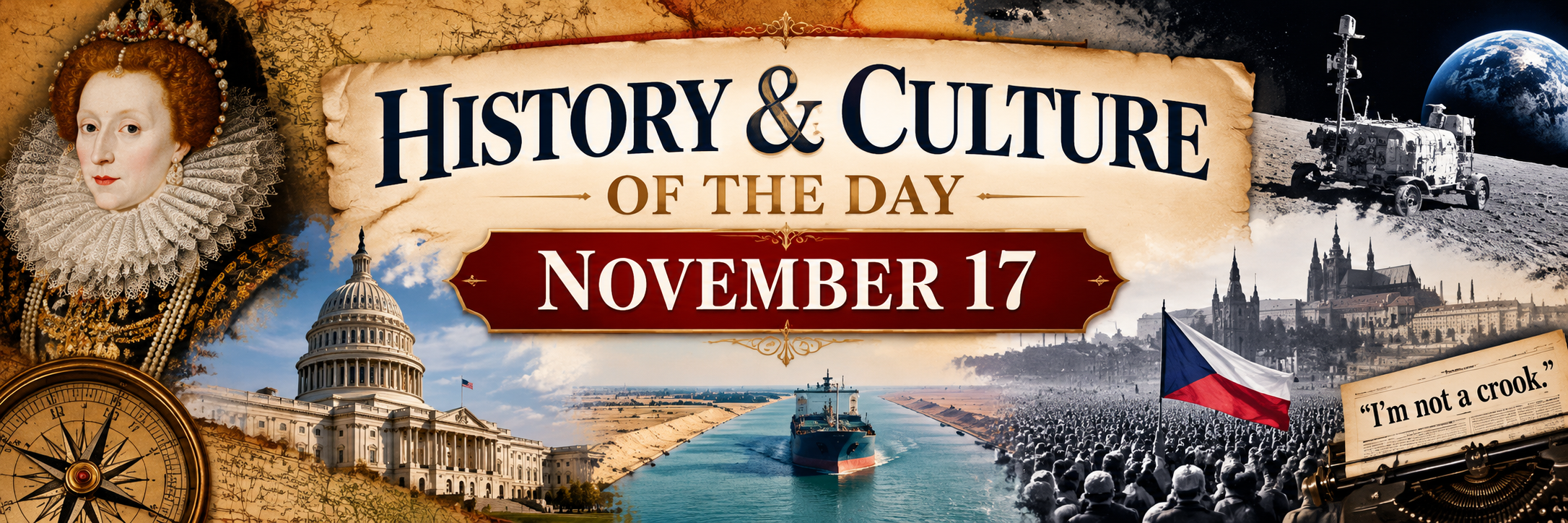
Every day on the calendar carries stories that have helped shape the world we live in. Some dates are remembered for political turning points, others for scientific discoveries, cultural achievements, or moments of extraordinary human courage. November 17 is one of those dates when history, culture, and human determination come together.
Throughout the centuries, November 17 has witnessed royal transitions, movements for freedom, important explorations, and events that changed the course of nations. It is also a day associated with international student activism, cultural traditions, and the enduring importance of education and human rights.
From the accession of Queen Elizabeth I to the English throne in 1558 to the student demonstrations that helped bring down communist rule in Czechoslovakia in 1989, November 17 reminds us that history is shaped not only by powerful leaders but also by ordinary people willing to stand up for what they believe.
Today, we explore the historical events, cultural milestones, famous birthdays, and fascinating facts that make November 17 a date worth remembering.
1. November 17, 1558 – Queen Elizabeth I Becomes Queen of England
One of the most significant events associated with November 17 occurred in 1558, when Queen Mary I of England died and her half-sister Elizabeth ascended the throne.
Elizabeth I would become one of England’s most influential monarchs, ruling for more than 44 years until her death in 1603.
Her reign, commonly called the Elizabethan Era, is remembered for remarkable developments in English literature, theater, maritime exploration, and national identity.
During this period, England experienced the flourishing of dramatic works by William Shakespeare and Christopher Marlowe. English explorers expanded their voyages across the Atlantic, while the country increasingly established itself as a maritime power.
Elizabeth also faced religious conflict, political conspiracies, and international threats, including the Spanish Armada in 1588.
Her accession marked the beginning of a period that would profoundly influence English history and culture.
Why It Matters Today: The Elizabethan Era left a lasting legacy in literature, language, theater, and England’s political development. Many works produced during this period remain widely studied and performed around the world.
2. November 17, 1800 – The United States Congress Meets in Washington, D.C.
On November 17, 1800, the United States Congress convened for the first time in Washington, D.C., establishing an important milestone in the development of the nation’s capital.
Before this historic meeting, Congress had assembled in several locations, including New York City and Philadelphia.
The decision to establish a permanent federal capital along the Potomac River had been made years earlier, following political negotiations involving the federal government and the states.
When Congress first met in Washington, the Capitol building was still under construction. The city itself was far from the bustling national capital that Americans recognize today.
Nevertheless, the gathering represented a major step in establishing Washington as the permanent center of the federal government.
Over the following centuries, the city would become home to major national monuments, museums, cultural institutions, and historic landmarks.
Why It Matters Today: Washington, D.C., remains the seat of the United States federal government, and the Capitol continues to symbolize American representative democracy.
3. November 17, 1869 – The Suez Canal Opens in Egypt
On November 17, 1869, the Suez Canal officially opened, creating one of the most important maritime transportation routes in the world.
The canal connects the Mediterranean Sea with the Red Sea, allowing ships to travel between Europe and Asia without sailing around the southern tip of Africa.
Before its construction, many trading vessels faced long and dangerous voyages around the Cape of Good Hope.
The canal dramatically shortened important shipping routes and transformed international trade.
Construction took approximately ten years and involved enormous engineering challenges. The project also came at a tremendous human cost, including the exploitation of Egyptian laborers.
The opening ceremony attracted international dignitaries and symbolized a new era in global transportation.
The canal would later become central to international politics, particularly during the Suez Crisis of 1956.
Why It Matters Today: The Suez Canal remains one of the world’s most strategically important waterways, connecting global markets and influencing international commerce.
4. November 17, 1939 – Nazi Germany Closes Czech Universities
November 17 carries a particularly solemn meaning in the history of education and resistance.
In 1939, Nazi authorities cracked down on university students and intellectuals in occupied Czech lands following demonstrations against German occupation.
The unrest had intensified after the death of medical student Jan Opletal, who had been wounded during an earlier protest.
On November 17, Nazi forces closed Czech universities, executed nine student leaders and academics, and sent more than a thousand students to concentration camps.
These events became a powerful symbol of resistance against oppression.
Two years later, student representatives meeting in London established November 17 as International Students’ Day to commemorate the victims and recognize the importance of student activism.
Why It Matters Today: The observance reminds people that education, intellectual freedom, and the right to peaceful expression are fundamental parts of a free society.
5. November 17, 1970 – Lunokhod 1 Begins Exploring the Moon
November 17, 1970, marked a milestone in robotic space exploration when the Soviet Union’s Lunokhod 1 rover began operating on the lunar surface.
Delivered by the Luna 17 spacecraft, Lunokhod 1 became the first successful remotely operated rover to explore another celestial body.
The eight-wheeled vehicle carried scientific instruments and cameras designed to study the Moon’s surface.
Operators on Earth controlled the rover remotely, guiding it across the lunar landscape while collecting valuable scientific information.
The mission demonstrated that robotic vehicles could perform meaningful exploration far beyond Earth.
Although the technology was limited compared with modern planetary rovers, Lunokhod 1 helped establish principles that would influence later missions to the Moon and Mars.
Why It Matters Today: Modern robotic explorers build upon decades of technological progress that began with pioneering missions like Lunokhod 1.
6. November 17, 1973 – President Richard Nixon Declares He Is Not a Crook
One of the most memorable political statements in American history occurred on November 17, 1973.
During a televised question-and-answer session with newspaper editors in Orlando, Florida, President Richard Nixon defended himself amid growing questions surrounding the Watergate scandal.
Nixon famously declared, “I’m not a crook.”
The statement became one of the most recognizable quotations associated with his presidency.
Watergate began with a 1972 break-in at Democratic National Committee headquarters and developed into a major political scandal involving efforts to conceal wrongdoing.
As investigations continued, evidence revealed serious abuses of presidential power.
Nixon eventually resigned from office in August 1974, becoming the first United States president to do so.
Why It Matters Today: Watergate remains an important case study in government accountability, investigative journalism, constitutional checks and balances, and public trust.
7. November 17, 1989 – The Velvet Revolution Begins in Czechoslovakia
November 17, 1989, became a defining moment in European history when students gathered in Prague to commemorate the events of 1939 and protest communist rule.
What began as a student demonstration grew into a nationwide movement demanding political freedom and democratic reforms.
Police violence against peaceful demonstrators helped ignite widespread public outrage.
Over the following days, hundreds of thousands of people participated in demonstrations and strikes.
The movement became known as the Velvet Revolution because of the relatively peaceful transition that followed.
By the end of the year, communist rule in Czechoslovakia had collapsed, and dissident playwright Václav Havel became president.
The revolution was part of the extraordinary political transformations sweeping Central and Eastern Europe in 1989.
Why It Matters Today: The Velvet Revolution demonstrates how peaceful protest, civic participation, and collective determination can help transform political systems.
8. November 17, 2003 – Arnold Schwarzenegger Becomes Governor of California
On November 17, 2003, actor and former professional bodybuilder Arnold Schwarzenegger was sworn in as California’s 38th governor.
Schwarzenegger had achieved international fame through bodybuilding and Hollywood films, including The Terminator.
His election followed a historic recall vote that removed Governor Gray Davis from office.
The recall election attracted enormous national attention because it demonstrated how California voters could use the state’s recall process to remove an elected governor before the end of a term.
Schwarzenegger served as governor until January 2011.
His political career became a notable example of a celebrity successfully transitioning into high public office.
Why It Matters Today: His election remains a significant event in California political history and illustrates the relationship between celebrity culture, media, and American politics.
9. International Students’ Day – A Celebration of Education and Freedom
November 17 is observed internationally as International Students’ Day.
Unlike many educational celebrations, its origins are rooted in tragedy, resistance, and the struggle for freedom.
The day commemorates the students who suffered under Nazi occupation in 1939 and recognizes the role young people have played in movements for political and social change.
Educational institutions and student organizations around the world use the occasion to promote student rights, international cooperation, and access to education.
The observance also encourages reflection on the difficulties students face, including financial barriers, discrimination, conflict, and unequal educational opportunities.
Education does more than prepare people for employment. It encourages critical thinking, strengthens communities, and helps individuals understand different cultures and perspectives.
International Students’ Day reminds us that learning is both a personal opportunity and a powerful force for social progress.
10. November 17 and the Cultural Significance of Freedom
One of the most fascinating connections among November 17’s historical events is the recurring theme of freedom.
In 1558, Elizabeth I inherited a kingdom deeply divided by religious conflict.
In 1939, students resisted the oppression of Nazi occupation.
In 1989, another generation of students helped bring democratic change to Czechoslovakia.
Although these events occurred in different centuries and circumstances, each involved questions about authority, identity, and the rights of individuals.
History reveals that freedom is rarely achieved or maintained without effort.
Sometimes progress emerges through political leadership. At other times, it comes from students, workers, writers, activists, and ordinary citizens.
November 17 provides an opportunity to recognize the people whose actions helped create a different future.
Famous People Born on November 17
November 17 is also the birthday of several influential individuals whose work has shaped entertainment, art, and popular culture.
Martin Scorsese – Born November 17, 1942
Martin Scorsese is one of the most celebrated filmmakers in American cinema.
Known for films such as Taxi Driver, Raging Bull, Goodfellas, and The Departed, Scorsese has spent decades exploring complex characters, morality, identity, and society.
His filmmaking techniques and commitment to film preservation have influenced generations of directors.
Danny DeVito – Born November 17, 1944
Danny DeVito is an American actor, director, and producer known for his distinctive comedic performances.
His work includes the television series Taxi and films such as Twins, Matilda, and Batman Returns.
His career demonstrates the lasting importance of character acting and versatility in entertainment.
RuPaul – Born November 17, 1960
RuPaul is an American performer, television personality, and cultural figure known for bringing drag entertainment to mainstream audiences.
Through music, television, and RuPaul’s Drag Race, RuPaul has influenced fashion, performance, and popular culture.
Jeff Buckley – Born November 17, 1966
Jeff Buckley was an American singer-songwriter whose emotional vocal performances earned lasting recognition.
His 1994 album Grace became highly influential, and his interpretation of Leonard Cohen’s Hallelujah remains widely admired.
Although Buckley’s life ended in 1997, his musical legacy continues to inspire listeners and artists.
Interesting Facts About November 17
November 17 contains several remarkable historical connections that make the date especially interesting.
-
The Elizabethan Era began on this date in 1558, eventually becoming one of the most celebrated periods in English cultural history.
-
Washington, D.C., welcomed its first congressional session in 1800, establishing an enduring center of American government.
-
The Suez Canal opened in 1869, reshaping international maritime trade.
-
International Students’ Day commemorates events from 1939, connecting education with resistance against oppression.
-
Lunokhod 1 explored the Moon in 1970, demonstrating the possibilities of robotic space exploration.
-
The Velvet Revolution began in 1989, helping bring an end to communist rule in Czechoslovakia.
These events illustrate how a single calendar date can connect politics, engineering, exploration, education, and culture across hundreds of years.
How November 17 Has Influenced Modern Society
History becomes especially meaningful when we recognize its influence on the present.
The political events of November 17 remind us that governments are shaped by public expectations, institutions, and changing ideas about leadership.
The opening of the Suez Canal demonstrates how transportation infrastructure can transform economies and international relationships.
The history of International Students’ Day reveals that education is closely connected to civil liberties and social participation.
The Velvet Revolution shows that major political change does not always require prolonged armed conflict.
Meanwhile, the achievements of filmmakers, musicians, and performers born on November 17 remind us that cultural influence can endure long after an individual’s lifetime.
Each of these stories offers a different perspective on human progress.
Some achievements resulted from years of planning and scientific innovation. Others emerged from unexpected circumstances or the courage of people who refused to remain silent.
Together, they reveal that history is not simply a collection of dates and names.
It is an ongoing story of human choices and their consequences.
Lessons We Can Learn From November 17
November 17 offers several important lessons that remain relevant today.
Courage Can Change History
The students who protested in Prague in 1989 could not know exactly how their demonstrations would unfold.
Yet their willingness to challenge an established political system helped inspire a movement that transformed their country.
Their example demonstrates how individual courage can become collective strength.
Education Is Worth Protecting
The events of November 1939 show the dangers that arise when governments suppress learning and independent thought.
Protecting educational institutions and academic freedom helps preserve opportunities for future generations.
Innovation Connects the World
The Suez Canal and Lunokhod 1 represent very different forms of technological achievement.
One transformed transportation across Earth, while the other expanded humanity’s ability to explore space.
Both demonstrate how innovation can change what people believe is possible.
Leadership Requires Accountability
The Watergate scandal serves as a reminder that political authority carries responsibilities.
Strong institutions, independent journalism, and public scrutiny all play important roles in maintaining democratic accountability.
Culture Preserves Human Experience
Through films, music, literature, and performance, artists communicate emotions and experiences that connect people across generations.
Cultural achievements help societies understand both their histories and their identities.
Why Remembering History Matters
It can be easy to view history as something distant from everyday life.
However, the institutions we depend on, the freedoms we exercise, and the cultural traditions we enjoy are all connected to events that happened before us.
Studying history encourages us to ask important questions.
Why did people make certain decisions? What circumstances shaped their beliefs? How did their actions affect future generations?
History also teaches humility.
People in earlier centuries faced uncertainty just as we do today. They made decisions with incomplete information, struggled with competing priorities, and sometimes failed to recognize the consequences of their actions.
By examining their experiences, we gain a broader understanding of our own world.
Remembering the past does not mean believing that every historical event was positive or every historical figure was admirable.
It means recognizing achievements, acknowledging injustice, and learning from both.
November 17 is particularly meaningful because its stories include triumph, tragedy, innovation, and peaceful political transformation.
Final Thoughts: November 17 Is a Day of Change, Courage, and Cultural Legacy
November 17 stands out as a remarkable date in world history.
It marks the beginning of Queen Elizabeth I’s reign, the first meeting of Congress in Washington, the opening of the Suez Canal, pioneering lunar exploration, and the start of the Velvet Revolution.
It is also a day to remember students who resisted oppression and to celebrate the importance of education.
These events span different continents, centuries, and cultures, yet they share an important message: the world we know today was shaped by people who made decisions, pursued discoveries, challenged injustice, and imagined a different future.
Some changed history through leadership. Others did so through scientific achievement, artistic expression, or peaceful protest.
Their stories remind us that progress is not always immediate, and that actions taken today can influence generations yet to come.
As we reflect on November 17, we can appreciate the achievements of the past while recognizing our own responsibility to help shape the future.
History is more than remembering what happened. It is understanding why it matters and carrying those lessons forward.
What historical event from November 17 do you find most fascinating, and what lesson do you think it offers us today?



Leave a Reply