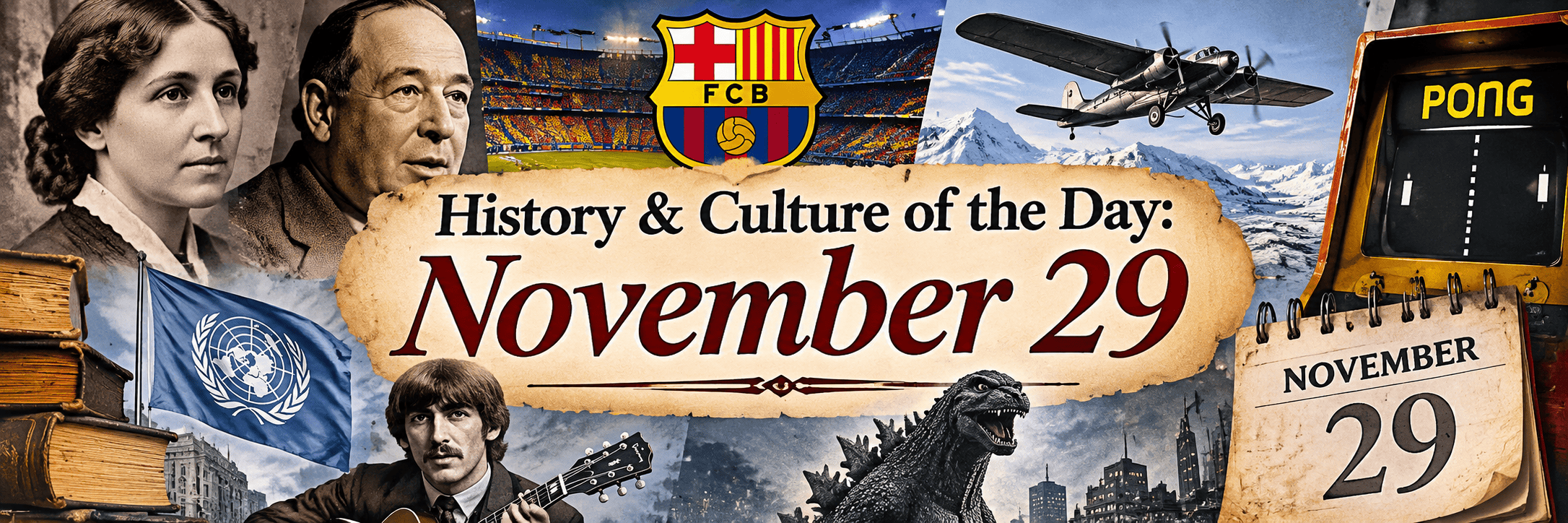
Every date on the calendar carries stories that help explain how our world became what it is today. November 29 is no exception. Throughout history, this day has witnessed remarkable achievements in science, major political developments, cultural transformations, and moments that forever changed the way people live.
From the birth of influential writers and groundbreaking scientific discoveries to the evolution of entertainment and international traditions, November 29 offers an opportunity to explore the people, ideas, and events that shaped human civilization.
History is more than a collection of dates. It is the story of human ambition, creativity, struggle, resilience, and progress. Understanding the significance of November 29 helps us appreciate how decisions made generations ago continue to influence our modern world.
November 29, 1899: The Founding of FC Barcelona
One of the most recognizable sports organizations in the world traces its beginnings to November 29, 1899.
On this date, Swiss-born sports enthusiast Joan Gamper and a group of fellow football players founded FC Barcelona in Spain.
What began as a small football club eventually grew into an international sporting institution with millions of supporters.
Over the decades, FC Barcelona became closely connected to the cultural identity of Catalonia, the region of Spain where the club is based.
Its famous motto, Més que un club, meaning “More than a club,” reflects the organization’s significance beyond athletics.
The club became a symbol of regional pride, community, and cultural expression, particularly during periods when Catalan identity faced political restrictions.
Today, FC Barcelona’s history demonstrates how sports can bring communities together, preserve cultural identity, and create traditions that cross national boundaries.
November 29, 1832: The Birth of Louisa May Alcott
November 29 marks the birthday of Louisa May Alcott, one of America’s most influential nineteenth-century authors.
Born in Germantown, Pennsylvania, in 1832, Alcott became internationally known for her novel Little Women, first published in 1868.
The story follows the March sisters as they navigate family relationships, personal ambitions, financial difficulties, and the challenges of growing up.
Unlike many literary works of her era, Little Women portrayed young women as individuals with distinct personalities, dreams, and aspirations.
The character Jo March became particularly influential because of her independence, determination, and desire to become a writer.
Alcott’s work helped challenge traditional expectations surrounding women’s roles in society.
Her novels continue to inspire readers because they explore timeless themes such as family, sacrifice, independence, friendship, and personal growth.
November 29 provides an opportunity to celebrate the lasting cultural importance of literature and the writers who help shape society’s understanding of itself.
November 29, 1898: The Birth of C.S. Lewis
November 29 is also the birthday of C.S. Lewis, the celebrated author, literary scholar, and Christian thinker.
Born in Belfast, Ireland, in 1898, Lewis became one of the twentieth century’s most influential writers.
He is best remembered for The Chronicles of Narnia, a seven-book fantasy series that introduced readers to a magical world filled with unforgettable characters, moral challenges, and powerful lessons about courage, loyalty, sacrifice, and redemption.
His works also include Mere Christianity, The Screwtape Letters, and The Problem of Pain.
Lewis’s writing combined imaginative storytelling with philosophical and spiritual questions.
His books continue to influence literature, education, religious thought, and popular entertainment.
His birthday serves as a reminder that stories can do more than entertain. They can challenge readers to think about life’s deepest questions and inspire generations to explore their own beliefs and values.
November 29, 1929: The First Flight Over the South Pole
On November 29, 1929, American explorer Richard E. Byrd and three companions completed the first airplane flight over the South Pole.
The expedition represented an extraordinary achievement in aviation and geographical exploration.
Flying over Antarctica presented enormous challenges, including freezing temperatures, unpredictable weather, limited navigation technology, and the danger of mechanical failure.
Byrd’s crew traveled in a Ford Trimotor aircraft named Floyd Bennett, honoring an aviator who had participated in earlier polar expeditions.
The flight took approximately 18 hours and 41 minutes.
This accomplishment demonstrated that aviation could open previously inaccessible regions to scientific investigation.
It also helped inspire later Antarctic expeditions and expanded public interest in polar exploration.
The historic flight remains a symbol of humanity’s determination to explore the unknown, even when success requires extraordinary courage and preparation.
November 29, 1947: The United Nations Partition Plan for Palestine
One of the most consequential international political decisions of the twentieth century occurred on November 29, 1947.
On this date, the United Nations General Assembly adopted Resolution 181, recommending the partition of British-administered Palestine into separate Jewish and Arab states, with Jerusalem placed under a special international arrangement.
The proposal emerged during a period of increasing tensions involving Jewish and Arab communities, competing national aspirations, and the approaching end of British administration.
Jewish leaders generally accepted the partition proposal, while Arab leaders rejected it, arguing that it violated the political rights of Palestine’s Arab majority.
The resolution was followed by escalating violence and the 1948 Arab-Israeli War.
Israel declared independence in May 1948, while hundreds of thousands of Palestinians fled or were expelled from their homes during the conflict, an event Palestinians remember as the Nakba.
The consequences of these events continue to shape the political and cultural history of the Middle East.
November 29 is also observed by the United Nations as the International Day of Solidarity with the Palestinian People.
The anniversary encourages reflection on historical grievances, national identity, human rights, and the continuing search for a peaceful resolution to the Israeli-Palestinian conflict.
November 29, 1972: Pong Helps Launch the Video Game Revolution
November 29, 1972, marks an important milestone in the history of digital entertainment.
On this date, Atari released Pong, an arcade video game that helped introduce electronic gaming to a mass audience.
The game’s concept was simple. Two players controlled paddles on opposite sides of a screen, attempting to bounce a moving ball past their opponent.
Despite its basic graphics and limited gameplay, Pong became a commercial success.
Its popularity helped demonstrate that video games could become a major entertainment business.
During the following decades, the gaming industry evolved dramatically, introducing home consoles, personal computer games, handheld systems, online multiplayer experiences, and sophisticated virtual worlds.
Today, video games influence music, film, storytelling, education, and global popular culture.
Competitive gaming has also grown into an international phenomenon, with professional players, tournaments, and dedicated audiences.
The success of Pong illustrates how a relatively simple technological idea can create an entirely new cultural industry.
November 29, 2001: The Death of George Harrison
On November 29, 2001, the world lost George Harrison, the English musician, songwriter, and former lead guitarist of the Beatles.
Harrison was 58 years old.
As a member of one of the most influential bands in music history, Harrison helped transform popular music during the 1960s.
Although John Lennon and Paul McCartney received much of the early songwriting attention, Harrison developed into an accomplished composer in his own right.
His contributions included songs such as Here Comes the Sun, Something, and While My Guitar Gently Weeps.
Beyond his musical achievements, Harrison helped introduce many Western audiences to Indian classical music and elements of Eastern spirituality.
His interest in the sitar and collaborations with Indian musicians, including Ravi Shankar, encouraged greater cultural exchange between Western popular music and Indian musical traditions.
Following the Beatles’ breakup, Harrison continued his successful solo career.
He also helped organize the Concert for Bangladesh in 1971, an important early example of large-scale benefit concerts for humanitarian causes.
His legacy extends beyond records and performances. Harrison demonstrated how music can connect cultures, inspire compassion, and encourage people to explore ideas beyond their familiar surroundings.
November 29, 2004: Godzilla Receives a Hollywood Walk of Fame Star
On November 29, 2004, Godzilla received a star on the Hollywood Walk of Fame, recognizing the character’s extraordinary influence on international cinema.
The ceremony coincided with celebrations surrounding the monster’s fiftieth anniversary.
Godzilla first appeared in the 1954 Japanese film Gojira, produced by Toho.
The original film reflected Japan’s experiences with nuclear destruction and the fears associated with atomic weapons.
Rather than simply presenting a giant monster destroying cities, the story explored humanity’s relationship with dangerous technology and the consequences of scientific advancement.
Over time, Godzilla evolved into an international cultural icon.
The character appeared in numerous films, television productions, comics, toys, and video games.
Later portrayals transformed Godzilla from a frightening symbol of destruction into a more complicated figure that sometimes protected humanity from other threats.
The Hollywood recognition demonstrated how a character rooted in Japanese postwar experiences could become part of worldwide popular culture.
Godzilla’s history also shows how entertainment can preserve deeper social messages while continuing to evolve for new generations.
Famous People Born on November 29
Several influential individuals share November 29 as their birthday.
Christian Doppler (1803–1853): Austrian physicist remembered for describing the Doppler effect, the apparent change in frequency of a wave when its source and observer move relative to one another. The principle is used in astronomy, medicine, meteorology, and modern technology.
Louisa May Alcott (1832–1888): American novelist whose literary works helped influence generations of readers and expanded cultural conversations about women’s independence.
C.S. Lewis (1898–1963): Author and scholar whose fantasy stories and philosophical writings continue to influence literature and religious discussions.
Madeleine L’Engle (1918–2007): American author best known for A Wrinkle in Time, a novel that blends science fiction, fantasy, family relationships, and questions about good and evil.
Chadwick Boseman (1976–2020): American actor celebrated for portraying important historical figures and for his groundbreaking role as T’Challa in Black Panther. His performances contributed to conversations about representation, identity, and cultural pride in cinema.
These individuals worked in different fields, yet each left a lasting mark on society through creativity, discovery, or artistic expression.
Cultural Traditions and Observances Associated With November 29
November 29 is more than a collection of historical anniversaries. It is also associated with cultural observances and national traditions.
International Day of Solidarity with the Palestinian People
Observed annually on November 29, this United Nations observance encourages international awareness of Palestinian history, rights, and aspirations.
Educational programs, cultural events, discussions, and commemorative activities are among the ways organizations recognize the day.
It also highlights how historical events continue to influence modern questions of national identity and international relations.
Albania’s Liberation Day
November 29 is observed in Albania as Liberation Day, commemorating the country’s liberation from Nazi German occupation in 1944.
The occasion is connected to Albania’s experiences during World War II and the role of partisan resistance movements.
Commemorations may include ceremonies, historical reflections, and recognition of those who participated in the resistance.
The day remains part of Albania’s national historical identity, although interpretations of the wartime and subsequent communist periods have varied.
The Continuing Cultural Influence of Literature
Because November 29 is the birthday of both Louisa May Alcott and C.S. Lewis, the date offers a natural opportunity to celebrate literature.
Their works demonstrate how storytelling can connect generations and explore universal experiences.
Alcott’s stories examine family, responsibility, and personal ambition, while Lewis’s writings often explore imagination, faith, morality, and sacrifice.
Together, their literary legacies remind us that books can preserve cultural values while encouraging readers to question established ideas.
How November 29 Helped Shape Modern Culture
The events associated with November 29 reveal several important patterns in human history.
Entertainment Can Become Cultural Heritage
The founding of FC Barcelona, the success of Pong, and Godzilla’s international recognition demonstrate how entertainment can grow into something far larger than its original purpose.
Sports teams can become symbols of community identity.
Video games can transform technology into shared experiences.
Film characters can reflect the fears, hopes, and changing attitudes of entire generations.
These examples show that culture is continuously shaped by the activities people enjoy and the stories they share.
Creativity Can Influence Generations
The birthdays of Louisa May Alcott and C.S. Lewis and the musical legacy of George Harrison demonstrate the lasting influence of artistic expression.
A novel written more than a century ago can still inspire a young reader.
A song recorded decades earlier can continue to provide comfort, joy, or inspiration.
Creative achievements often outlive their creators because they speak to emotions and experiences that remain relevant across generations.
Exploration Expands Human Possibilities
Richard Byrd’s historic South Pole flight represents humanity’s willingness to challenge limitations.
What once seemed impossible became achievable through planning, technology, teamwork, and determination.
Such achievements remind us that progress often begins with individuals willing to explore beyond what is already known.
Historical Decisions Have Lasting Consequences
The 1947 United Nations partition resolution demonstrates that political decisions can influence generations.
Its legacy remains connected to questions of national identity, displacement, security, self-determination, and peace.
Studying such events requires an understanding of multiple historical experiences and recognition of the human consequences of political conflict.
History becomes more meaningful when we examine not only what happened but also how those events continue to affect people’s lives.
Why Learning About History and Culture Matters
Understanding history and culture helps us develop a deeper appreciation for the world around us.
It explains why communities celebrate particular traditions, why certain books remain influential, and how technological innovations become everyday necessities.
Historical knowledge also encourages critical thinking.
By studying the achievements and mistakes of earlier generations, we can better understand the challenges facing modern society.
Cultural awareness promotes respect for different experiences, beliefs, and traditions.
It reminds us that human civilization has been shaped by contributions from people across continents, languages, and backgrounds.
Even seemingly ordinary dates can reveal extraordinary stories.
November 29 connects literature, aviation, international politics, music, sports, film, and technology into a single historical timeline.
Each event offers a different perspective on how societies grow, change, and remember their past.
Final Thoughts: Remembering November 29
November 29 stands as a reminder that history is created through countless individual and collective actions.
The founding of a football club can become an expression of cultural identity. A simple arcade game can help transform an entertainment industry. A writer’s imagination can inspire readers centuries after their birth.
At the same time, political decisions and international conflicts remind us that history includes difficult chapters whose consequences deserve careful study and understanding.
The stories of November 29 demonstrate that progress, creativity, courage, and cultural expression are all essential parts of the human experience.
By remembering these events, we gain a greater appreciation for the people who came before us and the ways their choices continue to shape our lives.
History is not simply about remembering yesterday. It is about understanding today and learning how to build a better tomorrow.
Which historical event or cultural milestone from November 29 do you believe has had the greatest influence on the modern world?



Leave a Reply