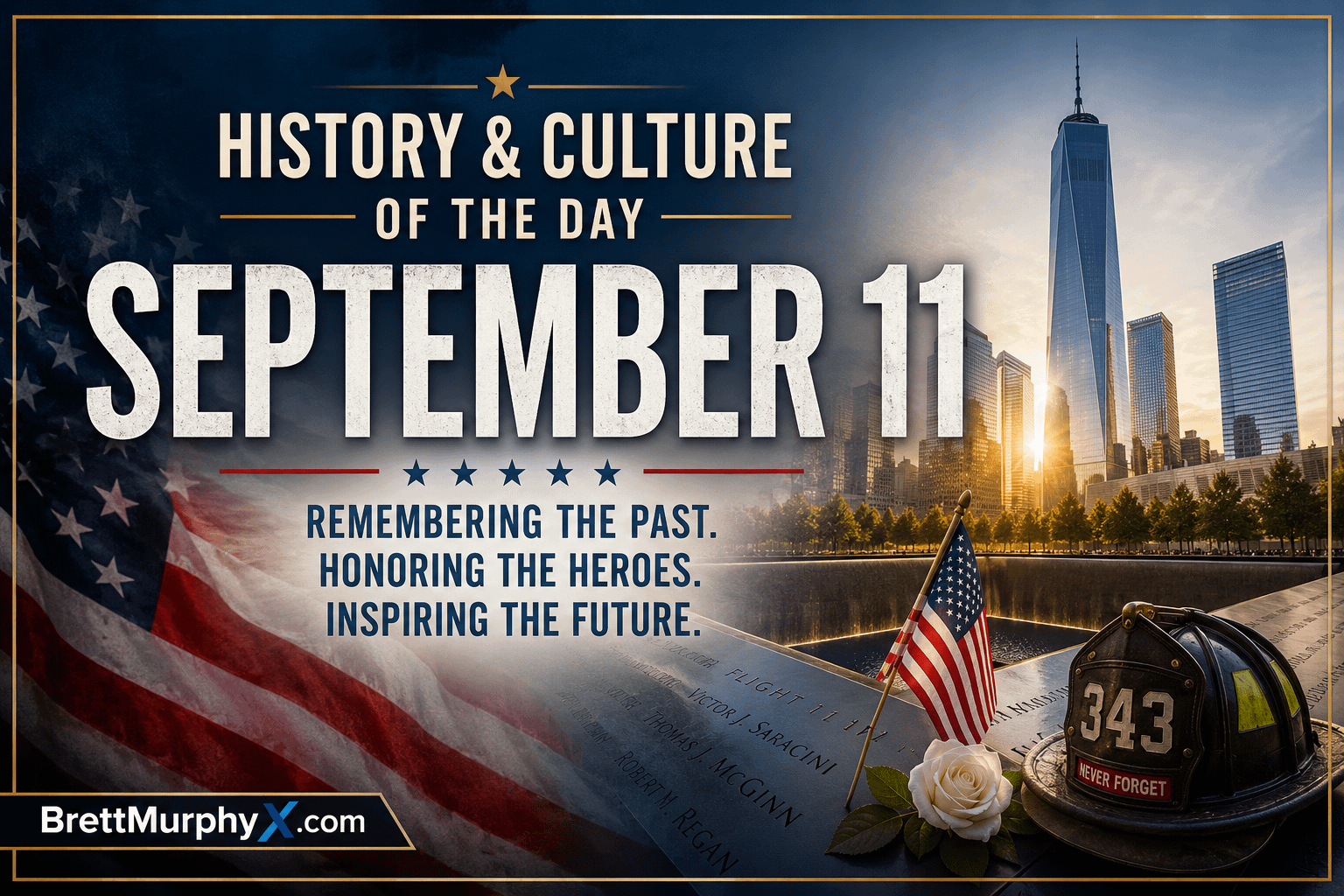
September 11 is a date that carries extraordinary weight in modern history, particularly in the United States. For millions of people, the date immediately brings to mind the terrorist attacks of September 11, 2001—a tragedy that took thousands of lives and permanently changed American society, national security, foreign policy, and the way people around the world thought about terrorism.
Yet September 11 also has a much longer history. Across centuries, the date has witnessed battles, political changes, cultural developments, scientific milestones, and moments that shaped nations.
Today, September 11 is both a day for remembering the past and reflecting on the values that emerge during difficult times: courage, service, compassion, unity, and remembrance.
September 11, 2001: A Day That Changed America
No discussion of September 11 can begin anywhere else.
On the morning of September 11, 2001, 19 terrorists affiliated with al-Qaeda hijacked four commercial airplanes in a coordinated attack against the United States.
American Airlines Flight 11 was flown into the North Tower of the World Trade Center in New York City.
United Airlines Flight 175 struck the South Tower shortly afterward.
American Airlines Flight 77 crashed into the Pentagon in Arlington, Virginia.
The fourth aircraft, United Airlines Flight 93, never reached its intended target. Passengers and crew members, after learning what had happened elsewhere, attempted to regain control of the aircraft. Flight 93 ultimately crashed in a field near Shanksville, Pennsylvania.
Nearly 3,000 people were killed in the attacks.
The victims came from many different backgrounds, professions, religions, nationalities, and walks of life. Office workers, airline passengers and crews, firefighters, police officers, emergency medical personnel, military personnel, and many others lost their lives.
September 11 became one of the defining moments of the early 21st century.
The World Trade Center Attacks
When American Airlines Flight 11 struck the North Tower of the World Trade Center at 8:46 a.m., many people initially struggled to understand what had happened.
Seventeen minutes later, at 9:03 a.m., United Airlines Flight 175 crashed into the South Tower.
The second impact made the nature of the attack unmistakable.
Television networks around the world began broadcasting live images from Lower Manhattan. Millions watched as smoke poured from the towers while firefighters, police officers, emergency workers, and civilians rushed toward the disaster.
The South Tower collapsed at 9:59 a.m.
The North Tower followed at 10:28 a.m.
The skyline of New York City was transformed within a matter of hours.
But amid the devastation were countless acts of courage.
First responders climbed stairways while thousands of people were evacuating in the opposite direction. Coworkers helped one another escape. Strangers assisted injured people. Boat operators helped evacuate people from Lower Manhattan by water.
These individual acts of humanity became an important part of how September 11 would be remembered.
The Attack on the Pentagon
At 9:37 a.m., American Airlines Flight 77 crashed into the Pentagon.
The Pentagon is the headquarters of the United States Department of Defense and one of the most recognizable symbols of American military power.
The crash caused extensive destruction and fires.
The attack demonstrated that September 11 was not simply an assault on New York City. It was a coordinated attack against major symbols of American economic and military power.
Emergency personnel immediately responded to the Pentagon, beginning rescue and recovery operations under extremely dangerous conditions.
The Heroes of Flight 93
United Airlines Flight 93 has become one of the most powerful stories of courage associated with September 11.
After the hijacking began, passengers and crew members were able to communicate with people on the ground. Through those conversations, they learned that other hijacked airplanes had already been used as weapons.
Realizing their aircraft was likely part of the same coordinated attack, passengers and crew members made the decision to fight back.
They attempted to regain control of the airplane.
Flight 93 crashed near Shanksville, Pennsylvania, at approximately 10:03 a.m.
Everyone aboard was killed.
Investigators concluded that the hijackers intended to strike a target in Washington, D.C. The passengers’ resistance prevented the aircraft from reaching that destination.
Their actions have since been remembered as an extraordinary example of courage under unimaginable circumstances.
The First Responders of September 11
Among the most enduring images of September 11 are firefighters, police officers, paramedics, and other emergency workers heading directly toward danger.
New York City’s firefighters suffered devastating losses.
Members of the New York City Police Department, Port Authority Police Department, emergency medical services, and numerous other organizations were also killed.
Thousands more participated in rescue, recovery, cleanup, and rebuilding operations during the weeks and months that followed.
For many responders, the consequences did not end when the recovery operation concluded.
Exposure to toxic dust and debris at Ground Zero contributed to serious long-term illnesses among responders, recovery workers, survivors, and residents.
Their experiences are another reason the consequences of September 11 continue decades later.
Patriot Day and National Remembrance
September 11 is officially observed in the United States as Patriot Day.
Each year, Americans are encouraged to remember the victims and honor those who responded to the attacks.
Flags are traditionally flown at half-staff.
Communities hold memorial ceremonies, moments of silence, religious services, educational programs, and volunteer events.
Moments of silence are often observed at times corresponding with major events from the attacks, including the moments when the planes struck and the towers fell.
The observance is not simply about remembering tragedy.
It is also about remembering people.
Behind the number of nearly 3,000 victims were thousands of individual lives—parents, children, spouses, siblings, friends, coworkers, and neighbors.
The September 11 Memorial & Museum
The former World Trade Center site has become one of America’s most important places of remembrance.
The National September 11 Memorial features two enormous reflecting pools located within the footprints of the original Twin Towers.
The names of those killed in the September 11 attacks and the February 26, 1993, World Trade Center bombing are inscribed around the memorial pools.
Nearby, the National September 11 Memorial & Museum preserves artifacts, photographs, recordings, personal stories, and historical materials connected to the attacks.
The memorial helps ensure that future generations understand not only what happened but also who was lost.
How September 11 Changed American Culture
The attacks affected far more than government policy.
They changed American culture.
In the weeks following September 11, American flags appeared on homes, vehicles, businesses, clothing, and public buildings throughout the country.
Patriotism surged.
Communities organized blood drives, fundraisers, memorial services, and assistance programs.
People thanked firefighters, police officers, military personnel, and other public servants.
The phrase “Never Forget” became permanently associated with September 11.
Music, television, movies, books, photography, journalism, and art all attempted to process what had happened.
For an entire generation, September 11 became a dividing line between life before the attacks and life afterward.
Changes to Air Travel
Anyone who traveled by airplane before September 11, 2001, experienced a very different security environment.
The attacks resulted in dramatic changes to aviation security.
The Transportation Security Administration was established following the attacks, and airport screening procedures became significantly more extensive.
Cockpit doors were strengthened.
Passenger screening increased.
Restrictions were introduced regarding what travelers could bring aboard aircraft.
Security procedures continued evolving during subsequent years.
Many practices modern travelers consider routine are directly connected to the security changes that followed September 11.
The Beginning of the War on Terror
The political consequences of September 11 were enormous.
The United States launched what became known as the War on Terror.
In October 2001, American and allied forces began military operations in Afghanistan after the Taliban government refused U.S. demands concerning al-Qaeda and its leadership.
The conflict would become America’s longest war.
The broader response to September 11 also affected intelligence operations, surveillance policies, international alliances, immigration procedures, airport security, and military strategy.
Debates surrounding these policies—including questions about civil liberties, military intervention, intelligence practices, and national security—continued for decades.
September 11 therefore changed not only America’s immediate response to terrorism but also its long-term political landscape.
The Spirit of September 12
One cultural memory connected to September 11 is what happened the following day.
September 12, 2001, is sometimes remembered as a moment when Americans felt unusually united.
Political disagreements did not disappear, but for a time many people experienced a strong sense of shared national identity.
Neighbors helped neighbors.
People donated blood.
Businesses provided supplies.
Volunteers traveled to New York and other affected communities.
People gathered for candlelight vigils and religious services.
The unity was imperfect and did not extend equally to everyone; Muslim, Arab, Sikh, and South Asian Americans, among others, experienced harassment and hate crimes in the aftermath. Remembering that reality is also an important part of understanding the period.
The better lesson from the days after September 11 is therefore not simply patriotism.
It is the importance of compassion without prejudice.
Other Historical Events on September 11
Although the events of 2001 dominate the modern meaning of September 11, other significant events have occurred on this date throughout history.
1297 – The Battle of Stirling Bridge
On September 11, 1297, Scottish forces led by William Wallace and Andrew Moray defeated a larger English army at the Battle of Stirling Bridge.
The battle became one of the most famous victories of the First War of Scottish Independence.
William Wallace later became one of Scotland’s most recognizable historical figures and a symbol of resistance and independence.
1609 – Henry Hudson Reaches the Region of Manhattan
During his exploration of North America’s Atlantic coast, English navigator Henry Hudson entered the waters around what is now New York Harbor in September 1609.
His voyage helped establish Dutch claims in the region and eventually contributed to the creation of the colony of New Netherland.
The settlement of New Amsterdam would later become New York City.
Centuries later, that same city would become central to the historical meaning of September 11.
1777 – The Battle of Brandywine
During the American Revolutionary War, British and American forces fought the Battle of Brandywine on September 11, 1777.
General George Washington’s Continental Army attempted to stop British forces commanded by General William Howe from advancing toward Philadelphia.
The British won the battle, and Philadelphia was captured later that month.
Despite the defeat, Washington preserved much of his army, allowing the Continental forces to continue fighting.
1814 – The Battle of Lake Champlain
September 11, 1814, brought an important American victory during the War of 1812.
American naval forces commanded by Thomas Macdonough defeated a British fleet during the Battle of Plattsburgh, also known as the Battle of Lake Champlain.
The victory helped stop a major British invasion from Canada and strengthened the American position during peace negotiations.
1857 – The Mountain Meadows Massacre
September 11 is also associated with one of the darker episodes of American westward expansion.
In September 1857, a wagon train traveling through Utah Territory was attacked in what became known as the Mountain Meadows Massacre.
Approximately 120 members of the emigrant party were killed.
The massacre remains a painful and controversial chapter in the history of the American West.
1941 – Construction Begins on the Pentagon
September 11 has an unusual historical connection to the Pentagon.
Groundbreaking for construction of the Pentagon took place on September 11, 1941.
Exactly 60 years later, the building became one of the targets of the September 11 terrorist attacks.
The Pentagon was built during World War II as the United States rapidly expanded its military infrastructure.
It remains the headquarters of the Department of Defense.
September 11 in Popular Culture
September 11 has had a profound influence on American popular culture.
Musicians wrote songs inspired by loss, patriotism, fear, grief, and resilience.
Filmmakers produced documentaries and dramatic works exploring the attacks and their consequences.
Authors wrote memoirs, historical studies, novels, biographies, and children’s books.
Photographers and journalists created some of the most recognizable images of modern American history.
Television changed as well.
In the immediate aftermath of the attacks, entertainment programming was interrupted or postponed. Over time, television programs began incorporating themes involving terrorism, national security, military service, grief, and the experiences of first responders.
The cultural impact remains visible more than two decades later.
Teaching September 11 to New Generations
An important transition is taking place in how September 11 is remembered.
Millions of Americans alive today were born after 2001.
For them, September 11 is history rather than personal memory.
That makes museums, schools, documentaries, oral histories, photographs, memorials, and survivor accounts increasingly important.
There is a difference between knowing that an event occurred and understanding what it meant to the people who experienced it.
Teaching September 11 responsibly means discussing the victims, first responders, survivors, political consequences, military conflicts, cultural changes, and difficult questions that followed.
It also means remembering that history involves individual human beings—not simply dates and statistics.
Remembering the People Behind the History
History often reduces enormous events to numbers.
September 11 cannot be understood that way alone.
Every person who died had a story.
Someone was expecting them home.
Someone loved them.
Someone had spoken with them that morning without realizing it would be their final conversation.
Children lost parents.
Parents lost children.
People lost spouses, siblings, coworkers, friends, and neighbors.
Thousands of families entered a life of grief they had never expected.
That human reality is what makes remembrance so important.
The buildings can be reconstructed.
Cities can rebuild.
Policies can change.
But the people who were lost cannot be replaced.
A Day of Service
In addition to remembrance, September 11 has increasingly become associated with volunteerism.
The federally recognized September 11 National Day of Service and Remembrance encourages Americans to honor those who were killed and those who served by helping others.
People participate in food drives, neighborhood projects, charitable activities, support for veterans, disaster preparedness programs, blood donations, and other forms of community service.
It transforms remembrance into action.
Rather than allowing tragedy to have the final word, people can choose to respond through kindness and service.
What September 11 Can Teach Us
History matters most when we allow it to teach us something.
September 11 teaches us how quickly ordinary life can change.
It reminds us that courage does not always belong to famous people.
Sometimes courage is a firefighter climbing a staircase.
Sometimes it is a police officer directing people toward safety.
Sometimes it is an airline passenger deciding to fight back.
Sometimes it is a stranger helping another stranger through smoke and confusion.
Sometimes it is a family finding the strength to continue living after an unimaginable loss.
September 11 also reminds us to resist hatred and prejudice. Tragedy can bring people together, but fear can also cause people to turn against innocent neighbors.
Remembering both responses helps future generations understand the responsibility that comes with remembrance.
Never Forget
September 11 will forever occupy a unique place in American history.
The images of the Twin Towers, the Pentagon, and the field near Shanksville remain powerful reminders of what happened.
But September 11 should never be remembered only through images of destruction.
Remember the firefighters climbing upward while others escaped downward.
Remember the police officers and emergency workers who entered danger.
Remember the passengers and crew members aboard Flight 93.
Remember the people who opened their doors to strangers.
Remember the volunteers who showed up when help was needed.
Remember the families who carried unimaginable grief into every September that followed.
And above all, remember the nearly 3,000 people whose ordinary Tuesday morning became their final day.
History & Culture of the Day – September 11
From medieval Scotland and the American Revolution to the construction of the Pentagon and the events of September 11, 2001, this date contains centuries of history.
But some dates become more than entries on a calendar.
September 11 is one of them.
It is a day of remembrance.
A day of history.
A day of service.
A day to honor courage.
And a day to remember how precious an ordinary day can be.
Never forget the lives lost. Never forget the courage shown. Never forget the families who continue carrying their memories.
What does September 11 mean to you, and what lesson from that day do you believe future generations should never forget?
Leave a Reply