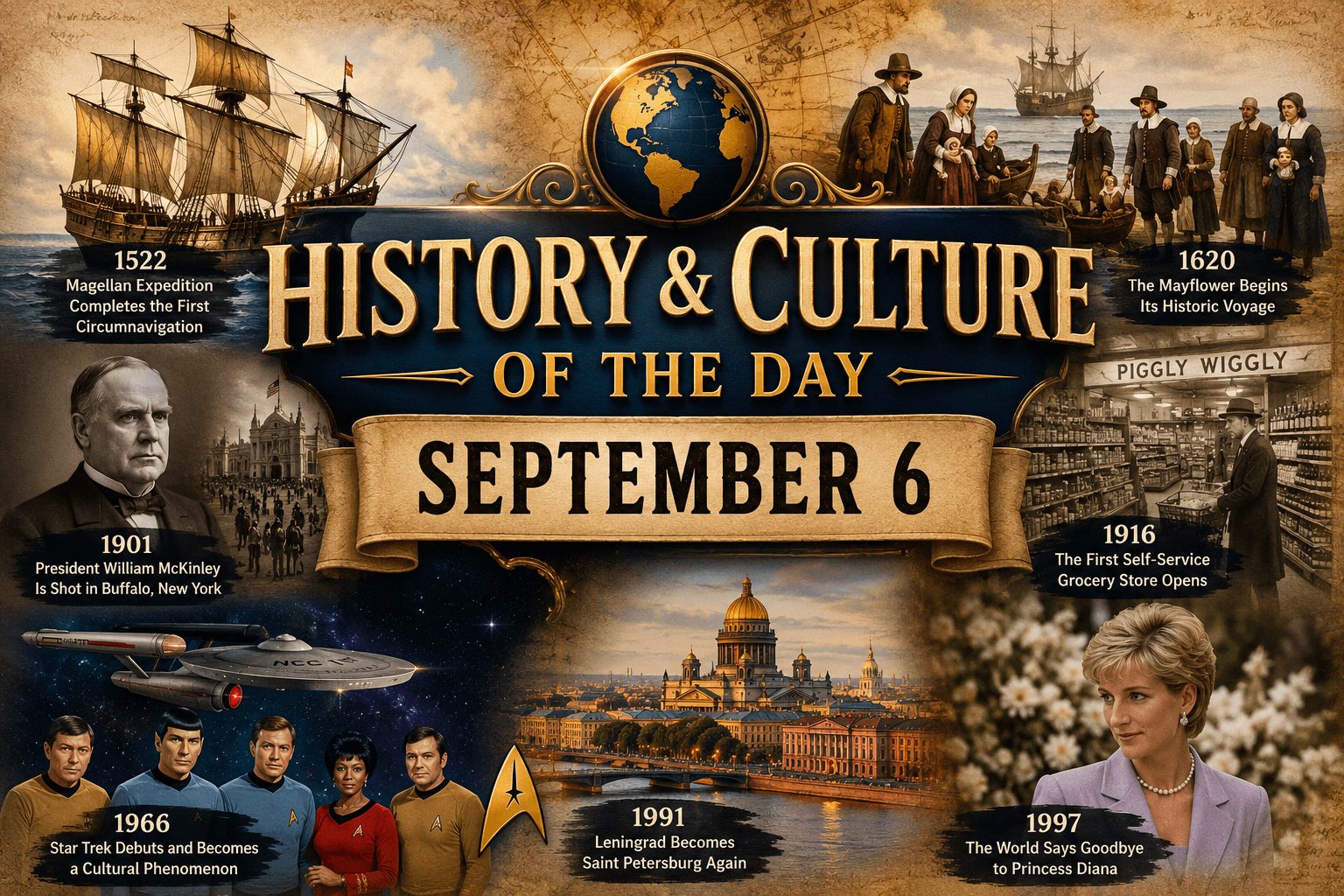
September 6 is a date filled with fascinating moments in history, cultural milestones, exploration, political change, and events that helped shape the modern world. From the voyage that would lead Ferdinand Magellan’s expedition toward the first circumnavigation of the globe to the birth of one of America’s most famous settlement houses, September 6 offers plenty of reasons to look back and appreciate how the past continues to influence us today.
1522 – The Magellan Expedition Completes the First Circumnavigation of the Globe
One of the greatest achievements in the history of exploration reached its conclusion on September 6, 1522, when the Victoria arrived back in Spain after completing the first known circumnavigation of the Earth.
The expedition had begun in 1519 under the leadership of Portuguese explorer Ferdinand Magellan, who sailed on behalf of Spain in search of a western route to the Spice Islands.
Magellan himself never completed the voyage. He was killed in the Philippines in 1521.
Command eventually passed to Juan Sebastián Elcano, who guided the surviving crew and the Victoria back to Spain.
Only a small number of the original expedition members completed the entire journey, but their accomplishment demonstrated on an unprecedented practical scale the enormous size of the planet and the possibility of sailing around it.
The voyage became one of the defining achievements of the Age of Exploration.
1620 – The Mayflower Prepares for Its Historic Atlantic Crossing
September 6 is also closely associated with the story of the Mayflower, although dates surrounding its departure can be confusing because England was still using the Julian calendar.
The Mayflower departed Plymouth, England, in September 1620 carrying English passengers who hoped to establish a new life across the Atlantic.
After a difficult voyage lasting more than two months, the passengers reached the area of Cape Cod in November.
Before establishing Plymouth Colony, the settlers created the Mayflower Compact, an agreement establishing principles for governing their new community.
The voyage would become one of the most recognizable stories in early American colonial history, although its legacy is complex. European settlement brought profound and often devastating consequences for Indigenous peoples who had lived in the region for thousands of years.
Understanding both sides of that history provides a fuller picture of how colonial America developed.
1901 – President William McKinley Is Shot
On September 6, 1901, President William McKinley was shot while attending the Pan-American Exposition in Buffalo, New York.
McKinley had been greeting members of the public at the Temple of Music when anarchist Leon Czolgosz approached him and fired two shots.
At first, there was hope that the president would recover. His condition later deteriorated, however, and McKinley died on September 14.
Vice President Theodore Roosevelt then became president of the United States.
Roosevelt was only 42 years old when he assumed the presidency, making him the youngest person ever to become U.S. president.
The assassination therefore became a major turning point in American political history, bringing one presidency to a tragic end while beginning the Roosevelt era.
1916 – The First Self-Service Grocery Store Opens
September 6, 1916, brought an innovation that would eventually transform everyday shopping.
Clarence Saunders opened the first Piggly Wiggly store in Memphis, Tennessee.
At the time, grocery shopping looked very different from what most people experience today. Customers typically gave their orders to clerks, who retrieved items from behind counters.
Saunders introduced a revolutionary concept: allow customers to walk through the store, select products themselves, and bring their purchases to a checkout area.
It sounds completely ordinary today, but it represented a dramatic change in retail culture.
The self-service model helped influence the development of the modern supermarket and eventually became the standard shopping experience throughout much of the world.
1966 – Star Trek Begins Its Journey Into Popular Culture
September 1966 marked the beginning of one of the most influential franchises in science-fiction history.
Star Trek, created by Gene Roddenberry, debuted during this period and introduced audiences to Captain James T. Kirk, Mr. Spock, Dr. Leonard McCoy, Lieutenant Uhura, and the crew of the USS Enterprise.
The series imagined humanity centuries in the future exploring space and encountering new civilizations.
But Star Trek was never simply about spaceships and aliens.
The show frequently explored issues involving prejudice, war, diplomacy, technology, morality, equality, and humanity’s ability to build a better future.
Its diverse cast was particularly significant during the social and political changes of the 1960s.
Although the original television series lasted only three seasons, its cultural impact became enormous.
Movies, television series, books, conventions, merchandise, and generations of devoted fans transformed Star Trek into a global cultural phenomenon.
Its influence has even extended into science and technology, inspiring engineers, astronauts, scientists, and inventors.
1991 – Leningrad Becomes Saint Petersburg Again
On September 6, 1991, the Russian city of Leningrad officially returned to its historic name, Saint Petersburg.
The city had experienced several name changes throughout its history.
Founded by Peter the Great in 1703, it was originally called Saint Petersburg. During World War I, the name was changed to Petrograd because Saint Petersburg sounded too German.
After the death of Vladimir Lenin in 1924, the city became Leningrad.
Following decades under Soviet rule, residents voted in 1991 to restore the name Saint Petersburg.
The change occurred during an extraordinary period of political transformation. The Soviet Union was approaching its final months, and countries and cities throughout the region were reconsidering symbols associated with the Soviet era.
Restoring the city’s original name represented more than a change on a map. It reflected changing ideas about history, identity, culture, and Russia’s relationship with its past.
1997 – The World Says Goodbye to Princess Diana
September 6, 1997, became part of one of the most emotional cultural moments of the decade when the funeral of Diana, Princess of Wales, was held at Westminster Abbey.
Diana had died following a car crash in Paris on August 31 at the age of 36.
Her death produced an extraordinary global outpouring of grief.
Millions of people watched the funeral on television, while enormous crowds gathered along the procession route in London.
Diana had become an international figure not simply because of her connection to the British royal family but also because of her humanitarian work.
She used her visibility to bring attention to issues including homelessness, HIV/AIDS, and landmines. Her willingness to interact publicly and compassionately with people affected by AIDS was particularly significant at a time when fear and misinformation surrounding the disease remained widespread.
Her funeral demonstrated the extraordinary connection many people felt toward her and became one of the defining televised events of the 1990s.
Culture Through the Years
History isn’t shaped only by wars, governments, and political leaders. Culture develops through inventions, entertainment, exploration, social movements, traditions, and changes in everyday life.
September 6 demonstrates that beautifully.
A voyage completed in 1522 changed humanity’s understanding of global exploration.
A grocery store opened in 1916 helped transform something as ordinary as buying food.
A science-fiction television series helped generations imagine what humanity’s future might look like.
A Russian city reclaimed a centuries-old name as an entire political system approached its end.
And the funeral of Princess Diana showed how one person’s life could produce an emotional response felt around the world.
These events may seem unrelated, yet each reveals something about the way societies evolve.
Why History & Culture Matter
Looking back at history gives us more than dates to memorize.
It helps us understand why our communities, traditions, governments, technologies, and cultures look the way they do today.
Some historical moments represent extraordinary achievements. Others remind us of tragedy, conflict, inequality, and difficult lessons. Both deserve to be remembered.
Culture works the same way. Music, television, food, language, fashion, technology, traditions, and shared experiences become pieces of history as generations pass.
What seems ordinary today may someday become an important part of the historical record.
September 6 Reminds Us That the World Is Always Changing
From explorers crossing unknown oceans to shoppers walking through the aisles of a self-service grocery store for the first time, history is filled with people experiencing something new.
September 6 reminds us that change doesn’t always announce itself as history.
Sometimes history happens inside presidential exhibitions and royal ceremonies.
Sometimes it happens aboard ships crossing distant oceans.
And sometimes it happens inside an ordinary grocery store.
Every generation contributes another chapter to the story.
The people living through these moments rarely know exactly how history will remember them. That is one of the most fascinating things about studying the past: today’s ordinary moments can become tomorrow’s history.
Which historical or cultural event from September 6 do you find the most fascinating, and why?
Leave a Reply