Category: History & Culture

  • History & Culture of the Day – September 8

    History & Culture of the Day – September 8

    Every date on the calendar carries stories from the past, but September 8 offers an especially interesting collection of moments involving exploration, religion, immigration, literature, entertainment, politics, and the people who helped shape culture around the world.

    From the founding of one of the oldest continuously inhabited European-established settlements in the United States to the arrival of immigrants who helped transform American society, September 8 reminds us that history is not simply a collection of dates. It is the story of people moving, creating, struggling, discovering, celebrating, and leaving something behind for future generations.

    Here is a look at some of the notable history and cultural moments connected to September 8.

    1565 – St. Augustine Is Established in Florida

    One of the most significant events associated with September 8 occurred in 1565, when Spanish settlers established St. Augustine in what is now Florida.

    Spanish explorer Pedro Menéndez de Avilés arrived along the Florida coast and established a settlement in the name of Spain. The community would survive wars, political changes, attacks, and centuries of development.

    St. Augustine is widely recognized as the oldest continuously inhabited European-established settlement in the continental United States.

    Its establishment came more than four decades before Jamestown was founded in Virginia in 1607 and more than half a century before the Pilgrims arrived at Plymouth in 1620.

    The history of St. Augustine also demonstrates that the story of early America was much broader than the English colonies that eventually became the United States. Spanish exploration and settlement played an important role in the development of Florida and other parts of North America.

    The region was already home to Indigenous peoples long before Europeans arrived, making the history of St. Augustine part of a much larger story involving Native civilizations, European colonization, cultural exchange, conflict, and survival.

    Today, St. Augustine remains known for its historic architecture, Spanish heritage, fortifications, churches, museums, and centuries-old streets.

    September 8, 1565, therefore represents an important chapter in the long and complicated history of European settlement in North America.

    1664 – New Amsterdam Becomes New York

    September 8 also connects to the transformation of one of the world’s most famous cities.

    In 1664, Dutch control of New Amsterdam effectively came to an end as the English took possession of the colony.

    The settlement would become known as New York, named in honor of the Duke of York.

    Before English control, New Amsterdam had served as the center of the Dutch colony of New Netherland. Its location near the mouth of the Hudson River made it valuable for commerce and trade.

    The transition helped set the stage for the eventual development of New York City.

    Over the centuries, New York would become one of the world’s most influential centers of finance, immigration, publishing, entertainment, fashion, art, and culture.

    The city’s Dutch heritage did not completely disappear. Names such as Brooklyn, Harlem, and Staten Island reflect elements of the region’s Dutch colonial history.

    What began as a relatively small colonial settlement would eventually grow into one of the most recognizable cities on Earth.

    1883 – The Northern Pacific Railway Is Completed

    Transportation has repeatedly transformed American history, and September 8 marks an important moment in the expansion of the nation’s railroad system.

    On September 8, 1883, ceremonies in Montana celebrated the completion of the Northern Pacific Railway.

    The railroad connected the Great Lakes region with the Pacific Northwest, helping create another major transportation corridor across the United States.

    Railroads dramatically changed the country during the 19th century.

    They made it possible to move people, agricultural products, manufactured goods, mail, and natural resources across enormous distances much faster than before.

    Communities grew around railroad stations. Businesses gained access to distant markets. Migration toward western territories increased.

    However, railroad expansion also carried serious consequences.

    The growth of railroads contributed to the displacement of Native American communities and accelerated settlement across Indigenous lands. Railroad corporations also gained enormous economic and political influence during the period.

    The completion of major railroad networks demonstrates how technological progress can simultaneously create opportunity and disruption.

    1892 – The Pledge of Allegiance Appears in Print

    September 8 also has an interesting connection to an American tradition familiar to generations of schoolchildren.

    In 1892, the original version of the Pledge of Allegiance appeared in The Youth’s Companion, a popular children’s magazine.

    The pledge is generally credited to Francis Bellamy, a Baptist minister and writer who worked for the publication.

    His original version was much shorter than the pledge commonly recited today.

    Over the following decades, the wording changed.

    The words “the flag of the United States of America” were incorporated in 1923 and 1924. Congress officially recognized the pledge in 1942.

    The phrase “under God” was added in 1954 during the Cold War.

    The evolution of the Pledge of Allegiance demonstrates how traditions that may seem permanent can change significantly over time.

    For millions of Americans, reciting the pledge became a familiar part of school life, public ceremonies, government meetings, and patriotic gatherings.

    At the same time, debates surrounding compulsory recitation, religious language, freedom of speech, and patriotism have made the pledge an important subject in American legal and cultural history.

    1900 – The Galveston Hurricane Devastates Texas

    One of the deadliest natural disasters in United States history struck Galveston, Texas, on September 8, 1900.

    A massive hurricane pushed a devastating storm surge across the low-lying island city.

    Thousands of people died.

    Estimates vary, but approximately 6,000 to 12,000 people are believed to have been killed, making the Galveston hurricane the deadliest natural disaster in American history.

    At the beginning of the 20th century, weather forecasting technology was extremely limited compared with what exists today. Satellites, modern radar systems, sophisticated computer forecasting, and emergency alert networks did not exist.

    Many residents therefore had little warning about the scale of the approaching storm.

    Entire neighborhoods were destroyed.

    Homes were swept away.

    Families were separated.

    Businesses disappeared.

    The disaster permanently changed Galveston.

    Afterward, engineers constructed a massive seawall and undertook an extraordinary project to raise portions of the city’s elevation. Buildings were physically lifted while sand was pumped beneath them.

    The disaster also influenced the development of hurricane forecasting, emergency preparedness, and coastal engineering.

    More than a century later, the Galveston hurricane remains a powerful reminder of nature’s destructive potential and the importance of preparing communities for extreme weather.

    1930 – 3M Begins Marketing Scotch Transparent Tape

    Not every historical milestone involves wars, presidents, or disasters.

    Sometimes an everyday invention quietly changes how people live and work.

    On September 8, 1930, the 3M company began marketing Scotch transparent tape.

    The product became incredibly useful in homes, schools, offices, stores, and countless industries.

    Transparent tape helped people repair torn paper, wrap packages, complete craft projects, attach documents, and perform thousands of small everyday tasks.

    Its development also came during the Great Depression, when many Americans were trying to repair possessions rather than replace them.

    Over time, Scotch tape became so familiar that the brand name itself became closely associated with transparent adhesive tape.

    It is a good example of how seemingly simple inventions can become deeply embedded in everyday culture.

    1934 – The Passenger Liner Morro Castle Burns

    September 8, 1934, was marked by tragedy at sea when the passenger ship Morro Castle caught fire off the coast of New Jersey.

    The luxury liner was traveling from Havana, Cuba, to New York when the fire spread rapidly through the ship.

    More than 130 people died.

    The disaster attracted enormous public attention.

    Bodies and debris washed ashore along the New Jersey coast, while dramatic accounts from survivors appeared in newspapers across the country.

    The tragedy raised serious questions about ship construction, fire safety, emergency procedures, and crew preparedness.

    As with many major disasters, the lessons learned from the Morro Castle helped influence future maritime safety standards.

    1951 – The Treaty of San Francisco Is Signed

    The aftermath of World War II continued to reshape international relations for years after the fighting ended.

    On September 8, 1951, representatives of Japan and dozens of Allied nations signed the Treaty of San Francisco.

    The agreement formally helped end the state of war between Japan and many of the Allied powers.

    It also addressed questions involving territory, sovereignty, international relations, and Japan’s position in the postwar world.

    The treaty officially came into force in 1952.

    The agreement represented an important step in Japan’s transformation from a defeated wartime empire into a major participant in the international political and economic system.

    During the decades that followed, Japan experienced extraordinary economic growth and became one of the world’s leading industrial and technological nations.

    1952 – The Old Man and the Sea Is Published

    September 8 also holds an important place in literary history.

    On September 8, 1952, Ernest Hemingway’s The Old Man and the Sea was published in book form.

    The novella tells the story of Santiago, an aging Cuban fisherman who struggles with an enormous marlin far out at sea.

    The story explores themes of endurance, dignity, determination, defeat, pride, and the relationship between human beings and nature.

    Its simple narrative carries deeper questions about what it means to continue fighting even when success seems impossible.

    The book became one of Hemingway’s most famous works.

    It received the Pulitzer Prize for Fiction in 1953, and Hemingway was awarded the Nobel Prize in Literature the following year.

    The Old Man and the Sea continues to be taught and read around the world.

    Its cultural influence demonstrates the power of a relatively short story to communicate universal ideas about perseverance and the human spirit.

    1965 – Hurricane Betsy Strikes the Bahamas

    Hurricane Betsy became one of the major Atlantic hurricanes of 1965.

    After moving through parts of the Bahamas and Florida, Betsy eventually struck Louisiana, causing devastating flooding and destruction.

    The storm became historically significant partly because of its enormous economic impact.

    Betsy was sometimes called “Billion-Dollar Betsy” because it became the first Atlantic hurricane to cause more than $1 billion in reported damage.

    The storm demonstrated how growing coastal populations and development could dramatically increase the financial consequences of hurricanes.

    Its impact also contributed to discussions surrounding flood protection and disaster preparedness, particularly in Louisiana.

    1966 – Star Trek Premieres on American Television

    Few television premieres have had the cultural impact of Star Trek.

    On September 8, 1966, American television audiences were introduced to the science-fiction series created by Gene Roddenberry.

    The show followed the crew of the USS Enterprise as they explored space and encountered new civilizations.

    Although the original series lasted only three seasons, its influence became enormous.

    Star Trek imagined a future in which humanity had overcome many of its divisions and worked together while exploring the universe.

    Its diverse cast was notable during an era of major social change in the United States.

    Nichelle Nichols’ portrayal of Lieutenant Uhura became especially important. As a Black woman serving as a respected officer aboard the Enterprise, Nichols provided television audiences with an image rarely seen on American television at the time.

    The franchise eventually expanded into numerous television series, movies, novels, games, conventions, and generations of devoted fans.

    Its influence has extended beyond entertainment.

    Scientists, engineers, astronauts, and technology developers have frequently cited Star Trek as an inspiration.

    Devices imagined in the series have even been compared with later real-world technologies such as tablet computers, voice-controlled computers, video communication, and handheld communication devices.

    September 8 is now celebrated by many fans as Star Trek Day.

    1974 – President Gerald Ford Pardons Richard Nixon

    On September 8, 1974, President Gerald Ford issued a full and unconditional pardon to former President Richard Nixon for any federal crimes Nixon might have committed while serving as president.

    Nixon had resigned the presidency on August 9, 1974, amid the Watergate scandal.

    Ford’s decision became one of the most controversial presidential actions of the 20th century.

    Supporters argued that the pardon allowed the country to move beyond Watergate and avoid years of additional political division.

    Critics believed Nixon should have faced the legal process like any other citizen.

    Ford later explained that he believed continuing the Watergate controversy would prevent the country from addressing other serious challenges.

    The pardon had major political consequences and likely contributed to Ford’s declining public approval.

    Decades later, historians continue to debate whether the decision helped the nation heal or undermined public confidence in accountability.

    1986 – The Oprah Winfrey Show Begins National Broadcasting

    September 8, 1986, marked a major moment in American television and popular culture when The Oprah Winfrey Show began national syndication.

    Oprah Winfrey transformed the daytime talk-show format.

    Her program discussed relationships, books, health, personal struggles, social issues, celebrities, current events, and stories of ordinary people.

    Over time, Winfrey became one of the most influential media figures in the world.

    Her recommendations could dramatically increase book sales, introduce products to enormous audiences, and bring national attention to social issues.

    Oprah’s Book Club became particularly influential in American publishing.

    The show’s success also represented an important cultural milestone for Black women in American media.

    Winfrey eventually expanded her influence into film, publishing, philanthropy, television production, and business.

    The final episode of The Oprah Winfrey Show aired in 2011 after 25 seasons.

    1998 – Mark McGwire Hits Home Run Number 62

    Baseball history was made on September 8, 1998, when St. Louis Cardinals slugger Mark McGwire hit his 62nd home run of the season.

    The home run broke Roger Maris’ long-standing single-season Major League Baseball record of 61 home runs, established in 1961.

    The 1998 home run race between McGwire and Sammy Sosa captivated baseball fans across the United States.

    For much of the summer, sports fans followed each player’s home run totals closely.

    McGwire ultimately finished the season with 70 home runs.

    The achievement was celebrated as one of baseball’s great moments at the time.

    However, the era later became associated with controversy surrounding performance-enhancing drugs, changing how many fans and historians viewed the accomplishments of the period.

    Barry Bonds eventually surpassed McGwire’s total when he hit 73 home runs during the 2001 season.

    The 1998 season nevertheless remains one of the most memorable chapters in modern baseball history.

    International Literacy Day

    September 8 is also recognized around the world as International Literacy Day.

    UNESCO proclaimed International Literacy Day in 1966, with the first observance taking place in 1967.

    The day highlights the importance of literacy as a foundation for education, opportunity, communication, and participation in society.

    Being able to read and write affects nearly every aspect of life.

    Literacy helps people understand medical information, apply for jobs, participate in government, communicate with others, manage finances, access education, and understand the world around them.

    Although global literacy has improved dramatically over generations, millions of people still lack basic literacy skills.

    International Literacy Day encourages governments, schools, organizations, communities, and individuals to continue working toward greater access to education.

    September 8 in Popular Culture

    September 8 has accumulated a fascinating cultural identity.

    It is associated with colonial history through St. Augustine, literature through Ernest Hemingway, science fiction through Star Trek, television through Oprah Winfrey, sports through Mark McGwire, education through International Literacy Day, and political history through Gerald Ford’s pardon of Richard Nixon.

    These events may seem unrelated, but together they demonstrate what makes studying history so interesting.

    History is rarely one story.

    It is millions of stories happening simultaneously.

    While political leaders make decisions, writers create books.

    While engineers build transportation networks, inventors create everyday products.

    While natural disasters reshape communities, artists and entertainers reshape culture.

    Each becomes part of the historical record.

    What September 8 Teaches Us About History

    Looking across the centuries, several themes emerge from the events connected with September 8.

    One is change.

    New Amsterdam became New York. Japan transitioned from wartime defeat toward a new international role. Television changed through programs such as Star Trek and The Oprah Winfrey Show.

    Another theme is resilience.

    Galveston rebuilt after one of America’s deadliest natural disasters. Communities affected by hurricanes adapted and developed new approaches to protection and preparedness.

    There is also imagination.

    Hemingway used fiction to explore perseverance and dignity. Star Trek imagined technologies and social possibilities that inspired generations.

    And there is education.

    International Literacy Day reminds us that knowledge itself can transform lives.

    These stories show that history isn’t only something preserved inside museums or textbooks.

    We live with its consequences every day.

    The cities we visit, books we read, television programs we watch, technologies we use, political institutions we debate, and traditions we practice all have histories behind them.

    Remembering September 8

    September 8 gives us an opportunity to look backward while also thinking about the future.

    More than four centuries separate the founding of St. Augustine from the television premiere of Star Trek, yet both events became pieces of a much larger cultural story.

    One represents exploration and settlement in the physical world.

    The other imagined exploration far beyond it.

    Between those moments came disasters, inventions, political decisions, literature, transportation revolutions, and cultural transformations.

    That is one of the most fascinating things about history.

    A single date can connect people who lived centuries apart.

    They never knew one another.

    They experienced completely different worlds.

    Yet their stories eventually occupy the same page on the calendar.

    September 8 reminds us that today’s ordinary moments may become tomorrow’s history.

    Which September 8 moment do you think had the greatest impact on history or culture?
  • This Day in American History – September 8

    This Day in American History – September 8

    This Day in American History – September 8

    September 8 has witnessed moments of tragedy, political controversy, international diplomacy, cultural change, and national transformation. From the catastrophic Galveston Hurricane of 1900 to President Gerald Ford’s controversial pardon of Richard Nixon in 1974, events on this date have left lasting marks on the American story.

    Looking back at September 8 reminds us that history is not simply a collection of dates. It is the story of decisions, disasters, discoveries, conflicts, and people whose actions continue to influence the United States today.

    1900 – The Great Galveston Hurricane Devastates Texas

    One of the darkest natural disasters in American history occurred on September 8, 1900, when a massive hurricane struck Galveston, Texas.

    At the beginning of the 20th century, Galveston was one of Texas’s most important cities. Located on a barrier island along the Gulf Coast, it was a prosperous commercial center with a busy port and growing population.

    But its location also made it extremely vulnerable to hurricanes.

    During the afternoon and evening of September 8, conditions rapidly deteriorated as powerful winds and an enormous storm surge swept across Galveston Island. Much of the city was inundated, buildings were destroyed, and thousands of people were trapped by rising water.

    The National Weather Service describes the storm as the greatest natural disaster to strike the United States, with at least 6,000 people killed within a matter of hours.

    Entire neighborhoods disappeared.

    Homes were ripped apart.

    Families were separated.

    Debris from destroyed buildings became dangerous projectiles as the storm continued to batter the city.

    The scale of destruction was almost unimaginable.

    A Disaster That Changed Galveston

    Galveston did not simply rebuild after the hurricane. City leaders took extraordinary steps to protect the community from future storms.

    One of the most important projects was the construction of a massive seawall along portions of the island. Engineers also raised the elevation of significant sections of the city.

    Buildings were physically lifted, and enormous quantities of sand were pumped underneath them to raise the ground level.

    The disaster became an important lesson in hurricane preparedness, coastal engineering, weather forecasting, and disaster response.

    Today, the Great Galveston Hurricane remains a sobering reminder of the destructive power of nature and the importance of preparing vulnerable communities for extreme weather.

    1954 – The Southeast Asia Collective Defense Treaty Is Signed

    September 8 also played an important role in America’s Cold War foreign policy.

    On September 8, 1954, representatives from eight countries signed the Southeast Asia Collective Defense Treaty in Manila, Philippines.

    The participating nations were:

    • United States
    • United Kingdom
    • France
    • Australia
    • New Zealand
    • Pakistan
    • Thailand
    • Philippines

    The agreement became commonly known as the Manila Pact and led to the creation of the Southeast Asia Treaty Organization, better known as SEATO.

    According to the U.S. Department of State’s historical records, the countries agreed that aggression against a member could require collective action to confront the danger, consistent with each nation’s constitutional processes. A separate protocol also addressed Cambodia, Laos, and non-Communist Vietnam.

    America and the Cold War

    The treaty reflected the international tensions of the 1950s.

    Following World War II, American foreign policy increasingly focused on containing the spread of communism. The Soviet Union had emerged as America’s principal geopolitical rival, Communist forces had taken control of China in 1949, and the Korean War had demonstrated how quickly Cold War tensions could become military conflicts.

    Southeast Asia became another major area of concern.

    American officials feared that Communist expansion in one country might encourage similar developments throughout the region.

    SEATO was partly designed as a collective security arrangement intended to discourage further Communist expansion.

    Unlike NATO, however, SEATO never developed the same degree of military integration or political unity.

    The organization eventually dissolved in 1977, but the treaty signed on September 8, 1954, remains an important milestone in the history of American involvement in Southeast Asia and the broader Cold War.

    1974 – President Gerald Ford Pardons Richard Nixon

    Perhaps the most politically significant American event associated with September 8 occurred in 1974.

    Only one month earlier, President Richard Nixon had resigned from office as the Watergate scandal threatened to result in his impeachment and removal.

    Nixon officially left the presidency on August 9, 1974, becoming the first U.S. president to resign.

    Vice President Gerald Ford then became the 38th president of the United States.

    The country was deeply divided and exhausted by Watergate.

    Questions remained about whether Nixon could face criminal prosecution for actions committed while he was president.

    Then, on Sunday, September 8, 1974, President Ford addressed the nation.

    He announced that he was granting Nixon a full presidential pardon.

    Ford’s proclamation granted Nixon a “full, free and absolute pardon” for offenses against the United States that Nixon had committed or may have committed during his presidency.

    The decision immediately became one of the most controversial presidential actions of the 20th century.

    Why Ford Pardoned Nixon

    Ford believed that continuing legal proceedings involving Nixon could prevent the country from moving beyond Watergate.

    America was already dealing with serious problems.

    Inflation was hurting families and businesses. International tensions remained high. The Vietnam era continued to cast a shadow over American politics, and public confidence in government had been badly damaged.

    Ford argued that the nation needed closure.

    In explaining his decision, he said that the Nixon controversy could continue indefinitely unless someone brought it to an end.

    Ford believed that responsibility ultimately belonged to him as president.

    His decision was not based on whether the pardon would be politically popular. In fact, Ford understood that it could be extremely damaging to his presidency.

    And it was.

    The Political Consequences of the Nixon Pardon

    Many Americans were furious.

    Critics believed Nixon should have been required to face the same legal system as anyone else accused of wrongdoing.

    Some suspected that Nixon and Ford had secretly arranged the pardon before Nixon resigned, although Ford denied that any such agreement existed.

    The controversy became so intense that Ford later appeared before a congressional subcommittee to explain his decision.

    Even members of Ford’s own administration objected.

    White House Press Secretary Jerald terHorst resigned on September 8 following Ford’s decision to pardon Nixon.

    The pardon damaged Ford politically and remained an issue during the 1976 presidential election, when he narrowly lost to Jimmy Carter.

    Over time, however, some historians and political leaders came to view Ford’s decision differently.

    Supporters argued that the pardon allowed the country to stop focusing on Nixon and begin recovering from the Watergate crisis.

    Critics continued to argue that the decision weakened the principle that even presidents should be fully accountable under the law.

    That debate remains part of Ford’s historical legacy.

    A Major Test of Presidential Power

    The Nixon pardon also demonstrated the enormous power granted to the president under the Constitution.

    Article II, Section 2 gives presidents the authority to grant reprieves and pardons for federal offenses, except in cases of impeachment.

    Ford used that constitutional authority before Nixon had been formally convicted—or even formally charged—of a federal crime.

    The decision therefore became an important example in discussions about presidential power, executive authority, accountability, and the limits of political forgiveness.

    Decades later, presidential pardons continue to generate debate, and Ford’s pardon of Nixon remains one of the most famous examples in American history.

    September 8 and the Changing American Story

    The major events associated with September 8 occurred during very different periods of American history, yet each reveals something important about the challenges the country has faced.

    The Galveston Hurricane demonstrated America’s vulnerability to natural disasters.

    The Southeast Asia Collective Defense Treaty demonstrated the growing international responsibilities the United States assumed during the Cold War.

    The Nixon pardon demonstrated the political and constitutional challenges that can arise when a country attempts to recover from a crisis of government.

    Each event produced consequences that extended far beyond September 8 itself.

    Lessons From the Galveston Hurricane

    The 1900 disaster showed the importance of taking natural hazards seriously.

    Weather forecasting technology in 1900 was extremely limited compared with what Americans have today. There were no weather satellites, sophisticated radar networks, smartphone emergency alerts, or computer models capable of tracking hurricanes with modern precision.

    Communication was also far slower.

    Today, meteorologists can watch tropical systems develop thousands of miles away and provide communities with days of warning.

    Yet the fundamental lesson remains the same.

    Preparation saves lives.

    The tragedy in Galveston helped inspire improvements in coastal protection and disaster preparedness that continue to influence hurricane-prone communities.

    Lessons From the Cold War

    The 1954 Manila Pact illustrates how America’s international role expanded dramatically following World War II.

    Before the war, many Americans favored avoiding permanent involvement in international conflicts.

    After the war, that approach changed.

    The United States became deeply involved in alliances around the world.

    American leaders believed those alliances could discourage aggression and protect countries threatened by hostile powers.

    Some alliances, such as NATO, became long-lasting institutions.

    Others, including SEATO, eventually disappeared.

    Nevertheless, these agreements helped shape decades of American foreign policy.

    Lessons From Watergate

    The events surrounding Nixon and Ford offer another kind of historical lesson.

    Democracies depend heavily on public trust.

    When citizens lose confidence in government institutions, restoring that confidence can take years.

    Watergate damaged America’s faith in political leadership.

    Ford entered the presidency promising stability and honesty, but his decision to pardon Nixon immediately placed him at the center of another national controversy.

    Whether Ford’s decision was right or wrong remains open to interpretation.

    What cannot be disputed is its significance.

    On September 8, 1974, one presidential signature changed the direction of the Watergate story and permanently influenced how Gerald Ford would be remembered.

    History Is More Than Dates

    It can be easy to look at history as a timeline filled with names, dates, wars, elections, and political decisions.

    But every historical event represents real people.

    The Galveston Hurricane involved families desperately trying to survive rising water and collapsing buildings.

    The Cold War treaties of the 1950s involved leaders attempting to navigate a world divided between competing political and military powers.

    The Nixon pardon involved a nation struggling with questions about justice, accountability, forgiveness, and political stability.

    Those human experiences are what make history meaningful.

    Remembering September 8

    September 8 is a date that represents both tragedy and transformation in American history.

    In 1900, Galveston experienced unimaginable destruction as one of the deadliest natural disasters in the nation’s history struck the Texas coast.

    In 1954, the United States joined seven other nations in signing a treaty that reflected America’s expanding Cold War role in Asia.

    And in 1974, President Gerald Ford made one of the most controversial decisions ever made by an American president when he pardoned Richard Nixon.

    Different generations faced different challenges, but each event became part of the larger American story.

    Studying these moments gives us more than knowledge about the past. It helps us understand how disasters influence preparedness, how international conflicts shape foreign policy, and how decisions made by presidents can affect public trust for generations.

    History continues to remind us that decisions made during moments of crisis can have consequences lasting far beyond the people who originally made them.

    Which September 8 event do you believe had the greatest long-term impact on the United States—the Galveston Hurricane, the Cold War defense treaty, or President Ford’s pardon of Richard Nixon?

  • History & Culture of the Day – September 7

    History & Culture of the Day – September 7

    September 7 is a date filled with fascinating moments in history, cultural milestones, exploration, innovation, entertainment, and events that helped shape the world we know today. From the early days of European exploration to major developments in American culture and modern technology, September 7 offers plenty of reasons to look back and remember how the past continues to influence the present.

    September 7, 1533 – Queen Elizabeth I Is Born

    One of the most influential monarchs in English history, Elizabeth I, was born on September 7, 1533, at Greenwich Palace in England.

    Elizabeth was the daughter of King Henry VIII and Anne Boleyn. She eventually became Queen of England and Ireland in 1558 and ruled until her death in 1603.

    Her reign became known as the Elizabethan Era, a period remembered for English exploration, growing international influence, and a remarkable flourishing of literature and theater.

    Perhaps no cultural figure is more closely associated with this era than William Shakespeare, whose plays and poetry became some of the most celebrated works in the English language.

    Elizabeth’s reign also included the defeat of the Spanish Armada in 1588, an event that strengthened England’s position as an emerging maritime power.

    Her nearly 45-year reign left a lasting mark on British history and Western culture.

    September 7, 1813 – The United States Gets the Nickname “Uncle Sam”

    One of America’s most recognizable national symbols is traditionally connected to September 7, 1813.

    According to the popular story, meatpacker Samuel Wilson of Troy, New York, supplied barrels of meat to the United States Army during the War of 1812. The barrels were stamped with the initials “U.S.”

    Workers reportedly joked that the letters stood for “Uncle Sam,” referring to Samuel Wilson.

    Over time, Uncle Sam became a personification of the United States government and eventually the country itself.

    The image most Americans recognize today—a stern-looking man with white hair, a goatee, and patriotic clothing—became especially famous through recruiting posters during World War I.

    The famous “I Want YOU for U.S. Army” poster featuring Uncle Sam remains one of the most recognizable pieces of American propaganda and popular culture.

    Congress officially recognized Samuel Wilson as the inspiration behind the national symbol in 1961.

    September 7, 1822 – Brazil Declares Independence

    September 7 is one of the most important dates in Brazilian history.

    On this day in 1822, Dom Pedro, the son of Portugal’s King João VI, declared Brazil’s independence from Portugal.

    According to Brazilian tradition, Pedro made the declaration near the Ipiranga River with the famous proclamation associated with “Independence or Death!”

    Pedro soon became Emperor Pedro I of Brazil.

    Brazil’s path to independence was different from many independence movements throughout the Americas because the country initially became an independent empire rather than immediately establishing a republic.

    September 7 is now celebrated as Independence Day in Brazil, with ceremonies, parades, patriotic displays, and other events commemorating the country’s independence.

    September 7, 1888 – The First Baby Is Placed in an Incubator at a U.S. Hospital

    The late 19th and early 20th centuries brought significant advances in medicine, including improvements in the care of premature infants.

    Early infant incubators helped physicians provide controlled environments where premature babies could remain warm and protected.

    The development and wider adoption of incubator technology eventually became an important part of neonatal medicine.

    Interestingly, incubators were once displayed at public exhibitions, including attractions associated with Coney Island, where visitors paid admission to see premature infants being cared for using the relatively new technology.

    What began as experimental medical technology ultimately helped pave the way for the sophisticated neonatal intensive care units used in hospitals today.

    September 7, 1921 – The First Miss America Pageant Begins

    A major piece of American popular culture began in Atlantic City, New Jersey, in September 1921.

    The event that eventually became known as the Miss America competition originated as part of an effort to encourage tourists to remain in Atlantic City after the traditional end of the summer season.

    The first winner was Margaret Gorman, a teenager from Washington, D.C.

    Over the following decades, Miss America became one of the country’s best-known competitions and a major television event.

    Its history also reflects changing American attitudes toward beauty, entertainment, women’s roles, education, celebrity, and popular culture.

    While the competition has evolved considerably since its early years, its origins remain closely connected with the culture of American seaside tourism during the early 20th century.

    September 7, 1940 – The Blitz Begins Over London

    World War II entered a devastating new phase on September 7, 1940, when Nazi Germany launched a massive bombing attack against London.

    This marked the beginning of what became known as the Blitz.

    German aircraft repeatedly bombed London and other British cities over the following months, destroying buildings, damaging infrastructure, and killing thousands of civilians.

    Londoners adapted to nightly air raids by seeking protection in shelters, basements, and Underground stations.

    The Blitz became one of the defining experiences of civilian life in Britain during World War II.

    Stories of communities helping one another during the bombings became symbols of endurance and resilience that remain deeply embedded in British cultural memory.

    September 7, 1963 – The Pro Football Hall of Fame Opens

    Football history reached an important milestone when the Pro Football Hall of Fame opened in Canton, Ohio, in 1963.

    Canton was chosen partly because of its important role in the early development of professional football. The organization that eventually became the National Football League was founded in Canton in 1920 as the American Professional Football Association.

    The Hall of Fame preserves the history of professional football while honoring players, coaches, officials, executives, and other individuals who made extraordinary contributions to the game.

    Each year, new members are enshrined in Canton, making the ceremony one of the NFL’s most important annual traditions.

    Today, the Hall of Fame contains memorabilia, exhibits, photographs, documents, and artifacts telling the story of professional football and its enormous influence on American culture.

    September 7, 1979 – ESPN Launches

    Sports broadcasting changed dramatically on September 7, 1979, when ESPN began broadcasting.

    The network’s name originally stood for Entertainment and Sports Programming Network.

    At a time when television audiences were accustomed to watching sports primarily on major broadcast networks, the idea of a channel devoted to sports programming around the clock was ambitious.

    One of ESPN’s signature programs, SportsCenter, debuted alongside the network and became a cornerstone of American sports media.

    Over the decades, ESPN helped transform how fans consume sports by offering live games, highlights, analysis, interviews, documentaries, and continuous sports coverage.

    Its success also demonstrated the growing power of cable television and specialized television networks.

    September 7, 1996 – Tupac Shakur Is Shot in Las Vegas

    One of the most influential artists in hip-hop history was critically wounded on September 7, 1996.

    Rapper and actor Tupac Shakur was shot while riding in a vehicle in Las Vegas following a Mike Tyson boxing match.

    He died from his injuries six days later, on September 13, at the age of 25.

    Tupac’s death became one of the most discussed events in music history.

    His songs frequently explored poverty, racism, violence, social inequality, family relationships, ambition, and life in American cities.

    Despite his short life, Tupac became a defining figure in hip-hop culture.

    Decades after his death, his music, poetry, interviews, and cultural influence continue to reach new generations.

    September 7, 1998 – Google Is Incorporated

    Another event associated with September 7 helped shape the modern digital world.

    In September 1998, Larry Page and Sergey Brin formally established Google as a company while developing a new approach to organizing information on the rapidly expanding World Wide Web.

    Google’s search technology emphasized the relationships between websites as part of determining which pages might be most useful to users.

    The company grew far beyond its beginnings as a search engine.

    Google eventually became associated with email, online video, digital advertising, maps, mobile technology, cloud computing, artificial intelligence, and numerous other technologies.

    Its growth illustrates how dramatically the internet changed everyday life at the end of the 20th century and beginning of the 21st.

    Culture Through the Years

    Looking at September 7 across different centuries reveals just how dramatically human culture changes.

    In 1533, the birth of a future queen would help define an era remembered for exploration, political change, literature, and theater.

    By the 1800s, nations such as Brazil were establishing their independence while national symbols such as Uncle Sam were becoming part of American identity.

    The 20th century brought world wars, professional sports, television, beauty competitions, and eventually 24-hour sports broadcasting.

    By the end of the century, hip-hop had become a powerful global cultural movement while the internet was beginning to transform how people communicated and accessed information.

    Each development tells part of a much larger story about how societies evolve.

    Remembering September 7

    History isn’t simply a collection of dates. It is the story of people, ideas, discoveries, tragedies, achievements, and cultural changes that continue to influence our lives.

    September 7 reminds us that history can be found everywhere—from royal palaces and battle-scarred cities to football fields, television studios, recording booths, and the early days of the internet.

    Some events changed nations. Others changed entertainment, sports, technology, or popular culture. Together, they show how events from very different eras can leave lasting marks on future generations.

    Which September 7 moment do you think had the greatest impact on the culture and world we live in today?

  • This Day in American History – September 7

    This Day in American History – September 7

    September 7 has witnessed moments that helped shape the identity, culture, diplomacy, and popular imagination of the United States. From the rise of one of America’s most recognizable national symbols to a landmark agreement over the Panama Canal, this date offers a fascinating look at how American history has developed across generations.

    1813 – “Uncle Sam” Becomes Associated With the United States

    One of America’s most famous symbols has an important connection to September 7.

    During the War of 1812, meat supplier Samuel Wilson of Troy, New York, provided provisions to American soldiers. Barrels of supplies were marked with the letters “U.S.” to indicate that they belonged to the United States government.

    According to the traditional story, soldiers and local residents jokingly connected the initials with Samuel Wilson, who was affectionately known as “Uncle Sam.” The nickname gradually became associated with the United States itself.

    On September 7, 1813, a newspaper reference helped spread the connection between “Uncle Sam” and the federal government.

    The story eventually became an accepted part of American folklore. In 1961, Congress formally recognized Samuel Wilson of Troy as the progenitor of the national symbol of Uncle Sam.

    The image most Americans recognize today came much later. During World War I, artist James Montgomery Flagg created the famous recruiting poster depicting Uncle Sam pointing directly at the viewer with the message calling Americans to military service.

    Today, Uncle Sam remains one of the most recognizable personifications of the United States.

    1921 – The First Miss America Competition Is Held

    September 7, 1921, marked the beginning of what would become one of America’s best-known cultural competitions.

    The first Miss America event was held in Atlantic City, New Jersey. Originally connected to efforts to extend the summer tourist season, the event developed into an annual American tradition.

    Sixteen-year-old Margaret Gorman of Washington, D.C., won the competition and would later become recognized as the first Miss America.

    Over the decades, the competition changed considerably, reflecting shifting American attitudes toward entertainment, women’s roles, education, talent, and public service.

    What began as a promotional event in a seaside resort eventually became a nationally recognized institution.

    1943 – The Gulf Hotel Fire Strikes Houston

    A tragedy struck Houston, Texas, on September 7, 1943, when a devastating fire swept through the Gulf Hotel.

    The blaze killed 55 people, making it one of the deadliest hotel fires in American history.

    The disaster occurred during World War II, when Houston was experiencing rapid population growth connected to wartime industries. The tragedy became another reminder of the importance of building safety, emergency exits, fire prevention, and stronger safety standards.

    Behind historical statistics are individual lives, families, and communities forever changed by events such as this one.

    1963 – The Pro Football Hall of Fame Opens

    Football history reached an important milestone on September 7, 1963, when the Pro Football Hall of Fame officially opened in Canton, Ohio.

    Canton was an appropriate location because of the city’s important connection to the beginnings of professional football. The organization that eventually became the National Football League was founded there in 1920 as the American Professional Football Association.

    The Hall of Fame was created to preserve the history of professional football and honor the players, coaches, executives, and contributors who helped build the sport.

    Professional football would eventually become one of America’s most popular forms of entertainment, making the Hall of Fame an important institution for preserving the game’s history.

    1977 – The Panama Canal Treaties Are Signed

    One of the most significant American diplomatic events associated with September 7 occurred in 1977.

    President Jimmy Carter and Panamanian leader Omar Torrijos signed two agreements known collectively as the Torrijos-Carter Treaties in Washington, D.C.

    For much of the 20th century, the United States exercised extensive control over the Panama Canal and the surrounding Canal Zone. The arrangement had long been a source of tension between Panama and the United States.

    The 1977 agreements established a process that would eventually transfer control of the canal to Panama.

    The first agreement, the Neutrality Treaty, established provisions concerning the canal’s permanent neutrality. The second, the Panama Canal Treaty, provided for the Canal Zone to cease to exist in 1979 and for control of the canal itself to pass to Panama at the end of 1999.

    The agreements faced significant political opposition in the United States and required approval by a two-thirds majority in the Senate. The Senate ultimately ratified both treaties in 1978.

    On December 31, 1999, Panama assumed full responsibility for operating the Panama Canal, completing the transition established by the treaties signed more than two decades earlier.

    1996 – Tupac Shakur Is Shot in Las Vegas

    September 7, 1996, became an infamous date in American music history when rapper and actor Tupac Shakur was shot in Las Vegas.

    Shakur had attended a boxing match at the MGM Grand earlier that evening. While riding in a vehicle later that night, he was struck multiple times during a drive-by shooting.

    He died from his injuries six days later at the age of 25.

    Tupac had already become one of the most influential voices in hip-hop. His music frequently addressed poverty, violence, racism, inequality, relationships, survival, and life in America’s inner cities.

    His death shocked the music world and became one of the most discussed events in hip-hop history.

    Decades later, his music and cultural influence continue to reach new generations.

    September 7 and the American Story

    The events connected with September 7 demonstrate just how varied American history can be.

    The story of Uncle Sam shows how folklore can evolve into a national symbol.

    The beginning of the Miss America competition reflects changing elements of American popular culture.

    The Gulf Hotel fire reminds us of the human cost behind historical tragedies.

    The opening of the Pro Football Hall of Fame represents America’s deep connection with sports.

    The Panama Canal Treaties demonstrate how diplomacy can reshape relationships between nations.

    And the shooting of Tupac Shakur represents a tragic turning point in modern American music and culture.

    History isn’t simply a collection of dates. Every date represents people making decisions, facing challenges, experiencing tragedy, creating traditions, and leaving legacies that continue to influence the world around us.

    September 7 is another reminder that America’s story has been shaped not by one type of event, but by countless moments involving war, diplomacy, culture, sports, tragedy, politics, and ordinary people whose stories became part of something much larger.

    Why Remember September 7?

    Looking back at history gives us an opportunity to understand how today’s America came to be.

    Some events changed government policy. Others transformed popular culture. Some brought people together, while others exposed conflicts and challenges that would take generations to address.

    Remembering these moments isn’t simply about looking backward. History allows us to see how decisions made decades—or even centuries—ago can continue influencing society today.

    From the emergence of Uncle Sam during the War of 1812 to the diplomatic transformation represented by the Panama Canal Treaties, September 7 holds a unique place in the American historical calendar.

    Which September 7 event do you think had the greatest impact on American history?

  • History & Culture of the Day – September 6

    History & Culture of the Day – September 6

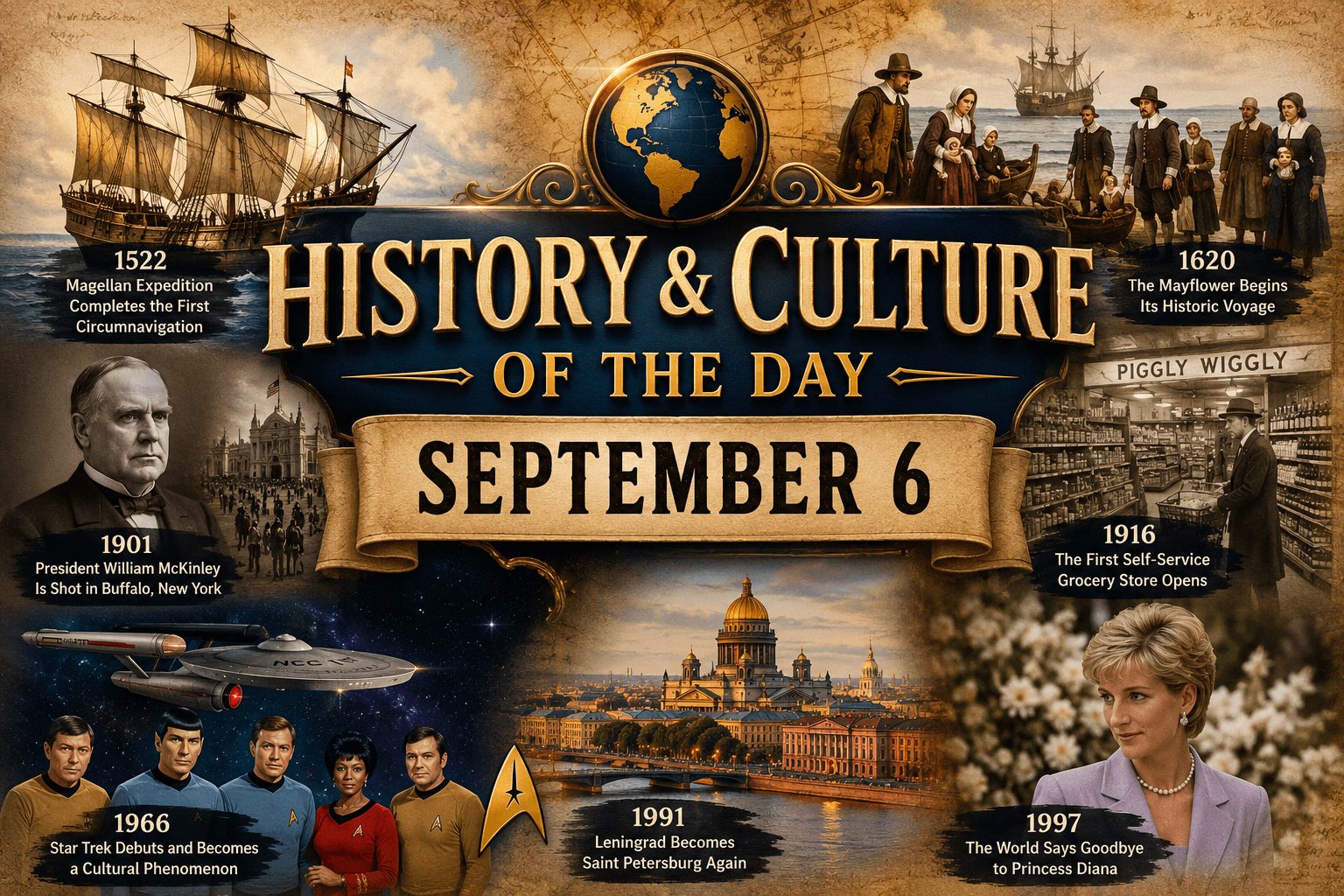
    September 6 is a date filled with fascinating moments in history, cultural milestones, exploration, political change, and events that helped shape the modern world. From the voyage that would lead Ferdinand Magellan’s expedition toward the first circumnavigation of the globe to the birth of one of America’s most famous settlement houses, September 6 offers plenty of reasons to look back and appreciate how the past continues to influence us today.

    1522 – The Magellan Expedition Completes the First Circumnavigation of the Globe

    One of the greatest achievements in the history of exploration reached its conclusion on September 6, 1522, when the Victoria arrived back in Spain after completing the first known circumnavigation of the Earth.

    The expedition had begun in 1519 under the leadership of Portuguese explorer Ferdinand Magellan, who sailed on behalf of Spain in search of a western route to the Spice Islands.

    Magellan himself never completed the voyage. He was killed in the Philippines in 1521.

    Command eventually passed to Juan Sebastián Elcano, who guided the surviving crew and the Victoria back to Spain.

    Only a small number of the original expedition members completed the entire journey, but their accomplishment demonstrated on an unprecedented practical scale the enormous size of the planet and the possibility of sailing around it.

    The voyage became one of the defining achievements of the Age of Exploration.

    1620 – The Mayflower Prepares for Its Historic Atlantic Crossing

    September 6 is also closely associated with the story of the Mayflower, although dates surrounding its departure can be confusing because England was still using the Julian calendar.

    The Mayflower departed Plymouth, England, in September 1620 carrying English passengers who hoped to establish a new life across the Atlantic.

    After a difficult voyage lasting more than two months, the passengers reached the area of Cape Cod in November.

    Before establishing Plymouth Colony, the settlers created the Mayflower Compact, an agreement establishing principles for governing their new community.

    The voyage would become one of the most recognizable stories in early American colonial history, although its legacy is complex. European settlement brought profound and often devastating consequences for Indigenous peoples who had lived in the region for thousands of years.

    Understanding both sides of that history provides a fuller picture of how colonial America developed.

    1901 – President William McKinley Is Shot

    On September 6, 1901, President William McKinley was shot while attending the Pan-American Exposition in Buffalo, New York.

    McKinley had been greeting members of the public at the Temple of Music when anarchist Leon Czolgosz approached him and fired two shots.

    At first, there was hope that the president would recover. His condition later deteriorated, however, and McKinley died on September 14.

    Vice President Theodore Roosevelt then became president of the United States.

    Roosevelt was only 42 years old when he assumed the presidency, making him the youngest person ever to become U.S. president.

    The assassination therefore became a major turning point in American political history, bringing one presidency to a tragic end while beginning the Roosevelt era.

    1916 – The First Self-Service Grocery Store Opens

    September 6, 1916, brought an innovation that would eventually transform everyday shopping.

    Clarence Saunders opened the first Piggly Wiggly store in Memphis, Tennessee.

    At the time, grocery shopping looked very different from what most people experience today. Customers typically gave their orders to clerks, who retrieved items from behind counters.

    Saunders introduced a revolutionary concept: allow customers to walk through the store, select products themselves, and bring their purchases to a checkout area.

    It sounds completely ordinary today, but it represented a dramatic change in retail culture.

    The self-service model helped influence the development of the modern supermarket and eventually became the standard shopping experience throughout much of the world.

    1966 – Star Trek Begins Its Journey Into Popular Culture

    September 1966 marked the beginning of one of the most influential franchises in science-fiction history.

    Star Trek, created by Gene Roddenberry, debuted during this period and introduced audiences to Captain James T. Kirk, Mr. Spock, Dr. Leonard McCoy, Lieutenant Uhura, and the crew of the USS Enterprise.

    The series imagined humanity centuries in the future exploring space and encountering new civilizations.

    But Star Trek was never simply about spaceships and aliens.

    The show frequently explored issues involving prejudice, war, diplomacy, technology, morality, equality, and humanity’s ability to build a better future.

    Its diverse cast was particularly significant during the social and political changes of the 1960s.

    Although the original television series lasted only three seasons, its cultural impact became enormous.

    Movies, television series, books, conventions, merchandise, and generations of devoted fans transformed Star Trek into a global cultural phenomenon.

    Its influence has even extended into science and technology, inspiring engineers, astronauts, scientists, and inventors.

    1991 – Leningrad Becomes Saint Petersburg Again

    On September 6, 1991, the Russian city of Leningrad officially returned to its historic name, Saint Petersburg.

    The city had experienced several name changes throughout its history.

    Founded by Peter the Great in 1703, it was originally called Saint Petersburg. During World War I, the name was changed to Petrograd because Saint Petersburg sounded too German.

    After the death of Vladimir Lenin in 1924, the city became Leningrad.

    Following decades under Soviet rule, residents voted in 1991 to restore the name Saint Petersburg.

    The change occurred during an extraordinary period of political transformation. The Soviet Union was approaching its final months, and countries and cities throughout the region were reconsidering symbols associated with the Soviet era.

    Restoring the city’s original name represented more than a change on a map. It reflected changing ideas about history, identity, culture, and Russia’s relationship with its past.

    1997 – The World Says Goodbye to Princess Diana

    September 6, 1997, became part of one of the most emotional cultural moments of the decade when the funeral of Diana, Princess of Wales, was held at Westminster Abbey.

    Diana had died following a car crash in Paris on August 31 at the age of 36.

    Her death produced an extraordinary global outpouring of grief.

    Millions of people watched the funeral on television, while enormous crowds gathered along the procession route in London.

    Diana had become an international figure not simply because of her connection to the British royal family but also because of her humanitarian work.

    She used her visibility to bring attention to issues including homelessness, HIV/AIDS, and landmines. Her willingness to interact publicly and compassionately with people affected by AIDS was particularly significant at a time when fear and misinformation surrounding the disease remained widespread.

    Her funeral demonstrated the extraordinary connection many people felt toward her and became one of the defining televised events of the 1990s.

    Culture Through the Years

    History isn’t shaped only by wars, governments, and political leaders. Culture develops through inventions, entertainment, exploration, social movements, traditions, and changes in everyday life.

    September 6 demonstrates that beautifully.

    A voyage completed in 1522 changed humanity’s understanding of global exploration.

    A grocery store opened in 1916 helped transform something as ordinary as buying food.

    A science-fiction television series helped generations imagine what humanity’s future might look like.

    A Russian city reclaimed a centuries-old name as an entire political system approached its end.

    And the funeral of Princess Diana showed how one person’s life could produce an emotional response felt around the world.

    These events may seem unrelated, yet each reveals something about the way societies evolve.

    Why History & Culture Matter

    Looking back at history gives us more than dates to memorize.

    It helps us understand why our communities, traditions, governments, technologies, and cultures look the way they do today.

    Some historical moments represent extraordinary achievements. Others remind us of tragedy, conflict, inequality, and difficult lessons. Both deserve to be remembered.

    Culture works the same way. Music, television, food, language, fashion, technology, traditions, and shared experiences become pieces of history as generations pass.

    What seems ordinary today may someday become an important part of the historical record.

    September 6 Reminds Us That the World Is Always Changing

    From explorers crossing unknown oceans to shoppers walking through the aisles of a self-service grocery store for the first time, history is filled with people experiencing something new.

    September 6 reminds us that change doesn’t always announce itself as history.

    Sometimes history happens inside presidential exhibitions and royal ceremonies.

    Sometimes it happens aboard ships crossing distant oceans.

    And sometimes it happens inside an ordinary grocery store.

    Every generation contributes another chapter to the story.

    The people living through these moments rarely know exactly how history will remember them. That is one of the most fascinating things about studying the past: today’s ordinary moments can become tomorrow’s history.

    Which historical or cultural event from September 6 do you find the most fascinating, and why?

  • This Day in American History – September 6

    This Day in American History – September 6

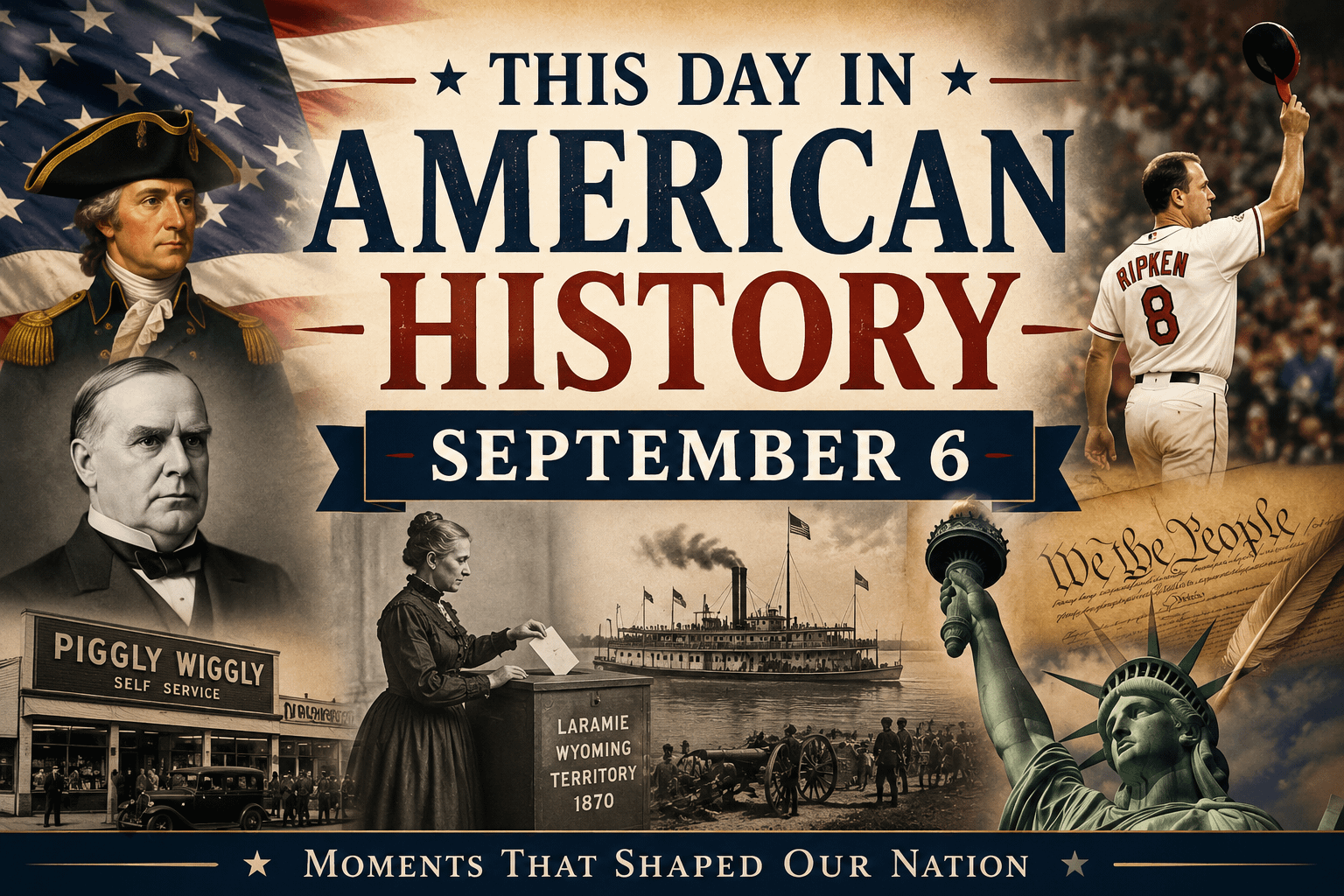
    September 6 has witnessed moments that changed American politics, expanded voting rights, shaped the Civil War, transformed everyday shopping, and produced unforgettable achievements in sports. From the Revolutionary War to the assassination of a president and a baseball record once considered nearly impossible to break, September 6 offers a fascinating look at the people and events that helped shape the United States.

    1781 – Benedict Arnold Attacks New London, Connecticut

    On September 6, 1781, one of the most infamous figures of the American Revolution returned to Connecticut—not as an American patriot, but as a commander fighting for the British.

    Benedict Arnold had once been celebrated for his courage and military leadership on behalf of the American cause. After defecting to the British, however, his name became permanently associated with betrayal.

    Arnold commanded British forces in an attack against New London and nearby Fort Griswold in Connecticut. New London was an important port and privateering center, making it a valuable military target.

    British forces burned much of New London, while a bloody battle unfolded at Fort Griswold across the Thames River. The attack occurred only weeks before the decisive American and French victory at Yorktown effectively brought major combat in the Revolutionary War to an end.

    Arnold’s actions on September 6 added another dark chapter to the story of the man who became America’s most famous traitor.

    1861 – Ulysses S. Grant Captures Paducah, Kentucky

    September 6 also played an important role during the early months of the American Civil War.

    On September 6, 1861, Union forces under Brigadier General Ulysses S. Grant moved into Paducah, Kentucky. Union gunboats Lexington and Tyler supported the operation.

    The location was strategically important because of its proximity to the Tennessee and Cumberland rivers. Controlling these waterways would become an important part of Union strategy in the western theater of the war.

    The operation was an early glimpse of the aggressive military leadership that would eventually make Grant one of the Union’s most important commanders—and later the 18th president of the United States.

    1870 – Louisa Ann Swain Makes Voting History

    One of the most important milestones in the history of American women’s voting rights occurred on September 6, 1870.

    That morning, 69-year-old Louisa Ann Swain went to the polls in Laramie, Wyoming Territory, and cast her ballot in a general election.

    Wyoming Territory had granted women voting rights in 1869, decades before women throughout the nation gained constitutional protection for their right to vote.

    Swain is widely recognized as the first woman in the United States to legally cast a ballot in a general election after 1807.

    Her vote came 50 years before the ratification of the 19th Amendment in 1920, which prohibited denying the right to vote on the basis of sex.

    Today, Swain’s simple act of walking into a polling place represents an important chapter in the long American struggle for equal voting rights.

    1901 – President William McKinley Is Shot

    Perhaps the most significant event in American history associated with September 6 occurred in 1901.

    President William McKinley was attending the Pan-American Exposition in Buffalo, New York. While greeting members of the public at the Temple of Music, McKinley was shot twice by Leon Czolgosz, an anarchist.

    McKinley initially survived the shooting, and there was hope that he would recover. His condition later deteriorated, however, and he died on September 14, eight days after being shot.

    Vice President Theodore Roosevelt then became president.

    McKinley’s assassination was the third assassination of a sitting American president, following Abraham Lincoln in 1865 and James A. Garfield in 1881.

    The tragedy also contributed to changes in presidential security. Roosevelt would become the first president to receive continuous Secret Service protection following McKinley’s death.

    The assassination unexpectedly placed Theodore Roosevelt in the White House and helped begin one of the most consequential presidencies of the early 20th century.

    1916 – America’s First Self-Service Grocery Store Opens

    September 6 also marks an important moment in American retail history.

    On September 6, 1916, the first Piggly Wiggly store opened in Memphis, Tennessee.

    The concept was revolutionary.

    Before self-service grocery stores became common, customers typically gave their shopping lists to clerks, who gathered items from shelves behind a counter.

    Piggly Wiggly allowed customers to walk through the store and select products themselves.

    It sounds completely ordinary today, but at the time it represented a major transformation in the shopping experience. The self-service model helped influence the development of the modern supermarket.

    1943 – A Deadly Pennsylvania Railroad Disaster

    On September 6, 1943, tragedy struck the Pennsylvania Railroad when a passenger train traveling toward New York derailed in Philadelphia.

    The accident killed 79 people.

    The disaster occurred during World War II, when America’s railroads were carrying enormous numbers of military personnel, workers, and civilians across the country.

    It remains one of the darker transportation stories associated with September 6.

    1949 – The Camden Mass Shooting

    Another tragedy occurred on September 6, 1949, when Howard Unruh carried out a mass shooting in Camden, New Jersey.

    Unruh walked through his neighborhood shooting people, ultimately killing 13. The event became one of the most notorious mass killings in American history at the time.

    The tragedy remains a disturbing chapter in the history of American mass violence.

    1995 – Cal Ripken Jr. Breaks Baseball’s “Unbreakable” Record

    September 6 also produced one of the most celebrated moments in American sports history.

    On September 6, 1995, Baltimore Orioles shortstop Cal Ripken Jr. played in his 2,131st consecutive Major League Baseball game, surpassing the legendary Lou Gehrig.

    Gehrig’s record of 2,130 consecutive games had stood for more than half a century.

    When the game became official, play stopped as fans at Baltimore’s Camden Yards gave Ripken an extended standing ovation.

    Ripken took a memorable victory lap around the field, shaking hands with fans as he celebrated the accomplishment.

    He didn’t stop at 2,131.

    Ripken eventually extended his streak to an extraordinary 2,632 consecutive games, earning his famous nickname:

    The Iron Man.

    The streak became more than a baseball record. For many fans, it represented reliability, determination, durability, and the willingness to show up every day.

    September 6 Through the Years

    From revolution and civil war to voting rights, presidential tragedy, innovation, and baseball history, September 6 demonstrates how a single date can connect remarkably different chapters of the American story.

    The attack led by Benedict Arnold in 1781 reminds us of the sacrifices and divisions of the American Revolution.

    Ulysses S. Grant’s actions in Kentucky in 1861 foreshadowed the military career of the man who would eventually help preserve the Union.

    Louisa Ann Swain’s historic ballot in 1870 reminds us that many rights Americans recognize today were achieved only after generations challenged the limitations of their time.

    President William McKinley’s shooting in 1901 dramatically altered the country’s political leadership and unexpectedly elevated Theodore Roosevelt to the presidency.

    The opening of Piggly Wiggly in 1916 shows that history isn’t limited to wars and presidents—sometimes an idea as simple as allowing shoppers to choose their own groceries can transform everyday American life.

    And Cal Ripken Jr.’s historic night in 1995 reminds us that American history is also written on baseball diamonds, basketball courts, football fields, racetracks, and countless other places where people accomplish something extraordinary.

    Remembering September 6

    History isn’t simply a collection of dates.

    It is the story of decisions, sacrifices, tragedies, breakthroughs, and ordinary people whose actions sometimes become extraordinary with the passage of time.

    September 6 contains all of those things.

    Some events changed the direction of the nation immediately. Others seemed relatively small when they occurred but became more significant when viewed through the lens of history.

    Together, they remind us that every day adds another page to the American story.

    Which September 6 event do you think had the greatest impact on American history?

  • History & Culture of the Day: September 5

    History & Culture of the Day: September 5

    September 5 is a date filled with fascinating moments that have helped shape world history, popular culture, science, exploration, entertainment, and the way people live today. From the rise and fall of powerful leaders to groundbreaking voyages, international sporting traditions, and unforgettable cultural milestones, September 5 offers plenty of reasons to look back at the past.

    History is more than a collection of dates in a textbook. It is the story of people—their ambitions, discoveries, struggles, creativity, mistakes, and achievements. Every generation leaves something behind for the next, and sometimes events that seemed relatively small at the time eventually have enormous consequences.

    On September 5, history has witnessed political upheaval, daring exploration, technological innovation, athletic achievement, and the birth of people who would become influential figures in entertainment and culture.

    Let’s travel through time and explore some of the notable historical and cultural events connected to September 5.

    1666: The Great Fire of London Finally Begins to Die Down

    One of the most devastating disasters in the history of London was the Great Fire of 1666.

    The fire began during the early hours of September 2 in a bakery on Pudding Lane. At the time, much of London consisted of tightly packed wooden buildings. Combined with dry conditions and strong winds, the city’s construction made it extremely vulnerable to fire.

    The flames spread rapidly.

    Entire streets disappeared as the fire moved through the city. Thousands of buildings were destroyed, including homes, businesses, churches, and important public structures.

    By September 5, the enormous fire was largely brought under control.

    Although the physical destruction was staggering, the disaster eventually resulted in major changes to London.

    Rebuilding efforts encouraged greater use of brick and stone rather than timber. Streets and buildings were reconsidered with fire prevention in mind, and new construction regulations helped influence the development of the modern city.

    The Great Fire of London remains a powerful example of how tragedy can permanently reshape an urban landscape.

    1698: Peter the Great Introduces a Tax on Beards

    Sometimes history is shaped by wars and revolutions.

    Other times, it is shaped by facial hair.

    On September 5, 1698, Russian Tsar Peter the Great imposed a tax on beards as part of his campaign to modernize and Westernize Russia.

    Peter had traveled through parts of Western Europe and became fascinated with European technology, military organization, shipbuilding, clothing, and social customs.

    When he returned to Russia, he attempted to introduce many Western practices.

    Traditional Russian beards became one of his targets.

    Men who wanted to continue wearing their beards could be required to pay a tax and carry a special token proving they had paid.

    It might seem like a strange government policy today, but Peter’s beard tax represented something much larger.

    He wanted to change how Russia presented itself to the world.

    Clothing, grooming, military organization, education, and technology became parts of a broader cultural transformation.

    The beard tax therefore became one of history’s more unusual examples of a government attempting to influence culture through law.

    1774: The First Continental Congress Meets in Philadelphia

    September 5, 1774, marked an important moment in the growing conflict between Britain’s American colonies and the British government.

    Representatives from 12 of the 13 colonies gathered in Philadelphia for what became known as the First Continental Congress.

    Georgia did not send delegates.

    The meeting was organized largely in response to British policies imposed after the Boston Tea Party, particularly the measures colonists called the Intolerable Acts.

    Delegates debated how the colonies should respond.

    At this point, independence was not yet universally supported. Many colonists still hoped disagreements with Britain could be resolved.

    Nevertheless, the gathering represented an important development.

    Colonies that had often acted independently were beginning to cooperate politically.

    The First Continental Congress helped establish relationships among colonial leaders and demonstrated that coordinated resistance to British policies was possible.

    Less than a year later, fighting at Lexington and Concord would begin the American Revolutionary War.

    September 5 therefore represents an important step on the long road toward American independence.

    1836: Sam Houston Is Elected President of the Republic of Texas

    On September 5, 1836, Sam Houston was elected president of the newly established Republic of Texas.

    Earlier that year, Texas forces had defeated the Mexican army at the Battle of San Jacinto, securing Texas independence following a dramatic military campaign.

    Houston became one of the central figures in Texas history.

    The Republic of Texas existed as an independent nation from 1836 until it joined the United States in 1845.

    Houston’s political career continued well beyond his presidency of the republic. He later served as a U.S. senator and governor of Texas.

    His legacy remains deeply connected with the history and identity of Texas.

    The city of Houston, which grew into one of America’s largest cities, was named in his honor.

    1882: The First Labor Day Parade Takes Place

    September 5 also holds an important place in American labor history.

    On September 5, 1882, thousands of workers participated in what is widely recognized as the first Labor Day parade in the United States.

    The event took place in New York City.

    Organized labor was growing rapidly during the late 19th century as workers demanded improvements in wages, working hours, and workplace conditions.

    Industrialization had transformed the American economy, but many factory workers faced extremely long hours and dangerous environments.

    The parade was both a celebration and a public demonstration of worker solidarity.

    Over time, the idea of a holiday honoring American workers spread throughout the country.

    In 1894, President Grover Cleveland signed legislation establishing Labor Day as a federal holiday celebrated on the first Monday in September.

    Today, Labor Day is often associated with cookouts, travel, sales, and the unofficial end of summer.

    Its origins, however, are deeply connected to the labor movement and generations of workers who fought for better conditions.

    1905: The Treaty of Portsmouth Helps End the Russo-Japanese War

    On September 5, 1905, the Treaty of Portsmouth was signed, officially ending the Russo-Japanese War.

    The conflict had begun in 1904 as Russia and Japan competed for influence in East Asia.

    Japan’s military victories surprised many observers around the world.

    U.S. President Theodore Roosevelt helped mediate negotiations between the two nations.

    Representatives met in Portsmouth, New Hampshire, eventually reaching an agreement.

    Roosevelt’s role in the negotiations contributed to his receiving the Nobel Peace Prize in 1906.

    The treaty also demonstrated Japan’s growing status as a major world power.

    The outcome changed international perceptions of political and military power in Asia and influenced geopolitical relationships for decades afterward.

    1914: The First Battle of the Marne Begins

    During the opening months of World War I, Germany launched a massive offensive through Belgium and into France.

    By early September 1914, German forces had advanced dangerously close to Paris.

    On September 5, fighting associated with the First Battle of the Marne began.

    French and British forces launched a counteroffensive against the advancing German armies.

    The battle became one of the most important early confrontations of World War I.

    Germany’s advance was stopped, preventing the quick victory its military planners had hoped to achieve.

    Afterward, both sides began constructing extensive defensive positions.

    Trench warfare would come to dominate much of the Western Front.

    The First Battle of the Marne therefore helped transform World War I from a fast-moving campaign into the prolonged and devastating conflict remembered today.

    1939: The United States Declares Neutrality as World War II Expands

    World War II began in Europe when Nazi Germany invaded Poland on September 1, 1939.

    Britain and France declared war on Germany two days later.

    On September 5, President Franklin D. Roosevelt issued a proclamation of American neutrality.

    Many Americans remembered the enormous human cost of World War I and wanted the United States to remain outside another European conflict.

    Roosevelt publicly emphasized neutrality, although the United States would gradually provide increasing assistance to nations fighting Nazi Germany.

    That position changed dramatically after Japan attacked Pearl Harbor on December 7, 1941.

    The United States officially entered World War II the following day.

    Looking back, America’s September 1939 neutrality proclamation illustrates how dramatically international circumstances can change within only a few years.

    1946: Freddie Mercury Is Born

    September 5 is also an important date in music history because Farrokh Bulsara—better known as Freddie Mercury—was born on September 5, 1946, in Zanzibar.

    Mercury eventually became the legendary lead vocalist of Queen.

    His extraordinary voice, theatrical stage presence, songwriting ability, and willingness to push musical boundaries helped make Queen one of the world’s most influential rock bands.

    Songs associated with Mercury and Queen became cultural landmarks.

    “Bohemian Rhapsody” demonstrated just how unconventional a rock song could become while still reaching an enormous audience.

    Other Queen classics helped establish the band as a stadium-rock powerhouse.

    Mercury was particularly famous for his ability to command massive audiences.

    Queen’s performance at Live Aid at Wembley Stadium in 1985 is frequently remembered as one of the greatest live performances in rock history.

    Mercury died in 1991 at the age of 45.

    Decades later, his music continues reaching new generations.

    September 5 therefore marks the birthday of one of popular music’s most recognizable performers.

    1960: Cassius Clay Wins Olympic Gold

    Before the world knew him as Muhammad Ali, he was a young boxer named Cassius Clay.

    On September 5, 1960, the 18-year-old Clay won the light heavyweight gold medal at the Summer Olympics in Rome.

    The victory helped launch one of the most extraordinary careers in sports history.

    After turning professional, Clay quickly became known not only for his speed and boxing ability but also for his confidence and charismatic personality.

    He later changed his name to Muhammad Ali.

    Ali became heavyweight champion of the world and participated in some of boxing’s most famous fights.

    His influence extended far beyond sports.

    He became an important cultural figure whose views on race, religion, war, personal conviction, and social justice generated enormous public attention.

    His Olympic victory on September 5, 1960, was one of the earliest major milestones in a life that would eventually make him one of the most famous athletes in history.

    1972: Tragedy at the Munich Olympics

    September 5, 1972, is remembered for one of the darkest moments in Olympic history.

    During the Summer Olympics in Munich, members of the Palestinian militant organization Black September attacked the Israeli Olympic team.

    Israeli athletes and coaches were taken hostage.

    The crisis eventually ended in tragedy, with 11 members of the Israeli Olympic delegation killed, along with a West German police officer. Five of the attackers were also killed.

    The Munich massacre shocked the world.

    The Olympics had traditionally been promoted as a celebration of peaceful international competition.

    The attack demonstrated that even a global sporting event could become a target of political violence.

    The tragedy also led governments and international sporting organizations to reconsider security procedures surrounding major events.

    Modern Olympic security measures have been heavily influenced by lessons learned from Munich.

    September 5 remains a solemn date in Olympic history.

    1977: Voyager 1 Launches Toward the Outer Solar System

    One of humanity’s greatest journeys into space began on September 5, 1977.

    NASA launched Voyager 1 from Cape Canaveral, Florida.

    Its original mission focused on studying Jupiter and Saturn.

    The spacecraft provided remarkable images and scientific observations of the giant planets and their moons.

    But Voyager 1 did not stop there.

    After completing its primary planetary mission, the spacecraft continued traveling outward through the solar system.

    Decades after launch, Voyager 1 remained one of humanity’s most distant functioning spacecraft.

    Voyager also carries one of the most unusual cultural artifacts ever created—the Golden Record.

    The record contains sounds, music, greetings, and images intended to represent life and culture on Earth.

    If an extraterrestrial civilization were somehow to discover the spacecraft, the Golden Record would serve as a kind of introduction to humanity.

    That makes Voyager 1 more than a scientific instrument.

    It is also a tiny cultural time capsule traveling through space.

    Its September 5 launch symbolizes humanity’s curiosity and desire to understand what exists beyond our own world.

    1997: Mother Teresa Dies

    On September 5, 1997, Mother Teresa died in Kolkata, India.

    Born Anjezë Gonxhe Bojaxhiu in 1910, she became internationally known for her religious and humanitarian work.

    She founded the Missionaries of Charity, an organization devoted to serving people experiencing poverty, illness, abandonment, and other hardships.

    Her work gained worldwide attention.

    In 1979, she received the Nobel Peace Prize.

    Mother Teresa became one of the most recognizable religious figures of the 20th century.

    Her legacy has also been debated, with critics questioning aspects of the medical care and conditions associated with some facilities operated by her organization.

    Nevertheless, her name became internationally associated with charitable service and caring for people living in extreme poverty.

    She was canonized as Saint Teresa of Calcutta by the Catholic Church in 2016.

    The Cultural Importance of September 5

    The events connected with September 5 demonstrate just how broad the study of history can be.

    Political history appears through the First Continental Congress and the Republic of Texas.

    Military history emerges through World War I, World War II, and the Russo-Japanese War.

    Labor history appears through the first Labor Day parade.

    Music history is represented by Freddie Mercury.

    Sports history includes Muhammad Ali’s Olympic triumph as well as the tragedy of the Munich Olympics.

    Science and exploration are represented by Voyager 1.

    Urban history appears through the aftermath of the Great Fire of London.

    Even something as unusual as Peter the Great’s beard tax reminds us that governments have sometimes attempted to reshape not only political institutions but everyday culture itself.

    These stories may appear unrelated at first.

    Together, however, they illustrate an important truth about history.

    Human civilization develops through countless overlapping stories.

    Why Looking Back at History Matters

    Studying history isn’t simply about memorizing names and dates.

    It allows us to understand how today’s world developed.

    The rights workers enjoy today were influenced by generations of labor activism.

    Modern international diplomacy was shaped by earlier wars and peace negotiations.

    Security procedures at international sporting events evolved partly because of tragedies such as Munich.

    Our understanding of the solar system expanded because scientists and engineers were willing to send spacecraft billions of miles away from Earth.

    Popular culture continues to be shaped by musicians and performers whose work survives long after their deaths.

    History helps connect all of these stories.

    It reminds us that the world we inherited was built through the choices of people who lived before us.

    September 5: A Day of Change, Courage, Discovery, and Culture

    September 5 contains moments of triumph and tragedy.

    It includes workers marching through New York City demanding recognition.

    It includes political leaders attempting to reshape nations.

    It includes diplomats negotiating peace after war.

    It includes soldiers fighting battles that changed the direction of global conflicts.

    It includes a teenage boxer standing at the top of an Olympic podium before becoming one of the most famous athletes the world had ever seen.

    It includes Freddie Mercury entering the world decades before millions of people would sing Queen songs together in stadiums.

    And it includes Voyager 1 leaving Earth on a journey that would carry a small representation of humanity farther into space than its creators could personally travel.

    That is what makes exploring history one day at a time so interesting.

    Every date contains stories.

    Some changed governments.

    Some changed culture.

    Some expanded human knowledge.

    Others remind us of tragedy and the importance of remembering those who were lost.

    September 5 is no exception.

    It is a day that connects revolution, labor, war, diplomacy, sports, music, humanitarian service, science, and exploration across centuries of human experience.

    Tomorrow will bring another collection of stories, but September 5 reminds us that history is always closer than it seems. Every tradition we celebrate, technology we use, freedom we enjoy, song we recognize, and place we visit has a history behind it.

    The more we learn about those stories, the better we understand both the world that came before us and the world we are continuing to create.

    Which September 5 moment in history or culture do you find the most fascinating?

  • This Day in American History – September 5

    This Day in American History – September 5

    September 5 holds an important place in American history. Across the centuries, this date has witnessed moments that helped shape the struggle for independence, the growth of the nation, the labor movement, American military history, presidential security, exploration, politics, and popular culture.

    Perhaps the most historically significant event associated with September 5 occurred in 1774, when representatives from 12 of the 13 American colonies gathered in Philadelphia for the First Continental Congress. More than a century later, September 5 became associated with another American milestone when thousands of workers marched through New York City in what is recognized as the nation’s first Labor Day parade.

    From the earliest days of the American Revolution to the modern presidency, September 5 reminds us that American history is not defined by a single event. It is a collection of decisions, movements, conflicts, achievements, tragedies, and individuals that together tell the continuing story of the United States.

    1774 – The First Continental Congress Convenes

    One of the most consequential political gatherings in American history began on September 5, 1774.

    Delegates from 12 of Britain’s 13 American colonies assembled at Carpenters’ Hall in Philadelphia for what became known as the First Continental Congress. Georgia was the only colony that did not send delegates.

    The meeting came during a period of rapidly increasing tension between Britain and its American colonies. Parliament had enacted a series of measures known to the colonists as the Intolerable Acts or Coercive Acts, largely in response to the Boston Tea Party.

    Rather than viewing Britain’s actions against Massachusetts as an isolated dispute, colonial leaders increasingly recognized that the liberties of all the colonies could be threatened.

    That realization helped encourage cooperation among colonies that had previously operated largely as separate political communities.

    The delegates who gathered in Philadelphia included many individuals who would become central figures in the American Revolution and the creation of the United States.

    The First Continental Congress elected Virginia delegate Peyton Randolph as its presiding officer.

    The meeting did not immediately call for American independence. Many delegates still hoped reconciliation with Britain was possible.

    Nevertheless, the Congress represented an extraordinary development.

    For the first time, representatives from most of the colonies were gathering together to coordinate their response to British policies.

    They debated colonial rights, discussed economic pressure against Britain, and attempted to present a united political position.

    The significance of September 5, 1774, becomes even greater when viewed with the benefit of hindsight.

    The delegates who entered Carpenters’ Hall were not yet representatives of an independent United States. They were representatives of individual British colonies.

    Yet the political cooperation demonstrated by the Continental Congress helped create the foundation for something much larger.

    Less than two years later, the colonies would declare themselves independent states.

    The First Continental Congress therefore represents one of the critical steps in America’s transformation from a collection of British colonies into a united revolutionary movement.

    1781 – The Battle of the Chesapeake Helps Set the Stage for Yorktown

    Another major event connected with September 5 occurred during the American Revolutionary War.

    On September 5, 1781, British and French naval forces fought the Battle of the Chesapeake near the entrance to Chesapeake Bay.

    Although Americans were fighting for independence on land, French military assistance became enormously important during the final phase of the Revolutionary War.

    The French fleet prevented the British from effectively reinforcing or evacuating the army commanded by General Charles Cornwallis at Yorktown, Virginia.

    That naval advantage helped create the conditions that allowed American and French forces to surround Cornwallis.

    Several weeks later, Cornwallis surrendered at Yorktown.

    The surrender did not technically end every aspect of the Revolutionary War immediately, but it effectively destroyed Britain’s ability and political willingness to continue major offensive operations against the Americans.

    The Battle of the Chesapeake demonstrates an important lesson about the American Revolution: American independence was achieved not only through determination on the battlefield but also through diplomacy and international alliances.

    France’s military and naval assistance proved crucial.

    September 5, 1781, therefore represents one of the less frequently discussed but highly important dates leading toward American victory.

    1836 – Sam Houston Is Elected President of the Republic of Texas

    On September 5, 1836, Sam Houston was elected president of the newly established Republic of Texas.

    Houston had become one of the most prominent figures in the Texas Revolution after commanding the Texan army at the Battle of San Jacinto.

    That decisive victory helped secure Texas independence from Mexico.

    Houston entered the presidential race only shortly before the election but won overwhelmingly. According to the Texas State Historical Association, Houston received 5,119 votes, compared with 743 for Henry Smith and 587 for Stephen F. Austin. Mirabeau B. Lamar was elected vice president.

    Houston’s election represented an important stage in the political development of Texas.

    At the time, Texas was not yet part of the United States.

    It existed as an independent republic.

    Many Texans, however, favored eventual annexation by the United States. Houston himself became closely associated with efforts to stabilize the republic and pursue recognition and eventual annexation.

    Texas would ultimately join the United States in 1845.

    Houston’s political career continued long after his first election as president of the Republic of Texas. He later served as a United States senator and as governor of Texas.

    Few figures played a larger role in the early political history of Texas.

    1847 – Jesse James Is Born

    Jesse Woodson James was born in Missouri on September 5, 1847.

    Few American outlaws became as famous—or as mythologized—as Jesse James.

    As a teenager, James became involved with Confederate guerrilla forces during the Civil War. After the war, Jesse, his brother Frank, and several associates became connected with a series of robberies involving banks, trains, stagecoaches, and other targets.

    Over time, newspapers, books, films, television programs, and popular folklore transformed Jesse James into one of the most recognizable figures of the American Old West.

    Some stories portrayed him as a Robin Hood-like outlaw fighting powerful institutions.

    The historical reality was considerably darker.

    James and his associates were involved in violent crimes that resulted in deaths and injuries. The romantic image that later developed around him demonstrates how American popular culture sometimes transforms controversial historical figures into legends.

    The Library of Congress identifies Jesse James’ birth and the first Labor Day as two of its featured September 5 historical stories.

    1882 – America’s First Labor Day Parade

    September 5 is also an extremely important date in the history of American workers.

    On September 5, 1882, approximately 10,000 workers participated in what is widely recognized as America’s first Labor Day parade in New York City.

    The event was organized by the Central Labor Union.

    Workers marched through Manhattan before gathering with their families for a celebration that included speeches, music, and a picnic.

    The Library of Congress records that roughly 10,000 workers assembled for the event, marching from City Hall through the city before gathering at Wendel’s Elm Park.

    The U.S. Department of Labor also recognizes the September 5, 1882, demonstration as the first Labor Day parade.

    Today, Labor Day is often associated with barbecues, travel, retail sales, and the unofficial end of summer.

    Its origins, however, are deeply connected with the American labor movement.

    During the late 19th century, industrialization was transforming the United States.

    Factories, railroads, mines, steel mills, and other industries created enormous economic growth, but working conditions could be extremely difficult.

    Many workers faced long hours, dangerous environments, low wages, and few protections.

    Labor organizations increasingly pushed for better working conditions, reasonable hours, improved pay, and recognition of workers’ rights.

    The first Labor Day parade was therefore much more than a celebration.

    It was a public demonstration of the growing strength and visibility of organized labor.

    The movement continued to grow, and Labor Day eventually became a federal holiday in 1894.

    The September 5, 1882, parade helped establish a tradition that continues more than a century later.

    1939 – America Declares Neutrality as War Begins in Europe

    September 5 also played a role in America’s early response to World War II.

    Germany invaded Poland on September 1, 1939.

    Britain and France subsequently declared war on Germany, beginning the European conflict that would develop into World War II.

    At that point, the United States remained officially neutral.

    On September 5, President Franklin D. Roosevelt proclaimed American neutrality in the European conflict.

    The U.S. Navy was also ordered to begin what became known as the Neutrality Patrol, monitoring foreign military activity in waters near the United States.

    American public opinion contained strong isolationist sentiment following the enormous human and economic costs of World War I.

    Roosevelt understood that many Americans did not want their country drawn into another European war.

    Yet maintaining neutrality would become increasingly difficult.

    Over the next two years, the United States gradually expanded its support for nations fighting Nazi Germany, particularly Great Britain.

    Then everything changed on December 7, 1941, when Japan attacked Pearl Harbor.

    The following day, the United States officially entered World War II.

    Looking back, September 5, 1939, captures America at a historical crossroads—officially neutral while an international conflict was beginning that would eventually transform the United States and the world.

    1970 – Operation Jefferson Glen Begins in Vietnam

    On September 5, 1970, American and South Vietnamese forces began Operation Jefferson Glen in South Vietnam.

    The operation involved the U.S. Army’s 101st Airborne Division and South Vietnamese forces operating in Thua Thien Province.

    It became one of the last major American ground operations of the Vietnam War.

    By this period, President Richard Nixon’s administration was pursuing a policy known as “Vietnamization.”

    The goal was to transfer greater responsibility for combat operations to South Vietnamese forces while gradually reducing the number of American troops.

    Operation Jefferson Glen therefore occurred during a transitional period in the war.

    American forces were still heavily involved in combat, but the long process of U.S. withdrawal had begun.

    The Vietnam War would continue for several more years and remain one of the most divisive conflicts in American history.

    1975 – President Gerald Ford Survives an Assassination Attempt

    September 5, 1975, became a frightening day in presidential history.

    President Gerald Ford was visiting Sacramento, California, when Lynette “Squeaky” Fromme, a follower of Charles Manson, approached him near the California State Capitol carrying a handgun.

    Fromme raised the weapon toward the president but did not successfully fire it.

    Secret Service agents immediately intervened and restrained her.

    Ford was unharmed.

    The Gerald R. Ford Presidential Library documents the September 5 assassination attempt and Ford’s movements afterward.

    What makes the incident even more remarkable is what happened only 17 days later.

    On September 22, 1975, another woman, Sara Jane Moore, attempted to shoot Ford in San Francisco.

    Ford survived that attack as well.

    Two assassination attempts against the same president in the same month demonstrated the enormous security challenges surrounding the American presidency.

    The events contributed to continuing changes in how the Secret Service protected presidents during public appearances.

    1977 – Voyager 1 Begins Its Historic Journey

    On September 5, 1977, NASA launched Voyager 1 from Cape Canaveral, Florida.

    Few spacecraft have achieved anything comparable.

    Voyager 1 was designed primarily to study the outer planets, particularly Jupiter and Saturn.

    The spacecraft returned extraordinary images and scientific information that changed humanity’s understanding of the solar system.

    But Voyager’s journey did not end after its planetary encounters.

    It continued traveling outward.

    Eventually, Voyager 1 became the most distant human-made object from Earth.

    The mission represents one of America’s greatest achievements in robotic space exploration.

    The spacecraft also carries the famous Golden Record, a collection of sounds, music, greetings, and images intended to represent life and culture on Earth.

    The possibility that another civilization might ever encounter Voyager is extraordinarily remote.

    Nevertheless, the Golden Record carries enormous symbolic meaning.

    It represents humanity introducing itself to the universe.

    Voyager 1 began that remarkable journey on September 5.

    September 5 and the Story of America

    Looking across the centuries, September 5 offers an extraordinary cross-section of American history.

    On this date, colonial representatives gathered together in Philadelphia and began building the political cooperation that would help lead to American independence.

    French naval forces helped create the conditions for the decisive American victory at Yorktown.

    Sam Houston became president of an independent Texas.

    Jesse James, one of America’s most famous and controversial outlaws, was born.

    Thousands of workers marched through New York City during the country’s first Labor Day celebration.

    The United States declared neutrality as World War II erupted in Europe.

    American soldiers participated in one of the final major U.S. ground operations of the Vietnam War.

    A president survived an assassination attempt.

    And a spacecraft left Earth on a journey that would eventually carry it beyond the familiar boundaries of our solar neighborhood.

    These events could hardly be more different.

    Yet together they demonstrate the enormous range of stories that make up American history.

    Why Remember September 5?

    History becomes more meaningful when we stop viewing it simply as a collection of dates to memorize.

    Every date represents people making decisions without knowing exactly how history would judge them.

    The delegates arriving in Philadelphia on September 5, 1774, could not know that their gathering would eventually be remembered as an important step toward the creation of the United States.

    The workers marching through New York in 1882 could not know that their celebration would eventually develop into a national federal holiday.

    The engineers and scientists watching Voyager 1 leave Earth in 1977 could imagine an ambitious mission, but even they could not completely predict how long the spacecraft’s journey would continue.

    That is one of the most fascinating aspects of studying history.

    People experience events as the present.

    Only future generations can fully understand their historical significance.

    September 5 reminds us that history is continuously being created.

    The political meetings, social movements, scientific achievements, acts of courage, tragedies, conflicts, and everyday decisions happening today may become the history studied by generations still to come.

    Final Thoughts

    September 5 has witnessed several moments that helped define the American experience.

    The First Continental Congress demonstrated the growing willingness of the colonies to stand together.

    The Battle of the Chesapeake helped make victory at Yorktown possible.

    Sam Houston’s election reflected the complicated expansion and political development of the future United States.

    The first Labor Day parade gave American workers a powerful public voice.

    America’s neutrality declaration in 1939 reflected a nation trying to avoid another devastating international war.

    The Vietnam War demonstrated the difficult realities of American military power abroad.

    The assassination attempt against Gerald Ford reminded Americans of the vulnerability of their leaders.

    Voyager 1 showed what American science, engineering, imagination, and exploration could accomplish.

    Together, these stories make September 5 much more than another date on the calendar.

    They remind us that the United States has been shaped by revolutionaries and workers, soldiers and presidents, explorers and scientists, famous figures and ordinary citizens.

    Every generation adds another chapter.

    And every day gives us another opportunity to understand where America has been, how the country has changed, and what lessons its history can teach us about the future.

    Which September 5 event do you think had the greatest impact on American history?

  • History & Culture of the Day: September 4

    History & Culture of the Day: September 4

    Every date on the calendar carries stories that helped shape the world we know today. September 4 is no exception. Across centuries, this day has witnessed the fall of empires, encounters between cultures, technological achievements, political turning points, scientific developments, and moments that became part of popular culture.

    Some events associated with September 4 changed nations. Others changed how people communicate, travel, explore, and understand the world around them. There are also birthdays of influential figures whose work left lasting marks on music, art, science, government, and entertainment.

    Looking back at history isn’t simply about memorizing dates. It gives us an opportunity to understand how decisions, discoveries, conflicts, and cultural movements from the past continue to influence everyday life.

    Here is a journey through some of the memorable history and culture connected with September 4.


    476 – The Traditional Date for the Fall of the Western Roman Empire

    One of the most historically significant events connected with September 4 occurred in 476, when the young Western Roman emperor Romulus Augustulus was deposed by the Germanic leader Odoacer.

    Romulus Augustulus had only been emperor for a short period, and real political power in the Western Roman Empire had already weakened dramatically.

    Rome had once controlled enormous territories stretching across Europe, North Africa, and parts of the Middle East. For centuries, Roman armies, governments, roads, laws, architecture, and culture shaped much of the ancient Mediterranean world.

    But the Western Empire gradually became increasingly unstable.

    Political struggles, economic difficulties, military pressures, internal divisions, and invasions by Germanic peoples weakened Roman authority. By the fifth century, emperors in the West often controlled only fragments of what had once been a massive empire.

    When Odoacer removed Romulus Augustulus from power, he did not install another Western Roman emperor.

    Because of this, 476 is traditionally used by historians as a convenient date marking the end of the Western Roman Empire.

    The Eastern Roman Empire, centered in Constantinople, continued for nearly another thousand years and is commonly known today as the Byzantine Empire.

    The fall of the Western Roman Empire did not mean Roman culture suddenly disappeared. Roman law, architecture, engineering, language, government, religion, and philosophy continued influencing Europe for centuries.

    Even today, Roman influence can be seen in legal systems, government buildings, languages, literature, roads, calendars, and political terminology.

    September 4 therefore represents one of history’s great transitions—the gradual movement from the ancient Roman world toward medieval Europe.


    1609 – Henry Hudson Reaches the Region Near Manhattan

    On September 4, 1609, English explorer Henry Hudson, sailing for the Dutch East India Company aboard the Half Moon, reached the region around what is now New York.

    Hudson was searching for a navigable passage that could provide European merchants with a faster route to Asia.

    Instead, his voyage brought him to the northeastern coast of North America.

    Hudson explored the river that would eventually bear his name—the Hudson River.

    The expedition helped increase Dutch interest in the region. In the decades that followed, Dutch merchants and settlers established New Netherland, with New Amsterdam developing on Manhattan Island.

    New Amsterdam eventually came under English control and was renamed New York.

    The history is also inseparable from the Indigenous peoples who had inhabited the region for generations before Europeans arrived. Native communities had their own societies, trade networks, political relationships, languages, and cultures long before Hudson’s voyage.

    European colonization dramatically altered those communities through trade, land disputes, warfare, displacement, and disease.

    Today, New York City is one of the world’s most culturally diverse and economically influential cities.

    Its development was shaped by centuries of migration, commerce, conflict, creativity, and cultural exchange.


    1781 – Los Angeles Is Founded

    September 4 also holds special importance in the history of California.

    On September 4, 1781, a settlement was established under Spanish authority that would eventually become Los Angeles.

    The community was founded as part of Spain’s effort to expand settlements in Alta California.

    Its early settlers came from varied racial and cultural backgrounds, reflecting the complicated multicultural society of colonial New Spain.

    The settlement’s formal name is traditionally associated with El Pueblo de Nuestra Señora la Reina de los Ángeles.

    Few people living there in 1781 could have imagined what the small agricultural community would eventually become.

    Over the following centuries, control of California shifted from Spain to Mexico and later to the United States.

    Los Angeles grew dramatically, especially during the nineteenth and twentieth centuries.

    Railroads, agriculture, oil, manufacturing, migration, international trade, aerospace, tourism, television, and motion pictures all contributed to its expansion.

    Eventually, Los Angeles became one of the largest and most culturally influential cities in the United States.

    Its influence extends around the world through Hollywood movies, television, music, fashion, sports, food, art, and entertainment.

    The city’s cultural identity has been shaped by generations of Native American, Latino, Mexican, Asian, Black, European, Middle Eastern, and immigrant communities.

    September 4 therefore marks the beginning of a settlement whose cultural influence would eventually reach nearly every corner of the globe.


    September 4 and the Growth of American Culture

    Los Angeles offers an interesting example of how cities evolve culturally.

    A community that began with only a small population eventually became synonymous with global entertainment.

    Hollywood transformed storytelling.

    Movies produced in Southern California introduced audiences around the world to American actors, music, fashion, landscapes, humor, and ideas.

    Television later expanded that influence.

    By the twentieth century, Los Angeles had become a center not only for entertainment but also for cultural experimentation.

    Musical movements developed there.

    New styles of architecture appeared.

    Car culture flourished.

    Surfing and beach culture became internationally recognized.

    Food traditions from Mexico, Asia, Central America, and countless immigrant communities blended into the city’s culinary identity.

    Few cities demonstrate the constantly changing nature of culture better than Los Angeles.


    1882 – Thomas Edison Opens the Pearl Street Station

    September 4, 1882, became an important date in the history of electricity.

    On this day, Thomas Edison’s Pearl Street Station began operating in lower Manhattan.

    The station was one of the world’s first central power stations designed to provide electricity to multiple customers.

    Electricity itself was not a new discovery, but creating a practical system for distributing electric power to homes and businesses represented an enormous technological challenge.

    Edison’s system supplied direct-current electricity to customers in the surrounding area.

    The early network was limited compared with modern electrical grids, but it demonstrated something revolutionary:

    Electricity could become a service delivered to communities.

    Today, electrical power is such a normal part of everyday life that it can be difficult to appreciate how extraordinary this development once seemed.

    Electric lights transformed nighttime life.

    Factories could operate differently.

    Businesses gained new possibilities.

    Homes eventually filled with electrical appliances.

    Communication technology expanded.

    Entire industries emerged.

    Modern cities would ultimately become dependent on enormous interconnected electrical networks.

    The Pearl Street Station represents an important early chapter in that transformation.


    1886 – Geronimo Surrenders

    Another major event associated with September 4 occurred in 1886, when Apache leader Geronimo surrendered to U.S. forces in Arizona.

    Geronimo became one of the most famous Native American figures of the nineteenth century.

    Born among the Bedonkohe band of the Chiricahua Apache, he lived during an era when Native communities across the American West faced enormous pressure from expanding American and Mexican settlement.

    Land loss, military campaigns, reservation policies, violence, and forced relocation fundamentally disrupted Indigenous life.

    Geronimo became known for resisting attempts to confine his people to reservations.

    For years, he and a relatively small group of followers avoided military forces across the rugged landscapes of the Southwest and northern Mexico.

    His surrender in 1886 is often regarded as marking the end of a major period of armed Indigenous resistance to U.S. expansion in the Southwest.

    Geronimo and other Apache prisoners were subsequently removed from their homeland.

    His story remains complicated.

    To some Americans of his era, he was portrayed as an enemy.

    To many others—especially in later historical interpretation—he became a symbol of resistance, survival, independence, and the devastating consequences of westward expansion for Native peoples.

    Understanding this history requires recognizing the experiences of Indigenous communities whose lands and cultures were profoundly affected by American expansion.


    Remembering Indigenous History

    Events such as Geronimo’s surrender remind us that history often looks very different depending on whose perspective is being considered.

    The westward growth of the United States created opportunities for settlers, businesses, railroads, farmers, and new communities.

    But that expansion also brought displacement, warfare, broken treaties, cultural destruction, and enormous suffering for many Native American nations.

    Both parts of the story matter.

    History becomes more meaningful when we look beyond simple descriptions of who “won” or “lost” and instead examine how events affected real people and communities.


    1888 – George Eastman Registers the Kodak Trademark

    Photography took an important step toward becoming accessible to ordinary people when inventor and entrepreneur George Eastman registered the Kodak trademark in 1888.

    Before innovations like Eastman’s cameras and roll-film systems, photography could be complicated and expensive.

    Early photographers often needed specialized knowledge, bulky equipment, and difficult chemical processes.

    Eastman’s goal was to simplify photography.

    Kodak cameras eventually helped make taking pictures something ordinary families could do.

    That development had enormous cultural consequences.

    Photography became more than a professional practice.

    People could document birthdays.

    Weddings.

    Vacations.

    Children growing up.

    Family gatherings.

    Historic events.

    Everyday moments.

    Photography changed how people remembered their lives.

    Family photo albums became personal historical archives.

    Journalism became increasingly visual.

    Advertising incorporated photography.

    Scientists used photographs for documentation.

    Eventually, photographic technology evolved from film cameras to digital cameras and then smartphones.

    Today, billions of photographs can be taken around the world in a single day.

    That modern culture of constant photography traces part of its history to innovators such as George Eastman, who helped make photography available to the public.


    1951 – The First Live Transcontinental Television Broadcast

    September 4, 1951, became an important date in American television history.

    On that day, President Harry S. Truman’s speech at the Japanese Peace Treaty Conference in San Francisco was transmitted across the United States in what is widely recognized as the first live transcontinental television broadcast.

    Television was still relatively young.

    Before nationwide television networks became commonplace, broadcasting live images across enormous distances required major technological infrastructure.

    The ability to transmit a live event from one coast to the other demonstrated television’s growing power.

    Americans thousands of miles apart could suddenly watch the same event at approximately the same moment.

    That experience would soon become normal.

    Presidential speeches.

    Political conventions.

    Sporting events.

    Moon landings.

    Breaking news.

    Award shows.

    Concerts.

    National tragedies.

    Television created shared cultural moments that millions of people experienced simultaneously.

    The September 4 broadcast helped demonstrate what nationwide television could become.


    1957 – The Ford Edsel Is Introduced

    Not every famous moment in history is remembered as a success.

    On September 4, 1957, Ford introduced the Edsel, one of the most famous commercial disappointments in American business history.

    Ford had invested heavily in developing and marketing the automobile.

    The company expected the Edsel to occupy an important place in the American automotive market.

    Instead, consumers largely rejected it.

    There were many contributing factors, including pricing, styling, economic conditions, positioning within Ford’s product lineup, and consumer expectations.

    Production ended only a few years later.

    The Edsel eventually became something bigger than a discontinued automobile.

    Its name became shorthand for a spectacular business failure.

    But the Edsel story also offers an important lesson about innovation.

    Large companies can conduct extensive research, spend enormous amounts of money, and create elaborate marketing campaigns—and still misunderstand what customers actually want.

    Failure is part of history too.

    Sometimes unsuccessful products teach future businesses just as much as successful ones.

    Today, surviving Edsels have become collectible automobiles and reminders of one of America’s most famous marketing miscalculations.


    September 4 in Music History

    September 4 also has connections to influential figures in music.

    1981 – Beyoncé Is Born

    On September 4, 1981, Beyoncé Knowles-Carter was born in Houston, Texas.

    She would become one of the most influential performers of her generation.

    Beyoncé first gained widespread fame as a member of Destiny’s Child, which became one of the most successful female groups in popular music.

    Her solo career expanded her influence even further.

    Through albums, concerts, visual projects, fashion, choreography, filmmaking, and business ventures, Beyoncé became a major figure in global popular culture.

    Her work has explored themes including love, relationships, ambition, empowerment, Black identity, family, history, and womanhood.

    Her elaborate live performances have also helped redefine expectations for large-scale pop concerts.

    Regardless of musical preference, her impact on twenty-first-century entertainment is difficult to ignore.

    Her September 4 birthday gives the date another important connection to modern cultural history.


    September 4 in Science and Exploration

    History is also shaped by humanity’s desire to explore.

    From early ocean voyages to modern space exploration, people have continually attempted to understand what lies beyond familiar boundaries.

    September 4 reminds us how dramatically exploration has changed.

    Henry Hudson sailed aboard a wooden ship into largely unfamiliar waters from a European perspective.

    Centuries later, scientists and engineers began sending machines beyond Earth.

    The tools changed.

    The distances became unimaginable.

    But the motivation remained surprisingly familiar:

    What is out there?

    Human curiosity has repeatedly pushed civilization toward new discoveries.


    How September 4 Connects Different Eras

    One fascinating thing about studying a single day in history is seeing how dramatically civilization changes across time.

    Consider the world represented by September 4.

    In 476, political power centered around emperors, armies, and ancient cities.

    By 1609, European explorers were crossing oceans searching for trade routes and territories.

    By 1781, colonial settlements were expanding across California.

    By the late nineteenth century, electricity and photography were transforming daily life.

    By the twentieth century, television could transmit images across an entire continent.

    And today, information can travel around the planet almost instantly.

    A person carrying a smartphone possesses communication and photographic capabilities that would have seemed impossible to people living only a few generations ago.

    History reminds us just how quickly technology and culture can change.


    The Cultural Importance of Everyday History

    History isn’t only about kings, presidents, generals, wars, and governments.

    Culture is equally important.

    The photographs families take.

    The music people listen to.

    The television programs they watch.

    The cities they build.

    The foods they share.

    The stories they tell.

    The traditions they pass down.

    These things eventually become history too.

    People living through historical events rarely know exactly how future generations will remember them.

    Someone attending the first transcontinental television broadcast probably couldn’t imagine streaming video on a phone.

    Someone purchasing an early Kodak camera couldn’t imagine taking thousands of digital photographs without using film.

    Residents of the small settlement that became Los Angeles couldn’t have imagined Hollywood movies being watched around the world.

    History is filled with beginnings whose importance was only understood later.


    What September 4 Can Teach Us

    Looking at the events associated with September 4 reveals several recurring themes.

    One is change.

    Empires rise and fall.

    Cities grow.

    Technology transforms society.

    Another is innovation.

    Electric power systems, photography, television, transportation, and communication technologies changed everyday life because people were willing to experiment with new ideas.

    September 4 also reminds us about perspective.

    The same historical event can represent progress to one group and profound loss to another. The history of European settlement and American expansion especially demonstrates why Indigenous perspectives must be included when discussing the development of the United States.

    Finally, September 4 demonstrates the importance of culture.

    History isn’t simply something that happens in government buildings or on battlefields.

    History happens in homes, neighborhoods, studios, businesses, laboratories, schools, theaters, and communities.

    Every generation contributes something to the larger human story.


    A Day of Empires, Exploration, Innovation, and Culture

    September 4 connects remarkably different chapters of human history.

    It recalls the traditional end of the Western Roman Empire.

    It remembers voyages that contributed to European colonization in North America.

    It marks the founding of the settlement that eventually became Los Angeles.

    It recalls Geronimo’s surrender and the difficult history of Indigenous resistance and American expansion.

    It represents breakthroughs in electrical power and photography.

    It remembers the growth of nationwide television.

    It includes one of America’s most famous automotive failures.

    And it celebrates the birthday of one of modern music’s most influential performers.

    Taken together, these events demonstrate something important about studying history.

    The world we inherit is built from countless moments that came before us.

    Some were triumphant.

    Some were tragic.

    Some represented extraordinary creativity.

    Others remind us of mistakes that should not be forgotten.

    Understanding them allows us to see our own time differently.

    The technology, communities, freedoms, conflicts, traditions, and cultures surrounding us did not simply appear. They developed through generations of human choices.

    And just as the people who lived through the events of September 4 helped create the world we know today, the choices we make now will become part of the history future generations inherit.

    Which September 4 moment in history or culture do you find the most interesting?

  • This Day in American History – September 4

    This Day in American History – September 4

    September 4 has witnessed moments that helped shape the United States in profound and sometimes complicated ways. From the founding of what would become one of America’s largest cities to the final surrender of the Apache leader Geronimo, and from technological advances to one of the defining confrontations of the Civil Rights Movement, this date offers a remarkable window into the American story.

    History is rarely a simple collection of victories and celebrations. It also contains conflict, injustice, courage, resistance, innovation, mistakes, and moments when ordinary people were forced to make extraordinary choices.

    On September 4, we remember events that changed communities, challenged the nation, and left consequences that can still be seen today.

    September 4, 1781 – Los Angeles Is Founded

    One of America’s largest and most influential cities traces its beginnings to September 4, 1781.

    On that day, a group of 44 settlers—11 men, 11 women, and 22 children—established a settlement near the Los Angeles River under the direction of Spanish colonial authorities.

    The settlement became known as El Pueblo de la Reyna de Los Angeles, often translated as “The Town of the Queen of the Angels.”

    The settlers had gathered at Mission San Gabriel before traveling to the location selected for the new pueblo.

    At the time, there was no United States city called Los Angeles. California was part of Spain’s colonial territory in North America, and the pueblo was established decades before California became part of the United States.

    The community remained under Spanish rule until Mexico gained independence from Spain in 1821. Los Angeles then became part of Mexico.

    Following the Mexican-American War, California came under American control, and in 1850 California officially became the 31st state.

    From its modest beginnings, Los Angeles eventually grew into a global center of entertainment, business, culture, international trade, sports, technology, and immigration.

    Today, millions of people call the Los Angeles metropolitan region home.

    It is remarkable to consider that one of the world’s most recognizable cities began with a relatively small group of families establishing a pueblo near a river in 1781.

    The story of Los Angeles also reminds us that American history did not begin when an area became part of the United States. California’s history includes generations of Indigenous peoples, Spanish colonization, Mexican government, migration, war, and eventually American statehood.

    September 4 therefore marks an important chapter not only in California history but also in the larger development of the American West.

    September 4, 1882 – Thomas Edison’s Electric System Begins Serving Customers

    The late 19th century was an era of extraordinary technological change in America.

    One of the most revolutionary developments was the expansion of practical electric power.

    On September 4, 1882, Thomas Edison’s Pearl Street generating station began supplying electricity to customers in a section of lower Manhattan.

    Electric lighting was not entirely new, but Edison and his associates were working toward something much bigger: an integrated electrical system capable of generating and distributing power to multiple customers.

    The Pearl Street Station represented an important step toward the electrical infrastructure that would eventually transform American life.

    Before widespread electricity, homes and businesses depended heavily on candles, oil lamps, gas lighting, fireplaces, and other technologies.

    Electricity eventually changed nearly every part of daily life.

    Factories could operate differently. Streets could be illuminated. Businesses could remain open after dark. Homes eventually filled with electric appliances.

    Over the following decades, electrical grids spread across American cities and eventually into rural communities.

    Today, electricity is so deeply integrated into modern life that it is easy to forget how revolutionary reliable electrical power once seemed.

    The technological changes underway in the 1880s helped create the foundation for the electrified America that emerged during the 20th century.

    September 4, 1886 – Geronimo Surrenders

    Another major event associated with September 4 occurred in the American Southwest.

    On September 4, 1886, the Chiricahua Apache leader and warrior Geronimo surrendered to U.S. forces following years of resistance and pursuit.

    Geronimo had become one of the most famous Indigenous resistance figures in American history.

    His life unfolded during an era of enormous upheaval for Native peoples throughout the West.

    As American settlement expanded, Indigenous nations faced military campaigns, forced relocation, reservation policies, broken agreements, and the loss of traditional lands.

    Geronimo and his followers repeatedly resisted confinement.

    In May 1885, Geronimo and a group of Chiricahua Apache followers fled the reservation system once again. For more than a year, American troops pursued them across the rugged borderlands of what are now the United States and Mexico.

    The pursuit became one of the final major military campaigns of the long conflicts commonly known as the Apache Wars.

    Eventually, Geronimo negotiated surrender terms with Brigadier General Nelson A. Miles.

    On September 4, 1886, Geronimo surrendered at Skeleton Canyon in the Arizona Territory.

    The surrender became a symbolic ending to a long period of armed conflict between the U.S. government and Apache groups in the Southwest.

    The consequences for Geronimo and the Chiricahua Apache were severe.

    Geronimo and many other Chiricahua were sent away from their homeland and held as prisoners of war. Geronimo would never again be permitted to return permanently to his ancestral homeland.

    He eventually became nationally famous, appearing at public events and even participating in Theodore Roosevelt’s 1905 inaugural parade.

    Yet behind the public fascination with Geronimo was the much more painful history of displacement, warfare, imprisonment, and the destruction of Indigenous independence.

    Geronimo died in 1909 at Fort Sill, Oklahoma.

    His surrender on September 4, 1886, remains one of the most historically significant moments in the history of the American Southwest.

    September 4, 1888 – George Eastman and the Kodak Camera

    Photography also took an important step forward around this period of American innovation.

    On September 4, 1888, inventor and entrepreneur George Eastman received a patent associated with his roll-film camera and registered the Kodak trademark.

    Eastman’s work helped transform photography.

    Before innovations such as roll film and simpler cameras, photography could require bulky equipment, complicated chemical processes, and considerable technical knowledge.

    Eastman wanted photography to become accessible to ordinary people.

    Kodak eventually helped make personal photography a normal part of American life.

    Families could document birthdays, vacations, weddings, children, holidays, military service, graduations, and everyday moments.

    Photography became more than a specialized profession.

    It became a way for ordinary Americans to preserve their own histories.

    The impact would ultimately extend beyond family photographs. Roll-film technology helped influence journalism, motion pictures, advertising, science, and entertainment.

    The ability to capture moments visually changed how Americans remembered both personal experiences and national events.

    September 4, 1951 – Television Connects a Growing Nation

    The middle of the 20th century brought another communications revolution: television.

    On September 4, 1951, President Harry S. Truman delivered a speech connected with the Japanese Peace Treaty conference in San Francisco that was transmitted as part of an early live transcontinental television broadcast.

    Television was rapidly becoming a major force in American society.

    Before television, Americans generally received immediate national information through newspapers and radio.

    Television added something powerful: pictures.

    Americans could increasingly watch presidents speak, see political conventions, follow breaking news, witness sporting events, experience entertainment programs, and eventually observe wars and social movements from their living rooms.

    That visual power would become especially significant just a few years later during the Civil Rights Movement.

    Television cameras exposed millions of Americans to scenes of segregation, protests, violence, demonstrations, and government intervention.

    One of those defining televised confrontations unfolded on September 4, 1957.

    September 4, 1957 – The Little Rock Nine Are Blocked From Central High School

    Perhaps the most consequential American event associated with September 4 occurred in Little Rock, Arkansas, in 1957.

    Three years earlier, the United States Supreme Court had ruled in Brown v. Board of Education that racial segregation in public schools was unconstitutional.

    But a Supreme Court ruling did not immediately eliminate segregation.

    Across parts of the country, officials and segregationists resisted school integration.

    Little Rock Central High School became one of the most important battlegrounds.

    A group of African American students prepared to attend the previously all-white Central High School.

    They would become known throughout history as the Little Rock Nine:

    Ernest Green, Elizabeth Eckford, Jefferson Thomas, Terrence Roberts, Carlotta Walls LaNier, Minnijean Brown, Gloria Ray Karlmark, Thelma Mothershed, and Melba Pattillo Beals.

    They were teenagers.

    Yet they were about to become central figures in a national constitutional confrontation.

    Arkansas Governor Orval Faubus ordered the Arkansas National Guard to Central High School, claiming the troops were necessary to prevent violence.

    Instead of protecting the African American students’ ability to enter the school, guardsmen blocked them.

    On September 4, African American students attempted to enter Central High.

    They were turned away.

    The confrontation became a national crisis.

    Elizabeth Eckford’s Walk Into History

    One of the most unforgettable images from the crisis involved 15-year-old Elizabeth Eckford.

    Plans had been made for the students to meet and approach the school together.

    But Elizabeth’s family did not have a telephone, and she did not receive word about the meeting arrangement.

    She arrived alone.

    Imagine being 15 years old and simply attempting to attend school while an angry crowd surrounds you.

    National Guard troops prevented her from entering Central High.

    She then walked through a hostile crowd as people shouted insults and threats.

    Photographs of Elizabeth walking calmly while being harassed became some of the most recognizable images of the Civil Rights Movement.

    The photographs revealed something words alone could not fully communicate.

    The country could see a teenager being denied access to a public school because of her race.

    Elizabeth eventually reached a bus stop and escaped the crowd.

    The Little Rock Crisis Becomes a Federal Test

    The September 4 confrontation created a much larger constitutional question.

    Could a state governor use state power to resist a federal court order?

    The crisis continued for weeks.

    On September 23, the African American students entered Central High under police protection, but an angry crowd outside became increasingly dangerous.

    The students were removed for their safety.

    President Dwight D. Eisenhower then took extraordinary action.

    On September 24, Eisenhower federalized the Arkansas National Guard and ordered soldiers from the U.S. Army’s 101st Airborne Division to Little Rock.

    The following day, September 25, the Little Rock Nine entered Central High School under federal military protection and completed their first full day of classes.

    American soldiers were effectively protecting American children as they exercised constitutional rights inside an American public school.

    It was an extraordinary moment.

    The confrontation demonstrated that Supreme Court decisions meant little if government officials were unwilling to enforce them.

    Eisenhower’s intervention showed that the federal government was prepared to enforce desegregation despite resistance from state authorities.

    The Courage Didn’t End at the School Door

    Entering Central High was only the beginning.

    The Little Rock Nine endured harassment throughout the school year.

    They faced insults, threats, intimidation, and physical abuse.

    Federal troops could help them enter the building, but soldiers could not eliminate hatred from every hallway and classroom.

    Still, the students continued.

    Ernest Green eventually became the first African American student to graduate from Central High School, receiving his diploma in May 1958.

    Their determination helped turn nine teenagers into enduring symbols of the American Civil Rights Movement.

    Their story demonstrates something important about history.

    Major social change isn’t accomplished only by presidents, generals, judges, or politicians.

    Sometimes history is changed by young people who simply refuse to surrender their dignity.

    September 4, 1957 – Ford Introduces the Edsel

    The same date that witnessed one of America’s most serious civil-rights confrontations also brought a very different chapter of American history.

    On September 4, 1957, Ford introduced the Edsel.

    The company had invested heavily in the new automobile brand and promoted it extensively.

    Expectations were enormous.

    Sales were not.

    The Edsel struggled with a combination of marketing problems, styling criticism, economic conditions, pricing, consumer expectations, and quality concerns.

    Ford discontinued the brand only a few years later.

    The Edsel became so closely associated with commercial disappointment that its name entered popular culture as shorthand for a highly promoted product that failed to meet expectations.

    Yet its story remains valuable for another reason.

    Failure can become part of history too.

    The Edsel is now studied as a famous example of how even large, successful companies can misjudge consumers and markets.

    One Date, Many Different American Stories

    Looking across the events of September 4 reveals the extraordinary variety of American history.

    In 1781, settlers established the community that would eventually become Los Angeles.

    In 1882, the expansion of commercial electricity helped move the nation toward a technological revolution.

    In 1886, Geronimo’s surrender marked a major turning point in the long conflict between the United States and the Chiricahua Apache.

    In 1888, developments associated with George Eastman helped make photography increasingly accessible.

    In 1951, television demonstrated its growing ability to connect Americans across enormous distances.

    And in 1957, young African American students in Little Rock challenged segregation and forced the country to confront whether constitutional rights would truly be protected.

    These stories might appear unrelated.

    But together they represent recurring themes throughout American history:

    Growth.

    Innovation.

    Conflict.

    Expansion.

    Resistance.

    Courage.

    Failure.

    Progress.

    And the continuing struggle to determine what America’s ideals mean in practice.

    Why September 4 Matters

    History becomes more meaningful when we look beyond dates and ask what those moments meant to the people who lived through them.

    September 4, 1781, probably did not feel like the beginning of one of the world’s great cities to the families establishing a small pueblo near the Los Angeles River.

    September 4, 1886, meant something entirely different to Geronimo, his followers, American soldiers, settlers, and the Indigenous communities whose lives had been transformed by decades of warfare and displacement.

    September 4, 1957, was not merely another school day for Elizabeth Eckford and the students who tried to integrate Central High.

    They were walking directly into history.

    They didn’t know exactly how future generations would remember them.

    They simply knew they were demanding a right that the nation’s highest court had said belonged to them.

    That may be one of the greatest lessons history teaches us.

    People rarely know when they are living through a moment that future generations will study.

    Remembering September 4

    This day in American history reminds us that the country we know today was created through countless individual moments.

    Some represented innovation.

    Others represented injustice.

    Some brought opportunity.

    Others brought loss.

    Some revealed America’s failures to live up to its principles.

    Others showed the courage of people determined to make those principles real.

    From the early development of Los Angeles to the technological revolutions of electricity, photography, and television, September 4 reflects America’s constant transformation.

    But perhaps its most enduring lesson comes from Little Rock.

    Nine teenagers helped demonstrate that courage doesn’t require political office, wealth, military rank, or fame.

    Sometimes courage means getting dressed, picking up your books, walking toward the doors of a school, and refusing to accept that you deserve fewer rights than anyone else.

    Their courage became part of America’s history.

    And every September 4 gives us another opportunity to remember it.

    Which September 4 event do you believe had the greatest impact on American history?