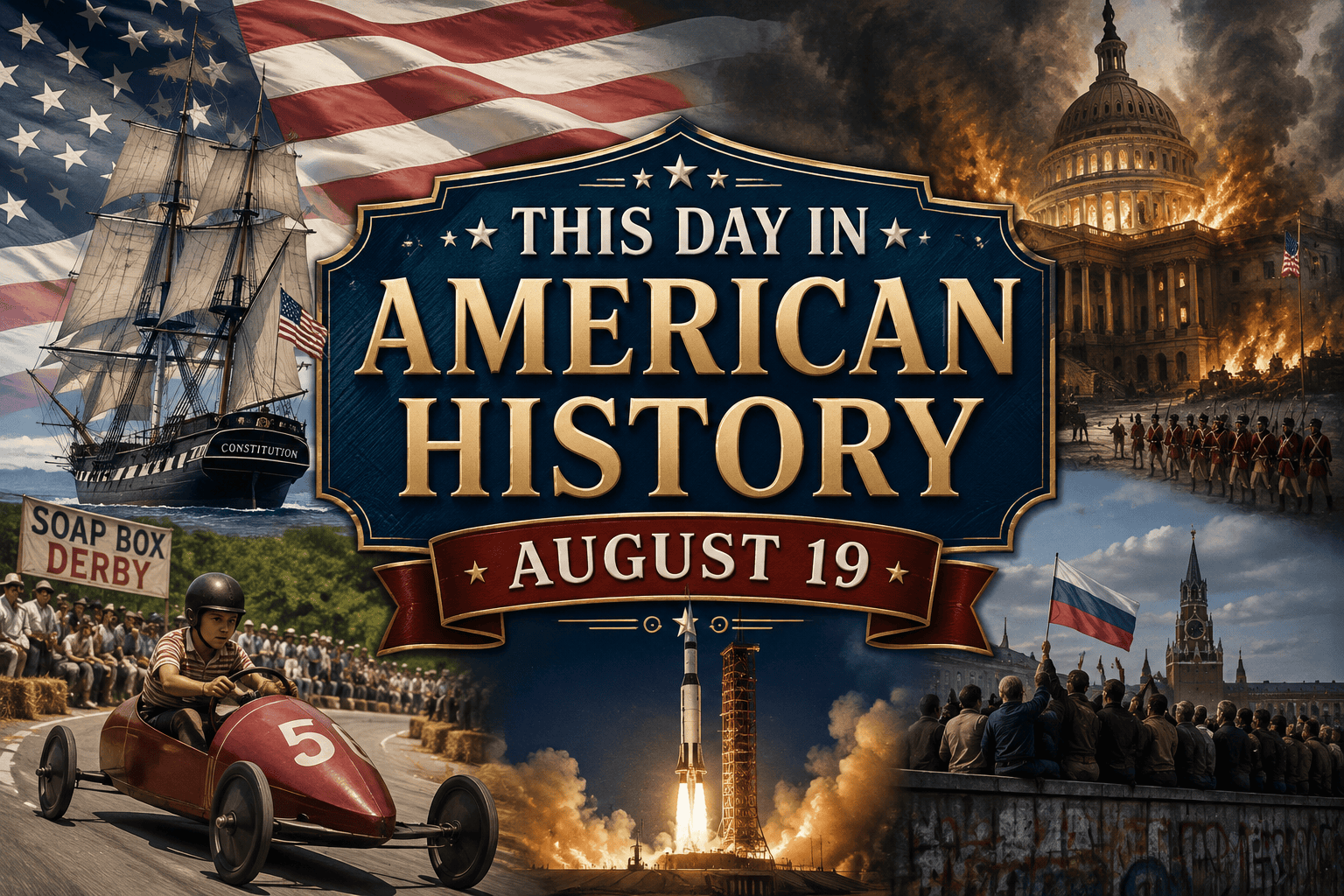
Every date on the calendar carries pieces of the American story, and August 19 is no exception. Across more than two centuries, this date has been connected with naval warfare, the defense of the nation’s capital, childhood innovation, the Space Race, and dramatic changes in the final months of the Cold War.
Perhaps the most famous American event associated with August 19 occurred during the War of 1812, when the USS Constitution defeated a British warship and earned the legendary nickname “Old Ironsides.” Just two years later, British forces landed in Maryland on August 19 and began advancing toward Washington, D.C.
Later generations would associate the date with a much different kind of competition—the beginnings of the Soap Box Derby tradition.
From cannon fire on the Atlantic to homemade racing cars rolling down American hills, August 19 provides a fascinating glimpse into the many different ways history is made.
Let’s travel back through time and explore some of the notable events connected with August 19 in American history.
1812 – USS Constitution Defeats HMS Guerriere
One of the most celebrated victories in the early history of the United States Navy took place on August 19, 1812.
The United States was only a few months into the War of 1812 against Great Britain. The young American Navy faced an enormous challenge.
Britain’s Royal Navy was the dominant naval force of its era. The United States, by comparison, possessed only a small fleet.
That made what happened aboard the USS Constitution even more significant.
Commanded by Captain Isaac Hull, Constitution encountered the British frigate HMS Guerriere while cruising in the North Atlantic.
According to the U.S. Naval History and Heritage Command, Constitution spotted Guerriere during the afternoon of August 19 and gradually closed the distance between the vessels. Guerriere began firing first, but Hull waited until the American ship had moved much closer before ordering his crew to unleash its guns.
The result was devastating.
Constitution’s heavy guns damaged Guerriere’s hull, rigging, and masts. The ships eventually collided during the fighting, creating an extremely dangerous situation as sailors and Marines prepared for the possibility of boarding.
The battle was relatively short, but its impact on American morale would last for generations.
The Birth of “Old Ironsides”
The battle produced one of the most famous nicknames in American military history.
As British cannonballs struck the USS Constitution, some reportedly failed to penetrate its exceptionally strong wooden hull.
The Naval History and Heritage Command recounts that a sailor, seeing enemy shot fall away from the ship’s thick oak construction, exclaimed that her sides appeared to be made of iron.
From that moment, the USS Constitution became known as:
“Old Ironsides”
The ship wasn’t actually made of iron.
Its remarkable strength came from its heavy wooden construction, including thick oak framing. But to sailors watching British cannon fire fail to destroy the vessel, the ship must have seemed nearly indestructible.
The nickname became part of American naval legend.
Captain Isaac Hull’s Crucial Decision
One of the most interesting aspects of the battle was Captain Hull’s patience.
Instead of immediately answering Guerriere’s long-range cannon fire, Hull maneuvered Constitution closer.
Only when the ships were at very close range did the Americans unleash a powerful broadside.
That decision helped maximize the effectiveness of Constitution’s heavier guns.
The Naval History and Heritage Command describes the main fighting as lasting roughly half an hour before the badly damaged Guerriere surrendered.
It was a remarkable victory.
The Royal Navy was accustomed to defeating its enemies at sea. Now one of its frigates had been decisively beaten by a warship from a nation whose navy was still in its infancy.
HMS Guerriere Is Destroyed
The damage to Guerriere was so severe that the captured vessel could not realistically be brought back to an American port.
After removing prisoners and wounded sailors, the Americans eventually burned the damaged British frigate.
Guerriere was destroyed on August 20, 1812, the day after the battle.
Constitution then sailed back toward Boston.
When Captain Hull and his crew arrived, they were greeted as heroes.
News of the victory spread rapidly throughout the country. At a time when Americans desperately needed encouraging news from the war, the victory provided exactly that.
Why the Victory Mattered
Militarily, the destruction of a single British frigate couldn’t significantly weaken the enormous Royal Navy.
Symbolically, however, the victory was enormous.
The United States had declared war against one of the world’s greatest military powers. Many Americans questioned whether their young country could successfully challenge Britain.
The victory of USS Constitution provided an answer.
American sailors had faced a British warship in direct combat—and won.
The Naval History and Heritage Command notes that Constitution’s victories didn’t determine the overall outcome of the War of 1812, but they had a tremendous effect on American morale and helped challenge the perception that Britain’s Royal Navy was unbeatable.
That psychological victory was important for a nation still developing its identity.
1814 – British Troops Land in Maryland
Exactly two years after Constitution’s famous victory, August 19 became associated with another major event in the War of 1812.
This time, however, the situation was far more dangerous for the United States.
On August 19, 1814, British forces under Major General Robert Ross and Rear Admiral George Cockburn landed at Benedict, Maryland, along the Patuxent River.
Their ultimate objective was the American capital.
Washington, D.C.
The Library of Congress notes that British forces landed at Benedict while additional British naval forces operated in the region. News of the invasion caused considerable alarm in Washington, and some residents began fleeing the city.
The threat was real.
The British were coming.
Washington Was Vulnerable
Washington in 1814 wasn’t the heavily protected capital we might imagine today.
American officials were uncertain exactly where the British intended to attack, and military forces were scattered.
Militia units from Maryland, Virginia, and Washington scrambled to organize defensive positions.
Meanwhile, Commodore Joshua Barney commanded a collection of American gunboats and other smaller vessels that had been operating against British forces in Chesapeake waters.
After being pushed farther up the Patuxent River, Barney’s forces eventually abandoned and destroyed their flotilla rather than allow the vessels to fall into British hands.
Barney and his men then moved overland to help defend Washington.
The stage was being set for one of the most humiliating—and memorable—episodes of the War of 1812.
The Road to Bladensburg
After landing in Maryland, British troops began moving toward Washington.
American forces attempted to stop them at Bladensburg, Maryland.
The resulting Battle of Bladensburg occurred on August 24, 1814.
The American defense collapsed, opening the road to the capital.
British troops entered Washington later that day.
Government officials, residents, and even the presidential household had already begun evacuating.
First Lady Dolley Madison famously left the White House shortly before British forces arrived, while ensuring that important items—including the well-known portrait of George Washington—were removed from danger.
1814 – Washington Burns
The British occupation of Washington became one of the most dramatic moments in American history.
British troops set fire to several government buildings, including the United States Capitol and the President’s House, which would later become widely known as the White House.
Flames illuminated the capital.
For Americans, the sight was devastating.
The young nation’s capital had been invaded by a foreign army.
The Library of Congress notes that the British attack also destroyed the congressional library housed inside the Capitol.
That destruction unexpectedly led to another important development.
Thomas Jefferson Helps Rebuild the Library of Congress
After the congressional library was destroyed, former President Thomas Jefferson offered Congress his personal collection of books.
Jefferson had accumulated an extraordinary library covering subjects ranging from government and philosophy to science, geography, literature, and history.
Congress purchased Jefferson’s collection in 1815.
His books became the foundation for rebuilding the Library of Congress.
So the British campaign that began with the August 19 landing in Maryland indirectly contributed to the transformation of America’s national library.
History often works this way.
One destructive event can lead to developments that nobody involved could have predicted.
1933 – Children and Homemade Cars Create a New Tradition
More than a century after the War of 1812, August 19 became associated with something far more peaceful.
Children.
Homemade cars.
Gravity.
Competition.
And thousands of spectators.
On August 19, 1933, young racers gathered in Dayton, Ohio, for a large competition involving homemade, motorless cars.
The idea grew after newspaper photographer Myron Scott saw local boys racing homemade vehicles.
Scott recognized that the activity could become something much bigger.
He helped organize a larger competition.
The response demonstrated that he was right.
Hundreds of young racers arrived.
Tens of thousands of spectators came to watch.
What looked like a simple childhood pastime was becoming a national phenomenon.
1934 – The All-American Soap Box Derby
The idea grew quickly.
On August 19, 1934, Dayton hosted the first official All-American Soap Box Derby.
Young competitors traveled from cities around the country to participate.
The concept was wonderfully simple.
Children would build small cars without engines.
Gravity provided the power.
Engineering, craftsmanship, weight distribution, aerodynamics, and driving skill could determine who reached the finish line first.
The event encouraged young people to work with their hands, solve problems, compete, and create something of their own.
Eventually, the national competition moved to Akron, Ohio, where the Soap Box Derby became a lasting American tradition.
More Than Just a Race
The Soap Box Derby represented several ideas deeply connected with American culture.
It encouraged:
- Creativity
- Mechanical skills
- Friendly competition
- Family participation
- Engineering
- Problem-solving
- Perseverance
- Sportsmanship
A child could begin with ordinary materials and an idea.
Then came planning.
Building.
Testing.
Failure.
Adjustments.
And finally—the race.
That process made the Derby about far more than simply reaching the bottom of a hill first.
It taught young competitors how to turn imagination into something real.
1960 – The Space Race Accelerates
August 19 also has an important connection with the Cold War competition that eventually helped send Americans to the Moon.
On August 19, 1960, the Soviet Union launched Sputnik 5, carrying animals including two dogs named Belka and Strelka.
The spacecraft orbited Earth before successfully returning its living passengers.
Although this was a Soviet achievement rather than an American one, developments like this mattered enormously to the United States.
America and the Soviet Union were engaged in an intense technological competition.
Every Soviet achievement created additional pressure on American leaders, scientists, engineers, and military officials.
Space had become another arena in the Cold War.
America Responds to the Space Race
The competition pushed the United States to move faster.
NASA had been established in 1958.
The United States developed increasingly ambitious human-spaceflight programs:
Project Mercury demonstrated that Americans could travel into space.
Project Gemini developed critical techniques such as longer-duration missions, spacewalking, orbital maneuvering, and rendezvous.
Then came Apollo.
On July 20, 1969, American astronauts Neil Armstrong and Buzz Aldrin walked on the Moon while Michael Collins orbited above them aboard Columbia.
Less than nine years separated the August 1960 Soviet animal flight from America’s first Moon landing.
The pace of technological development during that period was extraordinary.
A Surprising White House Connection
The story of Strelka later gained an unusual connection to an American president.
Strelka eventually had puppies.
Soviet leader Nikita Khrushchev gave one of those puppies, named Pushinka, to the family of President John F. Kennedy.
During one of the most dangerous periods of the Cold War, a descendant of a Soviet space dog was living with the American president’s family.
It was a small and almost humorous symbol of human connection during an era dominated by nuclear tension and ideological rivalry.
1991 – A Coup Shakes the Soviet Union
On August 19, 1991, Americans watched another extraordinary event unfold in the Soviet Union.
Hardline Soviet officials attempted to seize control of the government from Soviet President Mikhail Gorbachev.
Gorbachev had introduced major reforms through policies known as glasnost and perestroika.
But those reforms also unleashed political forces that were becoming increasingly difficult for Soviet leaders to control.
Some communist hardliners feared the country was collapsing.
They attempted to stop the process.
The World Watches Moscow
Images from Moscow were broadcast around the world.
Tanks appeared in the streets.
Russian leader Boris Yeltsin emerged as one of the most visible opponents of the coup.
One of the defining images of the crisis showed Yeltsin standing on a tank and addressing crowds resisting the takeover.
For Americans who had grown up during the Cold War, the scenes were extraordinary.
For decades, the Soviet Union had been America’s primary geopolitical rival.
Now its political system appeared to be unraveling before the world’s eyes.
The Coup Collapses
The coup failed within days.
Rather than strengthening communist hardliners, the attempted takeover accelerated the collapse of Soviet authority.
Gorbachev returned to Moscow, but his political power had been severely weakened.
Boris Yeltsin’s influence increased.
Soviet republics accelerated their movements toward independence.
Only a few months later, the Soviet Union ceased to exist.
On December 25, 1991, Gorbachev resigned as president of the Soviet Union.
By the end of December, the USSR had formally dissolved.
The Cold War era that had shaped American foreign policy for generations had reached its conclusion.
From Old Ironsides to the End of the Cold War
Looking across these events reveals just how much American history can be connected to a single date.
On August 19, Americans fought one of their young Navy’s most legendary battles.
Two years later, British troops landed in Maryland and began advancing toward the American capital.
More than a century later, children racing homemade cars helped create a beloved national tradition.
Then came the technological rivalry of the Space Race.
Finally, Americans watched as their greatest Cold War rival entered the final stages of its collapse.
These stories involve very different people and circumstances.
Yet each tells us something about America.
Courage at Sea
The USS Constitution story demonstrates the importance of courage and preparation.
Captain Isaac Hull and his sailors were facing a naval power with vastly greater resources.
They couldn’t control the size of Britain’s fleet.
They could control how they prepared, maneuvered, fought, and responded when the opportunity came.
Their victory became larger than a single naval engagement.
It became a national symbol.
Resilience After Defeat
The British campaign against Washington tells another story.
America suffered an embarrassing military defeat.
Its capital was occupied.
Government buildings burned.
Yet the country survived.
Washington was rebuilt.
The White House was rebuilt.
The Capitol was rebuilt.
The Library of Congress was rebuilt.
The American government continued.
National history isn’t a story of uninterrupted victories.
It also includes moments when the country suffered enormous setbacks and had to recover.
Innovation Starts Small
The Soap Box Derby offers another lesson.
Major traditions don’t always begin with government programs, wealthy investors, or enormous organizations.
Sometimes they begin with children racing homemade cars.
Someone notices.
Someone organizes.
People become interested.
An idea grows.
What started as neighborhood entertainment eventually became a national tradition.
Competition Can Accelerate Innovation
The Space Race demonstrates another side of history.
Competition between nations can create enormous pressure.
During the Cold War, that competition was dangerous.
But it also accelerated scientific and technological development.
Computing, communications, rocketry, materials science, navigation, and many other fields advanced alongside America’s space program.
The desire to reach the Moon pushed engineers and scientists to solve problems that had previously seemed impossible.
History Happens Before We Know It’s History
Perhaps the most important lesson from August 19 is that people rarely recognize the full importance of an event while they’re living through it.
The sailors aboard USS Constitution couldn’t know that people would still be telling their story more than two centuries later.
Residents fleeing Washington in 1814 couldn’t know exactly how the nation would recover.
Children racing homemade cars in Ohio couldn’t know they were helping create an American institution.
Americans watching television coverage from Moscow in August 1991 couldn’t know with certainty that the Soviet Union would disappear only months later.
History becomes clearer with distance.
When we’re living through major events, the future remains unknown.
Why This Day in American History Matters
Learning history isn’t simply about memorizing dates.
It’s about understanding people.
Their decisions.
Their fears.
Their courage.
Their failures.
Their discoveries.
And the consequences that followed.
Studying one day like August 19 allows us to travel across generations and discover connections that might otherwise be overlooked.
A naval battle from 1812.
An invasion in 1814.
Children racing cars during the Great Depression.
Animals orbiting Earth during the Cold War.
Political upheaval in Moscow in 1991.
Each event belongs to a different chapter.
Together, they form pieces of the larger American story.
Final Thoughts
August 19 has witnessed courage, conflict, creativity, competition, and enormous political change.
Perhaps its most enduring American story remains the victory of the USS Constitution over HMS Guerriere.
When enemy cannonballs appeared to bounce from Constitution’s heavy oak hull, a legend was born.
Old Ironsides.
More than 200 years later, the nickname survives.
But August 19 also reminds us that American history isn’t defined by one battle or one generation.
It is a continuing story.
Every generation inherits the consequences of what came before it while creating history for those who will come next.
The sailors fighting aboard Constitution didn’t know how their actions would be remembered.
The families watching Soap Box Derby racers didn’t know the event would become a tradition.
Americans watching the Soviet crisis unfold in 1991 didn’t yet know how dramatically the world was about to change.
And we don’t know which events happening around us today will someday appear in history books.
That’s one of the most fascinating things about history:
We aren’t simply studying it. We’re living through the next chapter of it.
Which August 19 story interests you the most: the USS Constitution earning the nickname “Old Ironsides,” the British advance toward Washington, the beginnings of the Soap Box Derby, the Space Race, or the dramatic final months of the Cold War?



Leave a Reply