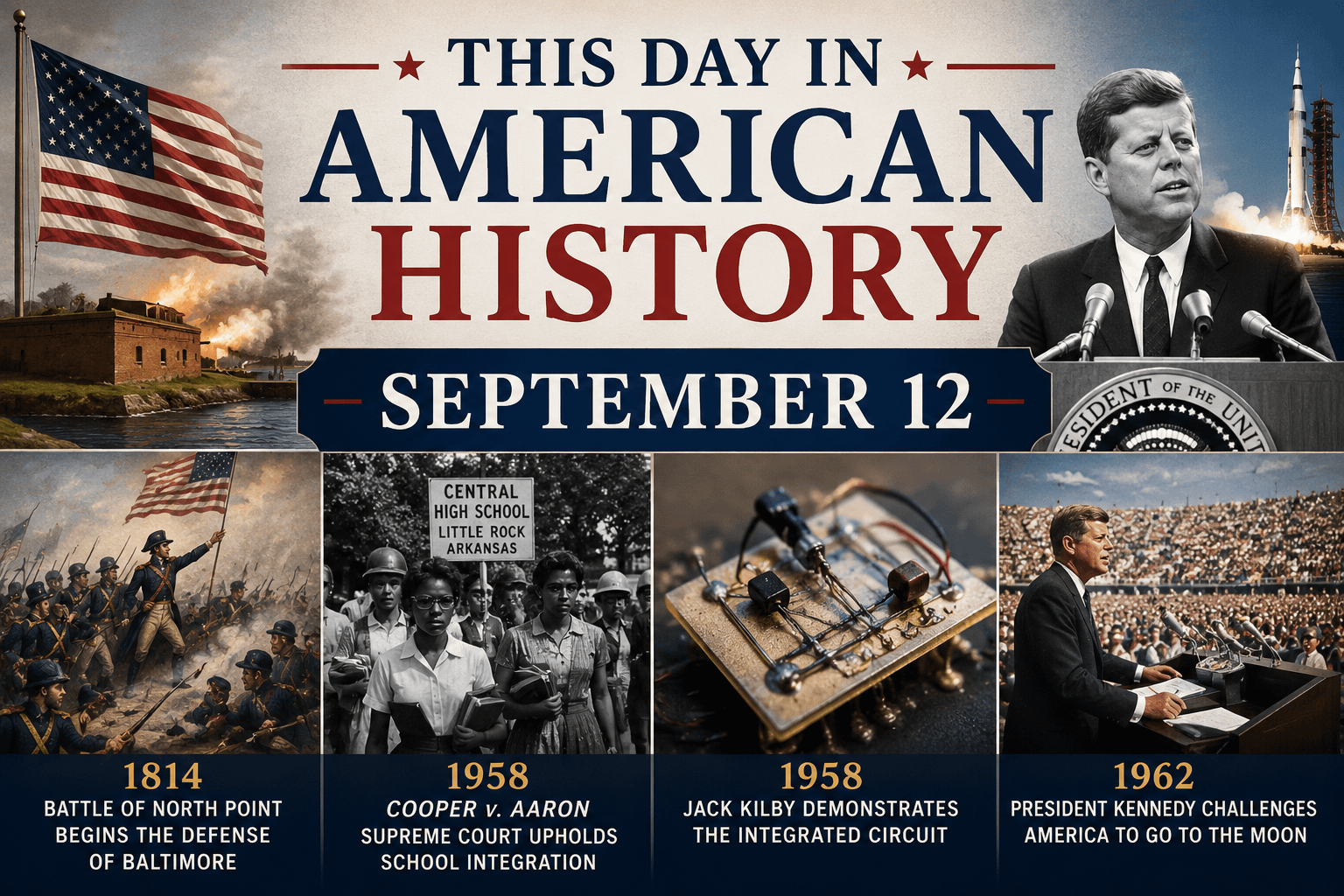
September 12 has witnessed moments that helped shape the United States through war, civil rights, technology, politics, and space exploration. From American defenders standing against British troops outside Baltimore during the War of 1812 to President John F. Kennedy challenging the nation to reach the Moon, the date offers several powerful chapters in the American story.
Some September 12 events produced immediate consequences. Others became more important with the passage of time. Together, they demonstrate a recurring theme in American history: periods of uncertainty have often been followed by moments of courage, innovation, determination, and change.
Here is a look back at some of the most significant events associated with September 12 in American history.
1814 – The Battle of North Point Begins the Defense of Baltimore
One of the most consequential events to occur on September 12 came during the War of 1812.
On September 12, 1814, British troops landed at North Point, Maryland, and advanced toward Baltimore. The attack came only weeks after British forces had captured Washington, D.C., and burned several public buildings in the nation’s capital.
Baltimore represented an important next target.
The city was a major commercial and shipbuilding center, and its capture would have delivered another serious blow to American morale.
According to the National Park Service, a British fleet of more than 30 warships and transports arrived near Baltimore, and approximately 5,000 British troops landed on the North Point peninsula before beginning their march toward the city.
American forces were waiting.
Roughly 3,200 Americans under Brigadier General John Stricker moved forward to slow the British advance.
The resulting confrontation became known as the Battle of North Point.
Americans Make Their Stand at North Point
The American troops faced a formidable opponent.
Britain possessed one of the world’s most powerful military forces, and its soldiers had extensive combat experience from years of warfare in Europe.
The Americans nevertheless chose to confront the advancing British army rather than simply remain behind Baltimore’s defensive positions.
The Battle of North Point began on the afternoon of September 12.
Although the British ultimately controlled the battlefield and the Americans withdrew, the battle accomplished something extremely important: it delayed the British advance.
The fighting also inflicted significant casualties on the British.
Among those killed was British Major General Robert Ross, who had commanded the force involved in the campaign against Washington and Baltimore.
The National Park Service notes that although North Point was technically a British victory, the American resistance slowed the British advance, strengthened American morale, and contributed to the defense of Baltimore.
Those additional hours mattered.
Baltimore had spent weeks preparing defenses, and thousands of Americans were ready to protect the city.
The British soon discovered that capturing Baltimore would be far more difficult than capturing Washington had been.
The Battle Leads Toward the Star-Spangled Banner
The fighting on September 12 was only the beginning of the Battle of Baltimore.
As American troops withdrew from North Point toward the city’s defenses, British warships moved into position along the Patapsco River.
Their next major obstacle was Fort McHenry.
During the night of September 12 and into the following morning, British vessels moved closer to Baltimore’s harbor defenses. The naval bombardment of Fort McHenry would begin on September 13 and continue into September 14.
Watching these events from aboard a vessel in the harbor was American lawyer Francis Scott Key.
Key had traveled with John Stuart Skinner to negotiate the release of Dr. William Beanes, an American physician who had been detained by the British.
Because Key had learned information about British military plans, he and his companions were temporarily prevented from returning to Baltimore.
That placed Key in a remarkable position to witness the attack.
When morning came after the bombardment, the enormous American flag was still flying above Fort McHenry.
The sight inspired Key to write the words that eventually became “The Star-Spangled Banner.”
More than a century later, the song officially became the national anthem of the United States.
The events beginning on September 12, therefore, were connected not only to the defense of Baltimore but also to one of America’s most enduring national symbols.
Why the Defense of Baltimore Mattered
The Battle of Baltimore demonstrated that the British advance through the Chesapeake region could be stopped.
After burning Washington, British forces might have appeared unstoppable.
Baltimore changed that perception.
American soldiers, sailors, militia members, and civilians had spent weeks preparing the city’s defenses. Free and enslaved African Americans were among those who contributed to the defensive effort.
By September 14, the British had failed to break through Baltimore’s defenses and withdrew.
The city survived.
The National Park Service describes the Battle of Baltimore, fought from September 12 through September 14, 1814, as a defining moment of the War of 1812.
The victory also gave Americans a powerful symbol of national resilience.
A battle that began on September 12 helped create the circumstances that inspired the words Americans would eventually sing before sporting events, ceremonies, military observances, and national celebrations.
1953 – John F. Kennedy Marries Jacqueline Bouvier
Another memorable September 12 moment occurred nearly 140 years later.
On September 12, 1953, future President John F. Kennedy married Jacqueline Lee Bouvier at St. Mary’s Church in Newport, Rhode Island.
Kennedy was serving as a United States senator from Massachusetts at the time.
The couple would eventually become one of the most recognizable political couples of the twentieth century.
Seven years after their wedding, Kennedy won the 1960 presidential election and became the 35th president of the United States.
Jacqueline Kennedy became one of America’s most famous first ladies, known for her interest in art, history, culture, and the restoration of the White House.
Remarkably, another defining moment in John F. Kennedy’s public life would occur on the exact same date nine years after his wedding.
1958 – The Supreme Court Acts in Cooper v. Aaron
September 12 also holds an important place in the history of the American civil rights movement.
On September 12, 1958, the United States Supreme Court acted in the landmark school desegregation case Cooper v. Aaron.
The dispute emerged from the battle over integration at Central High School in Little Rock, Arkansas.
Following the Supreme Court’s 1954 decision in Brown v. Board of Education, public schools were constitutionally required to end racial segregation.
Resistance remained intense in many communities.
In Little Rock, nine Black students—the Little Rock Nine—attempted to integrate Central High School in 1957.
The confrontation became a national crisis.
Arkansas Governor Orval Faubus initially used the Arkansas National Guard to prevent the students from entering the school. President Dwight D. Eisenhower eventually federalized the Guard and sent federal troops to enforce the students’ right to attend.
The conflict did not disappear after the 1957–1958 school year.
Little Rock school officials sought to postpone implementation of the integration plan.
On September 12, 1958, the Supreme Court issued an order preventing that delay. The Court’s journal records its action that day in the litigation involving the Little Rock school board and the students challenging segregation.
The Constitution Cannot Simply Be Ignored
Cooper v. Aaron became a major constitutional decision.
The Supreme Court unanimously rejected efforts to avoid complying with its interpretation of the Constitution.
The case reinforced an essential principle of the American constitutional system: state governments and officials cannot simply disregard federal constitutional requirements because they disagree with them.
The struggle over Little Rock demonstrated how difficult enforcing civil rights could be even after the Supreme Court had ruled segregation unconstitutional.
Court decisions could establish rights.
Making those rights meaningful often required continued legal action, political leadership, federal enforcement, and extraordinary courage from ordinary citizens.
The Little Rock Nine became lasting symbols of that courage.
September 12, 1958, therefore represents another important step in America’s long and unfinished struggle to live up to the principle of equal protection under the law.
1958 – Jack Kilby Demonstrates the Integrated Circuit
While one historic development was unfolding in the Supreme Court, another was taking place in a laboratory.
On September 12, 1958, engineer Jack Kilby, working at Texas Instruments, demonstrated an early working integrated circuit.
At first glance, that might not sound as dramatic as a battle or presidential speech.
Its consequences, however, were enormous.
Before integrated circuits, electronic equipment relied heavily on individual components connected together. These systems could become large, complicated, expensive, and difficult to manufacture.
The integrated circuit offered a revolutionary alternative by placing multiple electronic components together on a small piece of semiconductor material.
The technology became one of the foundations of modern electronics.
Integrated circuits eventually helped make possible increasingly powerful and compact computers, calculators, communications equipment, medical devices, automobiles, smartphones, spacecraft, and countless other technologies.
The modern digital world depends heavily on the semiconductor revolution that followed.
It is an excellent reminder that American history is not shaped exclusively in battlefields, courtrooms, and presidential offices.
Sometimes history changes on a laboratory workbench.
1962 – President Kennedy Challenges America to Go to the Moon
Four years after the events of 1958, September 12 became associated with one of the most famous speeches of the Space Age.
On September 12, 1962, President John F. Kennedy addressed approximately 40,000 people at Rice University Stadium in Houston, Texas.
His purpose was to strengthen public support for America’s ambitious effort to send astronauts to the Moon.
Kennedy had already proposed the lunar goal to Congress in May 1961.
The challenge was extraordinary.
Human spaceflight was still in its infancy.
The Soviet Union had placed Yuri Gagarin into orbit in April 1961, making him the first human to orbit Earth. The United States was determined to demonstrate that it could compete with—and ultimately surpass—the Soviet space program.
By September 1962, enormous technical obstacles remained.
NASA needed rockets far more powerful than anything previously flown.
Engineers needed spacecraft capable of carrying astronauts hundreds of thousands of miles through space.
Scientists and mission planners had to determine how astronauts would navigate to the Moon, land safely, launch from its surface, rendezvous in lunar orbit, return to Earth, and survive reentry.
Failure was entirely possible.
Kennedy nevertheless argued that difficulty was precisely why the challenge mattered.
“We Choose to Go to the Moon”
Kennedy’s Rice University address produced one of the most famous lines of his presidency:
“We choose to go to the Moon.”
The speech framed space exploration as more than a technological competition.
Kennedy presented the Moon program as a national challenge capable of organizing American talent, scientific knowledge, industrial capacity, and determination toward an extraordinary goal.
NASA records that Kennedy used the September 12 speech to reaffirm America’s commitment to achieving a crewed lunar landing before the decade ended.
It was a bold promise.
No human had traveled anywhere close to the Moon.
John Glenn had only become the first American to orbit Earth earlier that year.
Yet Kennedy was asking the country to move from brief Earth-orbit missions to landing human beings on another world within several years.
The challenge required an unprecedented national effort.
From Kennedy’s Speech to Apollo 11
Kennedy would not live to see the goal achieved.
He was assassinated on November 22, 1963.
NASA continued pursuing the lunar objective.
Thousands of engineers, scientists, technicians, mathematicians, astronauts, contractors, administrators, and workers contributed to the Apollo program.
The road was not easy.
The Apollo 1 fire in January 1967 killed astronauts Virgil “Gus” Grissom, Edward White II, and Roger Chaffee during a launch-pad test.
The tragedy led to major spacecraft redesigns and safety improvements.
NASA continued.
Apollo 8 carried humans around the Moon in December 1968.
Apollo 10 conducted a full dress rehearsal of the lunar landing mission in May 1969.
Then came Apollo 11.
On July 20, 1969, astronauts Neil Armstrong and Buzz Aldrin landed the lunar module Eagle on the Moon while Michael Collins remained aboard the command module Columbia in lunar orbit.
Armstrong became the first human to step onto the lunar surface.
The goal Kennedy had publicly championed was accomplished before the 1960s ended.
NASA notes that the September 12, 1962, Rice University speech helped reaffirm the commitment that ultimately culminated in Apollo 11’s successful Moon landing.
September 12 Connects Two Very Different American Frontiers
There is an interesting historical connection between two of September 12’s biggest stories.
In 1814, Americans were fighting to defend Baltimore from invasion.
In 1962, Americans were preparing to explore another world.
The circumstances could hardly have been more different.
Yet both moments involved a nation confronting an uncertain future.
The defenders at North Point could not know whether Baltimore would fall.
The engineers building America’s early spacecraft could not know with certainty whether Kennedy’s lunar challenge could actually be accomplished.
Both stories ultimately became associated with national determination.
One helped inspire the national anthem.
The other helped inspire the Moon landing.
From Battlefields to Microchips to the Moon
September 12 also demonstrates how dramatically the United States changed over roughly a century and a half.
In 1814, the young nation was struggling to defend one of its major cities against the British Empire.
By 1958, American engineers were helping create technology that would transform electronics and computing.
That same year, Americans were confronting the constitutional and moral struggle over racial segregation.
Four years later, the United States was committing enormous resources toward sending human beings to the Moon.
These stories reveal different sides of American history.
There is conflict.
There is injustice.
There is courage.
There is innovation.
There is ambition.
And there is change.
Understanding history requires acknowledging all of those elements rather than reducing the past to a collection of famous names and dates.
Why September 12 Matters in American History
September 12 deserves recognition because events occurring on this date touched several fundamental parts of the American experience.
The Battle of North Point helped protect Baltimore during the War of 1812 and contributed to the events that inspired “The Star-Spangled Banner.”
The struggle surrounding Cooper v. Aaron reinforced the authority of the Constitution and the federal courts during one of the most important civil rights battles of the twentieth century.
Jack Kilby’s integrated circuit demonstration helped launch technological developments that eventually transformed everyday life.
And President Kennedy’s Rice University speech gave memorable expression to America’s determination to reach the Moon.
Each event involved people facing challenges whose outcomes were not guaranteed.
That uncertainty is something easily forgotten when looking backward.
History can make major achievements appear inevitable.
They rarely were.
Remembering September 12
Looking back at September 12 reminds us that American history has been shaped by people willing to defend, challenge, invent, explore, and persevere.
The soldiers outside Baltimore did not know their resistance would become part of the story surrounding America’s future national anthem.
The students fighting segregation in Little Rock could not know exactly how their courage would influence generations that followed.
Engineers experimenting with early integrated circuits could only begin to imagine the digital revolution ahead.
And the thousands of people listening to President Kennedy at Rice University in 1962 could look into the night sky and see the Moon, but few could fully comprehend what would be required to place American astronauts there only seven years later.
History is filled with moments like these.
Some appear important immediately.
Others reveal their importance slowly.
September 12 contains both.
From the defenses of Baltimore to the struggle for constitutional equality, from the birth of revolutionary technology to America’s journey toward the Moon, this date provides a remarkable snapshot of the larger American story.
Which September 12 event do you think had the greatest lasting impact on the United States?
Leave a Reply