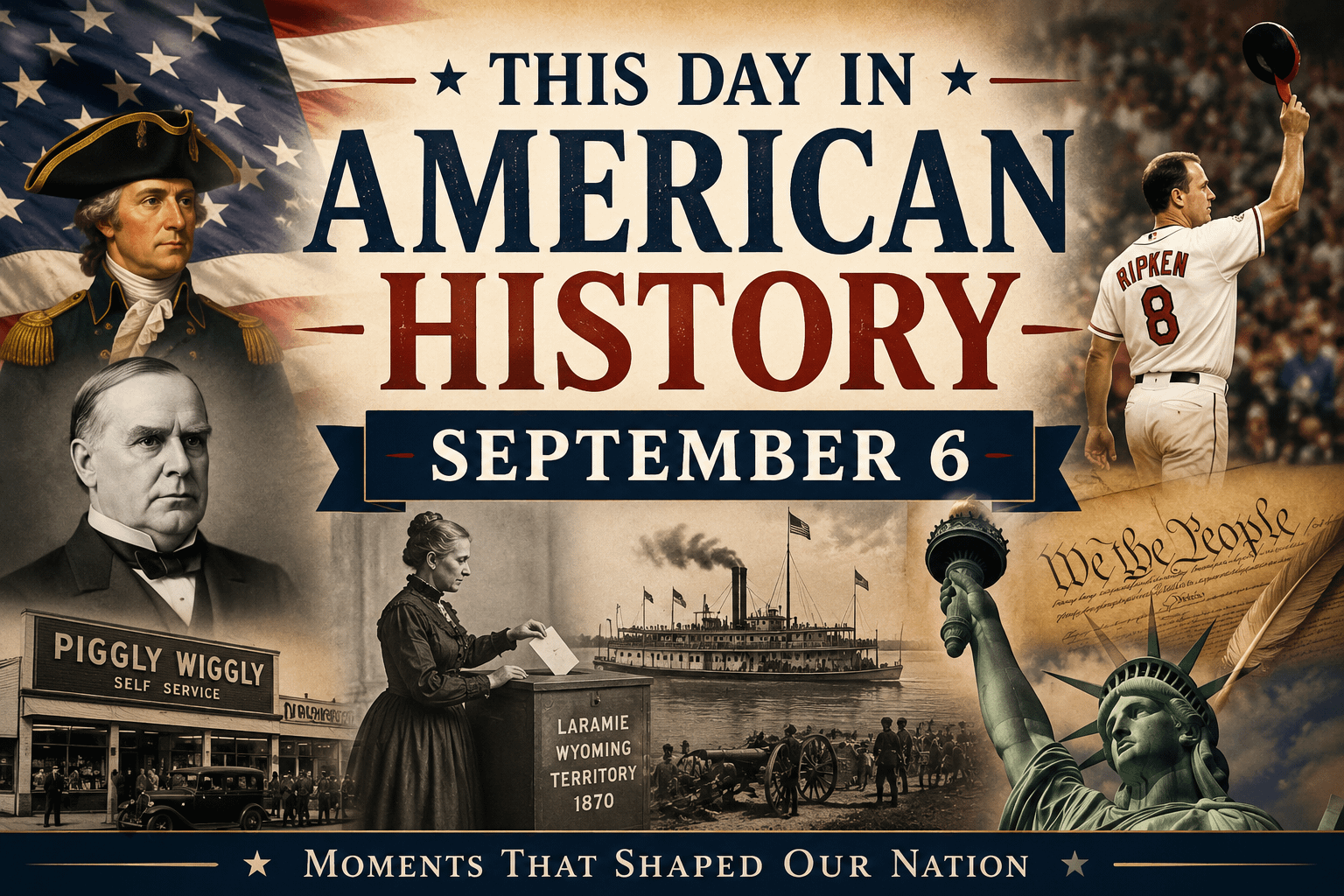
September 6 has witnessed moments that changed American politics, expanded voting rights, shaped the Civil War, transformed everyday shopping, and produced unforgettable achievements in sports. From the Revolutionary War to the assassination of a president and a baseball record once considered nearly impossible to break, September 6 offers a fascinating look at the people and events that helped shape the United States.
1781 – Benedict Arnold Attacks New London, Connecticut
On September 6, 1781, one of the most infamous figures of the American Revolution returned to Connecticut—not as an American patriot, but as a commander fighting for the British.
Benedict Arnold had once been celebrated for his courage and military leadership on behalf of the American cause. After defecting to the British, however, his name became permanently associated with betrayal.
Arnold commanded British forces in an attack against New London and nearby Fort Griswold in Connecticut. New London was an important port and privateering center, making it a valuable military target.
British forces burned much of New London, while a bloody battle unfolded at Fort Griswold across the Thames River. The attack occurred only weeks before the decisive American and French victory at Yorktown effectively brought major combat in the Revolutionary War to an end.
Arnold’s actions on September 6 added another dark chapter to the story of the man who became America’s most famous traitor.
1861 – Ulysses S. Grant Captures Paducah, Kentucky
September 6 also played an important role during the early months of the American Civil War.
On September 6, 1861, Union forces under Brigadier General Ulysses S. Grant moved into Paducah, Kentucky. Union gunboats Lexington and Tyler supported the operation.
The location was strategically important because of its proximity to the Tennessee and Cumberland rivers. Controlling these waterways would become an important part of Union strategy in the western theater of the war.
The operation was an early glimpse of the aggressive military leadership that would eventually make Grant one of the Union’s most important commanders—and later the 18th president of the United States.
1870 – Louisa Ann Swain Makes Voting History
One of the most important milestones in the history of American women’s voting rights occurred on September 6, 1870.
That morning, 69-year-old Louisa Ann Swain went to the polls in Laramie, Wyoming Territory, and cast her ballot in a general election.
Wyoming Territory had granted women voting rights in 1869, decades before women throughout the nation gained constitutional protection for their right to vote.
Swain is widely recognized as the first woman in the United States to legally cast a ballot in a general election after 1807.
Her vote came 50 years before the ratification of the 19th Amendment in 1920, which prohibited denying the right to vote on the basis of sex.
Today, Swain’s simple act of walking into a polling place represents an important chapter in the long American struggle for equal voting rights.
1901 – President William McKinley Is Shot
Perhaps the most significant event in American history associated with September 6 occurred in 1901.
President William McKinley was attending the Pan-American Exposition in Buffalo, New York. While greeting members of the public at the Temple of Music, McKinley was shot twice by Leon Czolgosz, an anarchist.
McKinley initially survived the shooting, and there was hope that he would recover. His condition later deteriorated, however, and he died on September 14, eight days after being shot.
Vice President Theodore Roosevelt then became president.
McKinley’s assassination was the third assassination of a sitting American president, following Abraham Lincoln in 1865 and James A. Garfield in 1881.
The tragedy also contributed to changes in presidential security. Roosevelt would become the first president to receive continuous Secret Service protection following McKinley’s death.
The assassination unexpectedly placed Theodore Roosevelt in the White House and helped begin one of the most consequential presidencies of the early 20th century.
1916 – America’s First Self-Service Grocery Store Opens
September 6 also marks an important moment in American retail history.
On September 6, 1916, the first Piggly Wiggly store opened in Memphis, Tennessee.
The concept was revolutionary.
Before self-service grocery stores became common, customers typically gave their shopping lists to clerks, who gathered items from shelves behind a counter.
Piggly Wiggly allowed customers to walk through the store and select products themselves.
It sounds completely ordinary today, but at the time it represented a major transformation in the shopping experience. The self-service model helped influence the development of the modern supermarket.
1943 – A Deadly Pennsylvania Railroad Disaster
On September 6, 1943, tragedy struck the Pennsylvania Railroad when a passenger train traveling toward New York derailed in Philadelphia.
The accident killed 79 people.
The disaster occurred during World War II, when America’s railroads were carrying enormous numbers of military personnel, workers, and civilians across the country.
It remains one of the darker transportation stories associated with September 6.
1949 – The Camden Mass Shooting
Another tragedy occurred on September 6, 1949, when Howard Unruh carried out a mass shooting in Camden, New Jersey.
Unruh walked through his neighborhood shooting people, ultimately killing 13. The event became one of the most notorious mass killings in American history at the time.
The tragedy remains a disturbing chapter in the history of American mass violence.
1995 – Cal Ripken Jr. Breaks Baseball’s “Unbreakable” Record
September 6 also produced one of the most celebrated moments in American sports history.
On September 6, 1995, Baltimore Orioles shortstop Cal Ripken Jr. played in his 2,131st consecutive Major League Baseball game, surpassing the legendary Lou Gehrig.
Gehrig’s record of 2,130 consecutive games had stood for more than half a century.
When the game became official, play stopped as fans at Baltimore’s Camden Yards gave Ripken an extended standing ovation.
Ripken took a memorable victory lap around the field, shaking hands with fans as he celebrated the accomplishment.
He didn’t stop at 2,131.
Ripken eventually extended his streak to an extraordinary 2,632 consecutive games, earning his famous nickname:
The Iron Man.
The streak became more than a baseball record. For many fans, it represented reliability, determination, durability, and the willingness to show up every day.
September 6 Through the Years
From revolution and civil war to voting rights, presidential tragedy, innovation, and baseball history, September 6 demonstrates how a single date can connect remarkably different chapters of the American story.
The attack led by Benedict Arnold in 1781 reminds us of the sacrifices and divisions of the American Revolution.
Ulysses S. Grant’s actions in Kentucky in 1861 foreshadowed the military career of the man who would eventually help preserve the Union.
Louisa Ann Swain’s historic ballot in 1870 reminds us that many rights Americans recognize today were achieved only after generations challenged the limitations of their time.
President William McKinley’s shooting in 1901 dramatically altered the country’s political leadership and unexpectedly elevated Theodore Roosevelt to the presidency.
The opening of Piggly Wiggly in 1916 shows that history isn’t limited to wars and presidents—sometimes an idea as simple as allowing shoppers to choose their own groceries can transform everyday American life.
And Cal Ripken Jr.’s historic night in 1995 reminds us that American history is also written on baseball diamonds, basketball courts, football fields, racetracks, and countless other places where people accomplish something extraordinary.
Remembering September 6
History isn’t simply a collection of dates.
It is the story of decisions, sacrifices, tragedies, breakthroughs, and ordinary people whose actions sometimes become extraordinary with the passage of time.
September 6 contains all of those things.
Some events changed the direction of the nation immediately. Others seemed relatively small when they occurred but became more significant when viewed through the lens of history.
Together, they remind us that every day adds another page to the American story.
Which September 6 event do you think had the greatest impact on American history?
Leave a Reply