Every family has a story.
Some parts of that story have been carefully preserved in photographs, letters, family Bibles, recipes, and documents. Other parts survive only in the memories of parents, grandparents, aunts, uncles, and other relatives. And some chapters may have been almost completely forgotten.
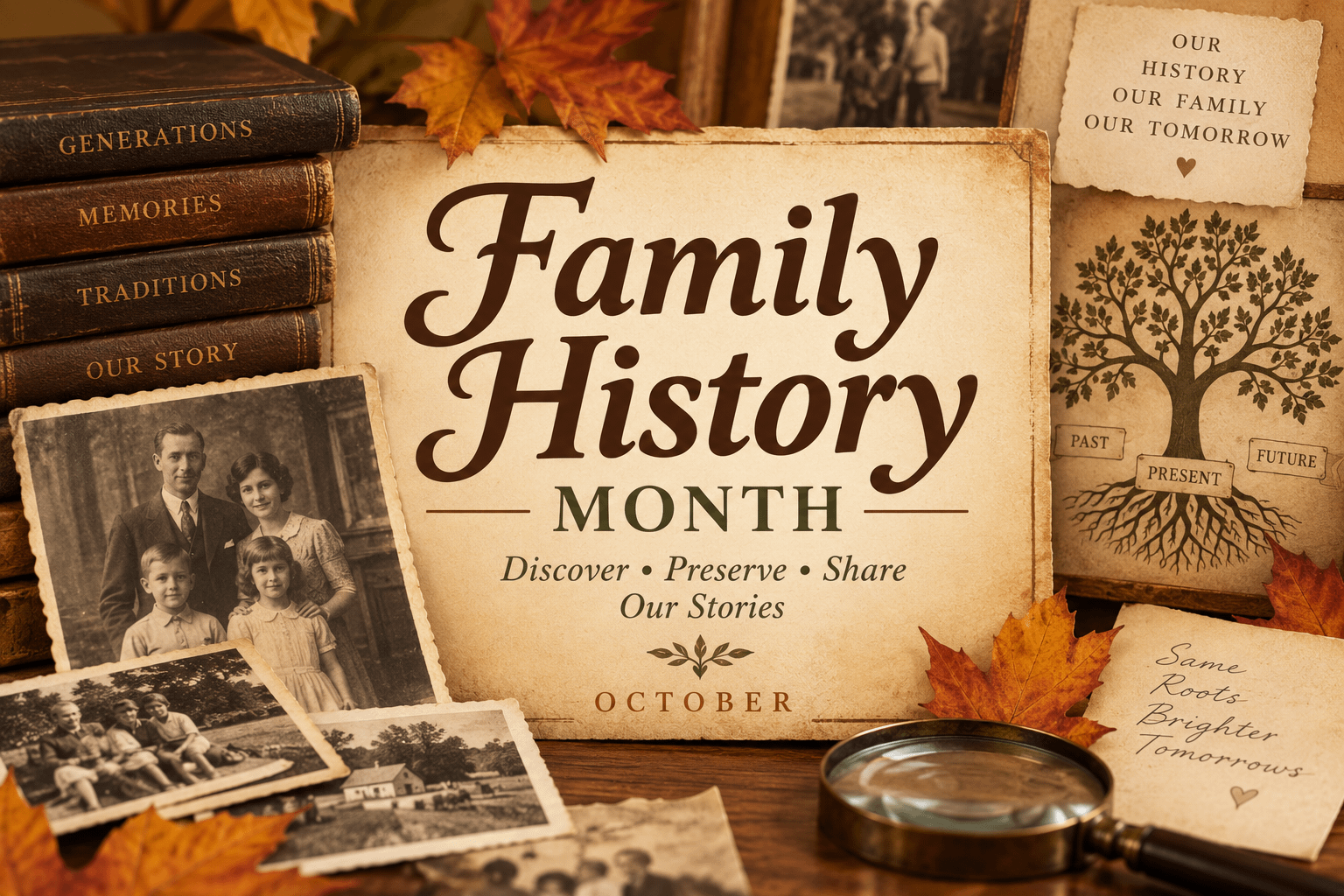
Family History Month, observed during October, gives us an opportunity to slow down, look into the past, and learn more about the people and experiences that helped shape our families.
Researching family history is about much more than building a family tree filled with names and dates. It is about discovering people. It is about understanding where they lived, what they experienced, what they believed, what they overcame, and how their choices eventually became part of our own story.
Perhaps most importantly, Family History Month reminds us to preserve the stories we still have before they disappear.
Every Family Has a History Worth Remembering
When people hear the words “family history,” they sometimes imagine genealogy charts stretching back hundreds of years.
Genealogy is certainly an important part of it, but family history can be much more personal.
It can be the story your grandfather told about his first job.
It can be the recipe your grandmother made every Christmas.
It can be the photograph of your parents when they were young.
It can be a handwritten letter stored in an old box.
It can be the story of a family member who served in the military, started a business, raised children through difficult circumstances, immigrated to a new country, survived hardship, or quietly spent a lifetime helping others.
These stories might never appear in a history textbook, but they are still history.
They are your family’s history.
Why Knowing Where We Come From Matters
Learning about previous generations can help us understand our own lives differently.
You might discover that a tradition you have followed for years began several generations ago. You might learn why your family settled in a particular city or state. You may uncover occupations that appeared repeatedly throughout your family tree.
Sometimes you discover similarities between yourself and relatives you never had the opportunity to meet.
Perhaps an ancestor loved cooking.
Maybe someone was a writer.
Perhaps entrepreneurship runs through several generations.
Maybe relatives were known for their faith, generosity, humor, determination, or ability to bring people together.
Discoveries like these can create a powerful sense of connection.
The people who came before us lived complete lives filled with hopes, disappointments, relationships, struggles, celebrations, and dreams. Learning their stories transforms them from names on a family tree into real human beings.
Start With the People Who Are Still Here
One of the best ways to celebrate Family History Month does not require a subscription, database, or complicated research project.
Talk to your family.
Parents, grandparents, older siblings, aunts, uncles, cousins, and longtime family friends may know stories that have never been written down.
Ask them questions.
Where did you grow up?
What was your childhood home like?
What did you do for fun?
What was school like?
What was your first job?
How did you meet your husband or wife?
What were your parents like?
What traditions did your family have?
What was the hardest period of your life?
What accomplishment are you most proud of?
What do you remember about your grandparents?
What advice would you want future generations of our family to hear?
Then listen.
Don’t worry about conducting a perfect interview. Allow the conversation to wander. Sometimes a simple question leads to a memory nobody expected.
With permission, record the conversation.
Years from now, hearing someone’s voice telling their own story may become one of your family’s most treasured possessions.
Look Through Old Photographs
Old photographs are another wonderful doorway into family history.
Pull out photo albums, boxes of photographs, slides, or old digital folders and go through them with relatives.
Instead of simply asking, “Who’s this?” ask for the story behind the picture.
Where was it taken?
What year was it?
Why was everyone together?
Who took the photograph?
What happened that day?
What was happening in the family’s life at the time?
Write down the answers.
A photograph of five unidentified people may mean very little to someone 50 years from now. A photograph labeled with names, dates, locations, relationships, and a short story suddenly becomes a historical record.
If you have physical photographs, consider scanning them and creating digital backups.
The photograph can fade.
The paper can deteriorate.
But creating multiple copies gives future generations a better chance of seeing them.
Search Through Family Documents
Many homes contain historical treasures without anyone realizing it.
Look through old boxes, filing cabinets, closets, attics, and storage containers for documents such as birth and marriage certificates, military papers, school records, newspaper clippings, postcards, letters, diaries, funeral programs, church records, immigration documents, property records, diplomas, and old family Bibles.
Even ordinary objects can tell stories.
A restaurant menu might remind someone of a family business.
A concert ticket may represent someone’s first date.
A recipe card written in a grandmother’s handwriting may have been used for decades.
An old driver’s license can show where someone lived at a particular point in life.
Family history is often hiding inside things people nearly throw away.
Build a Family Tree
If you have never researched your genealogy, Family History Month is an excellent time to begin.
Start with yourself and work backward.
Write down your parents’ full names, birth information, and important life events. Then add your grandparents and great-grandparents as far as your information allows.
Do not worry if there are gaps.
Those unanswered questions become your research list.
Genealogy websites, census records, historical newspapers, cemetery records, military records, libraries, archives, and local historical societies may help you uncover additional information.
But remember an important rule of family-history research:
Verify what you find.
Online family trees can contain mistakes that get copied from one tree to another. Whenever possible, compare information against original or reliable historical records.
Finding evidence is part of the adventure.
Preserve Family Recipes
Food carries history remarkably well.
A particular meal can transport someone back decades with a single smell or taste.
Maybe your family has a special Thanksgiving dish.
Perhaps someone makes a particular Christmas dessert every year.
Maybe your grandfather had a famous barbecue sauce.
Perhaps your mother makes something exactly the way her mother taught her.
Write those recipes down.
Better yet, preserve the stories behind them.
Who originally made the recipe?
Was it served on special occasions?
Did the recipe change over the years?
Was anything measured, or did Grandma simply know when it looked right?
Family cookbooks can become incredible historical records because they preserve both food and memories.
Record the Stories Behind Family Traditions
Traditions sometimes survive long after everyone has forgotten how they started.
Family History Month is a good opportunity to investigate them.
Maybe your family always gathers at someone’s house for Thanksgiving.
Perhaps you visit the same vacation destination every summer.
Maybe everyone makes the same meal on Christmas Eve.
Perhaps certain names have been passed through generations.
Ask why.
There may be a fascinating story behind something your family has been doing automatically for decades.
Remember Those Who Are No Longer With Us
Family history inevitably brings us to people we love who are no longer physically here.
That can make researching our families emotional.
But remembering someone is also a way of continuing their story.
Write down your memories of them.
Describe their personality.
Record their favorite sayings.
Save photographs.
Write about the things they taught you.
Remember the moments that made you laugh.
Document what made them unique.
We sometimes assume we will always remember everything about the people we love. But time changes memories. Small details can slowly become harder to recall.
Writing them down protects them.
The stories of people we love deserve more than a name and two dates on a family tree.
Their lives were everything that happened between those dates.
Write Your Own Story Too
Family history does not end with previous generations.
You are part of your family’s history.
Future generations may someday want to know about your life just as much as you want to know about your ancestors.
What was your childhood like?
What major events shaped your life?
What mistakes taught you the greatest lessons?
What dreams did you pursue?
Who influenced you?
What traditions mattered to you?
What were the happiest periods of your life?
What were the hardest?
What do you want your children, grandchildren, or future relatives to understand about you?
You do not need to write an autobiography.
Start with one story.
Then another.
Over time, those stories become something incredibly valuable.
Create a Family History Time Capsule
Another way to celebrate Family History Month is by creating a family time capsule.
Include photographs, handwritten letters, favorite recipes, family stories, children’s drawings, newspaper clippings, copies of important documents, and information about what life is like today.
You could even ask each family member to write a letter to future generations.
Describe your everyday life.
What music do you listen to?
What foods do you enjoy?
What technology do you use?
What are you worried about?
What are you excited about?
What do you hope the future looks like?
Ordinary details today can become fascinating history tomorrow.
Get Children Involved
Family history should not only belong to older generations.
Children can participate too.
Show them photographs of relatives when they were children. Tell funny family stories. Let them interview grandparents. Teach them family recipes. Visit places where relatives lived.
Instead of presenting genealogy as a collection of names and dates, turn it into storytelling.
Tell them:
“This was your great-grandfather. Here’s what he did.”
“This is where your grandmother grew up.”
“This recipe came from your great-grandmother.”
“This photograph was taken before you were born, and here’s what happened that day.”
When children understand that history includes real people connected to them, it can become much more meaningful.
Visit Places Connected to Your Family
If possible, visit locations that played an important role in your family’s story.
Drive past an old family home.
Visit a hometown.
Walk through a cemetery where relatives are buried.
Visit a church family members attended.
Explore a neighborhood where previous generations lived.
Visit a school they attended or the location where a family business once stood.
Standing in the same place where previous generations once stood can make history feel remarkably real.
Take photographs and document the visit for future generations.
Don’t Wait to Ask the Questions
One of the biggest lessons family historians learn is painfully simple:
We often think we have more time.
We tell ourselves we will ask Grandpa about his childhood someday.
We’ll ask Mom who is in those old photographs later.
We’ll record Dad telling that story next time.
We’ll organize Grandma’s recipes eventually.
Then circumstances change.
And suddenly the person who knew the answer isn’t there to ask anymore.
That is why preserving family history matters now.
You do not need to complete your entire family tree during Family History Month.
Simply begin.
Ask one question.
Record one conversation.
Scan one photograph.
Write one memory.
Save one recipe.
Identify one person in an old photograph.
Every small action preserves another piece of your family’s story.
Family History Is Really About People
Genealogy can involve dates, documents, databases, DNA matches, records, and research.
But underneath all of it are people.
People who loved.
People who struggled.
People who made mistakes.
People who worked.
People who raised families.
People who experienced heartbreak.
People who celebrated victories.
People who endured difficult times.
People who dreamed about a future they would never completely see.
Eventually, their future became our present.
And one day, our present will become someone else’s family history.
Preserve the Story While You Can
Family History Month reminds us that history isn’t only something that happened hundreds of years ago.
History happened yesterday.
It happened when your grandparents met.
It happened when your parents brought you home.
It happened during family vacations, birthday parties, weddings, Sunday dinners, ordinary conversations, difficult seasons, and unforgettable celebrations.
It is happening right now.
Take photographs.
Write things down.
Ask questions.
Record voices.
Save recipes.
Tell stories.
Preserve memories.
Because generations from now, someone in your family may discover your name and wonder:
Who were they? What was their life like? What did they love? What did they overcome?
The stories we preserve today may someday provide those answers.
Family History Month is not simply about looking backward.
It is about creating a bridge between the people who came before us, the people who are here today, and the generations who will come after us.
What family story would you most want future generations to remember?
Leave a Reply