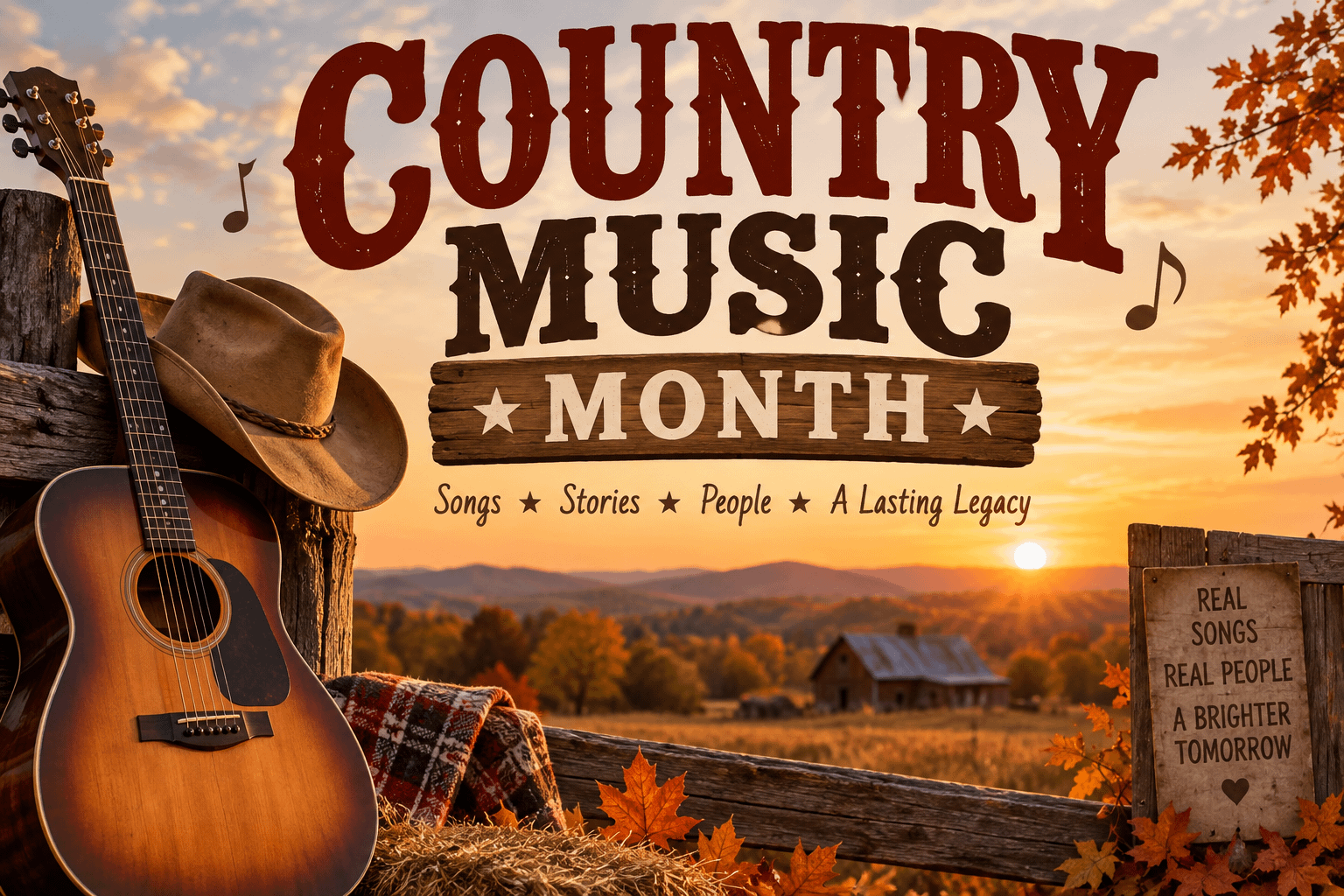
Every October, Country Music Month gives music lovers an opportunity to celebrate a genre built on storytelling, emotion, tradition, and everyday life. From songs about falling in love and raising a family to heartbreak, faith, small towns, hard work, loss, and starting over, country music has spent generations putting real human experiences into words.
Country music has changed dramatically over the years. The sounds heard on today’s country radio are often very different from the recordings that helped establish the genre generations ago. Yet underneath those changes remains something familiar: a great country song tells a story.
Sometimes that story makes us smile. Sometimes it reminds us of someone we love. Sometimes it brings back a memory we thought we had forgotten.
And sometimes a country song seems to understand exactly what we are going through.
That is part of what makes Country Music Month worth celebrating.
When Is Country Music Month?
Country Music Month is traditionally celebrated throughout October in the United States.
The observance has roots stretching back decades and provides an opportunity to recognize country music’s history, performers, songwriters, musicians, fans, and cultural influence.
But Country Music Month isn’t only about looking backward.
It is also a celebration of where country music is today and where the next generation of artists will take it tomorrow.
Country Music Has Always Been About Stories
One of country music’s greatest strengths is storytelling.
You don’t necessarily need complicated lyrics or an elaborate production to create a memorable country song. Sometimes all it takes is a guitar, a voice, and a story people recognize from their own lives.
Country songs have been written about nearly everything imaginable.
Love.
Marriage.
Divorce.
Family.
Children.
Faith.
Death.
Grief.
Friendship.
Drinking.
Working.
Driving.
Small towns.
Saturday nights.
Sunday mornings.
Mistakes.
Second chances.
And the desire to find your way home.
The details might change from generation to generation, but the emotions remain remarkably familiar.
That is why a song recorded decades ago can still speak to someone hearing it for the first time today.
The Roots of Country Music
Modern country music developed from several musical traditions, particularly those found throughout the American South and Appalachia.
Folk songs, ballads, fiddle music, gospel, blues, and other musical traditions all contributed to the development of what eventually became known as country music.
Early musicians often performed with relatively simple instruments.
Fiddles, guitars, banjos, mandolins, and other acoustic instruments became closely associated with the genre.
During the early twentieth century, advances in recording technology and radio allowed regional musicians to reach audiences far beyond their hometowns.
Country music was beginning its journey from porches, churches, dances, and community gatherings into homes across America.
The Bristol Sessions and Early Country Recording
One important moment in country music history occurred with the Bristol Sessions of 1927, recording sessions held in Bristol, Tennessee.
These sessions featured performers including the Carter Family and Jimmie Rodgers, artists who would become enormously influential in the development of country music.
The Carter Family helped establish a style of harmony, songwriting, and guitar playing that influenced generations of musicians.
Jimmie Rodgers became known for his distinctive singing and yodeling and is remembered as one of country music’s early major stars.
The success of these recordings demonstrated that there was a substantial audience for this developing musical style.
Country music was beginning to become a commercial industry.
Nashville Becomes the Heart of Country Music
No city is more closely associated with country music than Nashville, Tennessee.
Nashville’s importance grew considerably through radio, recording studios, publishers, musicians, and live performances.
One institution became particularly important: the Grand Ole Opry.
Beginning as a radio program in 1925, the Opry eventually became one of country music’s most recognizable institutions.
Appearing on the Grand Ole Opry stage became a milestone for countless country performers.
Nashville eventually earned its famous nickname:
Music City.
Songwriters arrived hoping someone would record their songs.
Musicians came looking for opportunities.
Singers arrived carrying dreams of becoming the next country star.
Those dreams continue today.
The Legends Who Helped Shape Country Music
Country music’s history is filled with performers whose voices and songs helped define different generations.
Hank Williams became one of the genre’s most influential songwriters and performers. Songs such as “Your Cheatin’ Heart,” “I’m So Lonesome I Could Cry,” and “Hey, Good Lookin’” became country standards.
Johnny Cash created a sound and image unlike almost anyone else. The Man in Black sang about love, faith, prisoners, working people, mistakes, redemption, and the darker sides of life.
Patsy Cline brought an unforgettable voice to songs filled with longing and heartbreak.
Loretta Lynn wrote candidly about women’s experiences, marriage, motherhood, poverty, and everyday struggles.
George Jones became famous for a voice capable of delivering extraordinary emotion.
Merle Haggard wrote about working-class life, prison, regret, independence, and America.
Willie Nelson developed his own unmistakable style while becoming one of the leading figures associated with outlaw country.
Dolly Parton combined songwriting, musicianship, personality, and storytelling into a career that crossed generations and musical boundaries.
And those names represent only a small part of country music’s enormous history.
Country Music Isn’t Afraid of Heartbreak
Few genres embrace heartbreak as completely as country music.
Country singers don’t always pretend everything will be fine.
Sometimes the relationship ends.
Sometimes someone leaves.
Sometimes the person you love chooses someone else.
Sometimes you realize you made the mistake.
Sometimes you can’t fix what happened.
Country music gives people permission to sit with those emotions.
A heartbreaking song can strangely become comforting because it reminds us that someone else has experienced something similar.
There is something powerful about hearing another person sing the words you couldn’t figure out how to say yourself.
Country Music and Grief
Country music also has a long history of addressing death and grief.
Losing someone you love changes the way you experience music.
A song you once enjoyed casually can suddenly carry an entirely different meaning after someone important is gone.
Certain lyrics can bring memories rushing back.
A song can remind you of a car ride.
A family gathering.
A concert.
A relationship.
A parent.
A friend.
Or a child.
Sometimes music hurts because it reminds us of what we lost.
But music can also help us remember.
The people we love become connected to songs, places, photographs, traditions, and memories. Hearing a familiar country song years later can make it feel, even briefly, as though a piece of that person has returned.
That is one reason music becomes such an important part of grief.
Faith Has Always Had a Place in Country Music
Faith and gospel traditions have deeply influenced country music.
Many country artists have recorded gospel albums, hymns, or songs about God, prayer, forgiveness, redemption, and heaven.
That connection makes sense considering the communities where much early country music developed.
Sunday morning church music and Saturday night country music often existed in the same towns and sometimes within the same families.
Country songs have frequently explored the struggle between temptation and faith.
People make mistakes.
They lose their way.
They ask forgiveness.
They search for hope.
They try again.
Those themes have appeared throughout country music for generations.
The Rise of the Honky-Tonk Sound
As country music developed, different styles began emerging.
Honky-tonk became particularly important during the 1940s and 1950s.
The music often featured strong rhythms, steel guitar, fiddle, and lyrics dealing with relationships, drinking, loneliness, and working-class life.
These weren’t necessarily stories about perfect people living perfect lives.
They were songs about complicated people.
That honesty became part of country music’s identity.
The Nashville Sound
During the late 1950s and 1960s, country music producers began developing a smoother style that became known as the Nashville Sound.
Traditional instruments were sometimes supplemented or replaced by polished arrangements, background vocals, strings, and pop-influenced production.
The approach helped country performers reach broader audiences.
Country music was discovering that it could maintain its storytelling roots while experimenting with sounds that appealed to listeners outside its traditional audience.
That conversation—between tradition and change—continues today.
Outlaw Country Changes the Rules
By the 1970s, some performers wanted greater creative control over their music.
Artists associated with the outlaw country movement challenged parts of Nashville’s established system.
Willie Nelson and Waylon Jennings became two of the movement’s best-known figures.
The term “outlaw” wasn’t simply about behaving badly.
It represented independence.
Artists wanted control over their songs, musicians, production, and image.
That independent spirit influenced country music long after the original outlaw movement faded.
Country Music Explodes in the 1990s
The 1990s became another enormous period for country music.
Artists including Garth Brooks, Shania Twain, Alan Jackson, George Strait, Brooks & Dunn, Reba McEntire, Tim McGraw, Faith Hill, Vince Gill, Clint Black, and many others brought country music to massive audiences.
Country concerts filled arenas and stadiums.
Music videos introduced performers to new fans.
Country radio became enormously influential.
Traditional sounds existed alongside increasingly pop-oriented productions.
It was another example of country music constantly evolving while maintaining connections to its past.
Today’s Country Music
Modern country music contains an enormous range of sounds.
Some artists embrace traditional country.
Others incorporate rock, pop, folk, blues, Americana, hip-hop, or other influences.
That variety occasionally creates debates about what should or shouldn’t be considered country music.
But debates over changing sounds aren’t new.
Country music has repeatedly evolved.
Every generation introduces new instruments, production techniques, songwriting approaches, and influences.
The interesting question isn’t necessarily whether country music changes.
It always has.
The question is what remains underneath those changes.
And one answer continues to be storytelling.
The Songwriters Behind the Stars
Country Music Month should also celebrate the people whose names many listeners never know.
The songwriters.
Some country performers write most of their own material, while others record songs written by professional songwriters.
Nashville has developed an extraordinary songwriting culture.
Writers gather in rooms with guitars, notebooks, phones, and ideas.
Someone might bring a title.
Someone else has a melody.
Another person remembers a phrase from a conversation.
A few hours later, there might be a song.
That song could eventually become part of someone’s wedding.
Or their breakup.
Or a funeral.
Or a road trip.
Or simply a song they play whenever they need to feel something.
Songwriters rarely know where their words will eventually travel.
Country Music Connects Generations
Music has an unusual ability to connect generations.
A grandfather might introduce his grandson to Johnny Cash.
A mother might play Dolly Parton for her daughter.
Someone who grew up listening to George Strait might later discover a younger artist who reminds them of the country music they loved growing up.
Then that younger listener might discover Hank Williams, Patsy Cline, or Loretta Lynn.
Suddenly, music recorded decades apart exists together on the same playlist.
That is how musical traditions survive.
One generation introduces the songs to another.
Country Music Is Road-Trip Music
There is something about country music and driving that simply belongs together.
Maybe it is because country songs contain so many roads.
Highways.
Pickup trucks.
Small towns.
Gas stations.
County lines.
Old hometowns.
Places someone is trying to leave.
And places someone desperately wants to return to.
Country music understands that sometimes driving isn’t simply transportation.
Sometimes you drive because you need time to think.
Sometimes you need to clear your head.
Sometimes you need the radio loud enough to drown out everything else.
And sometimes the perfect song comes on at exactly the right moment.
Country Music Celebrates Ordinary Life
Not every song needs to describe an extraordinary event.
Country music has always found stories in ordinary moments.
Sitting on a porch.
Having a beer with friends.
Cooking dinner.
Working a long shift.
Watching children grow up.
Dancing with someone you love.
Going fishing.
Driving home.
Remembering someone who is gone.
Those moments may seem small while they are happening.
Later, they often become the memories we treasure most.
Country music understands that.
How to Celebrate Country Music Month
October provides plenty of ways to celebrate.
Create a playlist combining classic and modern country songs.
Listen to an artist you’ve never heard before.
Go back and explore the music your parents or grandparents loved.
Attend a local country concert.
Support an independent singer or songwriter.
Watch performances from country music’s past.
Learn about the history of the Grand Ole Opry.
Try writing your own country song.
Visit a local venue featuring live country music.
Or simply spend an evening listening to the songs that mean the most to you.
Country Music Month doesn’t require a complicated celebration.
Sometimes celebrating music simply means pressing play.
Make a Country Music Memory Playlist
One meaningful idea is creating a playlist connected to different chapters of your life.
Choose songs that remind you of childhood.
Add songs from your teenage years.
Include music connected to your first love.
Add the songs you listened to during difficult periods.
Include songs that remind you of people you have lost.
Add songs representing where your life is today.
You may discover that the finished playlist becomes something more than music.
It becomes an autobiography told through songs.
Support Independent Country Artists
Country music isn’t limited to major record labels and famous performers.
Thousands of independent musicians perform in bars, restaurants, fairs, festivals, clubs, churches, community events, and online.
Some may never become household names.
That doesn’t make their music less meaningful.
Every legendary performer was once an unknown musician hoping someone would listen.
Country Music Month is a great opportunity to discover someone new.
Listen to an independent artist.
Share their music.
Attend their performance.
Buy their merchandise.
Tell someone else about them.
Sometimes one new listener can make a difference.
Why Country Music Continues to Matter
Technology changes.
Fashion changes.
Radio changes.
The music industry changes.
But people don’t change nearly as much as we sometimes think.
We still fall in love.
We still get our hearts broken.
We still miss people.
We still make mistakes.
We still worry about our families.
We still search for meaning.
We still hope tomorrow will be better.
And we still need stories that remind us we aren’t experiencing those things alone.
Country music has been telling those stories for generations.
That is why the genre continues to survive every transformation.
Celebrating the Heart of Country Music
Country Music Month is ultimately about more than cowboy hats, guitars, pickup trucks, or Nashville.
It is about stories.
Stories of people trying to build a life.
Stories of people falling in love.
Stories of relationships falling apart.
Stories of parents and children.
Stories of faith.
Stories of grief.
Stories of mistakes.
Stories of redemption.
Stories about leaving home.
And stories about finally finding your way back.
Country music has never required its characters to be perfect.
Maybe that is why so many people recognize themselves in the songs.
A great country song can make you laugh on Friday night, think about your life on Saturday, and give you hope on Sunday morning.
It can remind you of someone you haven’t seen in years.
It can bring back a moment you thought you had forgotten.
And sometimes, when life becomes difficult, one song can make you feel a little less alone.
So during Country Music Month this October, turn up your favorite song.
Remember the legends.
Discover someone new.
Support the songwriters and musicians keeping the tradition alive.
And celebrate a style of music that has spent generations telling the stories of ordinary people living extraordinary lives.
What country song brings back the strongest memory for you?
Leave a Reply