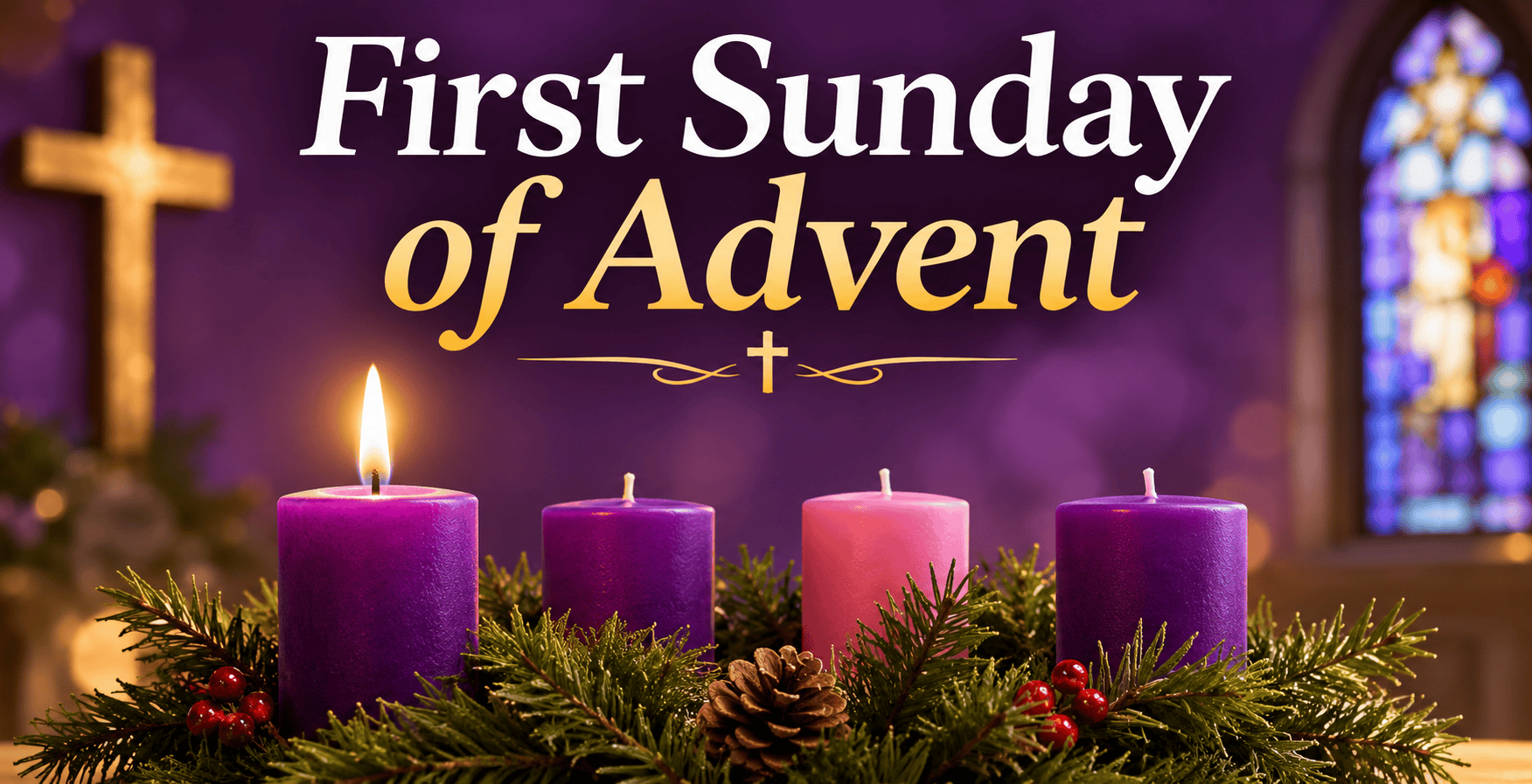
The First Sunday of Advent marks the beginning of one of the most meaningful seasons in the Christian calendar. It is a time of hope, reflection, preparation, and anticipation as Christians around the world begin their spiritual journey toward Christmas and the celebration of the birth of Jesus Christ.
While the holiday season often brings decorations, shopping, family gatherings, and festive celebrations, Advent invites believers to slow down and focus on the deeper meaning of Christmas. It encourages Christians to prepare their hearts, strengthen their faith, and remember the promise of hope that comes through Jesus Christ.
The First Sunday of Advent is especially significant because it begins a four-week period of spiritual preparation leading up to Christmas Day.
In 2026, the First Sunday of Advent falls on November 29, beginning the Advent season that continues through December 24.
What Is the First Sunday of Advent?
The First Sunday of Advent is the opening Sunday of the Advent season, a period of preparation observed by many Christian denominations, including Roman Catholics, Lutherans, Anglicans, Methodists, and other Protestant traditions.
The word “Advent” comes from the Latin word adventus, meaning “coming” or “arrival.”
In Christianity, Advent focuses on two important aspects of faith:
- Remembering the birth of Jesus Christ in Bethlehem.
- Looking forward to the promised second coming of Jesus Christ.
This combination of remembrance and anticipation makes Advent a season of both celebration and spiritual reflection.
Unlike Christmas Day, which celebrates Christ’s birth, Advent emphasizes preparing for His coming.
The First Sunday of Advent sets the tone for the entire season by focusing on hope, faith, and God’s promises.
When Is the First Sunday of Advent in 2026?
The First Sunday of Advent in 2026 will be observed on Sunday, November 29.
Advent begins on the fourth Sunday before Christmas Day and lasts until Christmas Eve.
The four Sundays of Advent in 2026 are:
- November 29: First Sunday of Advent — Hope
- December 6: Second Sunday of Advent — Peace
- December 13: Third Sunday of Advent — Joy
- December 20: Fourth Sunday of Advent — Love
These themes are widely used in contemporary Advent celebrations, although traditional liturgical readings and emphases vary among Christian denominations.
Advent also marks the beginning of a new liturgical year in many Western Christian churches.
For believers, this represents an opportunity for spiritual renewal and a fresh beginning in their relationship with God.
The History of Advent
The observance of Advent developed during the early centuries of Christianity.
Although historians cannot identify one exact date when Advent began, evidence of preparation for Christmas appears in Christian communities during the fourth and fifth centuries.
Early Advent practices varied by region.
In some Christian communities, Advent involved fasting, prayer, and repentance. These practices were intended to help believers prepare spiritually for the celebration of Christ’s birth.
In parts of Western Europe, Advent was originally observed over a longer period than the four weeks commonly recognized today.
Over time, the Western Church gradually established the four-Sunday Advent structure.
By the medieval period, Advent had become an important part of the Christian liturgical calendar.
Today, millions of Christians observe Advent through worship services, Scripture readings, prayer, candle lighting, charitable activities, and family traditions.
Although customs differ, the central purpose remains the same: preparing spiritually for the coming of Christ.
The Meaning of the First Sunday of Advent: Hope
The First Sunday of Advent is commonly associated with hope.
Hope is one of the most powerful themes in Christianity because it reminds believers that God’s promises remain trustworthy even during difficult circumstances.
The Advent message of hope is rooted in the belief that Jesus Christ came into the world as the fulfillment of God’s promise of salvation.
For centuries before the birth of Jesus, the people of Israel awaited the promised Messiah.
Christians understand the birth of Jesus as the fulfillment of that long-awaited promise.
The First Sunday of Advent encourages believers to remember that waiting does not mean God has forgotten them.
Hope is especially meaningful for people experiencing uncertainty, loneliness, grief, hardship, or personal struggles.
During Advent, Christians are reminded that even when life feels dark, God’s light continues to shine.
Hope does not require pretending that everything is perfect.
Instead, it means trusting that God remains present through life’s challenges.
The First Advent Candle: The Candle of Hope
One of the most recognizable Advent traditions is the lighting of candles on an Advent wreath.
The Advent wreath usually consists of evergreen branches arranged in a circle with four candles placed around it.
Many churches and families use three purple candles and one pink candle, although some traditions use blue candles instead of purple.
On the First Sunday of Advent, the first candle is lit.
This candle is commonly called the Candle of Hope or the Prophecy Candle.
It symbolizes the hope associated with God’s promises and the anticipation of the coming Messiah.
The candle’s light also serves as a reminder of Jesus Christ as the light of the world.
Each additional Sunday, another candle is lit until all four candles are burning.
Some Advent wreaths also include a fifth white candle in the center, known as the Christ Candle, which is traditionally lit on Christmas Eve or Christmas Day.
What Does the Advent Wreath Symbolize?
The Advent wreath contains several meaningful Christian symbols.
The circular shape: Represents eternity and God’s everlasting love, without beginning or end.
Evergreen branches: Symbolize enduring life and the hope of eternal life through Christ.
The candles: Represent the growing light as Christmas approaches.
The purple candles: Traditionally symbolize penitence, preparation, and spiritual reflection.
The pink candle: Commonly represents joy and is lit on the Third Sunday of Advent, known as Gaudete Sunday.
Together, these symbols help Christians focus on the spiritual significance of the Christmas season.
Bible Verses for the First Sunday of Advent
Scripture plays an important role in Advent observances.
Churches often select readings from the Old Testament prophets, the Gospels, and other biblical passages that emphasize hope, watchfulness, and God’s promises.
Several Bible passages are especially meaningful during the First Sunday of Advent.
Isaiah 9:6
“For unto us a child is born, unto us a son is given.”
This verse reminds Christians of the promised Messiah and the hope associated with the birth of Jesus.
Romans 15:13
“Now the God of hope fill you with all joy and peace in believing.”
This passage emphasizes the relationship between faith, hope, joy, and peace.
Isaiah 40:31
“But they that wait upon the LORD shall renew their strength.”
This verse offers encouragement to those who are waiting for answers, healing, or direction in their lives.
John 8:12
“I am the light of the world: he that followeth me shall not walk in darkness.”
This passage connects with the Advent tradition of lighting candles as a reminder of Christ’s presence.
These verses, quoted from the King James Version, can be used during family devotions, church services, or personal reflection.
How Christians Celebrate the First Sunday of Advent
The First Sunday of Advent is observed in many different ways depending on church traditions, family customs, and personal beliefs.
1. Attending Church Services
Many Christians begin Advent by attending a special Sunday worship service.
Churches may incorporate Advent hymns, Scripture readings, prayers, sermons, and the lighting of the first Advent candle.
These services encourage congregations to focus on the coming of Christ.
2. Lighting the First Advent Candle
Families often gather around an Advent wreath to light the Candle of Hope.
This tradition may include a short prayer, a Bible reading, or a discussion about the meaning of hope.
For families with children, it provides an opportunity to teach the spiritual meaning of Christmas.
3. Spending Time in Prayer
Prayer is an important part of Advent preparation.
The First Sunday of Advent offers an opportunity to thank God for His blessings, seek spiritual guidance, and pray for those experiencing difficulties.
Some believers begin daily Advent prayers that continue until Christmas.
4. Reading an Advent Devotional
Advent devotionals provide daily Scripture readings and reflections designed to help Christians prepare spiritually for Christmas.
These readings often focus on hope, faith, repentance, peace, joy, and love.
5. Practicing Kindness and Generosity
Advent is also a meaningful time to demonstrate Christian love through acts of kindness.
Helping someone in need, donating food, volunteering, or offering encouragement can reflect the spirit of the season.
6. Creating Family Traditions
Families may begin Advent calendars, read Christmas-related Bible passages, sing hymns, or spend quiet evenings reflecting on their faith.
These traditions can create lasting memories while keeping the spiritual meaning of Christmas at the center of the celebration.
The First Sunday of Advent and the Importance of Waiting
One of Advent’s most important lessons is learning how to wait with faith.
Modern life often encourages immediate results.
People want quick answers, fast solutions, and instant satisfaction.
Advent offers a different perspective.
It reminds Christians that some of life’s most meaningful blessings require patience, trust, and preparation.
The people of Israel waited generations for the promised Messiah.
Christians today continue to wait in hope for Christ’s return.
This spiritual waiting is not meant to be passive.
Instead, Advent encourages believers to remain faithful, practice compassion, strengthen their relationship with God, and live with purpose.
The First Sunday of Advent reminds us that waiting can become a season of growth rather than simply a period of uncertainty.
Finding Hope During Difficult Times
Although Advent is often associated with happiness and celebration, the Christmas season can be emotionally challenging.
For people grieving the loss of a loved one, experiencing loneliness, struggling financially, or facing family difficulties, the holidays may bring painful reminders of what is missing.
The First Sunday of Advent offers a message that can be especially meaningful during these moments.
Hope does not erase grief.
Faith does not mean a person will never experience sadness.
And celebrating Christmas does not require someone to hide their pain.
Instead, Advent invites people to acknowledge their struggles while holding on to the possibility of comfort, strength, and spiritual peace.
A single candle burning in a dark room offers a powerful reminder that even a small light can be meaningful.
For someone carrying grief, that light may represent the courage to face another day.
For someone experiencing uncertainty, it may symbolize trust in God’s guidance.
For someone feeling alone, it may serve as a reminder that their life still has meaning and value.
The message of Advent is not that darkness never exists.
It is that darkness does not have to extinguish hope.
First Sunday of Advent Prayer
Heavenly Father,
As we begin this Advent season, we come before You with grateful hearts and renewed hope.
Thank You for the promise of Your love and the gift of Your Son, Jesus Christ.
During this season of preparation, help us turn our hearts toward You.
Strengthen our faith when we feel uncertain.
Bring peace to our minds when life becomes overwhelming.
Comfort those who are grieving, encourage those who feel forgotten, and bring hope to those struggling through difficult circumstances.
Help us remember that Christmas is more than decorations, gifts, and celebrations.
It is a reminder of Your everlasting love and the promise of salvation through Jesus Christ.
As we light the first Advent candle, may its flame remind us that Your light continues to shine even during our darkest moments.
Guide our words, our actions, and our thoughts throughout this holy season.
Teach us to love others, extend kindness, practice patience, and share hope wherever we go.
May this Advent season bring us closer to You.
In Jesus’ name, Amen.
Ways to Make the First Sunday of Advent More Meaningful
The First Sunday of Advent does not require elaborate preparations or expensive celebrations.
Sometimes, the simplest traditions create the most meaningful experiences.
Consider setting aside a few quiet moments to reflect on what hope means in your life.
You might begin a gratitude journal, read a favorite Bible passage, contact someone who is feeling lonely, or offer a prayer for a person facing difficult circumstances.
Families can discuss the meaning of the first Advent candle and encourage each person to share something they are hopeful about.
Individuals spending the season alone can create their own meaningful traditions through prayer, reflection, music, or acts of service.
The important thing is not how elaborate the observance becomes.
What matters is approaching the season with an open heart and a willingness to grow spiritually.
Frequently Asked Questions About the First Sunday of Advent
What date is the First Sunday of Advent in 2026?
The First Sunday of Advent falls on November 29, 2026.
What does the First Sunday of Advent represent?
It represents the beginning of the Advent season and is commonly associated with hope, preparation, and anticipation of the coming of Jesus Christ.
What candle is lit on the First Sunday of Advent?
The first candle, commonly called the Candle of Hope or Prophecy Candle, is lit on the First Sunday of Advent.
What color is the first Advent candle?
In many traditional Advent wreaths, the first candle is purple. Some churches use blue candles to emphasize hope and anticipation.
Is the First Sunday of Advent the beginning of Christmas?
The First Sunday of Advent begins the season of preparation for Christmas. In many Western Christian liturgical traditions, the Christmas season itself begins on Christmas Eve or Christmas Day.
How long does Advent last?
Advent begins on the fourth Sunday before Christmas and continues through December 24. Its length varies slightly depending on the calendar year.
Why is hope important during Advent?
Hope reminds Christians of God’s promises, the birth of Jesus Christ, and the expectation of His return. It encourages faith and perseverance during uncertain times.
Final Thoughts: A Season of Hope Begins
The First Sunday of Advent is more than the beginning of a countdown to Christmas.
It is an invitation to renew faith, embrace hope, and prepare spiritually for the celebration of Jesus Christ’s birth.
As the first Advent candle is lit, its gentle flame reminds believers that even during seasons of darkness, hope remains possible.
The weeks ahead offer opportunities to practice kindness, strengthen relationships, spend time in prayer, and reflect on the blessings that truly matter.
Whether Advent is celebrated through church services, family traditions, quiet reflection, or personal prayer, its message remains meaningful.
God’s promises endure.
His love remains constant.
And His light continues to shine.
As the First Sunday of Advent arrives on November 29, 2026, may this season bring renewed hope to every heart, peace to every home, and comfort to everyone who needs a reminder that they are not alone.
What does the message of hope mean to you as you begin this Advent season?



Leave a Reply