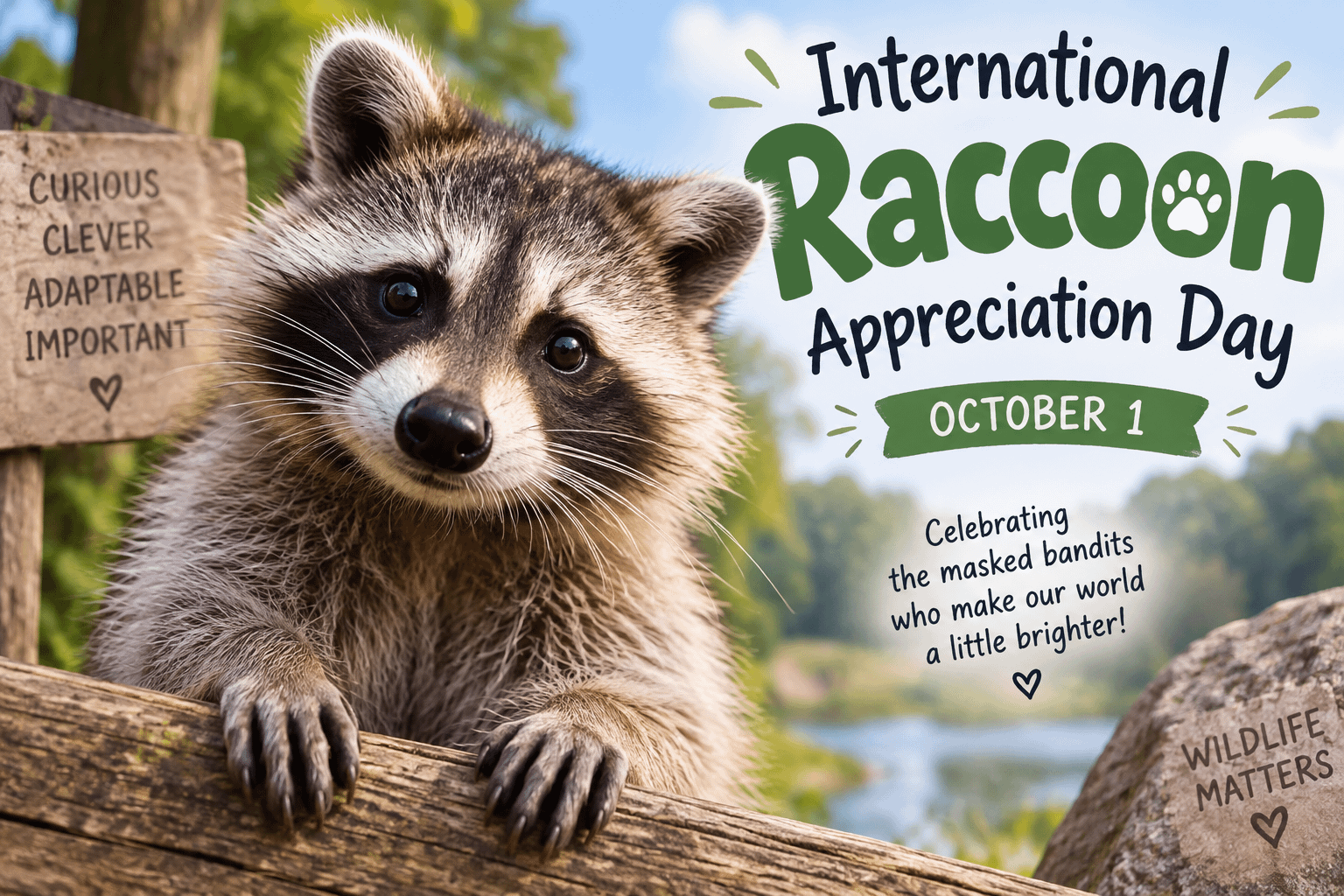
Every year on October 1, International Raccoon Appreciation Day gives us an opportunity to recognize one of the most intelligent, adaptable, and misunderstood animals living alongside humans.
Raccoons are instantly recognizable by their gray fur, ringed tails, pointed faces, and distinctive black markings around their eyes. Those markings have earned them nicknames such as “masked bandits,” especially because raccoons have developed a reputation for sneaking into garbage cans, gardens, campsites, and anywhere else they might discover an easy meal.
But there is much more to raccoons than their talent for finding food.
International Raccoon Appreciation Day encourages people to learn about these fascinating animals, understand the important role they play in ecosystems, appreciate wildlife responsibly, and consider how humans and wild animals can coexist.
What Is International Raccoon Appreciation Day?
International Raccoon Appreciation Day is observed annually on October 1.
The day is dedicated not only to raccoons but also to increasing awareness of animals that are sometimes misunderstood, considered pests, or overlooked because they live so close to human communities.
Raccoons are particularly good representatives of this idea.
As cities and suburbs have expanded into natural habitats, raccoons have learned how to survive remarkably well around people. They may live in forests, wetlands, agricultural areas, suburbs, parks, and even densely populated cities.
Seeing a raccoon wandering through a neighborhood at night can make it seem like the animal has invaded our territory. In reality, humans and wildlife increasingly share the same landscapes.
International Raccoon Appreciation Day is an opportunity to look beyond the overturned garbage can and appreciate the animal responsible for it.
Meet the Raccoon
The common raccoon, scientifically known as Procyon lotor, is native to North America.
Perhaps its most famous feature is its black facial mask. Combined with its ringed tail, the mask makes a raccoon easy to identify.
Adult raccoons vary considerably in size depending on their environment, available food, sex, and geographic location. They have compact bodies, thick fur, sensitive paws, sharp claws, and excellent climbing abilities.
Their front paws are especially impressive.
Raccoons can manipulate objects with surprising precision. Their highly sensitive paws allow them to investigate food, containers, openings, and unfamiliar objects.
Anyone who has watched a raccoon carefully inspect something understands just how curious these animals can be.
Why Do Raccoons Look Like They Are Washing Their Food?
One of the most famous behaviors associated with raccoons is their habit of placing food or other objects into water.
This behavior has sometimes been described as “washing” food.
That description can be misleading.
Raccoons have extremely sensitive front paws, and interacting with objects in or around water may help them gather additional sensory information. They are not necessarily cleaning dinner the way a person washes an apple before eating it.
Their scientific name even reflects the behavior historically associated with them. Lotor relates to washing.
The familiar image of a raccoon sitting near water and manipulating food with its paws has become one of the animal’s defining characteristics.
Raccoons Are Excellent Problem Solvers
One reason raccoons thrive in changing environments is their intelligence.
They are naturally curious and capable problem solvers.
A raccoon encountering a closed container may investigate different ways of getting inside. If food is available behind a barrier, the animal may explore openings, handles, lids, or weak points until it discovers a solution.
Unfortunately for homeowners, that intelligence can make an ordinary garbage can look like a puzzle waiting to be solved.
It is also why simply placing a loose lid over garbage may not be enough to discourage a determined raccoon.
Their ability to learn and adapt has helped raccoons survive dramatic changes to their environment.
Masters of Adaptation
Many wild animals struggle when natural habitats are replaced by roads, buildings, neighborhoods, and commercial development.
Raccoons have demonstrated an extraordinary ability to adjust.
Urban and suburban areas can provide many things raccoons need: food, water, shelter, trees, gardens, storm drains, sheds, attics, crawl spaces, and other protected areas.
Human garbage can also become an easy food source.
A raccoon doesn’t understand that a garbage can belongs to someone. It simply smells food and investigates.
That distinction is important because many conflicts between people and raccoons can be reduced by removing whatever is attracting the animals.
Securing garbage cans, bringing pet food indoors, cleaning outdoor eating areas, protecting gardens, and blocking access to potential denning locations can make properties less attractive to wildlife.
What Do Raccoons Eat?
Raccoons are omnivores, meaning they eat both plant and animal matter.
Their diets can vary greatly depending on their habitat and season.
They may eat fruits, berries, nuts, seeds, insects, worms, eggs, aquatic animals, and other available foods. In developed areas, raccoons may also take advantage of unsecured garbage, pet food, compost, and other human-associated food sources.
This flexible diet is another major reason they are so adaptable.
Rather than depending on a single food source, raccoons can change their eating habits according to what is available.
Their adaptability is impressive, but intentionally feeding wild raccoons isn’t a good way to celebrate them.
Wild animals are generally better off when they maintain a natural distance from people.
The Famous Raccoon Mask
Why does a raccoon have that famous black mask?
The markings certainly make raccoons memorable, but researchers have proposed different ideas about their function.
One possibility is that dark fur surrounding the eyes could potentially reduce glare or contribute to visual performance under certain conditions. Facial markings can also have roles in recognition or communication in some animal species.
Whatever evolutionary advantages contributed to the pattern, the raccoon’s mask has become an unmistakable part of its appearance.
Add the striped tail and there aren’t many animals that look quite like it.
Raccoons Are Mostly Active at Night
Raccoons are generally nocturnal, which means much of their activity occurs after sunset.
Nighttime gives them opportunities to search for food while avoiding some threats and human activity.
Their senses help them navigate darkness while investigating their surroundings.
However, seeing a raccoon during daylight does not automatically mean that it is sick or has rabies.
Raccoons can sometimes be active during the day for perfectly ordinary reasons, including searching for food or caring for young.
Behavior matters.
An animal that appears severely disoriented, unusually aggressive, unable to move normally, or obviously injured should be avoided, and the appropriate local wildlife or animal-control authority can be contacted.
Never approach or attempt to handle a wild raccoon.
Baby Raccoons
Young raccoons are commonly called kits.
Female raccoons raise their young in protected denning locations. Natural dens can include tree cavities and other sheltered areas, while raccoons living around humans sometimes discover attics, chimneys, sheds, or similar structures.
Young raccoons depend heavily on their mother during the early part of their lives.
As they grow, they begin exploring their surroundings and learning the skills necessary for survival.
A mother raccoon traveling with several young kits can be an unforgettable sight, but people should admire the family from a safe distance.
A protective mother is still a wild animal.
Raccoons Are Excellent Climbers
Look at a raccoon’s paws and claws and you’ll understand why trees provide such useful escape routes.
Raccoons are strong climbers.
They can climb trees to escape danger, rest, investigate food sources, or access potential shelter.
Their climbing abilities can also create problems around homes.
Tree branches near roofs, unsecured openings, damaged vents, chimneys, and other access points can provide routes into structures.
Preventing access is usually far easier than dealing with a raccoon that has already decided your attic is a comfortable place to live.
Their Role in Nature
Raccoons aren’t simply nighttime troublemakers.
Like other wildlife, they are part of larger ecosystems.
Because raccoons consume a wide variety of foods, their feeding behavior connects them to numerous plants and animals within their habitats. They can function as both predators and scavengers.
Scavenging is particularly important in nature.
Animals that consume available organic material participate in the movement of nutrients through ecosystems.
Raccoons are also part of the food web themselves.
Understanding an animal’s ecological role doesn’t mean pretending conflicts never happen. It means recognizing that wildlife has a place in natural systems even when sharing space with humans becomes complicated.
How to Appreciate Raccoons Responsibly
International Raccoon Appreciation Day isn’t an invitation to put food outside and wait for raccoons to arrive.
One of the best ways to appreciate wildlife is to allow it to remain wild.
You can celebrate responsibly by:
- Learning more about raccoons and other native wildlife.
- Observing wild animals from a safe distance.
- Keeping garbage containers securely closed.
- Bringing pet food and water inside when appropriate.
- Avoiding intentional feeding of raccoons.
- Teaching children to respect wildlife rather than approach it.
- Supporting reputable wildlife rehabilitation and conservation organizations.
- Protecting natural habitat in your community.
- Checking your home for potential wildlife entry points.
- Sharing accurate information about raccoons instead of spreading myths.
Responsible appreciation protects both people and animals.
If You See a Raccoon
If you encounter a raccoon outside, the simplest response is usually to give it space.
Do not corner it.
Do not attempt to pet it.
Do not encourage children or pets to approach it.
Never try to capture an injured or strangely behaving raccoon with your bare hands.
If there is a legitimate safety concern, contact local animal control, wildlife officials, or a licensed wildlife professional for guidance.
Keeping pets appropriately supervised and their rabies vaccinations current is also an important part of reducing wildlife-related risks.
Living Alongside Wildlife
International Raccoon Appreciation Day represents something larger than appreciation for one animal.
It reminds us that wildlife hasn’t disappeared simply because humans built cities.
Coyotes, squirrels, foxes, birds, opossums, raccoons, deer, and countless smaller creatures continue trying to survive in landscapes that humans have dramatically altered.
Sometimes those interactions are beautiful.
Sometimes they’re inconvenient.
And occasionally they can become dangerous.
Successful coexistence requires understanding animal behavior while reducing opportunities for conflict.
A securely closed garbage container might not sound like wildlife conservation, but preventing animals from becoming dependent on human food can make a meaningful difference.
Fun Facts About Raccoons
Here are a few reasons raccoons deserve a little extra appreciation:
Their paws are incredibly sensitive. Their front paws help them investigate and manipulate their environment.
They’re excellent climbers. Trees provide raccoons with escape routes and shelter opportunities.
They’re adaptable eaters. Raccoons can consume many different foods depending on what is available.
Their tails are distinctive. The alternating rings make the raccoon one of North America’s easiest mammals to recognize.
They’re clever problem solvers. Their curiosity and ability to manipulate objects help them navigate challenging environments.
They’ve adapted remarkably well to cities. Urban environments present dangers, but they also provide food and shelter opportunities that raccoons have learned to exploit.
A baby raccoon is called a kit. Several kits may remain with their mother while learning how to survive.
Why Raccoons Deserve Appreciation
It is easy to appreciate majestic wildlife.
People travel long distances hoping to see whales, bears, eagles, elephants, and other iconic animals.
Sometimes the animals living right outside our doors receive much less admiration.
Raccoons remind us that nature doesn’t exist only in wilderness areas.
It exists in neighborhood trees.
It walks along creeks behind shopping centers.
It moves through parks after dark.
And sometimes, yes, it tries to open the garbage can.
Raccoons have survived alongside expanding human communities because they are intelligent, curious, resourceful, and adaptable.
Those qualities deserve recognition.
Celebrating International Raccoon Appreciation Day
On October 1, take a moment to appreciate the masked nighttime visitors that have become such a familiar part of North American wildlife.
Learn something new about them.
Teach children why wild animals should be respected.
Make your property less attractive to wildlife by securing potential food sources.
Support organizations that protect wildlife and natural habitats.
Most importantly, remember that appreciating a wild animal doesn’t require touching, feeding, or taming it.
Sometimes appreciation simply means understanding it.
Raccoons may occasionally make a mess, steal something from a garden, or outsmart a supposedly secure garbage lid. But behind their mischievous reputation is an animal remarkably equipped to survive in a world constantly being changed by humans.
International Raccoon Appreciation Day gives us the chance to see these familiar animals differently—not simply as masked bandits, but as intelligent and fascinating members of the natural world.
What is the most memorable encounter you’ve ever had with a raccoon?
Leave a Reply