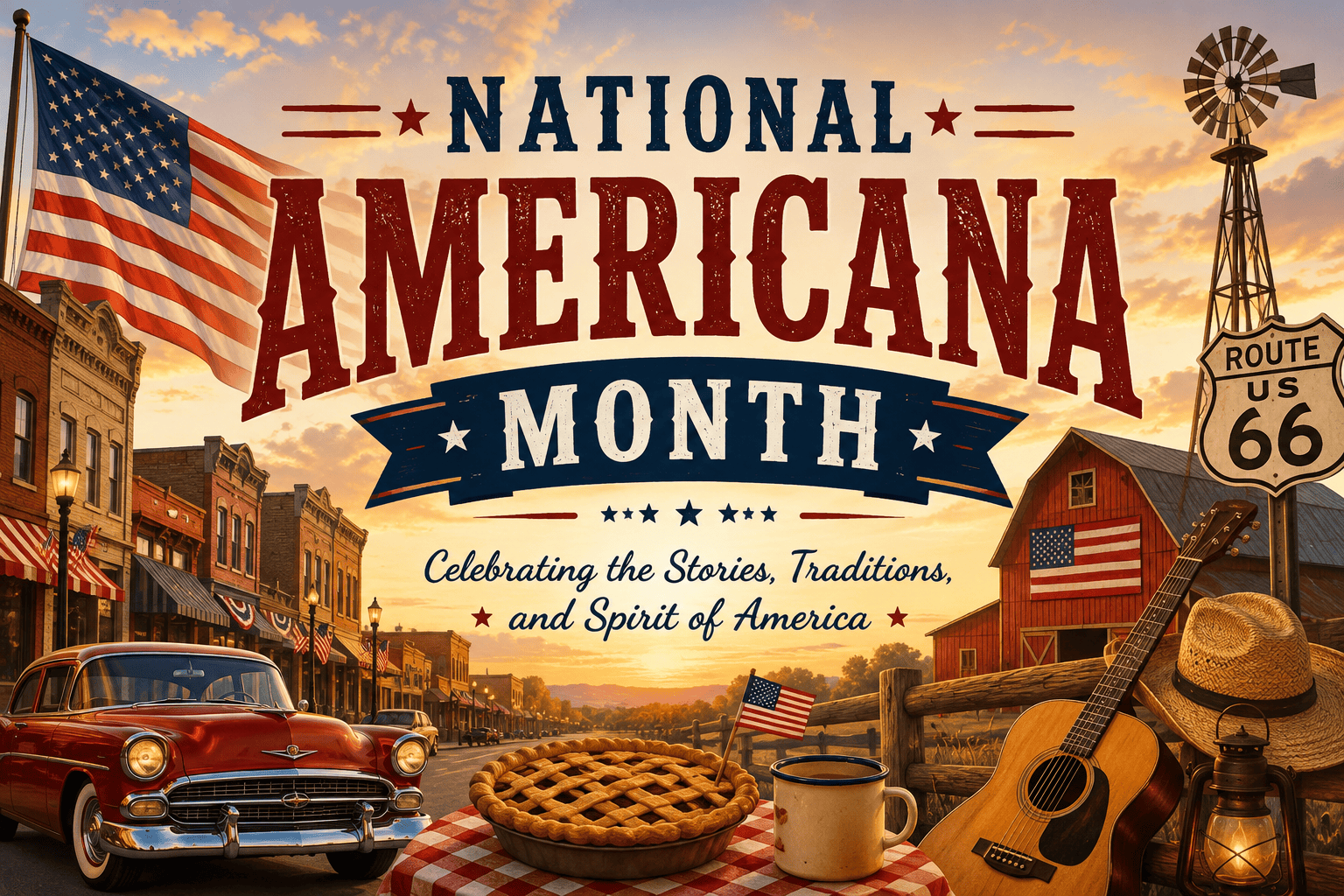
Every September, National Americana Month offers an opportunity to celebrate the traditions, stories, music, food, art, places, and everyday experiences that have helped shape American culture.
Americana is difficult to define with a single image or tradition. It might be a small-town Main Street lined with historic storefronts, a family recipe handed down through generations, a country song playing on an old radio, a county fair on a warm evening, or a road trip along a highway stretching toward the horizon.
But Americana is also much broader than nostalgia. It reflects the many people, communities, cultures, and experiences that have contributed to the American story.
National Americana Month is a chance to appreciate that story—where we have been, how the country has changed, and the traditions we continue carrying into the future.
What Is Americana?
The word Americana generally describes objects, traditions, art, music, stories, places, and cultural experiences associated with the history and identity of the United States.
When people hear the word, they may picture classic scenes such as:
- Small-town diners
- Historic Main Streets
- County and state fairs
- Baseball games
- Route 66 and classic road trips
- Vintage automobiles
- Farmhouses and barns
- Folk and country music
- Barbecue and regional foods
- American flags on front porches
- Old photographs and family albums
- National parks and scenic highways
Yet Americana isn’t limited to a particular period.
American culture has always been evolving. Indigenous traditions, immigration, regional customs, African American culture, Latino heritage, Asian American communities, European influences, and countless other experiences have all contributed to what we recognize as American culture today.
Americana is ultimately a collection of stories.
The Beauty of Everyday American Life
Some of the most memorable examples of Americana aren’t famous landmarks. They’re ordinary moments.
It’s sitting on the porch during a summer evening.
It’s stopping at a roadside diner while traveling across the country.
It’s attending the local Fourth of July parade where children wave flags while neighbors line the sidewalks.
It’s Friday night football, Saturday afternoon baseball, Sunday family dinners, farmers markets, neighborhood festivals, school carnivals, community fundraisers, and hometown celebrations.
These experiences may seem simple, but together they create memories that become part of our personal histories.
Years later, hearing a particular song, smelling a familiar meal, or seeing an old photograph can instantly take us back.
That’s one of the special qualities of Americana: the ordinary can become unforgettable.
America’s Musical Heritage
Few things tell America’s story as powerfully as music.
American music grew from countless cultural influences and gave rise to genres that eventually reached audiences around the world.
Blues emerged from African American communities and became one of the foundations of modern popular music.
Jazz developed into a uniquely American art form characterized by improvisation, creativity, and musical freedom.
Country music drew from folk traditions, storytelling, gospel, blues, and regional influences.
Rock and roll transformed popular culture in the 20th century.
Gospel, bluegrass, soul, R&B, hip-hop, folk, punk, and numerous other genres added new chapters to America’s musical history.
The Americana music genre itself often blends elements of country, folk, blues, roots rock, and other traditional styles.
These songs frequently tell stories about family, heartbreak, work, faith, travel, hardship, home, hope, and perseverance—the experiences of everyday life.
Food Is Part of the American Story
American food provides another fascinating look at the country’s history.
There isn’t one single American cuisine. Instead, America’s culinary traditions developed through generations of cultural exchange, migration, regional ingredients, family traditions, and innovation.
Consider how dramatically food changes as you travel across the country.
You might encounter:
Southern barbecue and comfort food.
New England clam chowder and lobster rolls.
Louisiana gumbo and jambalaya.
Texas brisket.
Chicago deep-dish pizza.
New York-style pizza.
California-inspired cuisine.
Southwestern dishes influenced by Mexican and Indigenous traditions.
Hawaiian specialties reflecting Polynesian and Asian influences.
And those are only a few examples.
Even simple foods such as hamburgers, hot dogs, apple pie, fried chicken, pancakes, sandwiches, and milkshakes have become associated with different chapters of American life.
Food connects history with memory.
A handwritten recipe card from a grandparent can sometimes tell as much about a family’s history as an old photograph.
The Great American Road Trip
Few experiences represent Americana quite like the road trip.
America’s enormous landscape encouraged generations of travelers to explore the country by automobile.
Historic highways connected cities and small towns, while roadside businesses began appearing to serve travelers.
Motels.
Gas stations.
Diners.
Drive-in restaurants.
Roadside attractions.
Souvenir stands.
Neon signs.
Many became symbols of mid-20th-century American travel.
Perhaps no highway became more famous than Route 66, which eventually became an enduring symbol of freedom, adventure, and the open road.
The road trip remains part of American culture today.
Sometimes the most memorable destination isn’t a famous attraction. It’s the unexpected little restaurant, scenic overlook, antique shop, roadside stand, or small town discovered along the way.
Small Towns and Main Streets
The image of Main Street holds a special place in Americana.
For generations, downtown districts served as gathering places where people shopped, worked, ate, attended movies, celebrated holidays, and connected with neighbors.
Historic theaters, barber shops, diners, hardware stores, local restaurants, general stores, and family-owned businesses became part of community identity.
Although many towns have changed dramatically, communities across the country continue working to preserve and revitalize historic downtown areas.
Walking through these neighborhoods allows us to see architecture, signs, storefronts, and buildings that tell stories about earlier generations.
County Fairs and Community Traditions
The county fair is another enduring piece of Americana.
Fairs combine agriculture, entertainment, food, competition, and community.
You might find livestock competitions next to carnival rides.
Homemade pies competing for blue ribbons.
Children carrying enormous stuffed animals won at midway games.
Families sharing funnel cakes beneath colorful lights.
Local musicians performing while vendors sell handmade crafts.
For agricultural communities, fairs have historically provided an important opportunity to showcase livestock, crops, skills, and achievements.
For everyone else, they provide something equally important: a place to gather.
Baseball and American Sports Culture
Baseball has long been called America’s pastime, and its influence stretches far beyond professional stadiums.
For generations, children have played baseball on school fields, neighborhood diamonds, vacant lots, and community parks.
The sounds and sights are instantly recognizable—the crack of the bat, the dusty infield, stadium lights, scoreboards, hot dogs, peanuts, and fans cheering from the stands.
But sports Americana extends beyond baseball.
High school football games, basketball courts, bowling alleys, racetracks, rodeos, boxing gyms, college rivalries, and neighborhood pickup games have all become parts of local American culture.
Sports often create traditions that connect generations.
Parents take their children to games because their parents once took them.
And eventually, another generation continues the tradition.
Preserving Family History
National Americana Month can also be a reminder to preserve your own family’s history.
You don’t need famous ancestors or extraordinary stories.
Every family has history worth remembering.
Ask older relatives about their childhoods.
Where did they grow up?
What was their neighborhood like?
What music did they listen to?
What did they eat?
Where did they work?
What major events do they remember?
What traditions mattered most to them?
Record these conversations when possible.
Label old photographs.
Save meaningful letters.
Digitize family videos.
Write down recipes.
Document stories you’ve heard repeatedly over the years.
Someday, future generations may treasure those details.
Americana Is More Than Nostalgia
It’s easy to romanticize the past.
Vintage advertisements, classic automobiles, diners, jukeboxes, old movie theaters, and historic Main Streets can make earlier decades appear simpler than they really were.
History, however, is complicated.
Every generation has experienced progress alongside struggle.
Celebrating Americana doesn’t require pretending America’s past was perfect. In fact, understanding the country means recognizing both its achievements and its challenges.
American history contains stories of innovation and injustice, opportunity and hardship, unity and division, extraordinary progress and painful mistakes.
All of those experiences contributed to the country we know today.
Remembering history honestly allows us to appreciate how far society has come while recognizing the work that remains.
Ways to Celebrate National Americana Month
There are countless ways to explore Americana throughout September. Visit a local history museum, explore a historic downtown, attend a county fair, listen to classic American music, watch an old movie, take a scenic road trip, support a longtime local business, visit a national or state park, cook a traditional family recipe, photograph historic buildings, or spend an afternoon exploring an antique store.
You could also make the month personal.
Create a family photo album.
Interview your parents or grandparents.
Write down childhood memories.
Research the history of your hometown.
Visit the neighborhood where you grew up.
Share an old photograph and explain the story behind it.
Preserving your own history is one of the most meaningful ways to celebrate Americana.
Supporting Local Communities
Americana isn’t something that exists only in museums.
It’s happening around us every day.
The family-owned restaurant that’s been serving the neighborhood for decades is part of local history.
So is the independent bookstore, neighborhood barber shop, farmers market, community theater, local newspaper, high school stadium, historic church building, volunteer organization, and annual town festival.
Supporting these places helps keep community traditions alive.
Spend locally when you can.
Attend community events.
Talk with longtime residents.
Learn about neighborhood history.
Sometimes preserving culture simply means showing up.
The American Landscape
America’s natural beauty is another major part of its identity.
From California’s Pacific coastline to the Appalachian Mountains, from the deserts of the Southwest to the forests of New England, the country’s landscapes have inspired generations of artists, writers, musicians, photographers, travelers, and adventurers.
National parks have helped preserve some of the country’s most remarkable places.
But you don’t necessarily need to travel across the nation to appreciate the landscape.
A local lake, hiking trail, river, beach, forest, mountain, or regional park can provide its own connection to the natural beauty of America.
Passing Traditions to the Next Generation
Traditions survive because people continue them.
Teach children the family recipe.
Tell them stories about their grandparents.
Take them to the local parade.
Visit museums together.
Show them the places where you grew up.
Introduce them to music from another generation.
Explain why certain family traditions matter.
And then allow them to create traditions of their own.
Culture isn’t preserved by keeping everything exactly the same. It survives when each generation learns from the previous one and adds something new.
Celebrating America’s Many Stories
Perhaps the greatest lesson of National Americana Month is that there is no single American story.
There are millions of them.
They belong to farmers and factory workers, teachers and veterans, musicians and artists, immigrants and entrepreneurs, parents and children, small towns and major cities.
They exist in family photographs, handwritten recipes, old buildings, songs, neighborhoods, businesses, celebrations, and memories.
Some stories are generations old.
Others are being written today.
Together, they create the constantly evolving story of America.
A Month to Remember, Explore, and Appreciate
National Americana Month gives us a reason to look around and notice the history woven into everyday life.
Visit somewhere you’ve never been.
Learn something about your hometown.
Listen to an old song.
Cook a family recipe.
Take the scenic route.
Support a local business.
Ask someone older than you to tell you a story.
Most importantly, preserve the stories that matter to you.
Because Americana isn’t simply about looking backward.
It’s about understanding where we’ve been, appreciating the people and traditions that shaped our communities, and carrying meaningful pieces of that history forward.
What piece of Americana brings back the strongest memories for you—a favorite food, song, road trip, hometown tradition, family story, or special place?



Leave a Reply