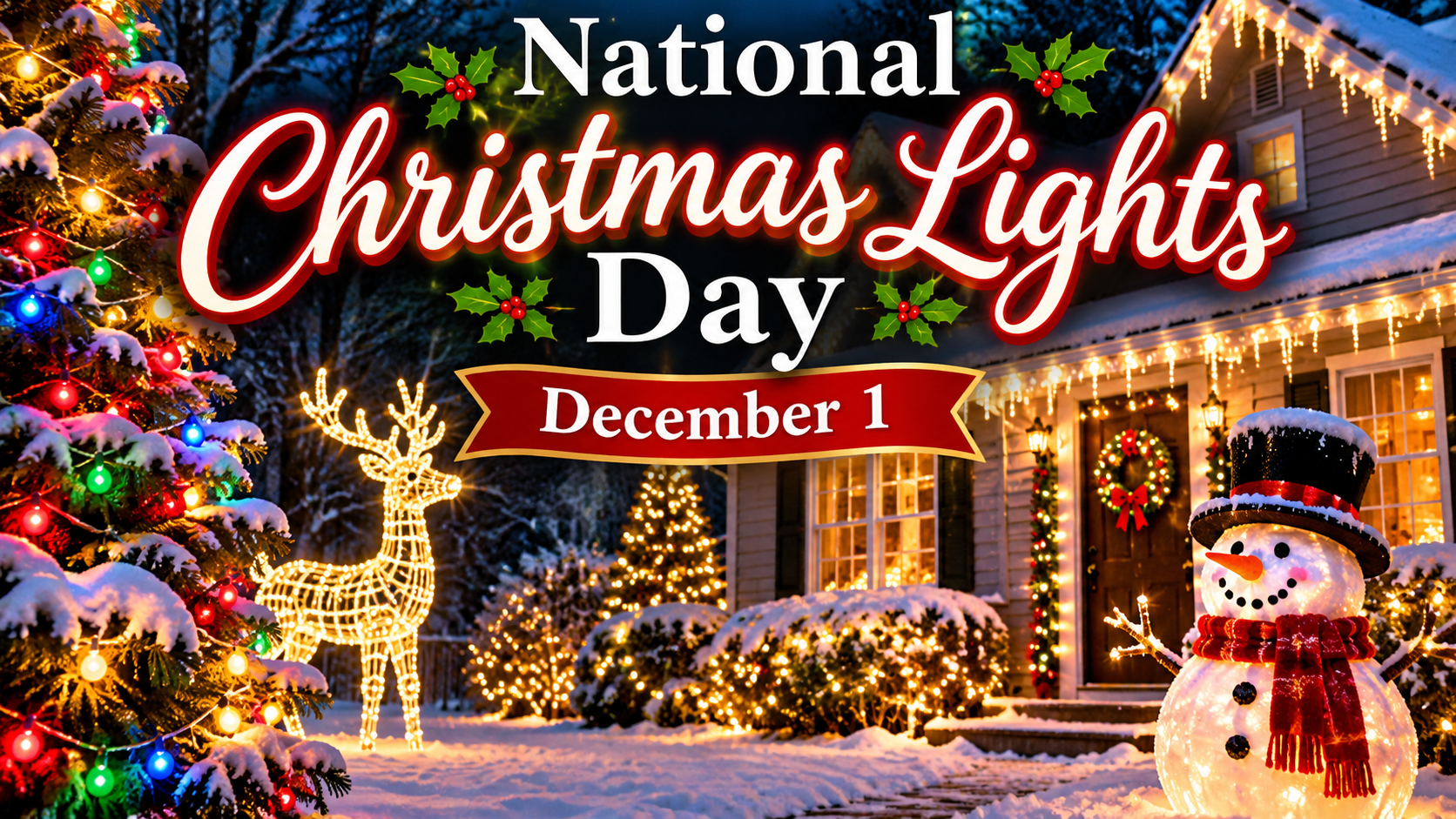
Every year on December 1, National Christmas Lights Day marks the beginning of one of the most beautiful traditions of the holiday season. As neighborhoods begin to sparkle with colorful displays, homes glow with warm white lights, and Christmas trees shine through living room windows, the world seems to become a little brighter.
Christmas lights are more than simple decorations. They represent joy, hope, togetherness, and the spirit of the holiday season. For many families, decorating with Christmas lights is a cherished tradition that brings generations together and creates memories that last a lifetime.
Whether you enjoy decorating your home with thousands of twinkling bulbs, driving through neighborhoods to admire elaborate displays, or sitting quietly beside a glowing Christmas tree, National Christmas Lights Day offers an opportunity to appreciate the beauty and meaning behind these festive decorations.
When Is National Christmas Lights Day?
National Christmas Lights Day is celebrated annually on December 1.
The observance encourages people to begin decorating their homes, businesses, and communities with Christmas lights in preparation for the holiday season.
December 1 is an ideal date because it marks the beginning of the final month of the year and the countdown to Christmas Day.
Although some families begin decorating immediately after Thanksgiving or even earlier, National Christmas Lights Day provides a special occasion for officially welcoming the holiday season.
The day celebrates both the decorative beauty of Christmas lights and the happiness they bring to families and communities.
The History of National Christmas Lights Day
The exact origins of National Christmas Lights Day are not well documented. However, the tradition it celebrates has a fascinating history stretching back several centuries.
Long before electric Christmas lights existed, people used candles to illuminate Christmas trees.
Christmas Tree Candles in Europe
The practice of decorating Christmas trees with candles became popular in parts of Germany during the 17th and 18th centuries.
Families placed small candles on tree branches to symbolize light, hope, and the spiritual significance of Christmas.
These candles created beautiful displays, but they also presented serious fire hazards.
Despite the dangers, candlelit Christmas trees remained a popular tradition for generations.
The Invention of Electric Christmas Lights
The development of electric lighting transformed Christmas decorating.
In 1882, Edward H. Johnson, an associate of Thomas Edison, displayed one of the first electrically illuminated Christmas trees at his home in New York City.
Johnson decorated the tree with approximately 80 electric bulbs in red, white, and blue.
At a time when electric lighting was still a remarkable innovation, the display attracted considerable attention.
Johnson’s Christmas tree helped introduce the idea that electricity could replace candles as a safer and more convenient way to illuminate holiday decorations.
Christmas Lights Become Popular
Electric Christmas lights were initially expensive and difficult for ordinary families to obtain.
Early installations often required professional electricians, making illuminated Christmas trees a luxury enjoyed primarily by wealthy households.
In 1895, President Grover Cleveland helped popularize electric Christmas decorations when the White House Christmas tree was decorated with electric lights.
As electrical technology improved and manufacturing costs decreased, Christmas lights gradually became more accessible.
By the early 20th century, companies began producing electric Christmas light strings for household use.
General Electric introduced Christmas lighting kits in the early 1900s, helping bring the tradition into more American homes.
Over the following decades, electric Christmas lights became a familiar part of holiday celebrations across the United States.
Why Do We Decorate With Christmas Lights?
Christmas lights have both historical and symbolic meanings.
For Christians, light is closely connected to the celebration of Jesus Christ’s birth.
The Bible frequently uses light as a symbol of faith, guidance, goodness, and hope.
One particularly meaningful verse is John 8:12, where Jesus describes Himself as the light of the world.
Christmas lights can serve as a reminder of the spiritual significance of the holiday.
However, Christmas lights also hold meaning for people who celebrate the season through family traditions, cultural customs, and community activities.
For many, the lights symbolize warmth during winter, happiness during difficult times, and the promise of brighter days ahead.
Their beauty has the ability to transform an ordinary evening into something magical.
How Christmas Lights Became an American Holiday Tradition
Christmas lighting became increasingly popular in American neighborhoods throughout the 20th century.
As electricity became widespread, families began decorating Christmas trees, windows, porches, and rooftops.
By the 1950s and 1960s, outdoor Christmas lights had become a recognizable part of suburban holiday celebrations.
Neighborhoods began developing traditions of elaborate displays, with homeowners competing to create the most impressive decorations.
Some communities organized decorating contests, while others established annual Christmas light tours.
Today, Christmas lighting has become an important part of American holiday culture.
Cities illuminate downtown streets, shopping districts decorate storefronts, and families travel to see spectacular light displays.
From small strands of warm white bulbs to enormous synchronized productions, Christmas lights continue to evolve while preserving their traditional charm.
10 Ways to Celebrate National Christmas Lights Day
National Christmas Lights Day offers countless opportunities to enjoy the holiday season.
Here are ten meaningful and enjoyable ways to celebrate December 1.
1. Decorate Your Christmas Tree
One of the simplest ways to celebrate is by decorating your Christmas tree with beautiful lights.
Choose traditional multicolored bulbs, warm white lights, or modern LED strands.
Invite family members to participate and turn decorating into a special holiday gathering.
2. Hang Outdoor Christmas Lights
Transform your home’s exterior with festive lighting.
Decorate your roofline, porch, windows, trees, or bushes.
You do not need an elaborate display to create a welcoming holiday atmosphere.
Even a few carefully arranged strands can make your home feel cheerful.
3. Take a Christmas Lights Drive
Gather your family or friends and drive through neighborhoods known for their holiday decorations.
Bring hot chocolate, play Christmas music, and enjoy the creativity of local homeowners.
For many families, Christmas light drives become annual traditions.
4. Visit a Community Christmas Light Display
Many cities host public Christmas light celebrations during December.
These events may feature illuminated parks, decorated gardens, festive music, and holiday activities.
Community displays provide opportunities to celebrate with neighbors and support local traditions.
5. Create a Christmas Lights Photo Tradition
Take photographs of your Christmas decorations each year.
Over time, these pictures become a wonderful collection of holiday memories.
You can also photograph family members beside the Christmas tree or at favorite community displays.
6. Host a Christmas Decorating Party
Invite friends and relatives to help decorate your home.
Serve holiday cookies, warm drinks, and seasonal snacks.
Play Christmas music and enjoy spending time together while preparing for the holidays.
7. Make Homemade Light Decorations
Use battery-operated fairy lights to create festive centerpieces, illuminated jars, or decorative arrangements.
These simple projects can add a personal touch to your holiday decorations.
8. Share Christmas Cheer With a Neighbor
Offer to help an elderly neighbor or someone with limited mobility decorate safely.
Sometimes a small act of kindness can make the holiday season much brighter for another person.
9. Enjoy a Quiet Evening by the Christmas Tree
Turn off the television, put away your phone, and spend a peaceful evening enjoying the lights.
Reflect on your blessings, your favorite holiday memories, and the people who have made your life meaningful.
10. Start a New Family Tradition
National Christmas Lights Day is a wonderful opportunity to create a tradition that can continue for years.
You might decorate the tree every December 1, visit a favorite light display, or share a special holiday meal.
The most meaningful traditions are often the simplest.
Interesting Facts About Christmas Lights
Christmas lights have a fascinating history filled with inventions, creativity, and memorable celebrations.
1. The first famous electrically illuminated Christmas tree appeared in 1882. Edward H. Johnson displayed approximately 80 electric bulbs on a rotating Christmas tree.
2. Early electric Christmas lights were expensive. Only wealthy families could initially afford elaborate electric lighting displays.
3. Christmas lights were once commonly called fairy lights. The term remains especially popular in the United Kingdom and other countries.
4. LED Christmas lights use less electricity. Modern LED bulbs are generally more energy-efficient than traditional incandescent Christmas lights.
5. Outdoor Christmas lighting became especially popular during the 20th century. Improvements in household electricity and lighting technology made decorations more accessible.
6. Christmas lights are available in many colors and styles. Popular options include warm white, cool white, multicolored, icicle, net, and programmable lights.
7. Some Christmas displays are synchronized with music. Computer-controlled systems can coordinate lighting effects with holiday songs.
8. Many communities hold annual Christmas light competitions. These events encourage creativity and neighborhood participation.
9. Christmas lights are used around the world. Different countries incorporate illuminated decorations into their own seasonal celebrations.
10. Christmas lighting technology continues to evolve. Smart lighting systems allow users to control colors, brightness, and schedules through mobile applications.
The Meaning of Christmas Lights During Difficult Times
For some people, the holiday season is not always filled with happiness.
Christmas can be especially difficult for those grieving the loss of a loved one, experiencing loneliness, or facing personal challenges.
The familiar glow of Christmas lights may bring back memories of holidays spent with someone who is no longer here.
A decorated Christmas tree might remind a parent of the excitement their child once felt on Christmas morning.
A favorite neighborhood light display might bring back memories of family drives, laughter, and moments that can never be recreated in quite the same way.
These memories can be both beautiful and painful.
National Christmas Lights Day can also become an opportunity to honor those we miss.
Some families place a special illuminated ornament on their Christmas tree in memory of a loved one.
Others display a candle-shaped electric light in a window or dedicate part of their decorations to someone who has passed away.
There is no requirement to feel joyful simply because the holiday season has arrived.
Sometimes the meaning of Christmas lights is found in their quiet symbolism.
Even during the darkest moments of life, a small light can remind us that love, memory, and hope continue to exist.
And sometimes, simply sitting beside a glowing Christmas tree and remembering someone we love is enough.
Christmas Light Safety Tips
Decorating with Christmas lights should always be enjoyable, but safety remains important.
Before installing holiday decorations, consider these essential precautions.
-
Inspect light strands for damaged wires, cracked sockets, or loose connections.
-
Use lights specifically rated for outdoor use when decorating outside.
-
Avoid overloading electrical outlets and extension cords.
-
Follow manufacturer instructions when connecting multiple light strands.
-
Use outdoor-rated extension cords and electrical connections where appropriate.
-
Keep electrical decorations away from standing water.
-
Turn off decorative lights before going to bed or leaving home, unless the equipment is specifically designed and safely configured for unattended operation.
-
Use stable ladders and appropriate assistance when decorating elevated areas.
-
Keep cords away from walkways to prevent tripping hazards.
-
Consider LED lights to reduce electricity consumption and heat generation.
Taking a few precautions can help ensure your holiday celebrations remain safe and memorable.
Are LED Christmas Lights Better Than Traditional Lights?
LED Christmas lights have become increasingly popular because of their energy efficiency and long operating life.
Traditional incandescent Christmas lights produce illumination by heating a filament inside a glass bulb.
LED lights use semiconductor technology to produce light more efficiently.
Benefits of LED Christmas Lights
LED Christmas lights offer several advantages.
They generally consume significantly less electricity, produce less heat, and last longer than incandescent alternatives.
They are also available in a wide variety of colors and lighting effects.
Although LED Christmas lights may cost more initially, their lower energy consumption and longer lifespan can make them more economical over time.
Traditional incandescent lights remain popular among people who appreciate their familiar warm glow.
Ultimately, the best choice depends on your decorating preferences, budget, and desired appearance.
How Different Countries Celebrate With Christmas Lights
Christmas lighting traditions are enjoyed in many parts of the world.
In the United States, elaborate neighborhood displays and illuminated Christmas trees are common holiday attractions.
In Germany, Christmas markets frequently feature strings of warm lights illuminating wooden stalls and festive streets.
In the United Kingdom, cities often celebrate the season with public Christmas light switch-on events.
In Australia, where Christmas occurs during summer, families decorate homes with colorful outdoor displays and visit illuminated neighborhoods.
In Japan, spectacular winter illumination events attract visitors to shopping districts, parks, and entertainment destinations. Many are seasonal rather than specifically Christmas celebrations.
Although traditions vary, decorative lighting often serves the same purpose: bringing people together and creating a sense of wonder.
Why National Christmas Lights Day Matters
National Christmas Lights Day may seem like a simple celebration of holiday decorations, but its meaning can extend much further.
Christmas lights encourage people to participate in traditions, spend time with loved ones, and create joyful memories.
They can strengthen communities by inspiring neighbors to decorate their homes and share festive experiences.
They also remind us of the importance of finding beauty in ordinary moments.
A strand of lights hanging across a porch might seem insignificant, but to someone passing by on a difficult evening, that warm glow may offer a moment of comfort.
A brightly decorated Christmas tree may become the centerpiece of a family’s most treasured holiday memories.
And a simple tradition of driving through illuminated neighborhoods may become something children remember long after they have grown.
Christmas lights are not merely about decorations.
They are about the experiences, emotions, and connections created around them.
Frequently Asked Questions About National Christmas Lights Day
What day is National Christmas Lights Day?
National Christmas Lights Day is celebrated every year on December 1.
Who invented electric Christmas lights?
Edward H. Johnson, an associate of Thomas Edison, is widely credited with creating one of the first electrically illuminated Christmas trees in 1882.
Why do people put up Christmas lights?
People decorate with Christmas lights to celebrate the holiday season, express religious or cultural traditions, create festive environments, and share joy with their communities.
When should Christmas lights be put up?
There is no official requirement. Many families decorate after Thanksgiving, while others begin on December 1 or earlier in November.
What do Christmas lights symbolize?
Christmas lights commonly symbolize hope, joy, warmth, celebration, and the triumph of light over darkness. In Christian traditions, they may also represent Jesus Christ as the light of the world.
Can you celebrate National Christmas Lights Day without decorating?
Absolutely. You can enjoy the day by visiting a public light display, admiring neighborhood decorations, watching a Christmas movie, or simply appreciating the beauty of the season.
Final Thoughts: Let Your Light Shine This Christmas Season
National Christmas Lights Day on December 1 is a beautiful reminder that the holiday season is about more than gifts, shopping, and decorations.
It is about togetherness, kindness, memories, and the hope that brighter days are always possible.
Every illuminated tree, glowing window, and sparkling rooftop contributes to the magic of Christmas.
For some, those lights represent excitement and celebration. For others, they carry memories of loved ones, family traditions, and Christmases from years gone by.
Whatever Christmas lights mean to you, their gentle glow offers an opportunity to appreciate the beauty of the season.
This December 1, take a moment to enjoy the lights around you. Share a memory, create a new tradition, or brighten someone’s day with a simple act of kindness.
Because sometimes the smallest lights can bring the greatest comfort.
Happy National Christmas Lights Day! May your holiday season be filled with warmth, beautiful memories, peace, and hope.



Leave a Reply