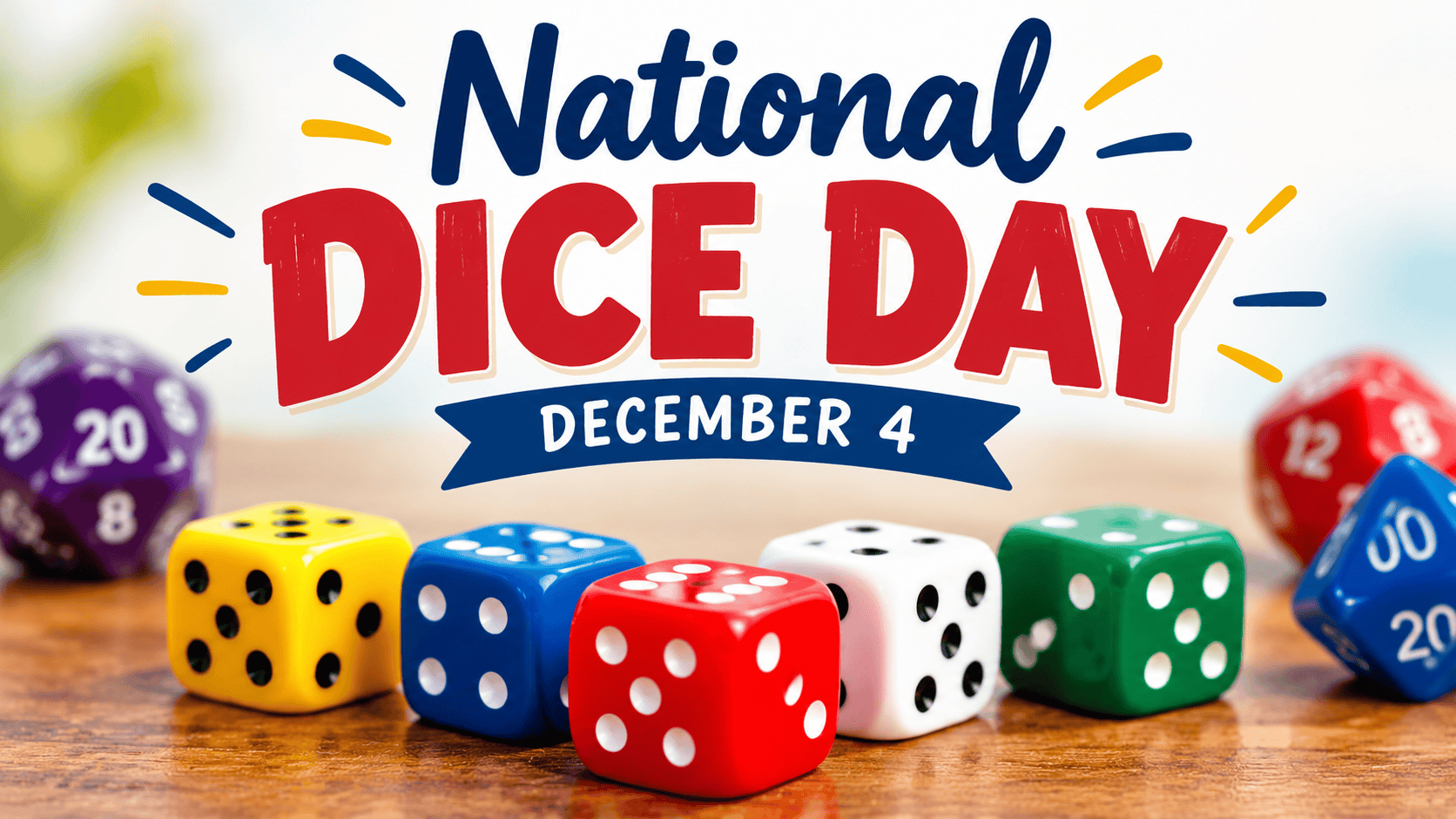
Every year on December 4, National Dice Day celebrates one of the oldest and most recognizable gaming tools in human history. From ancient civilizations to modern board games, dice have entertained generations, brought families together, and introduced an element of chance into countless activities.
Whether you enjoy rolling dice during a family game night, playing classic board games, or exploring the fascinating history behind these small numbered cubes, National Dice Day offers an opportunity to appreciate something simple that has influenced entertainment for thousands of years.
Dice may be small, but their impact on history, mathematics, culture, and recreation is surprisingly large.
When Is National Dice Day?
National Dice Day is celebrated annually on December 4.
The observance recognizes the history, enjoyment, and cultural significance of dice. It encourages people to participate in dice games, learn about their origins, and spend time with friends and family through friendly competition.
While National Dice Day is not a federal holiday, it provides a fun reason to organize a game night, discover new games, or revisit childhood favorites.
The celebration is suitable for people of all ages because dice appear in everything from simple children’s activities to complex strategy games.
What Is National Dice Day?
National Dice Day is an unofficial holiday dedicated to celebrating dice and the many ways people have used them throughout history.
Dice are small objects designed to produce random results when rolled or thrown. The most familiar type is the six-sided die, featuring numbered faces represented by dots called pips.
However, dice come in many shapes, sizes, and designs.
Some have four sides, while others feature eight, ten, twelve, twenty, or even more faces.
They are used in board games, educational activities, role-playing adventures, mathematical demonstrations, and numerous traditional games.
National Dice Day celebrates both the entertainment value of dice and their importance in the development of games and probability.
The History of Dice
Dice have a history stretching back thousands of years.
Archaeological discoveries indicate that early forms of dice were used in ancient civilizations, including Mesopotamia, Egypt, India, and other parts of the world.
Some of the earliest dice-like gaming objects were made from animal bones, particularly the ankle bones of sheep and other animals.
These bones, commonly called knucklebones, could land in different positions and were used in games of chance.
Over time, people began creating more standardized dice from materials such as ivory, bone, wood, stone, and clay.
Dice in Ancient Mesopotamia
Ancient Mesopotamia provides some of the earliest archaeological evidence of organized board gaming.
The Royal Game of Ur, dating to approximately 2600 BCE, used distinctive throwing pieces to determine movement.
Although these objects differed from modern six-sided dice, they performed a similar function by introducing chance into gameplay.
This demonstrates that people were combining strategy and randomness thousands of years before modern board games existed.
Dice in Ancient Egypt
Ancient Egyptians enjoyed several board games, including Senet.
Senet was played using pieces and throwing sticks that helped determine movement across the board.
While these throwing sticks were not conventional dice, they served a comparable purpose.
Games were important in Egyptian society, and some eventually developed religious and symbolic meanings connected to the afterlife.
Dice in Ancient Greece and Rome
Dice games became popular in ancient Greek and Roman cultures.
Romans used dice made from materials including bone, ivory, and stone.
Dice were associated with recreation, gambling, and social gatherings.
Roman soldiers and citizens played various games involving chance, and archaeological excavations have uncovered numerous examples of ancient dice.
The Romans also used knucklebones for games that combined skill and luck.
Dice During the Middle Ages
During the Middle Ages, dice remained popular throughout Europe.
People played dice games in taverns, marketplaces, military camps, and private homes.
Because dice were frequently associated with gambling, some religious and political authorities attempted to restrict certain games.
Despite these restrictions, dice continued to be a common form of entertainment.
Their portability and simple design made them accessible to people from many different backgrounds.
Dice in Modern Gaming
As board games became increasingly popular during the nineteenth and twentieth centuries, dice developed into essential gaming accessories.
Games such as Monopoly, Yahtzee, and Risk helped establish dice as familiar household objects.
Later, tabletop role-playing games such as Dungeons & Dragons introduced many players to dice with different numbers of sides.
Today, dice remain important in traditional tabletop games, educational activities, and modern gaming communities.
Why Do We Celebrate National Dice Day?
National Dice Day recognizes how something as simple as a small numbered object can create entertainment, excitement, and social connection.
Dice are more than gaming accessories.
They represent centuries of creativity, mathematical discovery, and shared experiences.
The holiday also encourages people to enjoy activities that do not require expensive equipment or complicated technology.
A few dice, some paper, and a group of friends can provide hours of entertainment.
For families, National Dice Day offers an opportunity to spend quality time together while introducing children to classic games.
For gaming enthusiasts, it is a chance to explore new strategies, discover unfamiliar games, and appreciate the history of tabletop entertainment.
15 Interesting Facts About Dice
Dice have several fascinating characteristics that many people may not know.
1. Dice Have Been Used for Thousands of Years
Archaeological evidence shows that people were using dice and similar randomizing objects in ancient civilizations thousands of years ago.
2. The Singular Form of Dice Is Die
Traditionally, one gaming cube is called a die, while two or more are called dice.
However, the word dice is also commonly used as a singular noun in modern English.
3. Standard Dice Have Six Faces
The most recognizable die is a cube with six faces numbered from one through six.
4. Opposite Sides Usually Add Up to Seven
On conventional six-sided dice, opposite faces are arranged so their values total seven.
One is opposite six, two is opposite five, and three is opposite four.
5. Dice Are Not Always Cubes
Dice can have many different geometric shapes.
Four-sided, eight-sided, twelve-sided, and twenty-sided dice are common in tabletop role-playing games.
6. Dice Help Teach Probability
Teachers frequently use dice to explain probability, statistics, fractions, and mathematical patterns.
7. Ancient Dice Were Made From Natural Materials
Early dice were often crafted from animal bones, stone, wood, or ivory.
8. Dice Are Used Around the World
Many cultures have developed traditional games involving dice or similar randomizing objects.
9. The Dots on Dice Are Called Pips
The small markings representing numbers on traditional dice are known as pips.
10. Two Dice Can Produce 36 Possible Ordered Outcomes
When two standard six-sided dice are rolled, there are 36 equally likely ordered combinations, assuming both dice are fair.
11. Seven Is the Most Common Total With Two Dice
When rolling two fair six-sided dice, the total of seven has the greatest probability because six different combinations produce that result.
12. Dice Can Be Collectible
Gaming enthusiasts sometimes collect unusual dice made from metal, gemstones, resin, wood, and other materials.
13. Some Dice Have More Than 20 Sides
Specialty dice can feature dozens or even more than one hundred numbered faces.
14. Dice Are Important in Role-Playing Games
Many tabletop role-playing games use dice to determine the outcomes of character actions, challenges, and encounters.
15. Dice Combine Luck With Strategy
Although individual dice rolls involve chance, many games require players to make strategic decisions based on the results.
Popular Dice Games to Play on National Dice Day
One of the easiest ways to celebrate National Dice Day is by playing a favorite dice game.
Here are several popular options.
Yahtzee
Yahtzee is a classic dice game involving five dice.
Players roll combinations to earn points in different scoring categories.
The game combines luck, probability, and decision-making.
Farkle
Farkle is a dice game that challenges players to decide whether to keep their accumulated points or continue rolling.
The excitement comes from balancing potential rewards against the risk of losing points earned during a turn.
Bunco
Bunco is a social dice game traditionally played in groups.
Players roll dice to score points during multiple rounds.
It is especially popular at parties and organized game nights.
Liar’s Dice
Liar’s Dice combines probability, bluffing, and observation.
Players make claims about dice results while attempting to determine whether their opponents are telling the truth.
Ten Thousand
Ten Thousand is a traditional dice game in which players accumulate points by rolling scoring combinations.
Different households may use slightly different rules.
Shut the Box
Shut the Box is a traditional game involving dice and numbered tiles.
Players roll dice and attempt to close numbered tiles using combinations matching the roll.
The goal is usually to close as many tiles as possible.
Monopoly
Although Monopoly is primarily a board game, dice play an essential role in determining movement around the board.
Dungeons & Dragons
Dungeons & Dragons uses several types of polyhedral dice to determine the outcomes of actions, combat, and other events.
The twenty-sided die is especially recognizable among tabletop role-playing enthusiasts.
How to Celebrate National Dice Day
National Dice Day can be celebrated in several entertaining and educational ways.
1. Host a Family Game Night
Gather family members around the table for an evening of dice games.
Choose games appropriate for everyone’s age and experience.
Offer snacks, create friendly competitions, and enjoy time together without relying on screens.
2. Learn a New Dice Game
Instead of playing a familiar game, challenge yourself to learn something new.
Explore games from different countries or try a modern tabletop game featuring unusual dice.
3. Teach Children About Probability
Dice are excellent educational tools.
Have children roll two dice and record their totals.
After several rolls, compare the results and discuss why certain numbers appear more frequently than others.
This activity makes mathematical concepts easier to understand.
4. Create Your Own Dice Game
Invent a game using ordinary six-sided dice.
Develop scoring rules, establish objectives, and decide how players can win.
Encourage children to participate in designing the game.
5. Organize a Dice Tournament
Invite friends or family members to compete in several dice games.
Keep score throughout the event and award a small prize to the winner.
The emphasis should be on participation and enjoyment rather than intense competition.
6. Explore the History of Dice
Spend time learning about ancient board games and how dice developed across different civilizations.
This can be especially interesting for history enthusiasts.
7. Try a Tabletop Role-Playing Game
If you have never played a tabletop role-playing game, National Dice Day provides a good opportunity to try one.
These games combine storytelling, imagination, teamwork, and chance.
8. Share National Dice Day on Social Media
Post a photograph of your favorite dice game, share an interesting historical fact, or invite friends to participate in a virtual game night.
Use the hashtag #NationalDiceDay to join the celebration.
The Mathematics Behind Rolling Dice
Dice provide one of the simplest ways to demonstrate mathematical probability.
When rolling a fair six-sided die, each numbered face has an equal chance of appearing.
The probability of rolling any particular number is:
1 out of 6, or approximately 16.67%.
When two dice are rolled together, the probabilities become more interesting.
Although the smallest possible total is two and the largest is twelve, not every total has the same probability.
For example, only one ordered combination produces a total of two: rolling a one on both dice.
However, six ordered combinations produce a total of seven.
Probability of Rolling Two Dice
| Total | Number of combinations | Probability |
|---|---|---|
| 2 | 1 | 2.78% |
| 3 | 2 | 5.56% |
| 4 | 3 | 8.33% |
| 5 | 4 | 11.11% |
| 6 | 5 | 13.89% |
| 7 | 6 | 16.67% |
| 8 | 5 | 13.89% |
| 9 | 4 | 11.11% |
| 10 | 3 | 8.33% |
| 11 | 2 | 5.56% |
| 12 | 1 | 2.78% |
These probabilities explain why seven appears more frequently than any other total when rolling two fair six-sided dice over many trials.
Understanding these patterns can help players make better decisions in certain games.
Different Types of Dice
While traditional six-sided dice are the most familiar, modern games use a wide variety of shapes.
Four-Sided Dice (D4): Often shaped like triangular pyramids and used in tabletop role-playing games.
Six-Sided Dice (D6): The standard dice found in many classic board games.
Eight-Sided Dice (D8): Commonly used in role-playing games and specialized tabletop activities.
Ten-Sided Dice (D10): Frequently used in games requiring numerical ranges or percentage calculations.
Twelve-Sided Dice (D12): Used in various tabletop gaming systems.
Twenty-Sided Dice (D20): Especially popular in fantasy role-playing games.
Hundred-Sided Dice (D100): May refer to a specialized hundred-sided die or a percentile roll produced using two ten-sided dice.
Each type serves different purposes depending on the rules and probability requirements of the game.
The Cultural Significance of Dice
Throughout history, dice have represented more than recreation.
They have often symbolized chance, uncertainty, fortune, and the unpredictable nature of life.
Expressions involving dice have become part of everyday language.
For example, the phrase “roll the dice” commonly means taking a chance or accepting uncertainty.
Similarly, “the die is cast” refers to a decision or action that cannot easily be reversed.
Dice have also appeared in literature, movies, artwork, and popular culture as symbols of risk and possibility.
Their cultural importance comes partly from their simplicity.
A single roll can create anticipation, excitement, disappointment, or celebration.
This emotional connection helps explain why dice have remained popular across generations.
Why Dice Games Are Great for Families
Dice games offer several benefits beyond entertainment.
They encourage interaction, communication, and friendly competition.
For children, dice games can help develop number recognition, counting skills, basic arithmetic, and an understanding of probability.
For adults, they provide opportunities to relax, socialize, and practice decision-making.
Many dice games are also relatively inexpensive and require very little preparation.
Unlike some forms of entertainment, they can be enjoyed without internet access, electronic devices, or elaborate equipment.
Most importantly, dice games encourage people to spend time together.
Whether a game lasts five minutes or several hours, the shared experience can create lasting memories.
National Dice Day Activities for Kids
Children can celebrate National Dice Day through simple activities that combine learning with fun.
Dice Addition Challenge
Give each child two dice.
Have them roll both dice and add the numbers together.
Award points for correct answers or challenge them to complete a certain number of calculations.
Roll and Draw
Assign a different drawing instruction to each number on a die.
For example, rolling a one might mean drawing a circle, while rolling a two means adding a square.
Children continue rolling until they have created a unique picture.
Dice Storytelling
Assign characters, settings, or actions to different dice numbers.
Children roll the dice and create stories based on their results.
This activity encourages creativity and imagination.
Dice Movement Game
Assign a physical activity to each number.
A roll of one might mean performing one jumping jack, while a roll of three might mean taking three giant steps.
Keep movements appropriate for the children’s abilities and available space.
Build a Paper Die
Use paper or cardstock to create a cube.
Label each face with a number or colorful dots.
This activity introduces children to basic geometry while allowing them to create their own gaming equipment.
National Dice Day and the Importance of Playing Together
In a world filled with digital entertainment and busy schedules, traditional games offer something valuable: personal connection.
Dice games encourage people to sit together, communicate, laugh, and share experiences.
They remind us that entertainment does not always require expensive equipment or advanced technology.
Sometimes the simplest activities produce the most meaningful memories.
A family game night can become a cherished tradition.
A friendly competition can strengthen relationships.
Teaching a child their first dice game can create a moment they remember for years.
National Dice Day is ultimately about celebrating these experiences as much as the dice themselves.
Frequently Asked Questions About National Dice Day
When is National Dice Day celebrated?
National Dice Day is celebrated every year on December 4.
What is the purpose of National Dice Day?
The holiday celebrates the history, cultural significance, and entertainment value of dice while encouraging people to enjoy dice games.
Who invented dice?
The exact inventor of dice is unknown. Dice and similar randomizing objects developed in several ancient civilizations thousands of years ago.
What is the oldest dice game?
It is difficult to identify one definitive oldest dice game. Ancient games such as the Royal Game of Ur provide early archaeological evidence of gaming systems involving randomizing pieces.
Why do standard dice have opposite sides that add up to seven?
This is a longstanding conventional arrangement for six-sided dice. It creates three opposite pairs with equal totals, although not every historical or novelty die follows the convention.
Are dice games good for children?
Yes. Age-appropriate dice games can help children practice counting, arithmetic, probability, turn-taking, and decision-making.
What are the most popular dice games?
Popular examples include Yahtzee, Farkle, Bunco, Liar’s Dice, Ten Thousand, and Shut the Box.
Can National Dice Day be celebrated at school?
Yes. Teachers can organize educational activities involving dice, including math challenges, probability experiments, and creative storytelling exercises.
Is National Dice Day a federal holiday?
No. National Dice Day is an unofficial observance rather than a federal holiday.
What hashtag should I use for National Dice Day?
The hashtag #NationalDiceDay is a straightforward way to share activities, photographs, and celebrations on social media.
Final Thoughts: Celebrating National Dice Day on December 4
National Dice Day is a reminder that some of the simplest inventions have the greatest staying power.
For thousands of years, dice have entertained people, inspired games, supported mathematical learning, and brought communities together.
From ancient gaming traditions to modern tabletop adventures, these small objects continue to play an important role in recreation and culture.
December 4 is the perfect opportunity to rediscover a favorite game, teach children something new, or gather loved ones for an evening of friendly competition.
Whether you roll a six-sided die, explore a twenty-sided adventure, or invent an entirely new game, National Dice Day celebrates the excitement of possibility.
After all, sometimes all it takes to create a memorable moment is a handful of dice, a little imagination, and someone to share the experience with.
Happy National Dice Day!


Leave a Reply