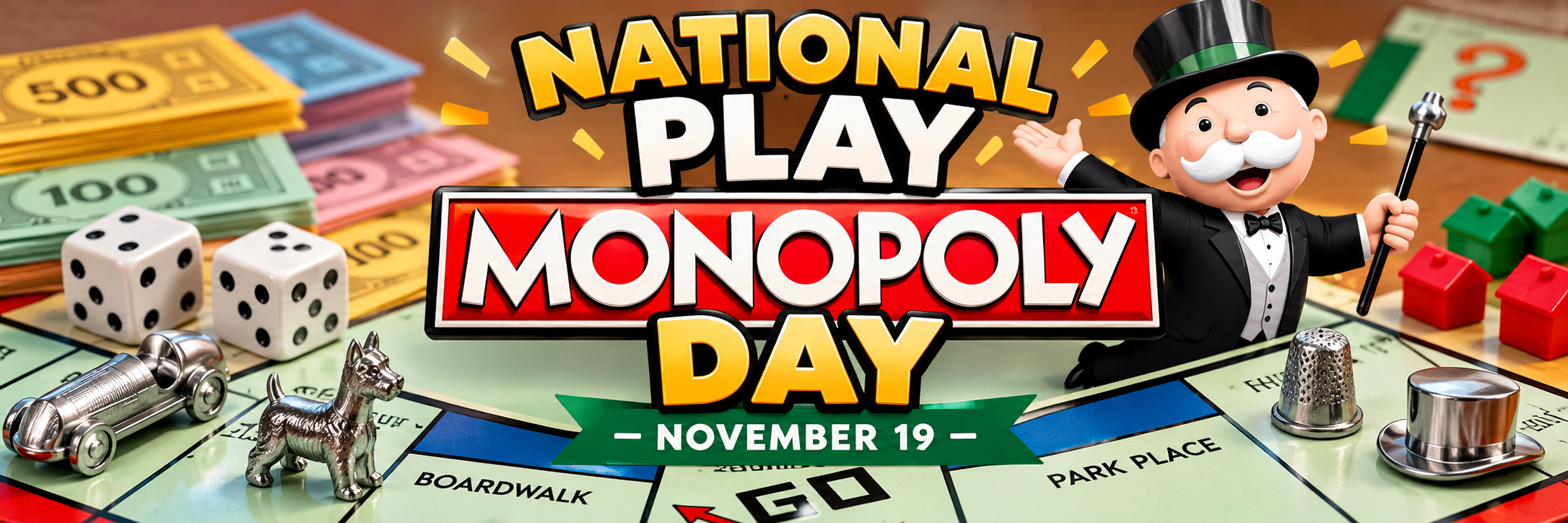
Few board games have captured the imagination of generations quite like Monopoly. From purchasing Boardwalk and Park Place to collecting $200 when passing GO, Monopoly has become a beloved tradition in homes worldwide. Whether you enjoy building a real estate empire, negotiating property trades, or watching your opponents land on your hotels, Monopoly offers hours of entertainment, competition, and unforgettable memories.
Every year on November 19, National Play Monopoly Day celebrates one of the most recognizable board games ever created. This unofficial observance encourages families, friends, and board game enthusiasts to gather around the table, roll the dice, and experience the excitement of buying, trading, and developing properties.
But Monopoly is more than a game about money. It teaches valuable lessons about decision-making, negotiation, financial planning, and the importance of spending quality time together.
Let’s explore the history of Monopoly, why this classic game remains popular, interesting facts, strategies for winning, and creative ways to celebrate National Play Monopoly Day.
When Is National Play Monopoly Day?
National Play Monopoly Day is celebrated annually on November 19.
Although it is not an official federal holiday, the observance recognizes the cultural significance of Monopoly and encourages people to enjoy this classic board game.
Monopoly has entertained generations of players, creating countless family traditions and friendly rivalries.
For many families, the game is associated with holidays, weekend gatherings, rainy afternoons, and evenings spent around the kitchen table.
National Play Monopoly Day provides the perfect excuse to bring everyone together for a little friendly competition.
The History of Monopoly
The story of Monopoly begins long before the familiar game appeared on store shelves.
The Landlord’s Game
In 1904, American game designer Elizabeth Magie received a patent for a board game called The Landlord’s Game.
Magie created the game to demonstrate the economic consequences of land ownership and monopolies.
Her original intention was educational. She wanted players to understand how concentrating land ownership and collecting rent could create economic inequality.
The Landlord’s Game included several concepts that would eventually become central features of Monopoly, including property ownership, rent collection, and financial competition.
Over time, different versions of the game circulated among communities, with players modifying rules and introducing new elements.
Charles Darrow and the Rise of Monopoly
During the Great Depression, Charles Darrow developed and popularized a version of the game that closely resembled modern Monopoly.
Darrow’s version featured properties named after locations in Atlantic City, New Jersey.
In 1935, Parker Brothers acquired the rights to Darrow’s game and began selling Monopoly commercially.
The company also acquired rights connected to earlier versions, including Elizabeth Magie’s original game.
Monopoly quickly became a commercial success.
Its popularity during the Great Depression was particularly interesting because the game allowed players to imagine accumulating wealth and owning valuable real estate during a period of widespread financial hardship.
Monopoly Becomes a Worldwide Phenomenon
Over the following decades, Monopoly expanded far beyond the United States.
The game was adapted for international markets, with different editions featuring cities, landmarks, currencies, and cultural references.
Today, Monopoly is recognized around the world and continues to be enjoyed by players of different ages.
Its combination of luck, strategy, negotiation, and competition has helped maintain its popularity for generations.
Why Is Monopoly So Popular?
Monopoly has remained popular for several reasons.
1. It Brings People Together
One of the greatest appeals of Monopoly is its ability to bring family members and friends together.
Unlike many individual entertainment activities, Monopoly encourages players to interact directly with one another.
Players negotiate trades, celebrate successful investments, and occasionally express frustration when landing on expensive properties.
These interactions create shared experiences that people remember long after the game ends.
2. Every Game Is Different
Although the basic rules remain the same, no two Monopoly games are exactly alike.
The roll of the dice, property purchases, trading decisions, and development strategies influence how each game unfolds.
A player who appears to be losing early may recover through a successful trade or a fortunate series of turns.
Meanwhile, a player with considerable wealth can suddenly face financial trouble after landing on an opponent’s developed property.
This unpredictability keeps the game exciting.
3. It Combines Luck and Strategy
Monopoly requires players to balance chance with thoughtful decisions.
Dice rolls determine movement, but players control many important financial choices.
They must decide which properties to purchase, when to build houses, whether to mortgage properties, and how to negotiate trades.
Successful players often combine strategic planning with the ability to adapt to changing circumstances.
4. It Creates Friendly Rivalries
Monopoly is famous for inspiring competitive moments.
Family members may develop favorite properties or strategies, while friends might remember particularly dramatic trades.
Although the competition can become intense, these moments often become entertaining stories shared for years.
The key is remembering that Monopoly is supposed to be fun.
Understanding the Basic Rules of Monopoly
For anyone unfamiliar with Monopoly, the objective is relatively simple.
Players compete to accumulate wealth through property ownership and eventually become the last player who has not gone bankrupt.
Starting the Game
In the standard U.S. version of Monopoly, each player begins with $1,500 in Monopoly money.
Players select tokens and take turns rolling two dice to move around the board.
Depending on where they land, players may purchase properties, pay rent, draw cards, pay taxes, or take other actions.
Purchasing Properties
When a player lands on an unowned property, they may purchase it from the bank for the listed price.
If they decline, the official rules call for the property to be auctioned.
This auction rule is frequently overlooked in casual games.
Collecting Rent
Once a player owns a property, other players generally must pay rent when landing on it.
Rent varies depending on the property and whether the owner has developed a complete color group.
Building Houses and Hotels
Players who own every property in a color group can begin developing those properties.
Building houses increases the rent opponents must pay.
After meeting the requirements for four houses on each property in a color group, a player may upgrade a property to a hotel.
Winning the Game
Players who cannot meet their financial obligations, even after permitted transactions such as selling buildings and mortgaging properties, may become bankrupt.
The game continues until only one player remains financially solvent.
That player wins Monopoly.
15 Interesting Facts About Monopoly
Monopoly has a fascinating history filled with unusual details.
1. Monopoly was commercially introduced by Parker Brothers in 1935. Its origins, however, trace back to earlier games.
2. Elizabeth Magie’s The Landlord’s Game helped inspire Monopoly. Her original game was designed to teach economic lessons.
3. Atlantic City inspired many of the original American property names. Boardwalk and Park Place are among the most recognizable.
4. The classic game includes 40 spaces. These include properties, railroads, utilities, taxes, and special spaces.
5. Players traditionally collect $200 when passing GO. This is one of the game’s most famous rules.
6. The original American game contains four railroads. They are Reading, Pennsylvania, B&O, and Short Line.
7. Monopoly includes two utilities. Electric Company and Water Works provide another way to collect rent.
8. The game has 22 colored street properties. They are organized into eight color groups.
9. Jail is one of the most recognizable spaces. Players can be sent there through cards, dice rolls, or landing on Go to Jail.
10. Monopoly money has become a cultural reference. People often use the phrase to describe money that has no real-world value.
11. Many themed editions exist. Versions have featured movies, television shows, sports teams, cities, and fictional worlds.
12. The game’s familiar mascot is commonly called Mr. Monopoly. He was previously known as Rich Uncle Pennybags.
13. The Free Parking jackpot is a house rule. Under the official standard rules, landing on Free Parking does not award money.
14. Monopoly has inspired electronic and digital adaptations. Players can enjoy versions of the game without using a physical board.
15. The game has become a symbol of property investment and financial competition. Its terminology is familiar even to many people who rarely play.
Strategies for Winning Monopoly
Although luck plays an important role, understanding certain strategies can improve your chances of winning.
Purchase Properties Early
Owning properties gives you opportunities to collect rent and negotiate trades.
During the early stages, purchasing available properties can help establish a strong position.
However, players should avoid spending all their money without considering future expenses.
Focus on Completing Color Groups
Owning a complete color group allows players to build houses and eventually hotels.
Developed properties can generate significantly more rent than undeveloped ones.
Completing color groups is often more valuable than owning several scattered properties.
Consider Orange and Red Properties
Experienced Monopoly players often favor orange and red properties because of their positions on the board.
The orange group can be particularly attractive because players leaving Jail frequently land in that area.
However, property values depend on the specific game situation, and no color group guarantees victory.
Build Houses Strategically
Building houses increases the financial pressure on opponents.
Three houses on a property can be especially powerful because of the rent increases available at that development level.
Players should remember that buildings must be distributed evenly across properties in a color group.
Keep Cash Available
A player may own valuable properties but still face bankruptcy without enough cash to pay rent.
Maintaining a financial reserve can help cover unexpected expenses.
Sometimes holding onto money is wiser than immediately purchasing another building.
Negotiate Carefully
Trading is one of Monopoly’s most important strategic elements.
A well-planned trade can help complete a color group and dramatically increase earning potential.
However, players should consider whether a trade gives an opponent an even greater advantage.
Understand the Official Rules
Many families use house rules without realizing they differ from the official game.
For example, collecting money from Free Parking can make games longer by keeping additional money in circulation.
Understanding the official rules can create a more balanced and efficient experience.
How to Celebrate National Play Monopoly Day
There are plenty of enjoyable ways to celebrate November 19.
1. Host a Family Monopoly Night
Invite family members to gather around the table for an evening of Monopoly.
Prepare snacks, choose your favorite tokens, and enjoy some friendly competition.
Make the evening about spending time together rather than simply winning.
2. Organize a Monopoly Tournament
Turn the celebration into a small tournament.
Invite friends or family members to participate in multiple games.
Award points for victories or use a predetermined time limit and scoring system for shorter rounds.
You can even create a homemade trophy for the overall winner.
3. Try a Different Monopoly Edition
If you usually play the classic version, consider trying a themed edition.
Different versions can introduce new locations, artwork, and gameplay features.
Choose an edition that reflects a shared interest among the players.
4. Teach Someone How to Play
National Play Monopoly Day is an excellent opportunity to introduce a younger family member or friend to the game.
Explain the rules, demonstrate property purchases, and help them understand how trading works.
Teaching someone a classic board game can create a meaningful shared experience.
5. Play Monopoly Online
If family members or friends live far apart, consider playing a digital version.
Online gameplay allows people to enjoy Monopoly even when they cannot gather around the same table.
This can be a fun way to maintain connections across long distances.
6. Create Monopoly-Themed Snacks
Add a creative touch to the celebration with themed food.
Consider making property deed cookies, dice-shaped treats, or a snack table inspired by the different color groups.
You could also prepare inexpensive finger foods so players can snack without interrupting the game.
7. Share Your Favorite Monopoly Memories
Ask family members about their most memorable Monopoly experiences.
Perhaps someone remembers an unexpected comeback, an unbelievable trade, or a particularly competitive holiday gathering.
Sharing these stories can be just as entertaining as playing the game itself.
What Monopoly Can Teach Us About Life
Although Monopoly is primarily a form of entertainment, several lessons can be drawn from its gameplay.
Financial Planning Matters
Monopoly encourages players to consider how they spend their resources.
Purchasing every available property without maintaining cash reserves can lead to financial difficulties.
Similarly, real-world financial decisions benefit from planning, budgeting, and preparing for unexpected expenses.
Of course, Monopoly is a simplified game and should not be treated as a complete model of personal finance.
Every Decision Has Consequences
Players constantly make choices that influence their future opportunities.
A property purchase may provide long-term benefits, while a poorly considered trade may strengthen an opponent.
The game demonstrates how decisions can create both opportunities and risks.
Negotiation Is a Valuable Skill
Monopoly requires players to communicate, persuade, and compromise.
A successful trade often depends on understanding what another player wants.
These skills can also be useful in everyday relationships, professional situations, and financial discussions.
Adaptability Is Important
Even the best Monopoly strategy can be disrupted by an unexpected dice roll.
Players must adjust their plans when circumstances change.
Life also requires flexibility and the ability to respond to situations beyond our control.
Winning Is Not Everything
Perhaps the most meaningful lesson of Monopoly has little to do with accumulating wealth.
The experience of sitting together, laughing, negotiating, and sharing time with loved ones can matter more than the final result.
Years later, people may not remember who won a particular game.
They may, however, remember the laughter and conversations that happened around the table.
Monopoly and Family Traditions
Board games have long been part of family entertainment.
Before smartphones, streaming services, and online gaming became everyday activities, families frequently gathered around board games for entertainment.
Monopoly became a familiar part of those traditions.
For some families, the game comes out during Thanksgiving or Christmas gatherings.
Others play during vacations, birthday celebrations, or quiet evenings at home.
These traditions can become especially meaningful because they provide opportunities for different generations to interact.
Grandparents can teach grandchildren strategies they learned decades earlier.
Parents can introduce children to the games they enjoyed growing up.
Siblings can revisit old rivalries and create new memories.
Monopoly’s enduring appeal comes partly from its ability to connect people across generations.
The board may change, the tokens may look different, and new editions may appear, but the excitement of rolling the dice remains familiar.
Why Board Games Still Matter in a Digital World
Modern entertainment offers more choices than ever before.
People can watch movies, play video games, browse social media, and communicate instantly with others around the world.
Yet traditional board games continue to hold an important place in many households.
One reason is that they encourage face-to-face interaction.
When people play Monopoly together, they participate in a shared activity that requires attention, communication, and decision-making.
Board games can also provide opportunities to practice patience, cooperation, problem-solving, and emotional regulation.
Younger players can learn how to follow rules, take turns, and handle disappointment.
Adults can enjoy a break from everyday responsibilities while reconnecting with friends and family.
Although Monopoly is competitive, the social experience can be rewarding regardless of who wins.
National Play Monopoly Day reminds us that entertainment does not always require complicated technology.
Sometimes a board, a few tokens, and a pair of dice are enough to create an enjoyable evening.
Common Monopoly House Rules
One reason Monopoly games can become surprisingly long is that families often introduce their own rules.
Some of the most common variations include:
-
Free Parking jackpot: Money collected through taxes and penalties is placed in the center of the board and awarded to whoever lands on Free Parking.
-
No property auctions: Players skip auctions when someone declines to purchase an unowned property.
-
Extra money for landing on GO: Players receive an additional bonus for landing directly on GO.
-
Loans between players: Some families allow players to lend money to one another.
-
Special starting conditions: Players may receive additional money or properties before the game begins.
These variations can be entertaining, but they are not part of the standard official rules.
Before beginning a game, everyone should agree on which rules will apply.
This can prevent disagreements later in the evening.
Fun Monopoly Challenges for November 19
If you want to make National Play Monopoly Day more exciting, introduce a few optional challenges.
The Classic Rules Challenge: Play an entire game using only the official rules, including property auctions and standard Free Parking rules.
The Family Championship: Create a yearly competition and record the winner of each National Play Monopoly Day celebration.
The Strategy Challenge: Encourage each player to explain one important strategic decision after the game.
The New Player Challenge: Invite someone who has never played Monopoly and help them learn the game.
The Memory Challenge: Ask everyone to share a favorite board game memory before starting.
These activities can turn a familiar game into a special annual tradition.
Frequently Asked Questions About National Play Monopoly Day
When is National Play Monopoly Day celebrated?
National Play Monopoly Day takes place every year on November 19.
Is National Play Monopoly Day an official holiday?
No. It is an informal observance celebrating the classic Monopoly board game rather than an official government holiday.
Who invented Monopoly?
Monopoly evolved from earlier property-trading games. Elizabeth Magie created The Landlord’s Game, patented in 1904, which provided important foundations. Charles Darrow later popularized a version that Parker Brothers began selling in 1935.
What is the objective of Monopoly?
The objective is to become the last player who has not gone bankrupt by purchasing properties, collecting rent, developing color groups, and managing money.
How much money does each player start with?
In the standard classic U.S. edition, each player starts with $1,500 in Monopoly money.
What is the most expensive property in classic Monopoly?
Boardwalk is the most expensive purchasable street property in the standard American version, with a purchase price of $400.
Is Monopoly a game of luck or skill?
Monopoly combines both. Dice rolls and cards introduce luck, while purchasing decisions, negotiations, building strategies, and cash management require skill.
Can children play Monopoly?
Yes. Classic Monopoly is generally recommended for ages 8 and older, while junior editions are designed for younger children.
Why does Monopoly sometimes take so long?
Games can become lengthy because of negotiation, cautious property development, and house rules that add money to the game or eliminate auctions.
Following the official rules can help keep games moving.
The Lasting Legacy of Monopoly
Few board games have maintained the cultural recognition and popularity of Monopoly.
For generations, the game has provided entertainment while introducing players to simplified concepts of property ownership, investment, negotiation, and financial competition.
Its influence extends beyond the game board.
Expressions such as passing GO, collecting $200, and going directly to Jail have become familiar references in everyday conversation.
Monopoly has also inspired countless themed editions, digital adaptations, and special releases.
However, its greatest legacy may be the memories it creates.
A simple game can become part of a family’s history.
The laughter over an unexpected dice roll, the excitement of completing a color group, and the dramatic moment when someone lands on a hotel can become stories retold for years.
These experiences remind us that shared time is often more valuable than anything we can purchase.
Final Thoughts: Celebrate National Play Monopoly Day on November 19
National Play Monopoly Day is more than an opportunity to buy properties, collect rent, and compete for imaginary wealth.
It is a celebration of a classic board game that has entertained generations and brought people together around the same table.
Whether you are an experienced player with a carefully developed strategy or someone who simply enjoys rolling the dice, November 19 offers a reason to revisit this timeless favorite.
Gather your family, invite a few friends, choose your favorite token, and prepare for an evening of unexpected twists, exciting trades, and friendly competition.
Remember that while Monopoly may be about becoming the wealthiest player, the memories created during the game are what truly matter.
This National Play Monopoly Day, take a break from the daily routine, enjoy a little competition, and make memories that will last long after the final property has been purchased.
What is your favorite Monopoly property to own, and have you ever experienced a game that became so competitive your family still talks about it today?

Leave a Reply